

Key Takeaways
- All entities must be registered with the Registro Nacional under the Código de Comercio before conducting any business activity in Costa Rica, and operating without this registration exposes the entity to legal liability under national commercial law.
- Appointing a resident agent who holds an active Costa Rican law license is a mandatory structural requirement, not an optional administrative convenience, for any entity seeking legal standing in the country.
- Under the Ley de Transparencia y Beneficiarios Finales, beneficial ownership disclosure obligations are enforceable compliance requirements that apply to entities registered in Costa Rica, regardless of the nationality of their owners.
- Foreign investors must account for the requirements imposed by both the Registro Nacional and the Dirección General de Tributación, as compliance obligations span the corporate registration process and the tax regulatory framework simultaneously.
Entity formation in Costa Rica is governed by the Código de Comercio (Commercial Code), with the Registro Nacional serving as the primary registry responsible for overseeing company incorporation requirements in Costa Rica. All entities seeking legal standing must be registered through this body before conducting business activity.
This article addresses the structural, documentary, and compliance-related requirements applicable to the incorporation process under Costa Rican law, as outlined in the Commercial Code.
Failure to meet these requirements results in rejection of the registration application or, where an entity operates without proper registration, exposure to legal liability under national commercial law.
Requirements can differ depending on the chosen entity type, the sector in which the business operates, and the structure of the ownership group. Foreign investors should treat the details in each section as applicable to the standard formation process, with the understanding that specific circumstances may alter what applies.
This article is most relevant to foreign nationals and internationally incorporated businesses seeking to establish a legal presence through a new entity registered directly with the Registro Nacional.
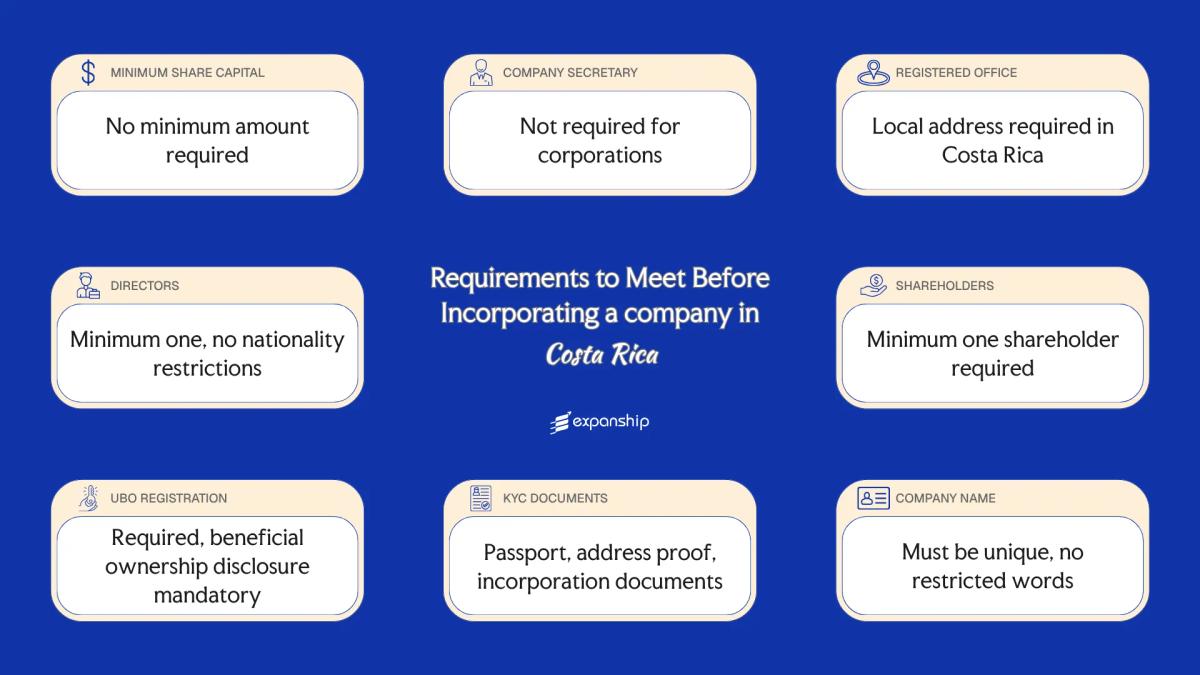
Minimum Share Capital Requirements in Costa Rica

Costa Rica share capital requirements are governed primarily by the Código de Comercio (Commercial Code), which applies to both the Sociedad Anónima (S.A.) and the Sociedad de Responsabilidad Limitada (S.R.L.). Both entity types operate on a par value share system, where each share or quota carries a nominal value established in the articles of incorporation.
No minimum authorized capital is mandated by statute for either structure. The Registro Nacional (National Registry) processes the incorporation filing but does not verify capital deposit as a condition of registration, meaning capital obligations are largely a matter of internal corporate governance rather than a threshold enforced at the point of formation.
| Parameter | Detail |
|---|---|
| Minimum Authorized Share Capital | No statutory minimum |
| Maximum Authorized Share Capital | No statutory maximum |
| Minimum Paid-Up Capital | No statutory minimum |
| Paid-Up Requirement at Incorporation | No statutory requirement |
| Accepted Currency | Costa Rican Colón (CRC); foreign currency permissible |
| Accepted Forms of Contribution | Cash or in-kind contributions |
| Timeframe to Deposit Capital | No statutory deadline |
Even without a statutory minimum, your articles of incorporation must define the authorized capital, par value per share, and number of shares. The Registro Nacional will reject filings that omit this capital structure, regardless of the amounts declared.
Resident Agent Requirements in Costa Rica
Under Costa Rica resident agent requirements, every sociedad anónima (S.A.) and sociedad de responsabilidad limitada (S.R.L.) must appoint a legal representative known as an apoderado. This individual holds the authority to act on behalf of the entity before public institutions, regulatory bodies, and third parties.
The apoderado's obligations include signing contracts, representing the company before the Registro Nacional, and accepting legal notifications on the entity's behalf. Failure to maintain a valid appointment can affect the firm's legal standing under Costa Rican corporate law.
Qualification criteria for who may serve as an apoderado:
- Must be a natural person; corporate entities cannot hold this role directly
- Costa Rican residency is generally required for the representative to exercise full legal authority locally
- No specific professional license is mandated, though legal practitioners commonly serve in this capacity
- Must have full legal capacity under Costa Rican civil law, meaning no legal incapacity or disqualification

Incorporate a Company in Costa Rica
Register your sociedad anónima or S.R.L. in Costa Rica with full support from entity setup through Registro Nacional filing.
Registered Office Requirements in Costa Rica
Costa Rica registered office requirements mandate that every sociedades anónimas (S.A.) and sociedad de responsabilidad limitada (S.R.L.) maintain a physical domicilio fiscal within the country's territory, registered with the Registro Nacional. Failure to maintain a compliant legal address can result in administrative penalties and may affect the entity's standing in the Registro Mercantil.
- A physical address located within Costa Rica is required; a post office box alone does not satisfy the domicilio fiscal obligation.
- Virtual office addresses are generally accepted provided they correspond to a verifiable physical location accessible for official correspondence.
- The address must be domestically based; a foreign address cannot fulfill the registered office obligation under Costa Rican corporate law.
- No ownership of the premises is required, but the address must be legitimately associated with the entity through a lease, service agreement, or equivalent arrangement.
- The registered address is publicly recorded in the Registro Nacional and accessible through its online public registry portal.
- Any change to the registered office address must be formally approved by the company's governing body and filed with the Registro Mercantil to take legal effect.
Director Requirements in Costa Rica

Upon appointment, directors of a Costa Rica sociedad anónima assume fiduciary duties toward the company and its shareholders, with personal liability exposure for decisions made in breach of the Código de Comercio. The junta directiva holds collective responsibility for ensuring the entity meets its statutory obligations under that code.
| Parameter | Detail |
|---|---|
| Minimum Number of Directors | A minimum of three directors is required to form the junta directiva of a sociedad anónima. |
| Maximum Number of Directors | No statutory maximum is prescribed under the Código de Comercio. |
| Local/Resident Director Required | No statutory requirement mandates that any director be a Costa Rican resident. |
| Nationality Restrictions | No nationality restrictions apply; foreign nationals may serve without limitation. |
| Minimum Age Requirement | Directors must have reached the age of majority, which is 18 years under Costa Rican law. |
| Corporate Directors Permitted | Corporate entities are not permitted to serve as directors of a sociedad anónima. |
| Director Must Be a Shareholder | No statutory requirement obliges a director to hold shares in the company. |
| Publicly Listed on Registry | Director appointments are recorded in the public Registro Nacional, making them accessible to third parties. |
| Disqualification Conditions | Individuals declared legally incapacitated or subject to certain criminal convictions may be disqualified from directorship. |
Despite requiring a minimum of three directors, all three positions can be held by the same individual simultaneously under different board titles, meaning a single person can constitute the entire junta directiva of a sociedad anónima.
Shareholder Requirements in Costa Rica

A Costa Rica sociedad anonima requires a minimum of two shareholders at the time of incorporation. No statutory maximum applies, allowing the company ownership requirements to scale with your business structure.
Nationality and Residency Restrictions
Foreign nationals may hold shares in a Costa Rican entity without restriction. Neither residency nor citizenship is required, and there is no cap on foreign ownership percentage.
Corporate Shareholders
Legal entities, including foreign corporations, are permitted to act as shareholders in a Costa Rica sociedad anonima. No additional licensing or special authorization is generally required for a corporate shareholder to hold shares.
Shareholder Liability
Shareholder liability is limited to the value of each accionista's capital contribution. Piercing the corporate veil remains possible under Costa Rican law where fraud or abuse of the legal form is established.
Register of Shareholders
Each company must maintain an internal share registry. This register is not publicly accessible through the Registro Nacional, though updates must reflect any transfer or change in ownership.
Guidance on Shareholder Structuring for Your Costa Rican Entity
Get clarity on ownership configurations, shareholder documentation, and compliance obligations before you incorporate in Costa Rica.
UBO / Beneficial Ownership Disclosure Requirements in Costa Rica
Under Costa Rica's beneficial ownership requirements, entities incorporated in the country must register ultimate beneficial owner information with the Registro de Transparencia y Beneficiarios Finales (RTBF), administered by the Banco Central de Costa Rica, pursuant to Law 9416 (Ley para Mejorar la Lucha contra el Fraude Fiscal).
- Identify all natural persons who hold, directly or indirectly, 15% or more of the entity's capital or voting rights, or who exercise effective control by other means.
- Submit the beneficial ownership declaration through the RTBF's online platform within 30 business days of incorporation.
- Update the registry within 15 business days whenever a change in beneficial ownership occurs.
- Retain supporting documentation to substantiate the declared ownership structure.
| Parameter | Detail |
|---|---|
| Ownership Threshold for UBO Status | 15% or more of capital or voting rights |
| Filing Authority | Registro de Transparencia y Beneficiarios Finales (RTBF), Banco Central de Costa Rica |
| Disclosure Deadline at Incorporation | 30 business days from incorporation |
| Publicly Accessible Register | No; restricted to authorized authorities |
| Penalties for Non-Disclosure | Administrative fines applicable under Law 9416 |
| Ongoing Update Obligation | Within 15 business days of any ownership change |
KYC / Document Requirements in Costa Rica
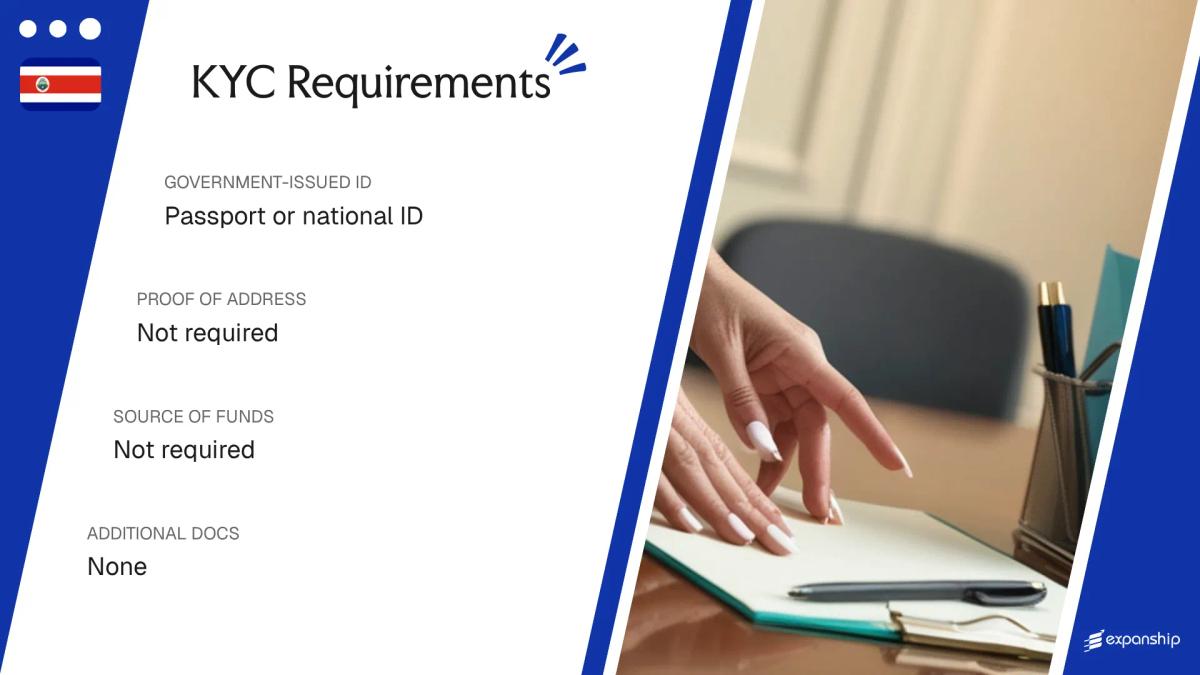
Costa Rica KYC requirements for incorporation are governed primarily by Law 7786 (Ley sobre estupefacientes, sustancias psicotrópicas, drogas de uso no autorizado, actividades conexas, legitimación de capitales y financiamiento al terrorismo) and its reforms, with oversight exercised by the SUGEF and the Financial Intelligence Unit (UIF) within the Instituto Costarricense sobre Drogas.
Individual / Personal Documents
- Valid government-issued photo ID (passport or national identity document)
- Proof of residential address dated within three months, such as a utility bill or bank statement
- Completed KYC questionnaire or due diligence form as required by the notary public handling incorporation
- Recent photograph may be required depending on the notary's internal compliance procedures
Corporate Documents
- Certificate of incorporation or equivalent constitutional document from the entity's home jurisdiction
- Current register of directors and, where applicable, register of shareholders
- Proof of the corporate entity's registered address in its home jurisdiction
- Good standing certificate issued by the relevant home-jurisdiction authority
Source of Funds Documentation
- Bank statements covering a minimum recent period to evidence available capital
- Audited financial statements or accountant-certified accounts where bank statements are insufficient
- Written declaration of source of funds signed by the relevant party
Notarisation and Apostille Requirements
- Foreign documents must generally be apostilled under the Hague Apostille Convention if issued in a signatory country
- Documents originating from non-Hague countries require consular legalisation through a Costa Rican consulate
- All foreign-language documents must be accompanied by a certified Spanish translation prepared by an officially registered translator
Unsigned or non-apostilled foreign identity documents are the most common cause of incorporation delays with the Registro Nacional.
Company Name Requirements in Costa Rica
Costa Rica company name requirements are assessed during the incorporation process, with proposed names reviewed for uniqueness and compliance before registration is confirmed. No two registered entities may share an identical or confusingly similar name.
Names must be in Spanish or include a Spanish translation. Every Sociedad Anónima must append "S.A." and every Sociedad de Responsabilidad Limitada must append "S.R.L." as a legal suffix.
Certain terms referencing government institutions, financial authorities, or regulated industries require prior approval from the relevant supervisory body. Words implying banking, insurance, or state affiliation are generally restricted or prohibited outright.
Name reservation is available through the Registro Nacional before formal incorporation. Reservations are time-limited, though the exact duration may vary; applicants submit the request directly to the registry to secure priority over a chosen name.
Compliance Services for Companies in Costa Rica
Keep your Costa Rica entity in good standing with ongoing compliance support, from annual filings to beneficial ownership reporting under local regulatory requirements.
Conclusion
Costa Rica company incorporation requirements span multiple regulatory layers, from the Registro Nacional's company registration process to the Dirección General de Tributación's tax obligations. Among the most consequential requirements covered are the mandatory appointment of a resident agent who must be a licensed Costa Rican attorney, and the beneficial ownership disclosure obligations now enforced under the Ley de Transparencia y Beneficiarios Finales. Once these requirements are understood, the practical work of engaging local legal counsel, preparing notarized constitutional documents, and establishing a compliant registered office in the country can begin.
Expanship's Corporate Services for Costa Rica Expansion
Expanship supports your Costa Rica corporate services incorporation work from the Registro Nacional filing stage through to ongoing compliance, reducing the operational weight of requirements like appointing a resident agent, maintaining a local registered office, and submitting beneficial ownership disclosures to the Banco Central. Our role is to handle the procedural layers so your team can focus on running the business rather than tracking regulatory deadlines.
Beyond registration, Expanship's service scope covers the full setup period and beyond:
- We prepare and file all incorporation documents with the Registro Nacional, including the articles of incorporation and public deed.
- A qualified resident agent and a compliant registered office address in Costa Rica are provided directly through our network.
- We liaise with government authorities and the Registro Nacional on your behalf throughout the filing process.
- Post-incorporation compliance obligations, including annual filings and UBO updates, are managed on an ongoing basis.
- Banking introduction assistance is available to help your entity establish a local or international account.
- Tax registration with the Ministerio de Hacienda and local authority liaison are handled as part of the setup process.
To discuss your requirements, contact Expanship Costa Rica.
Frequently Asked Questions (FAQ)
Under Costa Rica's beneficial ownership framework, individuals who directly or indirectly hold 15% or more of a company's share capital, or who exercise effective control, must be reported to the Registro de Transparencia y Beneficiarios Finales administered by the Ministerio de Hacienda. Failing to register or update this information within the prescribed deadlines triggers economic sanctions, and persistent non-compliance can result in legal restrictions on the entity's ability to operate.
Yes. Costa Rica does not require directors to be residents or nationals, and a foreign individual can hold the sole directorship of a Sociedad Anónima. The board must have a minimum of three positions — President, Secretary, and Treasurer — but these can all be held by foreign nationals residing outside the country.
If the registered address on file with the Registro Nacional ceases to be valid, the entity risks failed service of legal notices, which can result in default judgments or administrative penalties being issued without the company's knowledge. You are required to update the registered address through a formal notarial procedure, and the change must be registered with the Registro Mercantil to be legally effective.
Foreign-sourced identity documents submitted during Costa Rican incorporation generally require apostille certification under the Hague Apostille Convention, to which Costa Rica is a signatory. This requirement applies to all foreign shareholders and directors, and documents issued in non-member countries must instead be legalized through the consular chain. Translations into Spanish must be certified by an officially recognized translator registered in Costa Rica.
The resident agent for a Costa Rican company must be a licensed attorney (abogado) in good standing with the Colegio de Abogados y Abogadas de Costa Rica. This is a statutory requirement, not simply a convention, and appointing an unlicensed individual does not satisfy the legal obligation. The attorney assumes formal responsibilities related to legal notices and service of process on behalf of the entity.
Legal Disclaimer
The information provided in this article is for general informational purposes only and does not constitute legal, tax, or professional advice. While we strive to ensure the accuracy and timeliness of the content, laws and regulations are subject to change, and the application of laws can vary widely based on specific facts and circumstances.
Readers should not act upon this information without seeking professional counsel tailored to their individual situation. Expanship and its authors disclaim any liability for actions taken or not taken based on the content of this article.
For specific advice regarding your business setup, compliance requirements, or any legal matters, please consult with qualified legal and tax professionals in the relevant jurisdiction.