
Key Takeaways
- Costa Rica's territorial tax system means income earned outside the country's borders is not subject to local taxation, offering a structural advantage for businesses whose revenues originate from foreign clients or operations.
- Under Law No. 7210, companies operating within Costa Rica's Free Zone Regime gain access to a defined package of fiscal incentives that can materially reduce the tax burden for qualifying manufacturers and exporters.
- The Sociedad Anónima imposes no minimum capital requirement, removing a common upfront financial barrier that other jurisdictions use as a condition of incorporation.
- Foreign nationals and entities may hold 100% of shares in a Costa Rican company without a domestic partner, giving non-resident investors full ownership and operational control from the outset.
Situated in Central America between the Pacific Ocean and the Caribbean Sea, Costa Rica is a fully independent republic governed under a democratic constitutional framework. Company registration falls under the oversight of the Registro Nacional, the national registry responsible for formalizing legal entities and maintaining public corporate records. Foreign businesses incorporating here most commonly do so through a Sociedad Anónima.
On tax policy, the country operates a territorial system, meaning income generated outside its borders is generally not subject to local taxation. Foreign ownership faces no blanket restrictions — non-resident individuals and entities may hold 100% of shares in a locally incorporated firm without requiring a domestic partner. This openness extends to most sectors, making it a destination where foreign direct investment flows with relatively few structural barriers.
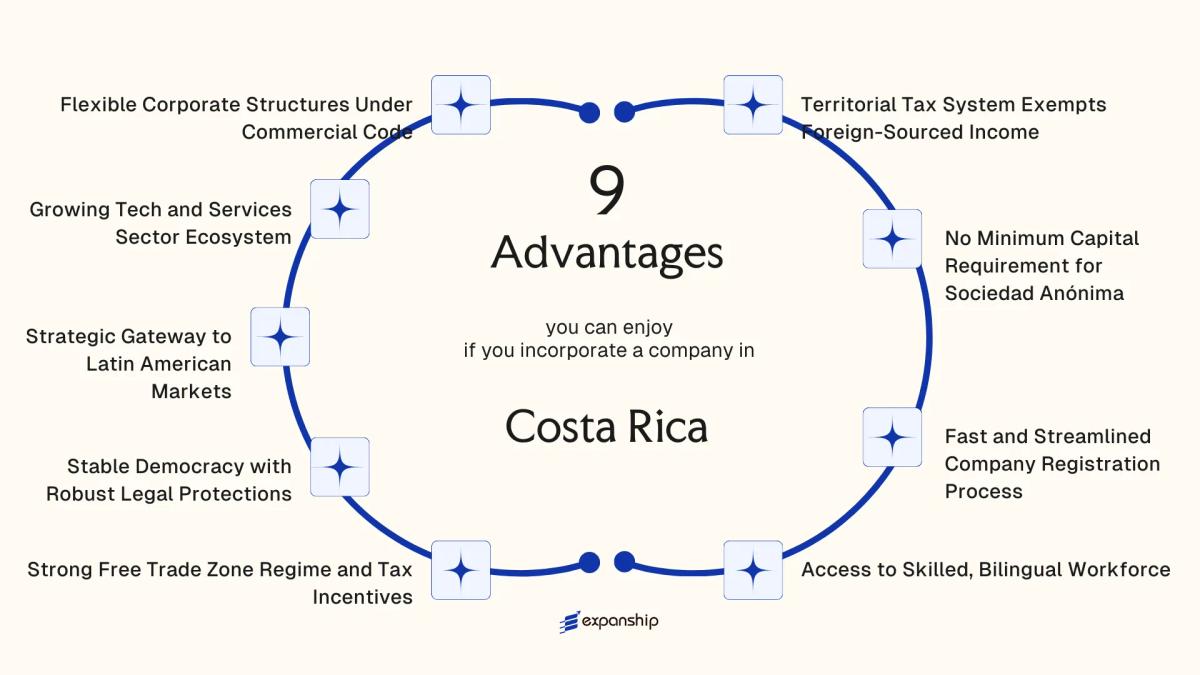
The benefits of incorporating in Costa Rica span tax efficiency, legal infrastructure, workforce quality, and market access. This article examines those advantages in detail, drawing on the specific legal and regulatory conditions that apply to businesses operating under Costa Rican commercial law.
Territorial Tax System Exempts Foreign-Sourced Income
Costa Rica's territorial tax system means your business is taxed only on income generated within the country's borders. Under this framework, foreign-sourced income falls entirely outside the scope of local taxation.
What the Law Actually Provides
The Ley del Impuesto sobre la Renta (Law No. 7092) defines taxable income as income derived from Costa Rican sources only. A company incorporated here that earns revenue from clients, contracts, or operations outside the country owes no income tax on those earnings to the Ministerio de Hacienda.
Why This Matters for Foreign-Owned Entities
For a holding company, an international service provider, or a firm managing offshore contracts, this structure can significantly reduce the effective tax burden compared to residence-based systems that tax global income. The standard corporate income tax rate of 30% applies only to locally sourced profits, leaving foreign revenue untouched by that rate.
Eligibility depends on proper income classification. Revenue must genuinely originate outside Costa Rican territory, and tax authorities may scrutinize the source of funds if domestic and foreign income streams are commingled.
Foreign revenue your company earns outside Costa Rica is not subject to local corporate income tax under Law No. 7092.
No Minimum Capital Requirement for Sociedad Anónima
Under Costa Rica's Commercial Code, a Sociedad Anónima can be formed with any share capital amount the founders choose to declare. There is no statutory minimum. For a foreign business owner, this means you can structure initial capitalization around actual operational needs rather than arbitrary regulatory thresholds.
This matters in practical terms because capital requirements in other jurisdictions can tie up funds before the entity generates a single transaction. A declared capital of as little as one colón is technically permissible, though most firms set a nominal figure that reflects their intended activity for credibility purposes.
The shares of a Sociedad Anónima are divided into nominative or bearer-equivalent registered shares under the current legal framework, and the capital can be denominated in colones or foreign currency. That flexibility allows your business to align its corporate structure with how it actually holds assets or invoices clients.
Several features of the SA capital framework benefit foreign founders specifically:
- No paid-up capital requirement means funds are not locked into a notarized escrow before registration
- Capital can be adjusted by shareholder resolution without court approval, reducing administrative friction over time
- The absence of a minimum threshold removes a common barrier for early-stage or holding structures
Registration still requires a public deed executed before a Costa Rican notary and inscription with the National Registry (Registro Nacional).

Incorporate a Sociedad Anónima in Costa Rica
Register your Costa Rica SA with no minimum capital requirement. Expanship manages the notarization, National Registry inscription, and post-incorporation compliance.
Fast and Streamlined Company Registration Process
Incorporating through Costa Rica's Registro Nacional is a relatively quick process by regional standards, and that speed has direct operational value for foreign business owners. A Sociedad Anónima can typically be constituted by a notarial deed, submitted for registration, and receive legal existence within a matter of weeks. Delays from prolonged pre-approval procedures or government licensing queues that are common elsewhere in Central America are largely absent at the formation stage here.
| Parameter | Detail |
|---|---|
| Registration Body | Registro Nacional de la República de Costa Rica |
| Governing Law | Commercial Code (Código de Comercio) |
| Formation Instrument | Public deed executed by a licensed notary |
| Minimum Shareholders | Two at incorporation |
| Typical Registration Timeline | 15 to 30 business days (subject to queue volume) |
Fast company registration benefits Costa Rica-based operations by allowing your firm to open corporate bank accounts, enter contracts, and hire staff under a recognized legal entity sooner. Each week spent in a formation backlog is a week your business cannot formalize supplier agreements or access the local financial system. The Registro Nacional processes filings digitally through its platform, which reduces manual bottlenecks that historically extended timelines. Your appointed notary manages deed execution and submission, meaning the administrative burden on foreign founders is limited from the outset.
Access to Skilled, Bilingual Workforce
Costa Rica's bilingual workforce advantage for business is one of the more structurally significant factors drawing foreign-owned entities to the country. Approximately 30% of the population has functional English proficiency, a figure that rises sharply among university graduates concentrated in the Greater Metropolitan Area.
This concentration matters operationally. Multinational service firms can staff client-facing roles, technical positions, and back-office functions without absorbing the cost of external translation infrastructure or extensive language training programs. The Universidad de Costa Rica and Instituto Tecnológico de Costa Rica graduate thousands of professionals annually in engineering, finance, and computer science fields.
English-speaking talent for foreign companies is further reinforced by the country's public education system, which has mandated English instruction at the primary level since the early 1990s. That sustained investment has produced a generational base of bilingual professionals now entering mid-career roles.
Keep these points in mind:
- English proficiency is concentrated in urban centers; rural hiring pools may require additional assessment.
- Technical and STEM graduates are primarily sourced from accredited public universities under CONESUP oversight.
- Labor contracts are governed by the Código de Trabajo, which applies equally to domestic and foreign-owned employers.
- Specialized roles in finance and software development face competitive hiring due to regional demand from established multinationals already operating locally.
Costa Rica has a higher English proficiency rate than several larger Latin American economies, despite having no official bilingual education policy at the secondary level.
Strong Free Trade Zone Regime and Tax Incentives
Costa Rica free trade zone tax incentives rank among the most structured in Central America, operating under Law No. 7210 (the Free Trade Zone Law) and administered by PROCOMER, the foreign trade promotion body. Companies admitted to the Zona Franca regime can access exemptions from import duties, export taxes, and sales tax on goods and services used within operations. The income tax exemption runs for eight years at 100%, followed by a partial phase-out period, giving your business a defined window of significantly reduced fiscal obligations.
What the Regime Actually Covers
Eligible activities extend beyond manufacturing. Service companies, including software development, business process outsourcing, and medical device firms, qualify under the regime, which broadens its relevance for knowledge-economy businesses. To qualify, companies must meet minimum investment thresholds and operate from a designated free trade zone park, conditions that are fixed by regulation rather than discretionary.
Why the Structure Matters to Foreign Investors
PROCOMER handles the application and ongoing compliance interface, centralizing what would otherwise be a multi-agency process. That administrative consolidation reduces friction when managing annual reporting and maintaining benefit eligibility. Because the exemptions are statutory rather than negotiated case-by-case, the terms are predictable over the benefit period, which allows for more reliable long-term financial modeling. For businesses structured around export-oriented services or manufacturing, the regime eliminates several cost layers that would otherwise accumulate under the standard tax code.
Maximize Your Free Trade Zone Benefits in Costa Rica
Speak with our team about qualifying for the Zona Franca regime and structuring your entity to access available tax exemptions under Law No. 7210.
Stable Democracy with Robust Legal Protections
Costa Rica's political stability business advantages are grounded in structural facts, not reputation alone. The country has maintained uninterrupted democratic governance since 1948, when it abolished its military through Article 12 of its Constitution. That constitutional provision remains in force today, removing a category of political risk that affects many regional markets.
- Foreign investors operate under the same property and contract rights as nationals, a protection codified in the Political Constitution and reinforced by the Foreign Investment Law (Law No. 7472 and related investment frameworks). This legal parity means your agreements and assets are not subject to a separate, lesser standard.
- The judicial system functions through an independent Supreme Court (Corte Suprema de Justicia) with four specialized chambers, including the Sala Constitucional, which reviews constitutional challenges. Judicial independence reduces the risk of politically influenced rulings affecting your entity.
- Costa Rica is a signatory to ICSID (International Centre for Settlement of Investment Disputes), giving foreign businesses access to international arbitration if domestic remedies fall short.
- Regulatory decisions by bodies such as SUGEF (financial supervision) and COMEX (trade policy) operate within defined legal mandates, limiting arbitrary administrative action against foreign-owned firms.
Strategic Gateway to Latin American Markets
Costa Rica's position as a Costa Rica gateway to Latin American markets is grounded in geography and trade architecture, not perception. Situated between North and South America, with Pacific and Caribbean coastlines, the country connects your business to two ocean corridors and a network of active free trade agreements.
Costa Rica has ratified FTAs with the United States, the European Union, China, Canada, and several Central American and Caribbean economies. For a foreign firm establishing regional operations here, those treaties translate into reduced tariff exposure across a substantial share of global trade volume.
Membership in the Central American Integration System (SICA) further extends preferential access to Guatemala, Honduras, El Salvador, Nicaragua, and Panama under the Central American Common Market framework. Goods produced or processed locally may qualify for regional tariff preferences, which can reduce landed costs when distributing into neighboring markets.
San José's infrastructure supports this function practically. Juan Santamaría International Airport operates direct cargo and passenger routes to major hubs across the Americas, and the Port of Caldera on the Pacific coast handles significant container volume for onward distribution.
A firm incorporated in Costa Rica and exporting to the United States under CAFTA-DR can access the U.S. market under reduced or zero tariffs on qualifying goods, while simultaneously distributing into Central American markets under CACM preferences, all from a single legal entity.
Growing Tech and Services Sector Ecosystem
Costa Rica tech sector advantages for foreign companies are grounded in a decades-long industrial policy that attracted firms like Intel, Amazon, HP, and Boston Scientific to establish regional operations in the country. That concentration of multinationals has produced a secondary ecosystem of suppliers, engineering firms, and specialized service providers that a foreign business can tap into from day one.
CINDE (the Costa Rican Investment Promotion Agency) actively facilitates connections between incoming firms and local industry clusters, particularly in software development, business process outsourcing, and medical device manufacturing. Your company gains access to an environment where sector-specific talent pipelines, shared infrastructure, and established supply chains already exist.
The technology services sector generates over $4 billion annually in exports, according to PROCOMER (the foreign trade promotion body). That scale signals a mature regulatory and commercial environment for services-oriented businesses, not an experimental one.
- Over 300 multinational companies operate regional service centers in the country.
- Software and IT services consistently rank among the top export categories by value.
- CINDE coordinates with MEIC (Ministry of Economy) on business facilitation programs for foreign entrants.
Free Zone regime benefits, administered by PROCOMER, apply only to companies that meet specific investment, employment, and activity requirements — general tech incorporation does not automatically qualify.
Flexible Corporate Structures Under Commercial Code
Costa Rica flexible corporate structures for investors center on two primary entity types governed by the Código de Comercio: the Sociedad Anónima (SA) and the Sociedad de Responsabilidad Limitada (SRL). Each form serves different operational needs, and the choice between them directly shapes governance, ownership transfer, and administrative overhead.
Sociedad Anónima (SA)
The SA issues shares that are freely transferable by default, unless the bylaws impose restrictions. For a foreign investor holding equity across multiple ventures, this transferability means ownership can shift without restructuring the entire entity. Governance is managed through a board of directors, which allows for distributed control among multiple stakeholders.
Sociedad de Responsabilidad Limitada (SRL)
Ownership in an SRL is divided into participaciones (membership quotas) rather than shares, and transfers to third parties typically require the consent of other members. This restriction is an advantage when closely held ownership and a defined partner group matter more than exit flexibility. Administrative requirements for an SRL are generally lighter, making it a practical choice for smaller operations or single-purpose entities.
Practical Implications for Foreign Owners
Both entity types permit 100% foreign ownership with no requirement for a local partner. Key structural considerations include:
- Shareholder and quota-holder meetings can be held outside the country
- Bylaws can be tailored at incorporation to govern profit distribution, voting thresholds, and succession
- A single individual can hold multiple officer roles within the same entity
This structural flexibility, codified in the Código de Comercio, allows your business to align its legal form with commercial reality rather than adapt operations to fit a rigid template.
Why Costa Rica Stands Out Among Regional Competitors
Panama and Mexico are the two jurisdictions most commonly evaluated alongside Costa Rica by foreign investors targeting Central America and the broader Latin American market. Panama draws comparisons because of its offshore reputation and dollarized economy; Mexico attracts attention because of its size, USMCA access, and manufacturing base. Placing these three side by side clarifies where Costa Rica's structural features, particularly its territorial tax scope under the Código de Normas y Procedimientos Tributarios and its Free Trade Zone regime under Law 7210, create distinct conditions for service-oriented and tech-focused foreign businesses.
What the table below surfaces is less about headline tax rates and more about the regulatory environment a foreign-owned entity actually operates within. Costa Rica's combination of no foreign ownership restrictions under the Código de Comercio, no minimum capital for a Sociedad Anónima, and a workforce with verifiable bilingual and technical credentials positions it differently from both Panama's holding-company model and Mexico's more complex federal compliance structure.
| Parameter | Costa Rica | Panama | Mexico |
|---|---|---|---|
| Foreign Ownership of Shares | 100% permitted | 100% permitted | 100% permitted (some sector restrictions apply) |
| Territorial Tax Scope | Foreign-sourced income exempt | Foreign-sourced income exempt | Worldwide income taxed for residents |
| Minimum Share Capital | None (S.A.) | None | None (S. de R.L. / S.A.) |
| Free Zone Tax Incentive | Up to 100% income tax exemption under Law 7210 | Available in Colón Free Zone | Available in designated ZEDEs and special zones |
| Corporate Tax Rate (domestic income) | 30% standard rate | 25% standard rate | 30% standard rate |
| Bilingual Workforce Availability | High (English-Spanish) | Moderate | Moderate (varies by region) |
| Typical Registration Timeframe | 1-3 weeks (Registro Nacional) | 3-5 business days | 2-4 weeks (SAT / SE process) |
| Regulatory Stability Index | High; consistent democratic governance | Moderate; FATF grey-list history | Moderate; federal regulatory complexity |
Compliance Services for Companies in Costa Rica
Maintain good standing with Costa Rica's Registro Nacional, SUGEF reporting obligations, and annual shareholder meeting requirements through Expanship's compliance support.
Conclusion
Costa Rica's territorial tax system and the absence of capital requirements for a Sociedad Anónima together reduce two of the most common barriers foreign investors face when establishing a presence in a new jurisdiction. Paired with the Free Zone Regime's structured incentives under Law No. 7210, these features create a framework where the legal and financial architecture works with your business model rather than against it.
That said, the advantages carry different weight depending on your industry, operational structure, and revenue geography. A technology services firm exporting to North American clients will realise the territorial exemption differently than a manufacturer operating within a free zone regime. The fit is structural, not universal.
For businesses that do qualify, the combination of a stable civil law framework, a commercially active workforce, and a tax regime that does not reach foreign income positions the country as a credible base for regional and international operations. The next step is translating these structural features into a properly incorporated and compliant entity.
Start Your Costa Rica Company with Expanship Today
Expanship assists foreign investors with the full cycle of establishing and maintaining a legal presence in Costa Rica, from selecting between a Sociedad Anónima and a Sociedad de Responsabilidad Limitada to meeting ongoing obligations with the Registro Nacional and the Ministerio de Hacienda. The scope of this blog has covered the territorial tax system, free zone incentives under Law 7210, flexible corporate structures, and workforce advantages — each of which requires specific documentation, filings, and local representation to activate properly. Expanship coordinates each of those requirements directly.
Services provided include:
- Preparation and legalization of incorporation documents, including articles of incorporation (pacto social) and shareholder registers
- Registered agent and registered office provision as required under the Código de Comercio
- Filing and liaison with the Registro Nacional for company registration and subsequent amendments
- Post-incorporation compliance management, including annual corporate tax declarations (impuesto a las personas jurídicas) and beneficial ownership registry (ROBE) filings
- Government liaison for Free Trade Zone regime applications under CINDE or PROCOMER, where applicable
- Banking introduction assistance to support corporate account opening with local and international institutions
To start your Costa Rica company with Expanship, contact the team directly through Expanship Costa Rica.
Frequently Asked Questions (FAQ)
Under Costa Rica's territorial tax principle, codified in the Ley del Impuesto sobre la Renta, only income with a source inside the country is subject to corporate income tax. Revenue generated from services delivered to foreign clients, or from business activities conducted entirely outside the territory, falls outside the scope of domestic taxation. This means a firm structured to earn exclusively foreign-sourced income would generally owe no Costa Rican income tax on those earnings.
The Zona Franca regime, governed by Ley No. 7210, extends its tax exemptions to qualifying service companies, not solely to manufacturers. Eligible businesses in approved parks can access exemptions on income tax, import duties, and certain municipal taxes for defined periods. Approval and ongoing compliance are administered by PROCOMER, the foreign trade promotion body that oversees Free Trade Zone operations.
Registration timelines vary depending on notarial processing and queue volumes at the Registro Nacional, but formation documents are generally filed within days of execution before a Costa Rican notary public. The Registro Nacional then processes the filing, which can take several weeks under standard procedures. Expedited registration options exist through the Registro Nacional's digital platform, which has reduced processing times in recent years.
The standard corporate income tax rate is 30% on net taxable income derived from domestic sources, though a reduced progressive rate schedule applies to smaller companies that fall below defined gross income thresholds. The thresholds and applicable rates are set annually and administered by the Ministerio de Hacienda. Companies operating exclusively on foreign-sourced income are not subject to this tax under the territorial system.
Failure to pay the annual fee established under Ley No. 9428 — the Ley de Impuesto a las Personas Jurídicas — results in the entity being placed in inactive status in the Registro Nacional, which restricts its ability to execute certain legal acts. Persistent non-compliance can lead to dissolution proceedings. The tax is administered jointly by the Registro Nacional and the Ministerio de Hacienda, and reinstatement requires payment of outstanding fees plus applicable surcharges.
Costa Rica operates under a civil law system with a functioning court hierarchy, including specialized commercial chambers within the Poder Judicial. Commercial disputes can be resolved through the ordinary courts or through arbitration under the framework established by Ley No. 7727, the Ley sobre Resolución Alterna de Conflictos. The country's consistent democratic governance record contributes to a legal environment where contract enforcement through established institutions is generally accessible, though court timelines can be lengthy in complex disputes.
Legal Disclaimer
The information provided in this article is for general informational purposes only and does not constitute legal, tax, or professional advice. While we strive to ensure the accuracy and timeliness of the content, laws and regulations are subject to change, and the application of laws can vary widely based on specific facts and circumstances.
Readers should not act upon this information without seeking professional counsel tailored to their individual situation. Expanship and its authors disclaim any liability for actions taken or not taken based on the content of this article.
For specific advice regarding your business setup, compliance requirements, or any legal matters, please consult with qualified legal and tax professionals in the relevant jurisdiction.