

Key Takeaways
- Foreign investors face a fragmented compliance environment governed by the Código de Comercio and multiple quasi-governmental bodies, meaning administrative overhead begins before a single business transaction takes place.
- Registration through the RNPC involves procedural delays that extend the timeline for legally commencing operations, a friction point that compounds when combined with the mandatory use of a registered agent.
- SUGEF oversight and sector-specific regulatory requirements impose an additional compliance layer on entities operating in financial or regulated industries beyond standard corporate obligations.
- Costa Rica's corporate tax and annual reporting obligations, alongside restricted foreign land ownership rights and local currency exposure through the colón, create a compounding burden for non-resident investors managing cross-border operations.
Costa Rica operates under a moderately regulated corporate framework, with oversight spread across multiple governmental and quasi-governmental bodies that affect how foreign-owned entities function day to day. The disadvantages of incorporating in Costa Rica span procedural, financial, and structural categories, each examined individually in this article.
Not every drawback applies equally to all businesses. The cons of forming a company in Costa Rica tend to weigh more heavily on foreign investors operating in regulated industries, real estate, or financial services than on those running straightforward commercial operations.
This article is most relevant to non-resident entrepreneurs and foreign investors who intend to actively operate, hold property, or transact in local currency through a Costa Rican entity. Governance obligations are grounded in the Código de Comercio, which sets the foundational legal requirements for corporate structure and compliance.
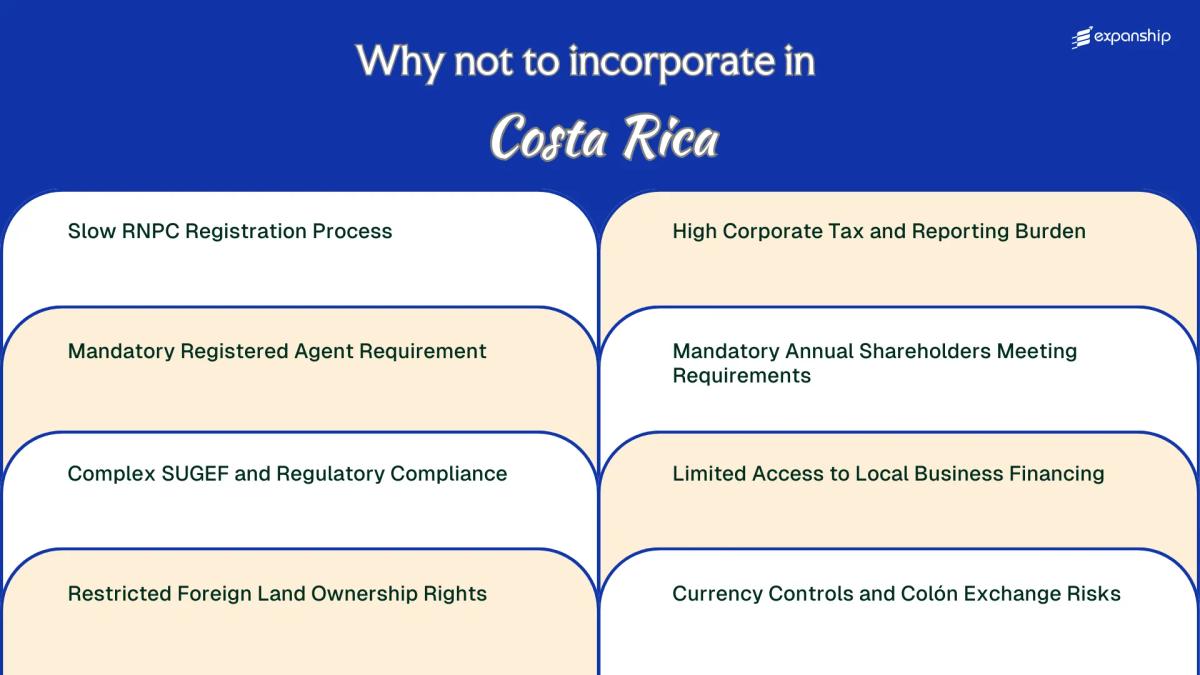
Slow RNPC Registration Process
Costa Rica RNPC registration delays affect foreign business owners from the outset, often before operations can begin. The Registro Nacional, which manages corporate filings, operates on timelines that frequently exceed initial projections.
Registration Timelines Create Operational Gaps
Standard incorporation through the Registro Nacional de Personas Jurídicas (RNPC) can take several weeks, and delays caused by document backlogs or notarization requirements extend this further. For a foreign investor awaiting a legal entity to open bank accounts, sign contracts, or hire staff, this waiting period directly suspends productive activity.
Incorporation requires a Costa Rican public notary to execute the articles of incorporation as a public deed, adding a procedural layer that most comparable jurisdictions do not impose. Each step in that notarial chain introduces a potential bottleneck outside your control.
Bureaucratic Structure Compounds the Delay
The RNPC's internal processing queue does not prioritize foreign entities, and there is no expedited or fast-track registration pathway available. This structural absence means your company's timeline depends entirely on current administrative capacity.
If your business entry into the market depends on a defined launch date, the absence of an expedited filing option at the RNPC makes that date effectively unenforceable.
Mandatory Registered Agent Requirement
One of the more persistent Costa Rica registered agent requirement drawbacks is that foreign-owned companies cannot simply appoint a nominal contact for formality. Under Costa Rican corporate law, every sociedad anónima and sociedad de responsabilidad limitada must maintain a legally empowered resident agent, known as an apoderado, who holds binding authority to act on behalf of the entity within the jurisdiction.
This is not an administrative placeholder role. The apoderado must be a licensed Costa Rican attorney or a qualified resident, and their powers are formally registered with the Registro Nacional.
For a foreign business owner, that dependency carries real operational friction:
- Replacing an apoderado requires a notarized power of attorney, formal deed execution, and re-registration, creating delays when agent relationships break down
- The apoderado's legal authority can expose your company to liability if the relationship is not tightly governed by contract
- Ongoing retainer fees add a fixed compliance cost with no equivalent in many other Latin American jurisdictions
- Any formal legal correspondence or regulatory notices route through this individual, meaning gaps in communication directly affect your firm's compliance standing
Sole foreign directors without local legal representation cannot satisfy this requirement themselves.

Company Incorporation in Costa Rica
Understand the full legal structure and agent requirements before registering your business in Costa Rica.
Complex SUGEF and Regulatory Compliance
Costa Rica SUGEF compliance challenges extend well beyond the banking sector. SUGEF, the Superintendencia General de Entidades Financieras, regulates financial entities under Law 7558, and any business operating in financial services, lending, or money transmission must register and comply with its framework before conducting a single transaction.
The compliance burden is not theoretical. Foreign-owned entities must submit detailed documentation on beneficial ownership, source of funds, and internal anti-money laundering controls, all reviewed against standards that SUGEF can revise without fixed notice periods.
| Requirement | Detail | Implication for Foreign Business |
|---|---|---|
| AML/CFT Policy Submission | Full internal policy documentation required before authorization | Delays operational launch; requires local legal drafting |
| Beneficial Ownership Disclosure | All ultimate beneficial owners must be identified and documented | Complex for multi-layered foreign holding structures |
| Ongoing Reporting Frequency | Periodic financial and compliance reports to SUGEF | Requires dedicated compliance staff or external counsel |
| CONASSIF Oversight | Financial policy set by the Consejo Nacional de Supervisión del Sistema Financiero | Regulatory changes can alter thresholds without advance warning |
Entities that fall outside SUGEF's direct scope are not free from financial regulatory burden. The Financial Intelligence Unit, under the Unidad de Inteligencia Financiera, requires non-financial businesses with exposure to cash transactions to maintain AML registers and file suspicious transaction reports under Law 7786.
Satisfying these obligations typically requires retaining local compliance counsel on a continuous basis. For small or mid-sized foreign firms, that recurring cost can represent a disproportionate share of operational expenses relative to the revenue generated in the market.
Restricted Foreign Land Ownership Rights
Costa Rica foreign land ownership restrictions catch many incorporation clients off guard, particularly those planning to acquire property as part of their business operations. Foreign-owned companies are generally permitted to hold private titled land under the same conditions as locally owned entities. The complication arises at the boundaries.
Under the Maritime Terrestrial Zone Law (Law No. 6043), a 200-metre strip along the coastline is classified as a public zone. The first 50 metres from the high-tide line cannot be owned by anyone, foreign or national, and the remaining 150 metres may only be concession-granted, not privately titled. Foreign nationals and foreign-controlled companies face an outright prohibition on holding concessions in this restricted zone unless they have maintained legal residency in Costa Rica for a minimum of five years.
For a foreign-registered business, this means that coastal hospitality, tourism, or real estate development projects cannot be structured through a new foreign entity without routing ownership through qualifying resident partners or alternative structures. The business assumption that company formation automatically grants property rights simply does not hold in this zone.
- Foreign companies cannot hold Maritime Zone concessions without qualifying resident ownership involvement
- The 50-metre public zone prohibits all private ownership, regardless of nationality or entity type
- Concession rights in the 150-metre restricted zone require municipal approval and are subject to non-renewal
- Titled land outside the Maritime Zone remains accessible, but coastal property acquisitions demand separate legal scrutiny
A foreign company can legally own a Costa Rican subsidiary that holds inland titled property, but that same subsidiary still cannot obtain a coastal concession if it lacks qualifying resident shareholders.
High Corporate Tax and Reporting Burden
Corporate tax rates in Costa Rica are tied directly to net income brackets, and the structure creates a meaningful Costa Rica corporate tax burden drawbacks for foreign-owned entities that generate moderate to high revenues.
Tax Rate Structure and Reporting Obligations
Under the Impuesto sobre la Renta framework administered by the Ministerio de Hacienda, resident companies pay progressive corporate income tax rates reaching up to 30% on net taxable income above ₡119,530,000. Your company must file annual income tax returns, monthly VAT declarations under the 13% rate established by Ley 9635, and quarterly estimated payments, each carrying independent deadlines and penalty exposure.
Compliance Costs for Foreign Business Owners
Non-compliance with Ministerio de Hacienda filing cycles triggers automatic surcharges, interest accruals, and potential audit flags. Foreign-owned firms without dedicated local accounting staff face disproportionate costs, since Costa Rica business tax reporting challenges require familiarity with local tax codes that differ substantially from most OECD frameworks. Businesses classified under specific sectoral regimes may face modified rate structures, but the base administrative burden applies broadly across standard corporate entities.
Support for Managing Tax and Compliance Obligations in Costa Rica
Get guidance on corporate tax filing requirements, Ministerio de Hacienda obligations, and ongoing reporting compliance for your Costa Rica entity.
Mandatory Annual Shareholders Meeting Requirements
Under Costa Rica mandatory shareholders meeting requirements, every Sociedad Anónima must hold at least one ordinary general assembly per fiscal year, as established under the Código de Comercio. For foreign owners who are not resident in the country, this obligation generates recurring logistical and administrative costs that do not disappear simply because the business is inactive.
- The Código de Comercio requires the ordinary shareholders' assembly to be held within three months of the fiscal year's close, meaning foreign-resident shareholders must either travel, grant notarized proxies, or appoint local representatives — each option carrying a direct cost.
- Minutes of the assembly must be recorded in the company's official minute book and signed by the participants, creating a paper trail that requires proper legal formatting or risks being challenged during audits.
- Failure to hold the required assembly can expose the S.A. to compliance deficiencies flagged during regulatory reviews, weakening the entity's standing with local institutions.
Limited Access to Local Business Financing
Limited business financing Costa Rica drawbacks stem largely from how the local banking system treats foreign-owned entities. State-owned banks — Banco Nacional and Banco de Costa Rica — dominate the credit market and apply conservative underwriting standards that effectively exclude most newly incorporated foreign firms.
To qualify for a business loan, your company typically needs an established credit history within the local system, collateral held in Costa Rica, and documented operating history spanning multiple years. Foreign entities rarely satisfy these requirements at incorporation.
Private banks do operate under supervision of SUGEF (Superintendencia General de Entidades Financieras), but their lending criteria for non-resident business owners are equally restrictive, often requiring personal guarantees backed by local assets.
Without access to domestic credit, foreign-owned firms must self-finance operations or rely on offshore capital, which introduces its own currency conversion costs given the colón-denominated lending environment.
A foreign-owned sociedad anónima incorporated in year one, seeking a 50,000 USD equivalent working capital loan from Banco Nacional, would typically be declined on the basis of insufficient local credit history and absence of domestic collateral — forcing the business to operate entirely on injected foreign capital for its initial years.
Currency Controls and Colón Exchange Risks
Costa Rica currency exchange risks business owners face stem primarily from operating in a dual-currency environment where the colón (CRC) is the legal tender, yet a significant portion of commercial transactions, leases, and contracts are priced in US dollars. This creates structural exposure: your costs may be denominated in one currency while your revenues arrive in another.
The Banco Central de Costa Rica (BCCR) manages exchange rate policy, and while Costa Rica does not impose strict capital controls like some jurisdictions, converting large colón balances back into foreign currency can involve timing friction and transaction costs through regulated financial intermediaries. Colón depreciation against the dollar has been a recurring pattern over multi-year periods, meaning foreign-owned firms that hold local currency reserves absorb real value erosion.
Repatriating profits is legally permitted, but the process runs through SUGEF-supervised entities, and exchange spreads applied by local banks can reduce the effective value of outbound transfers. For businesses with thin margins, that spread compounds across each remittance cycle.
If your business will hold or remit significant colón-denominated revenues, the exchange spread and BCCR rate fluctuations imposed through regulated intermediaries can materially reduce the actual value of repatriated funds beyond what pro forma projections typically account for.
Strategies to Overcome These Challenges
Overcoming Costa Rica incorporation challenges requires structural preparation before formation, not reactive adjustments after problems surface.
- Appoint a locally resident registered agent prior to filing with the Registro Nacional to satisfy mandatory representation requirements.
- Pre-register with the Ministerio de Hacienda and obtain your tax identification number (NIT) immediately after entity formation to avoid penalties under the corporate tax reporting cycle.
- Establish a colón-denominated operating account alongside any USD account to reduce transactional exposure to Banco Central exchange rate fluctuations.
- Document annual shareholders meeting minutes formally and retain them as required under the Código de Comercio to maintain good standing.
- Restrict direct land acquisition to concession or long-term lease arrangements where Maritime Zone Law restrictions apply to foreign-held entities.
- Source working capital through international lenders or parent-company funding structures given the limited foreign-entity access to local credit markets.
The steps above operate within a regulatory environment overseen by multiple bodies, including SUGEF and the Registro Nacional. Compliance obligations across these agencies run concurrently, and a gap in any one area can affect standing across others.
Costa Rica Still a Viable Business Destination
The operational friction covered across this blog reflects real structural conditions, not isolated edge cases. For the right business profile, Costa Rica remains a credible incorporation destination — one backed by political stability, a functioning legal system, and a treaty network that supports cross-border activity. That context does not cancel out the disadvantages; it simply defines who can absorb them.
| Pro | Con |
|---|---|
| Political stability and consistent rule of law support long-term business planning | RNPC registration timelines can delay commercial activity by several weeks |
| A network of free trade agreements broadens market access for incorporated entities | SUGEF oversight and financial sector compliance add regulatory layers for relevant businesses |
| Sociedades Anónimas offer a familiar share-based structure for foreign shareholders | Foreign nationals face constitutional restrictions on direct ownership of maritime zone land |
| The colón-to-dollar dual-currency environment gives some transactional flexibility | Exchange rate exposure on colón-denominated obligations carries ongoing financial risk |
| No residency requirement for directors reduces logistical barriers for foreign owners | Annual shareholders meeting obligations and reporting duties create recurring administrative overhead |
Corporate tax rates, financing access, and mandatory registered agent requirements all carry cost implications that accumulate over time.
Corporate Compliance Services in Costa Rica
Manage your annual obligations, shareholder meeting requirements, and regulatory filings for your Costa Rica entity.
Conclusion
The Costa Rica incorporation disadvantages summary reflects a jurisdiction with genuine structural friction for foreign businesses. Slow RNPC registration timelines, the mandatory registered agent obligation under the Código de Comercio, and SUGEF compliance requirements each impose real administrative and financial costs. Structuring around restricted maritime zone land ownership adds further legal complexity. Appropriate legal counsel and tax advice do not eliminate these constraints, but they do reduce the risk of non-compliance with local reporting obligations. Understanding the full scope of these requirements before incorporation allows your business to plan with accuracy rather than correct errors after the fact.
Expanship's Costa Rica Incorporation Support
From managing RNPC registration timelines to satisfying SUGEF compliance requirements and maintaining your registered agent obligations, incorporating in Costa Rica carries a specific administrative weight. Expanship Costa Rica incorporation support is structured around reducing that burden at each stage, from initial filing through to ongoing regulatory maintenance.
Expanship works with businesses entering the Costa Rican market across the full incorporation and compliance cycle. Our services include:
- Preparing and submitting your company registration documents with the Registro Nacional
- Providing a qualified registered agent and local office address as required under Costa Rican law
- Liaising with government bodies and regulatory authorities on your behalf
- Managing post-incorporation compliance obligations as your business operates
- Facilitating introductions to local banking institutions to support your account opening process
- Handling tax registration with the Ministerio de Hacienda and coordinating with relevant local authorities
Reach out to Expanship Costa Rica to discuss your incorporation requirements.
Frequently Asked Questions (FAQ)
Yes, all entities incorporated in Costa Rica, including the Sociedad Anónima and the Sociedad de Responsabilidad Limitada, must maintain a local registered agent. The agent must be a licensed Costa Rican attorney or notary, and failure to maintain one can result in compliance gaps that affect your legal standing with the RNPC and tax authorities.
Non-compliance with SUGEF, Costa Rica's financial supervisory authority, can result in administrative sanctions, fines, and in serious cases, forced closure of financial operations. SUGEF oversight applies broadly to entities conducting regulated financial activities, and the threshold for triggering that oversight is not always obvious to foreign operators unfamiliar with local law.
Corporate income tax in Costa Rica is levied on a progressive or flat basis depending on the company's gross income bracket, with rates reaching up to 30% for larger entities under the Ley del Impuesto sobre la Renta. Beyond the income tax itself, firms face annual legal entity fees, mandatory accounting filings, and Ultimate Beneficial Owner (UBO) declarations to the RNPC, which add both cost and administrative load.
The restriction primarily applies to the Maritime Terrestrial Zone under Law No. 6043, which prohibits foreigners from holding concessions in the 50-meter public zone and limits ownership in the 150-meter restricted zone to Costa Rican citizens or companies with at least 50% local shareholding. This does not affect all commercial property, but it is a significant constraint for businesses in coastal tourism, hospitality, or any sector tied to beachfront or maritime land.
Missing the annual general meeting requirement can expose your company to legal challenges regarding corporate governance, particularly if resolutions made outside the proper process are later contested. Under Costa Rican corporate law, the annual shareholders meeting is required to approve financial statements and appoint directors, and failing to hold it on schedule undermines the legal validity of subsequent corporate acts.
Costa Rica's colón is not pegged to the US dollar, unlike Panama, which is fully dollarized. This exposes your business to exchange rate volatility on local contracts, payroll, and colón-denominated tax obligations, a risk that does not exist to the same degree in Panama or El Salvador. For firms that invoice internationally in USD but operate locally in colónes, the mismatch can produce meaningful financial losses in periods of currency movement.
Structuring a Sociedad Anónima with majority Costa Rican shareholding can satisfy the ownership threshold under Law No. 6043, but this arrangement carries its own risks, including loss of effective control if the local shareholder relationship deteriorates. Regulatory authorities and courts scrutinize arrangements that appear to use local nominees solely to circumvent the ownership restriction, and such structures may be challenged if the foreign beneficial owner is deemed the true controller.
Legal Disclaimer
The information provided in this article is for general informational purposes only and does not constitute legal, tax, or professional advice. While we strive to ensure the accuracy and timeliness of the content, laws and regulations are subject to change, and the application of laws can vary widely based on specific facts and circumstances.
Readers should not act upon this information without seeking professional counsel tailored to their individual situation. Expanship and its authors disclaim any liability for actions taken or not taken based on the content of this article.
For specific advice regarding your business setup, compliance requirements, or any legal matters, please consult with qualified legal and tax professionals in the relevant jurisdiction.