
Key Takeaways
- Businesses incorporated in Mayotte operate under the Code de commerce and broader French metropolitan law, which imposes a rigid compliance framework with limited scope for jurisdictional adaptation or structural flexibility.
- Despite Mayotte's status as an EU outermost region, companies registered there do not benefit from full EU Single Market access on the same terms as mainland French entities, constraining cross-border trade opportunities.
- The island's small population base and underdeveloped local professional services sector mean that import-dependent businesses face compounded logistical costs that erode operating margins before revenue is generated.
- Administrative processing times for company registration in Mayotte extend beyond those typical of metropolitan France, creating material delays that affect capital deployment and operational launch timelines.
Incorporating in Mayotte places your business within a heavily regulated compliance environment, governed primarily by French metropolitan law as adapted and applied to this overseas department. The Code de commerce sets out the foundational rules for business formation and operation, leaving limited room for jurisdictional flexibility.
The disadvantages of incorporating in Mayotte span several structural, administrative, and market-access categories, each examined separately in this article.
Not every business will encounter all of these drawbacks equally. The severity of each constraint depends heavily on your industry, the legal entity you choose, and the scale of operations you intend to run.
Foreign investors planning cross-border trade, import-dependent businesses, and firms expecting access to broad EU market rights will find this analysis most directly applicable to their circumstances.
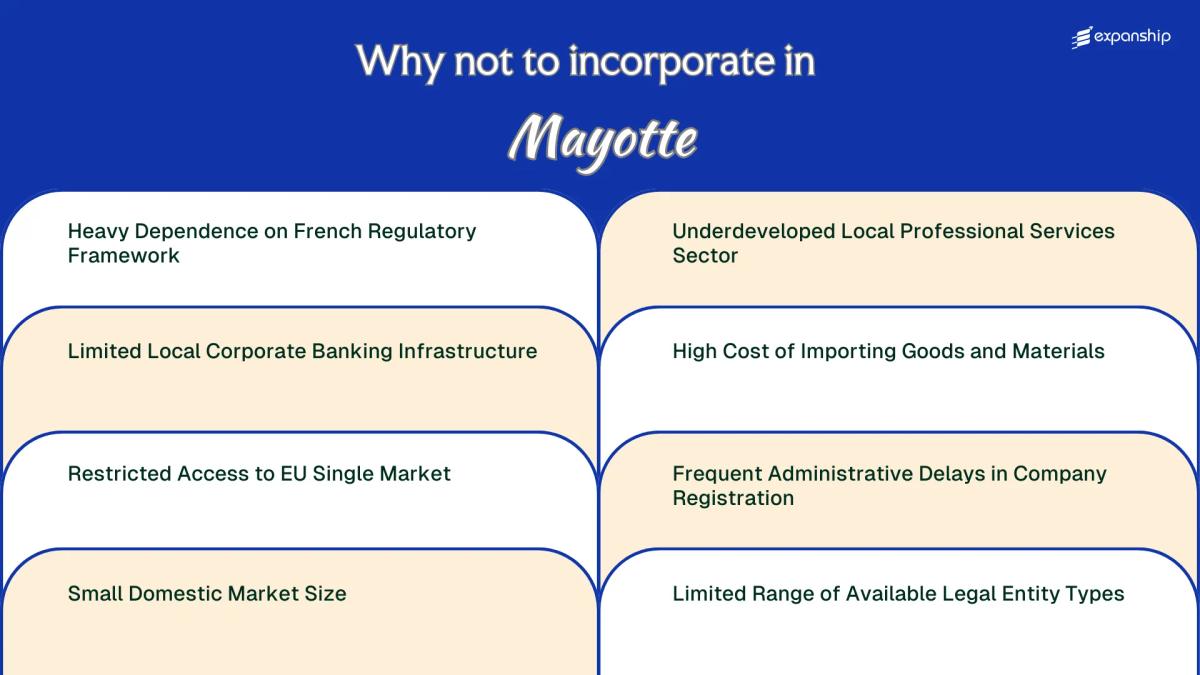
Heavy Dependence on French Regulatory Framework
Mayotte's Mayotte French regulatory framework challenges stem directly from its status as a French overseas department, meaning the full body of French metropolitan law applies with limited local adaptation.
Compliance Obligations Under French Metropolitan Law
French commercial law, including the Code de Commerce and the Code du Travail, applies in full to businesses registered in Mayotte. For a foreign business owner unfamiliar with French legal standards, meeting these obligations requires specialised legal counsel, which adds recurring compliance costs that would not arise in jurisdictions with simpler regulatory environments.
French law compliance burdens in Mayotte extend to corporate governance requirements, mandatory social contributions, and reporting obligations enforced through institutions such as the Tribunal de Commerce. These are not simplified versions of metropolitan rules but the same standards applied across France.
Structural Restrictions on Business Operations
Mayotte business regulation restrictions mean your firm must comply with French labour law, including mandatory employee protections and contribution rates, regardless of the size of your operation. This creates a disproportionate administrative burden for small foreign entities entering the market.
Foreign business owners should expect that full French metropolitan regulatory compliance will require ongoing professional legal and accounting support, representing a significant fixed operational cost.
Limited Local Corporate Banking Infrastructure
Mayotte corporate banking infrastructure limitations are among the most operationally disruptive factors for foreign business owners. Only a small number of banks operate on the island, with BRED Banque Populaire and Caisse d'Épargne among the primary retail and business banking providers. This concentration means your firm has few alternatives if an application is declined or service levels fall short.
Opening a corporate account requires satisfying French anti-money laundering requirements under the Code monétaire et financier, including extensive KYC documentation. For a foreign-owned entity, that process often takes weeks longer than on the French mainland.
The practical friction this creates includes:
- Delays in account opening force you to defer invoicing, payroll, and supplier payments until the process resolves
- Limited competition among local banks means fee structures face little market pressure, raising your operating costs
- Correspondent banking relationships for cross-border transfers are handled through mainland French networks, adding processing time and intermediary costs
Digital banking alternatives common across metropolitan France are largely absent at this territorial level, so your business cannot easily substitute fintech solutions for basic treasury functions.

Company Incorporation in Mayotte
Set up your business entity in Mayotte with structured guidance on registration, documentation, and compliance requirements.
Restricted Access to EU Single Market
Mayotte EU single market access restrictions represent one of the more consequential structural limitations facing foreign businesses that incorporate there. Despite being a French département since 2011, Mayotte holds Outermost Region (OMR) status under EU law rather than full single market integration on par with metropolitan France, and this distinction carries real commercial consequences.
Goods produced or processed in Mayotte do not automatically circulate freely across the EU internal market in the same way they would from mainland France. Your business may face additional certification requirements, customs procedures, or proof-of-origin conditions before products are accepted in other EU member states, adding compliance cost and logistical friction that would not exist if the firm were based in metropolitan Europe.
| Access Dimension | Restriction or Burden |
|---|---|
| Free movement of goods | Subject to OMR-specific derogations; not fully equivalent to metropolitan EU treatment |
| VAT harmonisation | Mayotte applies a local tax framework that diverges from the EU VAT Directive |
| EU passporting (financial services) | Not available; Mayotte entities cannot passport financial services across the EU |
| EU procurement access | Limited participation compared to entities incorporated in mainland EU jurisdictions |
Financial services firms are particularly affected. EU passporting rights, which allow a licensed entity in one member state to operate across the bloc, do not extend to businesses incorporated in Mayotte. That single restriction effectively closes off the EU financial services market to any firm structured through a Mayotte entity.
The OCT status market access drawbacks apply selectively depending on sector, meaning some industries face fewer barriers than others, but the burden of assessing and proving eligibility falls on your business.
Small Domestic Market Size
Mayotte small domestic market drawbacks are a structural constraint that most foreign investors underestimate before committing resources. With a population of approximately 320,000 and a GDP per capita that remains among the lowest in any French-administered territory, the addressable consumer base is narrow by any commercial measure.
Purchasing power across the island is significantly below the French metropolitan average. This compresses the revenue ceiling for businesses selling goods or services locally, making volume-dependent business models structurally unviable without external market access.
Most formal economic activity concentrates around public sector employment and French state transfers, which limits private sector demand. A business incorporated here faces a consumer market where discretionary spending is constrained and where informal economic activity reduces the effective reach of formal commercial channels.
- Local consumer demand is insufficient to support scale-dependent or volume-driven business models
- Revenue projections must account for a limited consumer base with below-average purchasing power relative to French metropolitan standards
- Public sector dependency means private demand is subject to fluctuations in French state transfer policies
- Market size constraints make it difficult to justify the fixed costs of local incorporation without an export or regional strategy
Despite being an official French département, Mayotte's nominal GDP per capita is less than one-quarter of the French metropolitan average, making it economically closer to neighbouring Comoros than to continental France.
Underdeveloped Local Professional Services Sector
The Mayotte professional services sector limitations create a structural gap that foreign businesses often underestimate before committing to incorporation on the island.
Scarcity of Qualified Local Practitioners
Qualified corporate lawyers, certified accountants, and licensed auditors with experience in French commercial law and OHADA-adjacent structures are concentrated on metropolitan France's mainland, not locally. If your firm requires ongoing compliance support under the French Code de Commerce as applied in Mayotte, sourcing that expertise locally is inconsistent and unreliable.
Most practitioners operating in Mayotte focus on public sector work or personal legal matters rather than corporate advisory mandates. The lack of legal and accounting services in Mayotte means that foreign-owned entities frequently incur additional costs by retaining professionals based in Réunion or Paris.
Practical Consequences for Foreign-Owned Entities
Engagements with remote advisors introduce delays in document notarization, statutory filings, and regulatory correspondence with the Greffe du Tribunal Mixte de Commerce de Mayotte. Time-sensitive compliance obligations become operationally difficult when your appointed advisors are operating across a significant time difference and without on-the-ground familiarity.
Corporate advisory services drawbacks in Mayotte extend to due diligence, shareholder agreements, and annual account filings, all of which demand specialized practitioners that the local market does not consistently supply.
Support for Navigating Business Challenges in Mayotte
Expanship can connect your business with qualified advisors and guide you through the compliance requirements that local service gaps make difficult to manage independently.
High Cost of Importing Goods and Materials
Mayotte high import costs represent one of the most concrete financial burdens for any business that depends on physical goods, given that the island produces almost no industrial or manufactured output locally. Nearly all materials, equipment, and consumer products must be shipped in, exposing your firm to layered freight costs, port handling fees, and customs duties administered under French territorial tax rules.
- Goods entering Mayotte are subject to the Taxe sur les Opérations de Main-d'Oeuvre (TOMO) and the Taxe sur les Produits (TP), territorial levies that increase landed costs beyond standard EU import duty rates, compressing margins from the outset.
- Shipping routes to Mayotte typically transit through Réunion or mainland France, adding transit time and logistics costs that suppliers in continental Europe or Asia pass directly to your business.
- Port infrastructure at Longoni remains capacity-constrained, meaning delayed clearance during peak periods increases holding costs and disrupts supply chain schedules.
- No free trade zone or bonded warehouse regime currently exists in the territory, so your firm cannot defer duty payment while goods await onward processing or sale.
Frequent Administrative Delays in Company Registration
Mayotte company registration administrative delays stem from a structural mismatch: the territory applies French metropolitan commercial law, yet its local institutions lack the staffing and infrastructure to process filings at mainland speeds. Registration of a business entity runs through the Registre du Commerce et des Sociétés (RCS), administered locally through the Tribunal Mixte de Commerce de Mayotte, which operates with significantly fewer resources than equivalent courts in metropolitan France.
Processing times at this tribunal regularly exceed those on the mainland, where RCS registration can be completed within a few business days through digital channels. Your firm may wait several weeks for a registration certificate, which delays the opening of a corporate bank account and the ability to sign contracts in the company's name.
The slow business registration process in Mayotte also affects subsequent filings. Any post-incorporation amendments, such as changes to directors or registered capital, face the same bottleneck.
A foreign-owned SARL incorporated in Mayotte, anticipating a four-week setup window, could face a six-to-ten-week delay before receiving its SIRET number from INSEE, pushing back its first billable activity and generating an estimated €3,000–€5,000 in sunk overhead costs before operations begin.
Limited Range of Available Legal Entity Types
Mayotte's corporate framework mirrors metropolitan French law, which means the menu of available structures is largely dictated by the French Commercial Code as applied to this overseas department. For foreign entrepreneurs, this creates a narrow selection concentrated around a small number of familiar French forms.
The entity types you can practically form are:
- Société à Responsabilité Limitée (SARL)
- Société par Actions Simplifiée (SAS)
- Entreprise Individuelle (sole trader)
- Société Anonyme (SA), though rarely used given its capital and governance requirements
The SA requires a minimum share capital of €37,000 and a board structure with at least three shareholders, making it functionally inaccessible for small foreign investors. Even the more accessible SARL and SAS impose administrative requirements tied to French company registration procedures, which adds friction without offering any structural flexibility in return.
Structures common in other jurisdictions, such as limited partnerships with pass-through taxation, offshore holding vehicles, or protected cell companies, simply do not exist under this framework. If your business model depends on a specific entity type for tax or liability purposes, the restricted corporate structures available here may force a costly restructuring of your broader group arrangement.
If your intended entity type does not exist under the French Commercial Code, no local workaround or hybrid structure is available to replicate it within this jurisdiction.
Strategies to Overcome These Drawbacks
Overcoming Mayotte incorporation drawbacks requires structural planning rather than reactive adjustments. The challenges specific to this jurisdiction — from administrative delays to limited banking options — call for deliberate pre-entry decisions.
- Register your entity type through the Greffe du Tribunal to confirm which legal structures are formally recognised under local French commercial law before committing to a formation path.
- Establish a banking relationship with a metropolitan French institution that operates in Mayotte, given the absence of a developed local corporate banking sector.
- Source an accountant or legal adviser qualified under French law, since local professional services capacity is limited and compliance obligations follow the French regulatory framework.
- Plan import logistics and duty costs in advance, as goods entering Mayotte are subject to the Octroi de mer tax regime.
- Account for extended processing timelines in your incorporation schedule, given the documented administrative delays at local registration offices.
These steps operate within a framework ultimately governed by French national law and transposed EU directives. Structural preparedness does not eliminate the constraints inherent to this jurisdiction, but it reduces the risk of compliance gaps and operational disruptions.
Mayotte's Overall Business Viability
Mayotte presents a credible, legally stable base for incorporation, anchored by French commercial law and eurozone membership. That stability comes with a set of structural constraints — from banking limitations to market size — that make the jurisdiction better suited to specific operational profiles than to general-purpose use.
| Pros | Cons |
|---|---|
| French legal framework provides a well-established regulatory foundation | Full compliance with French and EU regulations adds significant administrative burden |
| Euro currency eliminates foreign exchange exposure within the eurozone | Local banking infrastructure is limited, with few institutions offering corporate accounts |
| Geographic position in the Indian Ocean offers proximity to East African and Comoros markets | Mayotte is an EU outermost region, not part of the EU customs union, restricting single market access |
| French company law offers recognized entity structures such as the SARL and SAS | The range of available legal entities is narrower than in metropolitan France |
| Status as a French overseas department provides political and legal predictability | The small domestic consumer base limits revenue potential for locally oriented businesses |
Import costs remain elevated due to remote logistics chains, and professional services capacity on the island is constrained. Administrative processing times through local prefectural channels can extend timelines beyond what businesses would encounter in mainland France.
Compliance Services for Companies in Mayotte
Maintain your Mayotte entity in good standing with French regulatory requirements, including annual filings, tax obligations, and corporate record-keeping under applicable French overseas department rules.
Conclusion
Mayotte's incorporation cons and limitations summary points to a jurisdiction shaped by structural constraints rather than regulatory design choices. The banking infrastructure remains thin, administrative processing through French-aligned procedures adds time to entity formation, and the domestic market offers limited commercial scale for most business models. These factors, taken together, affect the practical utility of a Mayotte-registered firm for internationally oriented operations. Specialist legal and procedural support can reduce friction, particularly for foreign founders unfamiliar with the département's specific requirements under French overseas territory rules.
Expanship's Mayotte Business Setup Support
Incorporating in Mayotte means contending with a regulatory environment shaped by French overseas collectivity law, URSSAF social contribution obligations, and the oversight of the Greffe du Tribunal de Commerce de Mayotte. Expanship Mayotte business setup support is structured specifically around these operational realities, helping your business manage the administrative weight of French-aligned compliance without understating the genuine complexity involved.
Beyond registration, our services cover the full incorporation and maintenance cycle.
- We prepare and file all company formation documents with the relevant French regulatory authorities on your behalf.
- A registered agent and local office address are provided to satisfy domiciliation requirements.
- We liaise directly with the Greffe and other government bodies throughout the filing process.
- Post-incorporation compliance obligations, including annual filings, are managed on an ongoing basis.
- Banking introduction assistance is available to help you open a local or correspondent account.
- Tax registration with French fiscal authorities and liaison with local services are handled as part of the setup.
To discuss your specific requirements, contact Expanship Mayotte.
Frequently Asked Questions (FAQ)
Mayotte follows French law as a French département, so the Code de Commerce and associated corporate regulations apply, but transposition has not always been uniform or fully resourced. Certain provisions that function smoothly in metropolitan France can be slower to enforce or interpret locally due to limited judicial and administrative capacity. Your business may find itself in a position where the law on paper and its practical application diverge.
Yes, access to corporate banking in Mayotte is materially more restricted than in metropolitan France or even other overseas départements. The number of established banking institutions with full corporate services on the island is limited, and foreign-owned entities can face extended due diligence timelines. This directly delays your ability to receive capital, pay suppliers, or meet payroll after incorporation.
Import costs in Mayotte are structurally high due to its geographic isolation in the Indian Ocean and its dependence on external supply chains for most goods. Octroi de mer, a regional import levy applied across French overseas territories, adds cost at the point of entry that does not apply in mainland France. For any business model built around physical goods, these cumulative costs compress margins in ways that are difficult to offset through local pricing.
No. Mayotte holds Outermost Region status under Article 349 of the Treaty on the Functioning of the European Union, which means specific EU rules apply with adaptations, and full single market access is not equivalent to that of a business incorporated in continental Europe. Certain EU directives apply in modified form, and cross-border trade with EU member states may involve additional regulatory considerations that would not apply to a firm incorporated in France proper.
The available structures mirror those under French corporate law, primarily the SARL, SAS, and SA, but the practical use of more complex structures is constrained by the limited local expertise to administer them. Forming and maintaining a société anonyme, for instance, requires statutory auditors and governance processes that are difficult to resource locally. You may technically have access to the full range of French legal entities, but your practical options are narrower than in any major French commercial city.
Foreign companies often have higher compliance and structuring needs than domestic micro-enterprises, and Mayotte's limited pool of notaries, chartered accountants, and specialist corporate lawyers creates a direct service gap. You may need to source professional support from Réunion or metropolitan France, which adds cost, coordination complexity, and time to routine compliance tasks. This dependency becomes particularly acute during annual reporting cycles or if your firm faces any regulatory scrutiny.
Mayotte has the lowest GDP per capita of any French département, and the local talent pool for specialised business functions is correspondingly limited. Many qualified professionals operate from Réunion or mainland France, meaning your firm will likely incur travel costs or retainer fees for remote advisory services. This is not a temporary gap — it reflects a structural feature of the local economy that affects operational planning from day one.
Legal Disclaimer
The information provided in this article is for general informational purposes only and does not constitute legal, tax, or professional advice. While we strive to ensure the accuracy and timeliness of the content, laws and regulations are subject to change, and the application of laws can vary widely based on specific facts and circumstances.
Readers should not act upon this information without seeking professional counsel tailored to their individual situation. Expanship and its authors disclaim any liability for actions taken or not taken based on the content of this article.
For specific advice regarding your business setup, compliance requirements, or any legal matters, please consult with qualified legal and tax professionals in the relevant jurisdiction.