
Key Takeaways
- Businesses incorporated in Mayotte operate under French commercial law administered through the CFE Mayotte, giving them legal standing that locally registered entities in neighbouring Indian Ocean jurisdictions cannot match.
- The Mayotte tax code applies corporate tax rates and thresholds calibrated for a developing economy, meaning eligible companies pay less than equivalent entities incorporated in metropolitan France.
- Employer social contribution rates in Mayotte sit below mainland French levels, which directly reduces the cost of hiring local staff and affects the financial modelling of any entity planning regional operations.
- Under the modified French fiscal code applicable to Mayotte, businesses structured as an SARL or SAS can access preferential tax treatment that is unavailable under the standard metropolitan French tax regime.
Mayotte is a French overseas department and region located in the Indian Ocean, situated between the northern tip of Madagascar and the eastern coast of Mozambique. As a full département of France, it operates under French civil and commercial law, with company registration overseen by the CFE Mayotte — the Centre de Formalités des Entreprises responsible for processing business formation filings on the island. Foreign nationals face no general legal prohibition on owning or operating a business there, and the territory maintains an open posture toward foreign direct investment under French national law.
The benefits of incorporating in Mayotte stem largely from its dual character: a French-law jurisdiction with Indian Ocean geography and a tax regime that differs meaningfully from metropolitan France. The SARL remains the most common vehicle through which foreign businesses establish a local presence. From a tax posture standpoint, the territory applies a modified French fiscal code with locally adjusted rates rather than a zero-tax or purely territorial model.
This article outlines the principal advantages that Mayotte company formation offers to foreign investors and business operators.
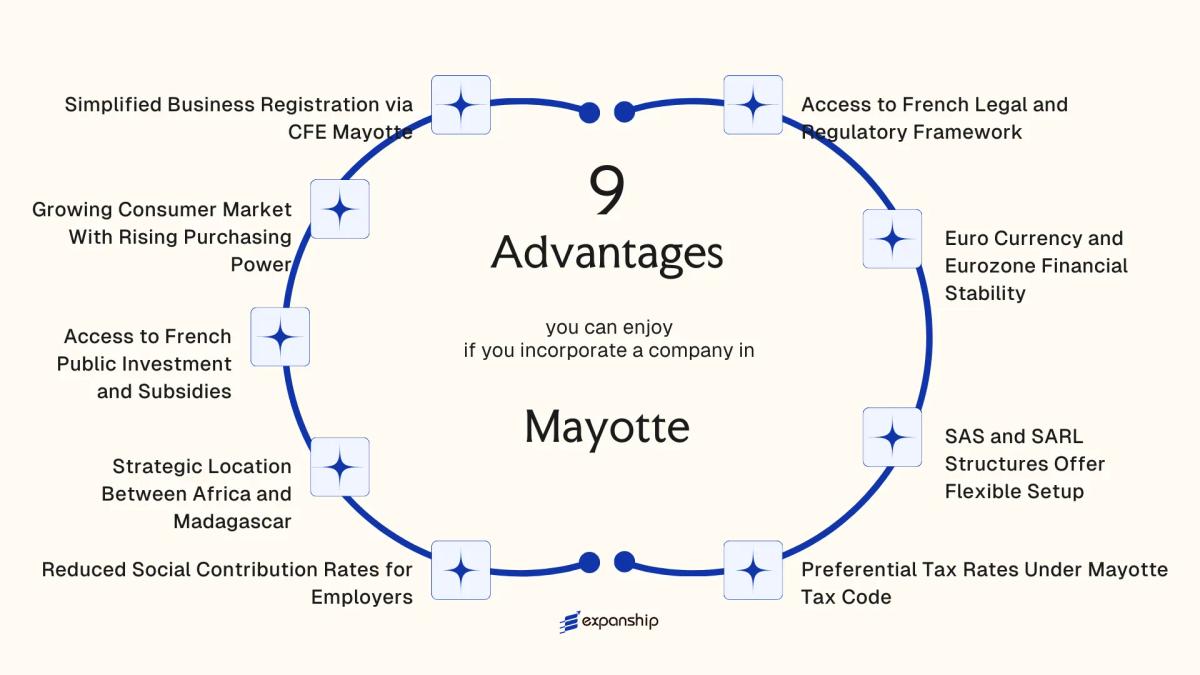
Access to French Legal and Regulatory Framework
Incorporating in Mayotte places your business directly under the French legal framework, a system governed by codified civil law with centuries of institutional development. French law applies in full, not in a modified or transitional form.
Civil and Commercial Law Protections
The French Code de commerce and Code civil both apply to entities registered in Mayotte, giving your business the same contractual enforceability and property rights protections available to companies incorporated in metropolitan France. Courts in Mayotte operate within the French judicial hierarchy, meaning disputes can ultimately be escalated to French appellate jurisdictions.
Regulatory Oversight and Compliance Standards
French regulatory bodies, including the Autorité des marchés financiers for financial services and the Autorité de la concurrence for competition matters, extend their authority to Mayotte. This means foreign investors benefit from the same Mayotte French regulatory system oversight that governs businesses across France, which carries direct weight when negotiating contracts or securing financing from European counterparties.
French law protection for businesses in Mayotte also reduces legal due diligence costs for EU-based partners, since the applicable legal system is already familiar to them.
Contracts signed under Mayotte's French legal framework carry the same enforceability as those governed by metropolitan French law.
Euro Currency and Eurozone Financial Stability
As a French territorial collectivity, Mayotte uses the euro as its official currency. For foreign businesses, euro currency stability benefits Mayotte-based entities by eliminating the exchange rate risk that typically accompanies operations in developing or emerging market jurisdictions. Pricing contracts, repatriating profits, and reporting financials all occur within the same monetary framework that governs the broader European single market.
The euro is managed by the European Central Bank under the Treaty on the Functioning of the European Union. This means your entity in Mayotte operates under the same monetary policy and price stability mandates that apply across the eurozone, rather than a locally administered currency subject to devaluation or liquidity constraints.
For euro-denominated business in Mayotte, this translates to concrete operational advantages:
- Banking relationships can be established with French metropolitan and European institutions familiar with eurozone regulatory norms
- Cross-border invoicing with European counterparties requires no currency conversion, reducing transaction friction
- Access to SEPA payment infrastructure enables low-cost, standardised transfers across 36 participating countries
- Financial statements prepared in euros are directly comparable to European benchmarks, simplifying audits and due diligence for investors
Monetary stability for investors is further reinforced by France's sovereign backing of public financial institutions operating in the territory.

Company Incorporation in Mayotte
Set up a legally compliant entity in Mayotte with full support from registration through to post-incorporation compliance.
SAS and SARL Structures Offer Flexible Setup
Both the SAS (Société par Actions Simplifiée) and SARL (Société à Responsabilité Limitée) are available to foreign investors incorporating in Mayotte, and the structural flexibility each entity type provides has direct operational consequences for how you govern and fund your business.
The SAS SARL company structures Mayotte advantages begin with shareholder configuration. An SAS can be formed by a single shareholder or multiple, with no ceiling on the number of participants. Share transfers and governance rules are defined within the company's statutes rather than dictated by a rigid statutory code, giving founders meaningful control over internal decision-making architecture.
| Feature | SAS | SARL |
|---|---|---|
| Minimum shareholders | 1 | 1 |
| Maximum shareholders | Unlimited | 100 |
| Minimum share capital | No legal minimum | No legal minimum |
| Governance rules | Defined by statutes | Governed by Code de Commerce |
| Share transferability | Freely arranged by statutes | Subject to approval clauses |
The SARL, governed by the French Code de Commerce as applied in Mayotte, suits businesses that prefer a more standardized governance model with defined manager roles and capped shareholder numbers at 100. This predictability can reduce negotiation complexity when onboarding co-investors.
Neither structure imposes a minimum capital requirement under current French commercial law, which means you can capitalize your entity according to genuine business need rather than regulatory minimums. Liability in both cases remains limited to each shareholder's contribution, separating personal assets from business obligations.
Preferential Tax Rates Under Mayotte Tax Code
Mayotte preferential tax rates for businesses stem from the territory's status as a French outermost region, which allows it to apply derogations from standard metropolitan French tax rules. Under the Code Général des Impôts as adapted for Mayotte, companies operating on the island benefit from a reduced corporate income tax environment relative to the 25% standard rate applied in mainland France.
Businesses established in Mayotte may qualify for partial or total corporate tax exemptions during their initial years of operation, particularly those engaged in productive activities under specific sectoral criteria. This directly reduces the effective tax burden during the period when a new entity generates its first profits, preserving early-stage cash flow.
Tax credits tied to investment in fixed assets are also available under the general outermost region aid scheme, anchored in EU state aid rules for outermost territories under Article 349 TFEU. These credits reduce the final tax liability rather than simply deferring it.
Keep in mind:
- Exemptions are activity-specific; manufacturing and productive services typically qualify more broadly
- Eligibility periods are fixed; late registration may reduce the years of benefit available
- Local tax filings remain subject to Direction Générale des Finances Publiques (DGFiP) oversight
- Benefits require maintaining genuine economic activity and substance in the territory
Mayotte applies a lower VAT rate than mainland France, with certain categories of goods taxed at 8.5% compared to the standard 20% rate applied in metropolitan France.
Reduced Social Contribution Rates for Employers
Mayotte reduced employer social contributions sit significantly below the rates applied in metropolitan France, creating a structurally lower payroll cost base for businesses operating on the island. This differential is not informal — it is codified under specific legislative provisions that govern social security alignment in Mayotte, where the extension of the French social protection system has been phased in gradually rather than applied in full.
Lower Contribution Ceilings Translate Directly to Payroll Savings
Employer contribution rates in Mayotte cover health, family, and pension branches, but the applicable ceilings and percentages remain below mainland French standards during the ongoing convergence period. For a business employing local staff, this means total social charges per employee are materially reduced compared to what the same firm would owe under the standard metropolitan contribution schedule. The gap affects every payroll cycle, not just at senior salary levels.
The Convergence Framework Defines the Benefit Window
The phased alignment process, managed under French social security law and overseen by bodies including the Caisse de Sécurité Sociale de Mayotte (CSSM), sets a defined transitional period during which lower rates remain in force. Registering and staffing your entity before full convergence takes effect means your firm benefits from the reduced contribution environment for a longer duration. Eligibility generally applies to employers registered and operating within the territory, subject to standard registration with the CSSM.
Understand Your Employer Contribution Position in Mayotte
Get guidance on current social contribution rates, CSSM registration requirements, and how the convergence timeline affects your payroll costs as a foreign employer in Mayotte.
Strategic Location Between Africa and Madagascar
Positioned in the Indian Ocean at approximately 12° south latitude, Mayotte sits between the northern tip of Madagascar and the Mozambique Channel coastline of East Africa. This geographic placement puts your business within a short maritime and air corridor of major regional economies including Tanzania, Mozambique, Kenya, and the Comoros archipelago. The Mayotte strategic location Africa Madagascar axis is not simply a matter of proximity — it translates into reduced logistics costs and faster transit times compared to routing trade through European or Gulf intermediary hubs.
- Dzaoudzi-Pamandzi International Airport connects the territory to Réunion, Nairobi, and other East African destinations, giving your company direct regional air access under French aviation regulatory standards.
- The Mozambique Channel is one of the busiest maritime corridors in the southern Indian Ocean. A company based in Mayotte can engage with port operators in Dar es Salaam, Maputo, and Moroni without operating through a non-EU intermediary entity.
- As a French overseas department, Mayotte applies French customs and trade administration rules, which gives your firm a legally predictable export framework when dealing with African counterparts who require EU-standard contractual documentation.
- Time zone alignment with East Africa (UTC+3) reduces scheduling friction for firms managing commercial relationships across the region.
Access to French Public Investment and Subsidies
As a French département since 2011, Mayotte qualifies for direct access to French state funding mechanisms and EU structural funds, which are unavailable to companies incorporated in independent island nations across the same region. For businesses operating in designated priority sectors, this translates into real capital access that reduces early-stage financial exposure.
French public investment subsidies for Mayotte businesses are administered partly through the Contrat de Convergence et de Transformation (CCT), a bilateral framework between the French state and the territorial government that channels public investment into economic development. Firms active in infrastructure-linked services, construction, and digital sectors have historically aligned with CCT priorities.
As an Outermost Region (OMR) under Article 349 of the Treaty on the Functioning of the European Union (TFEU), the territory receives allocations from the European Regional Development Fund (ERDF) and the European Social Fund (ESF). Eligibility for EU funding access for companies is determined by sector, employment thresholds, and project scope.
A hypothetical scenario: A construction firm incorporated locally and awarded a CCT-aligned public contract could access co-financing through ERDF allocations, reducing the firm's required capital outlay by a percentage that would be entirely unavailable to a comparable entity registered in Comoros or Madagascar.
Growing Consumer Market With Rising Purchasing Power
Mayotte's growing consumer market advantages stem directly from its demographic profile. With a population exceeding 320,000 and one of the youngest median ages in French territory, the island generates sustained demand for goods, services, and retail infrastructure that the local supply base has not yet matched.
Per capita income has risen steadily as French departmental status, granted in 2011, extended social transfer payments, public sector wages, and consumer credit access to the population. This gap between rising purchasing power and limited local production creates a structurally undersupplied market, which is a direct commercial opening for businesses entering sectors such as food distribution, construction materials, healthcare, and consumer electronics.
Because the territory operates under French consumer law and the euro, foreign businesses can price, contract, and collect payment under the same legal conditions that apply across France. There is no currency conversion risk and no separate consumer protection regime to interpret.
- Retail and distribution sectors face limited local competition relative to demand levels.
- Healthcare and educational services remain underdeveloped relative to the population size.
- Construction and housing supply continues to lag behind population growth projections.
Market entry sectors in Mayotte may be subject to specific licensing requirements under French commercial law, and some regulated professions require prior authorization from French national bodies before trading can begin.
Simplified Business Registration via CFE Mayotte
The CFE Mayotte business registration advantages begin at the administrative level. The Centre de Formalités des Entreprises (CFE) functions as a single-window registration body, meaning your business submits one consolidated dossier rather than filing separately with multiple agencies. This structure reduces duplication and shortens the time between submission and formal recognition of your entity.
For foreign investors, the practical benefit is directness. A single point of contact coordinates transmission to the relevant authorities, including the Registre du Commerce et des Sociétés (RCS), tax administration, and social security bodies. You are not required to manage parallel procedures across disconnected institutions.
The CFE framework also applies to sole traders, commercial companies, and craft enterprises, which means the Mayotte simplified company registration advantages extend across multiple legal forms. Whether you are establishing a SARL or registering as an auto-entrepreneur, the intake process follows the same consolidated format.
Processing times under this system are generally shorter than jurisdictions where registration is fragmented across multiple government bodies. Reduced administrative friction translates directly into lower setup costs, particularly for foreign principals who would otherwise need to coordinate through multiple local agents.
- One dossier covers commercial, fiscal, and social registration simultaneously
- The CFE routes filings to the appropriate government bodies on your behalf
- No separate applications to tax or social security authorities are required at the point of registration
- The system applies uniformly regardless of the chosen legal structure
Why Mayotte Stands Apart From Nearby Indian Ocean Jurisdictions
Comparing Mayotte's advantages over Indian Ocean jurisdictions requires focusing on competitors that a foreign investor would realistically evaluate at the same time. The Comoros, Madagascar, and Mozambique share the same maritime corridor and serve similar investor profiles, particularly those targeting East African trade flows or Indian Ocean logistics. What the comparison reveals is less about surface-level factors like incorporation fees and more about the structural depth of the legal and financial environment.
The Mayotte advantages over Indian Ocean jurisdictions stem primarily from its constitutional status as a French Département, which positions it within the European Union's legal order under Article 349 TFEU. Comoros operates under a domestic legal system with limited bilateral investment treaty coverage. Madagascar's OHADA membership provides a degree of legal harmonisation, but enforcement reliability differs substantially from a French civil jurisdiction backed by EU regulatory oversight. For cross-border contracts, dispute resolution, and banking access, that structural difference carries direct commercial consequences.
| Parameter | Mayotte | Comoros | Madagascar |
|---|---|---|---|
| Legal System | French civil law, EU-aligned under Art. 349 TFEU | Mixed domestic code, limited international treaty coverage | OHADA framework (partial), civil law base |
| Currency | Euro (EUR) | Comorian Franc (KMF), pegged to EUR | Malagasy Ariary (MGA), floating |
| Banking Supervision | Banque de France / ACPR | Banque Centrale des Comores | Banque Centrale de Madagascar |
| VAT Framework | French Code Général des Impôts (adapted) | Domestic VAT regime | Domestic VAT regime |
| Dispute Resolution | French commercial courts; EU enforcement mechanisms | Domestic courts; limited treaty reciprocity | OHADA arbitration; domestic courts |
| EU Market Access | Full preferential access as French Outermost Region | None | EPA framework with EU (partial) |
Compliance Services for Companies in Mayotte
Maintain your Mayotte entity's good standing with ongoing compliance support, from annual filings to regulatory reporting under the French Code de Commerce.
Conclusion
Mayotte's position as a French overseas department gives foreign investors access to a legal and fiscal environment that is rare in the Indian Ocean region. The benefits of incorporating in Mayotte rest on a specific combination: French commercial law, reduced employer social contribution rates, and preferential corporate tax thresholds that are not available in metropolitan France or most neighbouring jurisdictions.
Tax rates applicable under the Mayotte tax code, along with employer cost structures that sit below mainland French levels, directly affect the financial viability of operating from this territory. For a business owner calculating the total cost of establishing a local presence, these figures are not marginal. They affect hiring decisions, profit distribution, and the long-term cost of compliance.
Mayotte company formation advantages are most pronounced for entities structured to serve regional markets across the Mozambique Channel, where French legal recognition carries weight that locally incorporated vehicles from smaller jurisdictions cannot replicate. The strongest case for this territory is not geographic alone; it is the combination of EU-aligned governance, accessible public financing mechanisms, and a tax regime calibrated for a developing economy. Whether that combination aligns with your specific industry, revenue model, or ownership structure is a determination that requires careful analysis of the applicable rules under French tax and corporate law. The next step is matching those rules precisely to your business objectives.
Let Expanship Handle Your Mayotte Company Formation
Expanship assists foreign investors with Mayotte company formation, covering the full process from initial structure selection through to post-incorporation compliance. The work covered in this blog — SAS and SARL registration, interaction with the Centre de Formalités des Entreprises, employer contribution obligations, and operating within the French legal framework — each carry specific documentation and filing requirements that vary depending on your sector, ownership structure, and intended activities. Expanship manages these requirements directly, coordinating with the relevant local authorities on your behalf.
Our services for entities registered in Mayotte include:
- Preparation and legalization of incorporation documents
- Registered office and local agent provision
- Filing with the CFE Mayotte and liaison with the Greffe du Tribunal de Commerce
- Post-incorporation compliance management, including annual reporting obligations
- Corporate bank account introduction assistance
- Ongoing registered agent maintenance
Expanship Mayotte is available to answer specific questions about your incorporation requirements.
Frequently Asked Questions (FAQ)
Mayotte operates under a distinct tax code that provides reduced corporate tax rates compared to metropolitan France. These preferential rates are codified within the tax arrangements specific to French overseas departments and are designed to encourage investment in the territory. The exact applicable rate depends on the company's revenue threshold and sector, so confirming current figures with the Direction Générale des Finances Publiques in Mayotte is advisable.
Registration through the Centre de Formalités des Entreprises in Mayotte generally follows the same procedural framework as other French overseas departments, with processing times typically ranging from a few days to two weeks depending on the legal form chosen and completeness of submitted documents. An SAS or SARL can be registered once the articles of association are notarised or drafted, capital deposited, and the declaration of beneficial ownership filed with the relevant registry. Delays most often arise from incomplete documentation rather than administrative backlog.
Yes, employers registered in Mayotte benefit from reduced social contribution rates relative to those applicable in mainland France. This reduction is part of a broader framework of fiscal adaptations applied to French overseas departments to account for structural economic differences. The specific rates are set periodically and administered through URSSAF, the body responsible for collecting social contributions across French territory including its overseas departments.
Mayotte holds Outermost Region status within the European Union, which means businesses incorporated there operate under French and EU law but with certain adapted provisions. This status does not provide the same unrestricted access to EU single market trading as incorporation in a metropolitan EU member state would, as specific derogations and exemptions apply to Outermost Regions. For cross-border trade within the EU, the applicable rules depend on the product category and whether derogations affect the relevant regulatory area.
French law does not require an SAS to appoint a director who is resident in Mayotte or in France. The president of an SAS can be a foreign national residing abroad, provided they hold a valid legal identity and meet any sector-specific requirements. However, maintaining a registered office address in Mayotte is mandatory, and certain regulated activities may require a locally present responsible individual under applicable professional licensing rules.
Businesses in Mayotte may access funding through French state investment channels, including programmes administered by Bpifrance, which operates in overseas departments. EU structural funds allocated to Outermost Regions also apply to Mayotte, covering areas such as infrastructure, employment, and economic development. Eligibility conditions vary by programme, sector, and company size, and applications are typically submitted through the relevant regional administration or prefectural authority.
Mauritius operates as an independent jurisdiction with its own corporate tax regime, generally set at a flat rate with various incentive schemes targeting specific sectors like financial services and global business. Mayotte, as a French overseas department, applies a modified version of French tax law with reduced rates and social contribution reliefs specific to its status. The two jurisdictions serve different incorporation profiles: Mauritius is frequently used for holding and international structures, while Mayotte is more suited to businesses with an operational presence targeting the East African and Indian Ocean region under a French legal framework.
Legal Disclaimer
The information provided in this article is for general informational purposes only and does not constitute legal, tax, or professional advice. While we strive to ensure the accuracy and timeliness of the content, laws and regulations are subject to change, and the application of laws can vary widely based on specific facts and circumstances.
Readers should not act upon this information without seeking professional counsel tailored to their individual situation. Expanship and its authors disclaim any liability for actions taken or not taken based on the content of this article.
For specific advice regarding your business setup, compliance requirements, or any legal matters, please consult with qualified legal and tax professionals in the relevant jurisdiction.