
Key Takeaways
- Kosovo's limited double taxation treaty network forces most foreign-owned companies to manage tax exposure without bilateral relief mechanisms, increasing the effective cost of cross-border profit repatriation.
- Under the Law on Business Organizations, registration through the Kosovo Business Registration Agency (KBRA) remains susceptible to procedural delays that can extend incorporation timelines beyond what comparable regional jurisdictions require.
- Fewer than 100 countries recognize Kosovo as a sovereign state, which creates practical complications for companies relying on Kosovo-registered entities to enter contracts, open correspondent banking relationships, or access certain international markets.
- The dominance of the informal economy — estimated to account for a substantial share of domestic transactions — exposes formally incorporated businesses to compliance asymmetries and unfair competitive pressure that standard regulatory frameworks do not adequately address.
Kosovo operates under an evolving regulatory framework, with company law governed by the Law on Business Organizations and oversight handled by the Kosovo Business Registration Agency (KBRA). The framework is neither heavily prescriptive nor fully mature, and gaps in enforcement and institutional capacity create friction that foreign investors encounter at multiple stages.
The disadvantages of incorporating in Kosovo span several distinct categories, from financial infrastructure and market access to legal enforcement and international recognition.
Not every business will face these constraints equally. A small consultancy operating remotely faces different exposure than a manufacturing firm or a regulated financial entity seeking cross-border capital.
This article is most relevant to foreign investors and internationally operating businesses considering Kosovo company formation, particularly those expecting access to EU-aligned banking, treaty-based tax efficiency, or enforceable intellectual property protections.
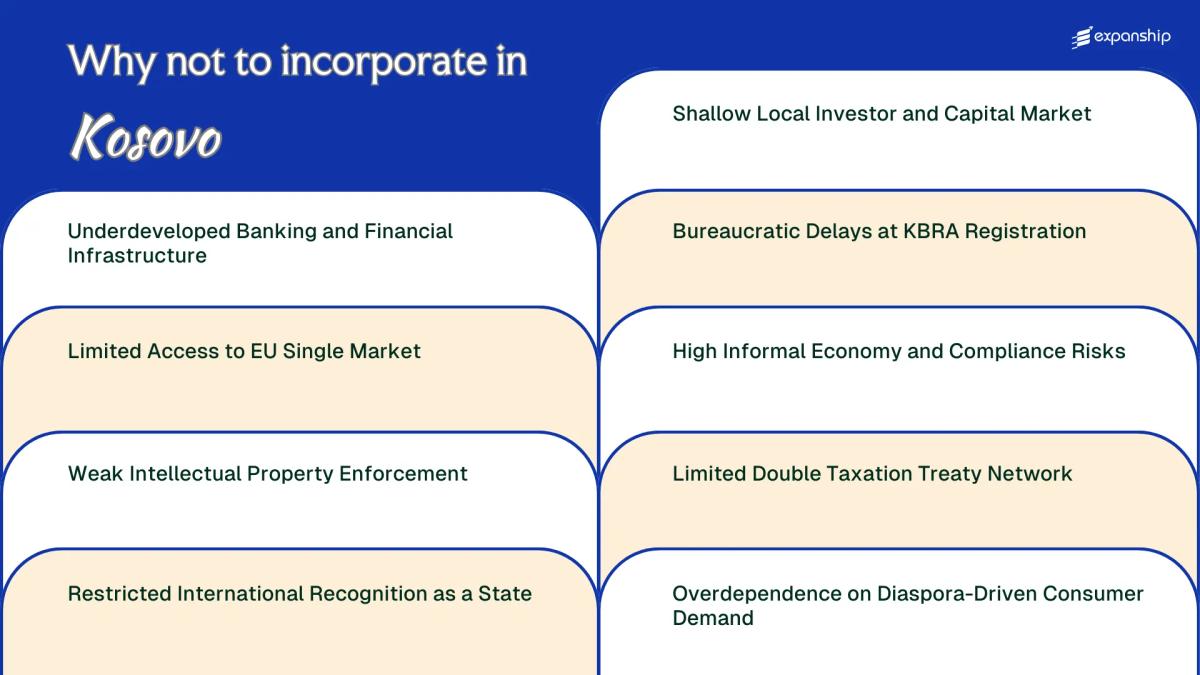
Underdeveloped Banking and Financial Infrastructure
Kosovo banking infrastructure limitations affect incorporated entities from the first week of operations. Accessing basic financial services requires more effort here than in most European jurisdictions.
Restricted Banking Access for Foreign-Owned Entities
The Central Bank of Kosovo (CBK) oversees a banking sector composed largely of subsidiaries and branches of regional banks, with limited presence from global institutions. For a foreign-owned company, this means fewer options for multi-currency accounts, trade finance facilities, or international payment rails that corporate clients typically require.
Correspondent banking relationships between Kosovo-based banks and major financial centers remain thin. Your firm may face delays processing cross-border transactions or find that certain currencies and destination countries fall outside what local banks can service directly.
Payment Infrastructure and Credit Access Gaps
Kosovo financial system risks for businesses extend into credit availability. Local banks apply conservative lending criteria, and foreign-incorporated entities with no local credit history face significant collateral requirements that domestic firms with existing relationships do not.
Digital banking infrastructure also lags behind regional peers, with limited API integrations and corporate treasury tools available through local providers.
A foreign business owner should expect that routine cross-border wire transfers processed through Kosovo-based banks can incur delays and rejections due to limited correspondent banking coverage, directly disrupting supplier payments and payroll cycles.
Limited Access to EU Single Market
Kosovo EU single market access restrictions create a concrete structural barrier for foreign businesses that incorporate there expecting European market reach. The country is not an EU member state, which means entities registered under Kosovo's Law on Business Organizations do not automatically benefit from the free movement of goods, services, capital, or labor guaranteed within the bloc.
Exports to EU countries from a Kosovo-registered firm are subject to standard third-country customs procedures. This adds cost, documentation burden, and transit delays that a company incorporated in, say, Slovenia or Estonia would never encounter.
Practical friction this creates for your business includes:
- Goods face EU customs clearance requirements, increasing per-shipment administrative costs and lead times
- Your firm cannot passport financial services into EU member states under EU regulatory frameworks
- EU public procurement rules generally exclude third-country suppliers, closing a significant contract market
- Attracting EU-based clients often requires establishing a separate EU-registered entity, duplicating incorporation and compliance costs
A Stabilisation and Association Agreement between Kosovo and the EU does provide some preferential trade terms, but this falls well short of the market access rights that EU membership or even European Economic Area status would confer.

Company Incorporation in Kosovo
Understand the full regulatory and market scope of incorporating a business in Kosovo before committing to the jurisdiction.
Weak Intellectual Property Enforcement
Kosovo intellectual property enforcement risks are a genuine operational concern for any foreign business registering a brand or product in the territory. The country's IP framework falls under the Law on Copyright and Related Rights and the Law on Industrial Property, administered by the Kosovo Intellectual Property Office (KIPO), but institutional capacity to act on violations remains limited.
KIPO can register trademarks and patents, yet registration alone provides little practical protection if enforcement downstream is unreliable. Court proceedings involving IP infringement tend to be prolonged, and specialized judicial expertise in IP disputes is not consistently available across Kosovo's court system.
| Enforcement Factor | Detail | Implication for Foreign Rights Holders |
|---|---|---|
| Trademark opposition window | 3 months from publication | Short window; requires active local monitoring to catch infringements |
| Dedicated IP court division | None established | Cases heard by general civil courts with limited IP specialization |
| Average civil IP case duration | Multi-year proceedings typical | Delayed remedies reduce deterrence value of registration |
| Customs IP enforcement capacity | Underdeveloped relative to EU norms | Counterfeit goods interception at borders is inconsistent |
Your trademark registration through KIPO does not guarantee that infringing products will be removed from local markets promptly. Without consistent customs-level interception or fast-track IP tribunals, the deterrent effect of IP rights is weakened.
Businesses in software, branded consumer goods, or proprietary technology face the highest exposure. The cost of pursuing infringement through civil litigation often exceeds the recoverable damages, making enforcement economically unviable for smaller rights holders.
Restricted International Recognition as a State
Kosovo's disputed state status creates direct, structural exposure for any foreign business that depends on cross-border trade, financing, or institutional relationships. The Kosovo limited state recognition business risks are not theoretical — they manifest in specific, recurring friction points that affect daily business operations.
Over 100 UN member states have not recognised Kosovo's 2008 declaration of independence, including Russia, China, Spain, and several other EU members. Your business entity registered under Kosovo law may be unrecognised in these jurisdictions, creating complications for enforcing contracts, opening correspondent banking relationships, or registering trademarks through international systems.
Kosovo is not a member of the United Nations or the World Trade Organization. Non-membership excludes Kosovo-incorporated firms from automatic access to WTO dispute resolution mechanisms and bilateral trade preferences that WTO accession typically provides.
The disputed sovereignty issues create business challenges around document legalisation. Kosovo is not a party to the Hague Apostille Convention, so official documents issued by Kosovo authorities require a more complex legalisation process that many countries simply will not process.
- [ ] Contracts may be unenforceable in the 88+ states that do not recognise Kosovo's statehood
- [ ] Business documents cannot be apostilled under the standard Hague Convention process
- [ ] Kosovo-issued corporate records may be rejected outright by banks in non-recognising states
- [ ] Kosovo-registered firms have no WTO standing for trade dispute resolution
Kosovo uses the euro as its official currency despite not being an EU member state and without any formal monetary agreement with the European Central Bank.
Shallow Local Investor and Capital Market
Kosovo's capital market limitations for businesses are among the most structurally significant constraints facing foreign-incorporated entities. Raising growth capital locally is not a realistic option for most firms operating here.
A Thin Public Market With Minimal Institutional Depth
The Kosovo Stock Exchange (KBSA) remains one of the least active exchanges in the Western Balkans, with trading volumes and listed companies far below regional peers like the Sarajevo or Belgrade exchanges. Your business cannot realistically expect to raise equity through a public listing, as institutional participation from pension funds and investment vehicles is minimal.
Domestic venture capital and private equity activity is similarly underdeveloped. The absence of a functioning secondary market means early investors have no practical exit mechanism, which discourages their participation from the outset.
Practical Consequences for Foreign-Owned Entities
Firms dependent on external funding rounds will find that Kosovo investor access challenges push capital sourcing entirely offshore, increasing financing costs and deal complexity. Debt financing through local banks carries high interest rates relative to EU norms, compounding the difficulty.
This constraint applies across sectors, though it bears most heavily on capital-intensive or high-growth businesses that require staged investment beyond initial incorporation.
Navigating Business Challenges in Kosovo
Speak with our team about structuring your Kosovo entity to work around local capital market constraints and financing limitations.
Bureaucratic Delays at KBRA Registration
KBRA registration delays Kosovo present a concrete operational risk for foreign incorporators, particularly because processing times and document requirements can extend the setup timeline well beyond initial projections. Administrative backlogs at the Kosovo Business Registration Agency (KBRA) have historically affected new business formation timelines.
- Foreign applicants must submit notarized and apostilled incorporation documents, and any errors or missing certifications trigger a rejection cycle that restarts the clock on your registration.
- KBRA procedures require physical or in-person submission steps that cannot always be completed remotely, forcing foreign principals to either travel or engage a local authorized representative at additional cost.
- Document authentication requirements tied to Kosovo's non-membership in several international conventions add translation and legalization layers that comparable EU jurisdictions do not impose.
- Delays at KBRA directly postpone your ability to open a corporate bank account, since banks require a registered entity certificate before processing any business account application.
- No statutory deadline legally binds KBRA to complete registration within a fixed window, leaving your timeline subject to administrative discretion rather than enforceable processing standards.
High Informal Economy and Compliance Risks
Kosovo informal economy compliance risks present a structural challenge that goes beyond routine accounting. The grey economy accounts for an estimated 30–35% of GDP, according to research published by the IMF and regional think tanks, meaning your registered competitors may operate at lower effective costs by avoiding VAT, social contributions, and corporate income tax obligations entirely.
Under the Law on Tax Administration and Procedures (Law No. 03/L-222), businesses are required to issue fiscal receipts through certified point-of-sale systems monitored by the Tax Administration of Kosovo (TAK). Despite this, undeclared transactions remain widespread in retail, construction, and professional services sectors.
For a foreign-incorporated entity operating transparently, this creates a direct pricing disadvantage. Your cost base reflects full statutory compliance, while unlicensed or informally operating local competitors absorb none of those costs.
TAK conducts field audits, but enforcement capacity is uneven across sectors and regions.
A foreign firm billing €500,000 annually in a sector where 40% of local competitors operate informally faces a structural cost gap of roughly €80,000–€100,000 in tax and contribution obligations that unregistered rivals do not carry, compressing margin and limiting price competitiveness from the outset.
Limited Double Taxation Treaty Network
Kosovo's double taxation treaty limitations present a concrete structural problem for foreign businesses routing income across borders. As of 2024, the country has signed DTTs with only a small number of jurisdictions, including Albania, Austria, Belgium, Finland, Germany, Hungary, Ireland, Latvia, Luxembourg, Macedonia, Netherlands, Slovenia, Switzerland, Turkey, and the United Kingdom. This narrow coverage leaves significant gaps in protection against double taxation on dividends, royalties, and interest payments.
Without a treaty in place, withholding taxes apply at domestic statutory rates. Kosovo levies a 10% withholding tax on dividends and interest paid to non-residents, with no treaty-reduced rate available for partners in non-covered jurisdictions. For a business with shareholders or parent entities in the United States, Canada, or most of Asia, this means no mechanism exists to reclaim or offset that tax through bilateral agreement.
The limited DTT coverage in Kosovo also affects the ability to structure holding arrangements efficiently. Cross-border payments between related entities trigger full statutory withholding, increasing the effective tax burden on repatriated profits.
If your parent company, shareholders, or key counterparties are based in a jurisdiction not covered by Kosovo's existing treaty network, all cross-border income flows will be subject to full domestic withholding tax rates with no bilateral relief available.
Overdependence on Diaspora-Driven Consumer Demand
Kosovo diaspora dependency business risks are structural, not cyclical. Remittances account for roughly 15–17% of GDP, and seasonal spending by diaspora visitors — concentrated in July and August — distorts demand patterns in retail, hospitality, and construction throughout the year.
For a foreign firm projecting annual revenue, this creates a forecasting problem. Demand peaks sharply during summer months, then contracts, leaving businesses with overhead calibrated to peak-season volumes.
Diaspora spending is also sensitive to conditions outside your control. Economic slowdowns in Germany, Switzerland, or Austria — where a significant share of the Kosovo diaspora resides — directly compress remittance flows and discretionary spending back home.
Consumer demand volatility in remittance-driven economies affects credit planning as well. Local banks price this risk into lending terms, which tightens working capital access during off-peak periods precisely when cash flow is weakest.
Overcoming Kosovo's Key Business Drawbacks
Overcoming Kosovo's Key Business Drawbacks
Overcoming Kosovo business drawbacks requires structural decisions made before and during incorporation, not reactive fixes applied after problems emerge. The challenges documented across this blog range from treaty gaps to KBRA processing delays, and each has a corresponding mitigation pathway.
- Register your entity through the KBRA portal in advance of operational deadlines to account for documented processing backlogs.
- Open accounts with a bank that maintains correspondent relationships with EU financial institutions to reduce transaction friction caused by Kosovo's limited banking integration.
- File intellectual property registrations with the Industrial Property Agency of Kosovo alongside any EUIPO filings to establish dual-layer protection.
- Structure your entity under a foreign parent company incorporated in an EU member state to access trade benefits unavailable to Kosovo-domiciled firms directly.
- Maintain formal payroll and invoicing records consistent with the Law on Business Organizations to reduce exposure from informal economy compliance risks.
Mitigating risks of incorporating in Kosovo depends heavily on how well your corporate structure anticipates regulatory gaps rather than responds to them. The country's existing legal framework provides workable foundations, but gaps in treaty coverage and market access require deliberate structural planning from the outset.
Kosovo's Overall Investment Appeal
Kosovo's incorporation environment carries genuine structural limitations, and the Kosovo investment appeal despite drawbacks rests on a narrow but real foundation: low corporate tax rates, a young workforce, and geographic access to regional markets. These factors do not cancel out the disadvantages documented in this blog, but they do mean the jurisdiction warrants consideration by businesses with the right operational tolerance.
| Pros | Cons |
|---|---|
| Corporate income tax is set at a flat 10%, one of the lowest statutory rates in the Western Balkans | Kosovo is not recognized by all UN member states, creating legal uncertainty in cross-border transactions |
| No double taxation treaty obligation means simpler domestic tax calculations for purely local operations | The limited DTT network exposes foreign shareholders to potential double taxation on dividends and royalties |
| The KBRA registration process is centralized and digitally accessible | Bureaucratic delays at KBRA can extend timelines beyond the nominal registration period |
| A young, low-cost labor market supports operational cost efficiency | The informal economy remains significant, raising due diligence and compliance risks for incoming firms |
| Proximity to EU member states offers physical market access | Companies incorporated here have no automatic access to the EU Single Market |
Kosovo's banking sector remains underdeveloped by regional standards, and intellectual property enforcement is inconsistent. The local capital market is shallow, diaspora consumption drives a disproportionate share of domestic demand, and the absence of a broader treaty network limits tax planning options for internationally structured entities.
Compliance Services for Companies in Kosovo
Maintain your Kosovo-registered entity in good standing with ongoing compliance support, including annual reporting, tax filings, and regulatory submissions under applicable Kosovo law.
Conclusion
A Kosovo company incorporation cons summary reflects a jurisdiction with genuine structural constraints rather than superficial administrative friction. Partial international recognition limits banking access and treaty coverage, while KBRA registration delays and weak IP enforcement create operational friction that affects day-to-day business management. The absence of a broad double taxation treaty network remains a concrete cost consideration for cross-border structures. For businesses requiring predictable regulatory conditions and deep capital market access, these factors carry real weight. Professional guidance on entity structuring, compliance obligations, and banking relationships can determine whether a formation in this jurisdiction remains viable long-term.
Expanship's Services for Kosovo Expansion
Incorporating in Kosovo means contending with a specific set of structural and procedural challenges: KBRA registration delays, limited double taxation treaties, weak IP enforcement mechanisms, and a banking sector with restricted correspondent relationships. Kosovo company formation services from Expanship are designed to reduce the operational weight of these obligations, so your team spends less time managing bureaucratic friction and more time building the business.
Expanship's service scope covers the practical requirements of establishing and maintaining a compliant entity in Kosovo.
- We prepare and submit all company registration documentation to the Kosovo Business Registration Agency on your behalf.
- A registered agent and local office address are provided to satisfy Kosovo's statutory presence requirements.
- We handle government filings and liaise directly with relevant regulatory authorities.
- Post-incorporation compliance obligations, including annual filings, are managed on an ongoing basis.
- Banking introduction assistance is available to help your business open a functional account with a local institution.
- Tax registration with the Kosovo Tax Administration and coordination with local authorities is included in our scope.
Reach out to Expanship Kosovo to discuss your incorporation requirements.
Frequently Asked Questions (FAQ)
The treaty gap affects any company earning income across borders, regardless of ownership structure. Kosovo has signed very few double taxation agreements, meaning profits paid to foreign shareholders, service fees sent abroad, or royalties flowing out of Kosovo may face withholding tax in both Kosovo and the recipient country simultaneously. There is no structural exemption for locally owned firms if their clients or suppliers are based in treaty-absent jurisdictions.
KBRA delays can push your company's operational start date back by weeks beyond the statutory processing window. This matters because contracts, employment agreements, and VAT registration all depend on your firm having a valid registration certificate, meaning delays at KBRA create a chain of downstream hold-ups. The practical risk is that you may incur costs before your entity is legally authorized to operate.
Every registered business in Kosovo faces compliance exposure from the informal economy, but foreign-owned entities carry additional scrutiny. The Kosovo Tax Administration regularly audits companies whose declared revenues appear inconsistent with sector norms, partly because informal competitors suppress observable market benchmarks. A foreign firm that prices or invoices conventionally may appear anomalous against a backdrop of underreported transactions, triggering disproportionate audit attention.
Kosovo has enacted intellectual property legislation, including the Law on Copyright and Related Rights, but enforcement at the institutional level remains limited. The capacity of courts to handle IP disputes quickly is constrained, and the practical timeline for obtaining injunctive relief against an infringer can stretch long enough to make litigation commercially pointless. For businesses whose primary asset is a brand, software product, or proprietary process, this enforcement gap is a genuine structural disadvantage.
Kosovo benefits from the Central European Free Trade Agreement and has a Stabilisation and Association Agreement with the EU, which provides preferential trade terms for goods. However, this is not equivalent to EU single market access. Your Kosovo-registered company cannot passport financial services, benefit from mutual recognition of professional qualifications, or operate under the EU's unified regulatory framework, all of which EU-incorporated entities take as baseline rights.
Kosovo has no functioning stock exchange for private company listings, and the local banking sector's appetite for lending to early-stage or growth-oriented businesses is limited. Venture capital infrastructure is minimal, meaning that if your entity needs equity financing beyond its founding capital, you will almost certainly need to source it externally from foreign investors or development finance institutions. This dependence on external capital sources adds cost, complexity, and timeline uncertainty to any growth plan.
Kosovo's Law on the Prevention of Money Laundering and Terrorist Financing imposes due diligence obligations on businesses handling significant cash transactions, and the Financial Intelligence Unit can escalate non-compliance cases. Operating in an environment where a large share of economic activity is cash-based means your firm will routinely encounter counterparties who cannot provide standard documentation, putting your own compliance posture at risk. Failure to file suspicious transaction reports or maintain adequate customer due diligence records can result in administrative penalties and reputational damage with correspondent banks.
Legal Disclaimer
The information provided in this article is for general informational purposes only and does not constitute legal, tax, or professional advice. While we strive to ensure the accuracy and timeliness of the content, laws and regulations are subject to change, and the application of laws can vary widely based on specific facts and circumstances.
Readers should not act upon this information without seeking professional counsel tailored to their individual situation. Expanship and its authors disclaim any liability for actions taken or not taken based on the content of this article.
For specific advice regarding your business setup, compliance requirements, or any legal matters, please consult with qualified legal and tax professionals in the relevant jurisdiction.