
Key Takeaways
- Kosovo's flat 10% corporate income tax rate, applied on a territorial basis, means foreign-sourced income falls outside the Kosovo tax net entirely, structurally reducing the effective tax burden for internationally active businesses.
- Under the Law on Business Organizations, a Kosovo LLC can be formed by a single foreign shareholder with no minimum capital requirement, removing two of the most common barriers to entry found in comparable regional jurisdictions.
- Registration through the Kosovo Business Registration Agency (KBRA) consolidates the incorporation process into a single administrative channel, shortening the time between formation decision and a legally operational entity.
- Membership in CEFTA combined with the Stabilisation and Association Agreement with the European Union gives a Kosovo-registered company preferential trade access to multiple markets without requiring separate market entry structures in each.
Declared independent in 2008, Kosovo is a landlocked republic in the Western Balkans, bordered by Serbia, North Macedonia, Albania, and Montenegro. Company registration is administered by the Kosovo Business Registration Agency (KBRA), which operates under the Ministry of Industry, Entrepreneurship and Trade. The most common vehicle through which foreign investors establish a local presence is the shoqëri me përgjegjësi të kufizuar, or LLC equivalent under Kosovo law.
From a tax standpoint, the country operates a low-rate territorial system, applying tax only to income sourced within its borders. Foreign ownership of local entities faces no general statutory restrictions, and the legal framework permits 100% foreign-held companies across most sectors — a posture that has attracted growing foreign direct investment in recent years.
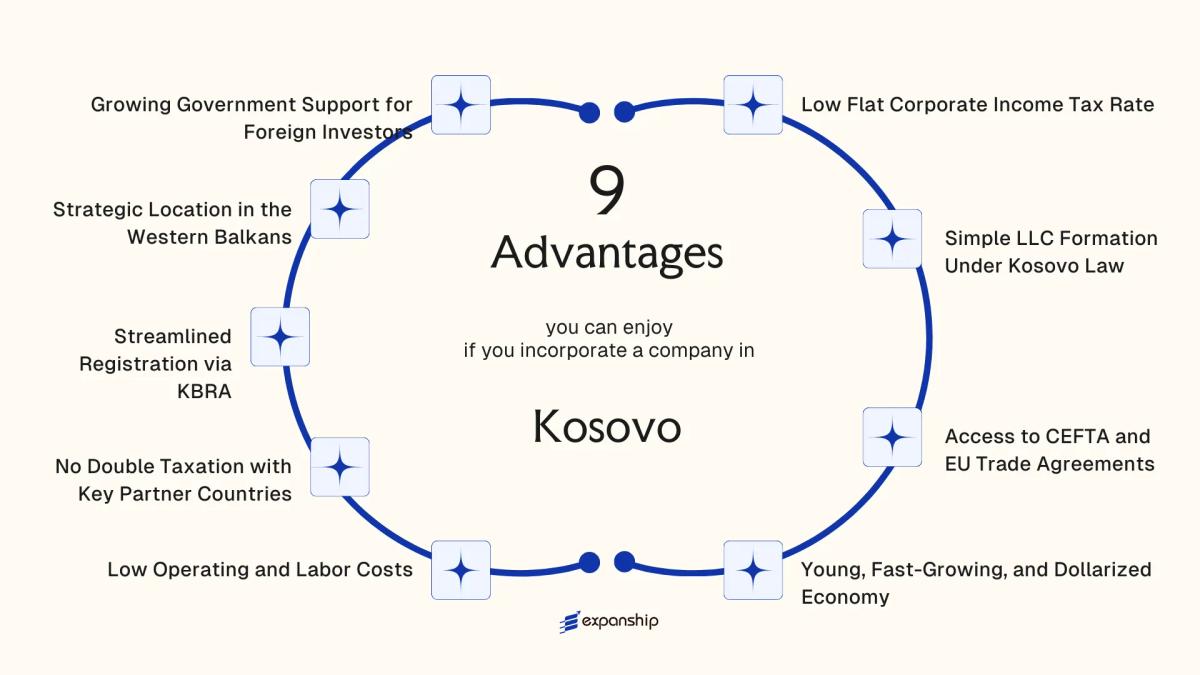
The benefits of incorporating in Kosovo span taxation, cost structure, trade access, and regulatory efficiency. This article examines those advantages in detail, drawing on the applicable legal framework and the conditions that define Kosovo company formation today.
Low Flat Corporate Income Tax Rate
Kosovo applies a flat corporate income tax rate of 10%, one of the lowest statutory rates in Europe. For foreign investors calculating after-tax returns, this single rate eliminates the uncertainty of progressive brackets entirely.
What the Rate Structure Means in Practice
Under the Law on Corporate Income Tax (Law No. 05/L-029), this 10% Kosovo flat corporate income tax rate applies uniformly to net taxable profit, regardless of the size or sector of the business. The EU average corporate tax rate sits above 21%, meaning your firm retains a significantly larger share of earnings operating from Pristina than from most European capitals.
Small taxpayers with annual turnover below a defined threshold may instead be subject to a presumptive tax regime, so verifying which regime applies to your specific entity structure is necessary before filing.
Why a Flat Rate Reduces Planning Complexity
A single rate removes the need for income-splitting strategies common in progressive tax systems. For a foreign-owned Kosovo business, this translates directly into lower compliance costs and more predictable tax modeling year over year.
A flat 10% rate lets you forecast net profit with a fixed tax variable, simplifying financial projections across multi-year investment plans.
Simple LLC Formation Under Kosovo Law
Forming a Shoqëri me Përgjegjësi të Kufizuar, commonly designated as SH.PK, requires a low minimum share capital of just €1 under the Law on Business Organizations. That threshold effectively removes financial barriers to entry for foreign entrepreneurs who would otherwise face capital lock-up requirements in comparable EU jurisdictions. Your liability as a shareholder is capped at the value of your contribution, which separates personal assets from business exposure from day one.
Registration is conducted through the Kosovo Business Registration Agency (KBRA), which operates a centralized online platform. A foreign national can hold 100% ownership of a SH.PK without a local partner requirement. That full foreign ownership provision is a direct structural advantage over jurisdictions that mandate joint venture arrangements or minimum domestic shareholding.
The SH.PK formation requirements are minimal by regional standards for several interconnected reasons:
- No minimum number of employees is required at the point of incorporation
- A single shareholder is sufficient to establish the entity
- No audited financial history or proof of prior business activity is required from the applicant
- The articles of association follow a standardized format, reducing the need for bespoke legal drafting
Once incorporated, the entity can open a local bank account and begin commercial activity without a separate operational license for most business categories.

Incorporate a Company in Kosovo
Register your SH.PK in Kosovo through KBRA with full foreign ownership and a €1 minimum share capital requirement.
Access to CEFTA and EU Trade Agreements
Kosovo's membership in the Central European Free Trade Agreement gives companies registered there preferential access to markets across Albania, Bosnia and Herzegovina, Moldova, Montenegro, North Macedonia, and Serbia. For a foreign business owner, this means goods produced or value-added within a Kosovo-registered entity can move across these borders under reduced or zero tariffs, without requiring separate trade arrangements in each country.
The EU dimension adds further reach. Under the Stabilisation and Association Agreement (SAA) between Kosovo and the European Union, which entered into force in April 2016, your business can export a broad range of goods to EU member states under preferential tariff conditions. The SAA also creates obligations that have progressively aligned Kosovo's trade and regulatory environment with EU standards, which reduces friction for businesses already operating within European supply chains.
| Agreement | Parties Covered | Primary Benefit for Registered Companies |
|---|---|---|
| CEFTA | 6 Western Balkans economies | Preferential tariff rates on intra-regional trade |
| SAA with EU | 27 EU member states | Preferential export access and regulatory alignment |
Access under the SAA is not unconditional. Rules of origin requirements apply, meaning goods must meet specific local content thresholds to qualify for preferential treatment. For businesses sourcing materials regionally or manufacturing within the entity, meeting these thresholds is structurally achievable and directly tied to where your company is incorporated.
Young, Fast-Growing, and Dollarized Economy
Kosovo's GDP growth has consistently outpaced the broader Western Balkans average over the past decade. The economy is one of the youngest in Europe by demographic profile, with over half the population under 30 — a structural feature that sustains long-term consumption growth and an expanding domestic workforce.
The country operates on the euro as its official currency despite not being an EU member state. This euroization, formalized through the Law on the Central Bank of Kosovo, eliminates currency conversion costs for firms billing European clients and removes exchange rate exposure entirely. For a foreign-owned entity receiving euro revenues, this is a meaningful operational advantage that most non-EU jurisdictions cannot replicate.
Remittance inflows from the diaspora, primarily from Germany, Switzerland, and Austria, consistently inject capital into household spending. This makes the fast-growing market less dependent on domestic public investment cycles.
Keep these points in mind:
- The euro is legal tender; no hedging instruments are required for EUR-denominated contracts
- Diaspora remittances provide a relatively stable consumer demand base independent of fiscal policy
- Kosovo's official statistics are published by the Kosovo Agency of Statistics (ASK), the primary reference for GDP and growth data
- Demographic youth skews toward a digitally active consumer segment, relevant to e-commerce and tech-oriented businesses
Kosovo adopted the euro unilaterally without a formal monetary agreement with the European Central Bank, making it one of the few economies globally to euroize outside any official currency union framework.
Low Operating and Labor Costs
Kosovo low labor costs for businesses represent one of the more concrete financial advantages available in the Western Balkans. Average gross wages remain among the lowest in the region, with monthly figures for general administrative and operational roles sitting well below those in neighboring North Macedonia or Serbia, let alone EU member states. For a foreign firm establishing a local subsidiary or operational team, this translates directly into a lower monthly payroll burden from day one.
Wage Levels and What They Mean for Your Payroll
Employment in Kosovo is governed by Law No. 03/L-212 on Labor, which sets out minimum wage thresholds, working hours, and termination procedures. The statutory minimum wage applies uniformly, and because overall wage expectations across most sectors remain modest, businesses can staff mid-level functions at costs that would be considered entry-level in Western European markets. This gap in compensation benchmarks allows foreign firms to hire local talent without the salary inflation common in more mature economies.
Office and Infrastructure Overhead
Commercial rental rates in Pristina, the primary business center, remain affordable by regional standards. General operating expenses, including utilities and basic office infrastructure, reflect a cost base still shaped by a developing urban economy. Your fixed overhead as a share of revenue is therefore structurally lower than in comparable EU-adjacent markets, which matters particularly for service-oriented entities where staffing and premises account for the bulk of operating expenditure.
Plan Your Kosovo Setup to Maximize Cost Advantages
Get tailored advice on structuring your Kosovo entity to take full advantage of the country's low labor and operating cost environment.
No Double Taxation with Key Partner Countries
Kosovo has signed double taxation treaties with a number of countries, and these agreements directly reduce the tax burden on cross-border income flows for foreign-owned entities registered there. Kosovo double taxation treaty benefits apply to dividends, interest, royalties, and capital gains under each bilateral agreement, meaning the same income is not taxed twice across two jurisdictions.
- Treaty partners include Albania, Austria, Belgium, Finland, Germany, Hungary, the Netherlands, Switzerland, Turkey, and the United Kingdom, among others. Each agreement assigns or limits taxing rights, which determines where and at what rate specific income is liable.
- For a foreign investor repatriating dividends or royalties to a treaty country, the withholding tax rate applied at source is typically reduced below the standard domestic rate, preserving a greater share of returns.
- Under Kosovo's domestic tax legislation, the standard withholding tax on dividends paid to non-residents is 10%. Applicable treaties can reduce or eliminate this rate depending on the specific agreement, creating a measurable cost difference for qualifying shareholders.
- Treaty protection also provides legal certainty. Disputes over taxing rights are resolved through defined procedures under each agreement, reducing exposure to conflicting tax claims from two administrations simultaneously.
Eligibility for treaty benefits generally requires that the recipient entity or individual qualifies as a tax resident of the partner country under that treaty's residency provisions.
Streamlined Registration via KBRA
The Kosovo Business Registration Agency (KBRA) operates a single-window registration system that allows a new business entity to be formally incorporated in as little as one business day. For a foreign investor, this eliminates the prolonged administrative timelines common in many European markets, where multi-agency filing requirements can extend the process by weeks.
Registration is conducted under the Law on Business Organizations, and the KBRA's online portal accepts electronic submissions, reducing the need for in-person appearance. Your firm receives a unique business identification number upon registration, which is simultaneously recognized across tax and customs authorities.
The practical consequence is reduced setup cost. Shorter registration windows mean less time spent on legal fees, notarization, and local representation before your company can begin operating.
A foreign-owned LLC incorporated through the KBRA portal can be fully registered and issued a fiscal number within 24 to 48 hours of submission, compared to an EU average of approximately 9 to 12 days for equivalent procedures, according to World Bank Doing Business benchmarking data for the region.
One condition applies: documents originating outside Kosovo generally require apostille certification or certified translation before the KBRA will process them.
Strategic Location in the Western Balkans
Kosovo's strategic location in the Western Balkans places your business within a few hours' road or air distance of major Southeast European markets, including Serbia, North Macedonia, Albania, and Montenegro. For companies that need physical proximity to multiple markets without the overhead of establishing separate entities across the region, this geographic position is a practical operational advantage.
Pristina's position near the center of the Balkan Peninsula means freight and logistics routes connect northward toward Central Europe and southward toward Greece and Turkey. This matters most for businesses in distribution, manufacturing, or regional services, where transit times and transport costs directly affect margins.
The Western Balkans region as a whole is undergoing gradual alignment with EU regulatory standards, and Kosovo's location within this corridor means your business operates inside a regional bloc that shares trade frameworks through CEFTA. Physical presence in the country gives companies a natural foothold for expansion into neighboring jurisdictions that operate under similar commercial rules.
- Road corridors connect to major Balkan transit routes, including Route 7 and Route 6 under the Trans-European Transport Network extension plans.
- Pristina International Airport offers direct connections to major European hubs.
Actual logistics benefits depend on your specific trade routes and product categories, so verify applicable customs procedures under CEFTA before assuming frictionless regional movement.
Growing Government Support for Foreign Investors
Kosovo government incentives for foreign investors are administered through a coordinated institutional framework rather than a single statute, with the Investment and Enterprise Support Agency of Kosovo (ASKI) serving as the primary body responsible for facilitating inward investment.
Dedicated Institutional Support
ASKI functions as a one-stop point of contact for foreign entities seeking to establish operations, connecting investors with relevant government ministries and resolving administrative bottlenecks. This reduces the time your business spends navigating inter-agency coordination, which in smaller or less-organized jurisdictions can extend the pre-operational period significantly.
Special Economic Zones
The government has designated Special Economic Zones (SEZs), including the zone in Prizren, where qualifying businesses may access preferential treatment on customs duties and other fiscal benefits. Manufacturing and export-oriented firms stand to benefit most directly, as SEZ eligibility is generally tied to the nature of business activity and minimum investment thresholds.
Investment Protection Framework
Kosovo is a signatory to multiple Bilateral Investment Treaties (BITs), which provide foreign investors with protections against expropriation, guarantee fair and equitable treatment, and allow for international arbitration in the event of disputes. These treaties reduce the legal risk exposure that typically accompanies early-stage foreign direct investment in developing markets.
Sector-Specific Incentive Programs
- Agriculture and agro-processing firms may access grant co-financing through the IPARD-equivalent support programs administered under EU pre-accession assistance
- Technology sector businesses can access support through Kosovo's initiatives aligned with the Western Balkans Digital Agenda
- Export-oriented enterprises may qualify for promotion support through ASKI's trade facilitation programs
Why Kosovo Stands Out Among Regional Incorporation Hubs
The three jurisdictions chosen for comparison are Serbia, North Macedonia, and Albania. All four countries are Western Balkans economies competing for similar inward investment, they share overlapping trade frameworks, and a foreign investor evaluating one will typically evaluate the others. The comparison focuses on structural parameters where Kosovo vs Balkans incorporation advantages are most apparent: tax rates, minimum capital requirements, and registration infrastructure.
What the table cannot convey is the combination effect. A 10% flat corporate tax rate paired with zero minimum share capital under the Law on Business Organizations, registration through a single agency (KBRA), and euro-denominated transactions creates a measurably lower cost of entry and compliance overhead than most regional alternatives. Kosovo competitive advantages over Balkans rivals are less about any single factor and more about how these features operate together without the additional procedural layers found elsewhere in the region.
| Parameter | Kosovo | Serbia | North Macedonia | Albania |
|---|---|---|---|---|
| Corporate Income Tax Rate | 10% flat | 15% | 10% | 15% |
| Minimum Share Capital (LLC) | None | None | None | None |
| Functional Currency | Euro (EUR) | Serbian Dinar (RSD) | Macedonian Denar (MKD) | Albanian Lek (ALL) |
| Company Registration Body | KBRA | APR | CRARM | QKR |
| CEFTA Membership | Yes | Yes | Yes | Yes |
| SAA with EU | Yes (2016) | Yes (2013) | Yes (2004) | Yes (2009) |
Compliance Services for Companies in Kosovo
Maintain your Kosovo entity's good standing with ongoing compliance support, from annual reporting obligations to regulatory filings with KBRA and tax authority requirements.
Conclusion
Kosovo's position as a viable incorporation destination rests on a combination of structural features that are rare to find together in one market. A flat 10% corporate income tax rate, single-shareholder LLC eligibility under the Law on Business Organizations, and registration processed through the Kosovo Business Registration Agency create a formation environment with minimal bureaucratic friction. For a foreign business owner, that combination shortens the path from decision to operational entity considerably.
The benefits of incorporating in Kosovo are strongest for businesses whose activities align with the country's existing trade architecture. Access to CEFTA and the SAA with the European Union connects a Kosovo-registered entity to preferential trade channels that would otherwise require separate market entry strategies. Operating costs, including labor, remain among the lowest in the region, which directly affects margin on locally delivered services or goods.
Whether a specific business structure makes full use of these advantages depends on the nature of your operations, the countries you trade with, and how your group is structured for tax purposes. A holding entity, an operational subsidiary, and a service company each interact differently with Kosovo company formation advantages. The Kosovo context suits certain business profiles more than others, and identifying that fit requires a clear-eyed assessment of your commercial and compliance needs. That assessment is the logical starting point for any formation process.
Start Your Kosovo Company with Expanship Today
Incorporating in Kosovo involves specific procedural requirements under the Law on Business Organizations, and Expanship manages that process directly with the Kosovo Business Registration Agency (KBRA). From preparing the founding act for a Private Limited Company (Sh.p.k.) to meeting the minimum capital requirement and ensuring your entity meets ongoing compliance obligations under Kosovo tax and corporate law, Expanship coordinates each stage so your business is properly constituted from the outset.
Expanship's service scope for Kosovo company formation covers the following:
- Preparation and legalization of incorporation documents, including the founding act and articles of association
- Registered agent and registered office address provision within Kosovo
- Filing coordination and direct liaison with the KBRA on your behalf
- Post-incorporation compliance management, including annual returns and tax registration with the Tax Administration of Kosovo (TAK)
- Banking introduction assistance to support your corporate account opening process
- Ongoing registered office maintenance and correspondence handling
For foreign business owners who want to access CEFTA trade channels, benefit from the 10% flat corporate tax rate, or establish a presence in a euro-denominated economy without unnecessary administrative delay, Expanship Kosovo provides structured support at each stage of the process.
Frequently Asked Questions (FAQ)
Yes, foreign nationals may own 100% of a Kosovo-registered entity without requiring a local shareholder or partner. The Law on Business Organizations permits full foreign ownership of a limited liability company (SH.P.K.), and there is no mandatory joint-venture structure for most sectors. Certain regulated industries may carry sector-specific ownership restrictions, so verifying requirements under the relevant licensing authority is advisable before registration.
Kosovo applies a flat corporate income tax rate of 10% on taxable profit. This rate applies uniformly to resident companies on their worldwide income and to non-resident entities on Kosovo-sourced income. Small businesses with annual turnover below a defined threshold may qualify for a presumptive tax regime at a lower effective rate under the Law on Tax Administration and Procedures.
Registration through the Kosovo Business Registration Agency (KBRA) can typically be completed within one to three business days for a standard limited liability company. The process is handled through KBRA's online portal, and the firm receives a unique business identification number upon approval. Delays may occur if submitted documentation is incomplete or if the chosen business name conflicts with an existing registration.
Kosovo has signed double taxation agreements with a number of countries, including several EU member states and regional partners, which reduce or eliminate withholding taxes on dividends, interest, and royalties paid across borders. The specific rates and conditions depend on the treaty in force with the investor's home country. Where no treaty exists, domestic law governs the tax treatment of cross-border payments.
Kosovo's participation in the Central European Free Trade Agreement (CEFTA) is legally operative and provides preferential tariff treatment on goods traded among signatory parties, which include several Western Balkan economies. This means a company incorporated in Kosovo can export to CEFTA member markets with reduced or zero customs duties on qualifying products. The agreement does not automatically cover services or investment protections, which are governed separately under bilateral arrangements.
Physical presence is not strictly required if registration is completed through an authorized representative holding a notarized power of attorney. The KBRA online registration system allows documentation to be submitted remotely, though certain notarization and apostille requirements for foreign-origin documents must still be satisfied. The specific requirements depend on the nationality of the applicant and the type of documentation being submitted.
The Law on Business Organizations does not impose a significant minimum share capital requirement for forming a limited liability company (SH.P.K.) in Kosovo, making initial capitalization accessible for small and medium-sized businesses. The founding capital must be stated in the incorporation documents and registered with KBRA, but there is no mandatory paid-up threshold comparable to those found in some EU jurisdictions. Founders should nonetheless ensure the declared capital is consistent with the intended scope of business activity.
Legal Disclaimer
The information provided in this article is for general informational purposes only and does not constitute legal, tax, or professional advice. While we strive to ensure the accuracy and timeliness of the content, laws and regulations are subject to change, and the application of laws can vary widely based on specific facts and circumstances.
Readers should not act upon this information without seeking professional counsel tailored to their individual situation. Expanship and its authors disclaim any liability for actions taken or not taken based on the content of this article.
For specific advice regarding your business setup, compliance requirements, or any legal matters, please consult with qualified legal and tax professionals in the relevant jurisdiction.