

Key Takeaways
- Foreign investors operating in Pakistan must navigate SECP registration and ongoing compliance obligations under the Companies Act 2017, a framework that imposes procedural requirements more demanding than many comparable emerging markets.
- Profit repatriation requires State Bank of Pakistan approval, adding a regulatory layer that delays and conditions the transfer of foreign-held earnings out of the country.
- Pakistan's corporate tax burden, combined with an extensive withholding tax regime applied across payments, dividends, and services, increases the effective cost of doing business beyond the headline rate.
- Sectors including media, agriculture, and certain financial services carry foreign ownership restrictions that structurally limit the equity control available to international investors.
Pakistan operates under an evolving but heavily regulated corporate framework, where the Securities and Exchange Commission of Pakistan (SECP) serves as the primary authority governing company formation and ongoing compliance under the Companies Act 2017. The disadvantages of incorporating in Pakistan span regulatory, financial, and operational categories, each carrying distinct implications for foreign-owned entities.
How significantly these drawbacks affect your business depends on the sector you enter, the ownership structure you adopt, and the scale of your planned operations. A manufacturing firm faces different constraints than a services company or a branch office.
This article is most relevant to foreign investors and internationally incorporated businesses considering a direct presence in Pakistan through a private limited company or wholly foreign-owned entity.
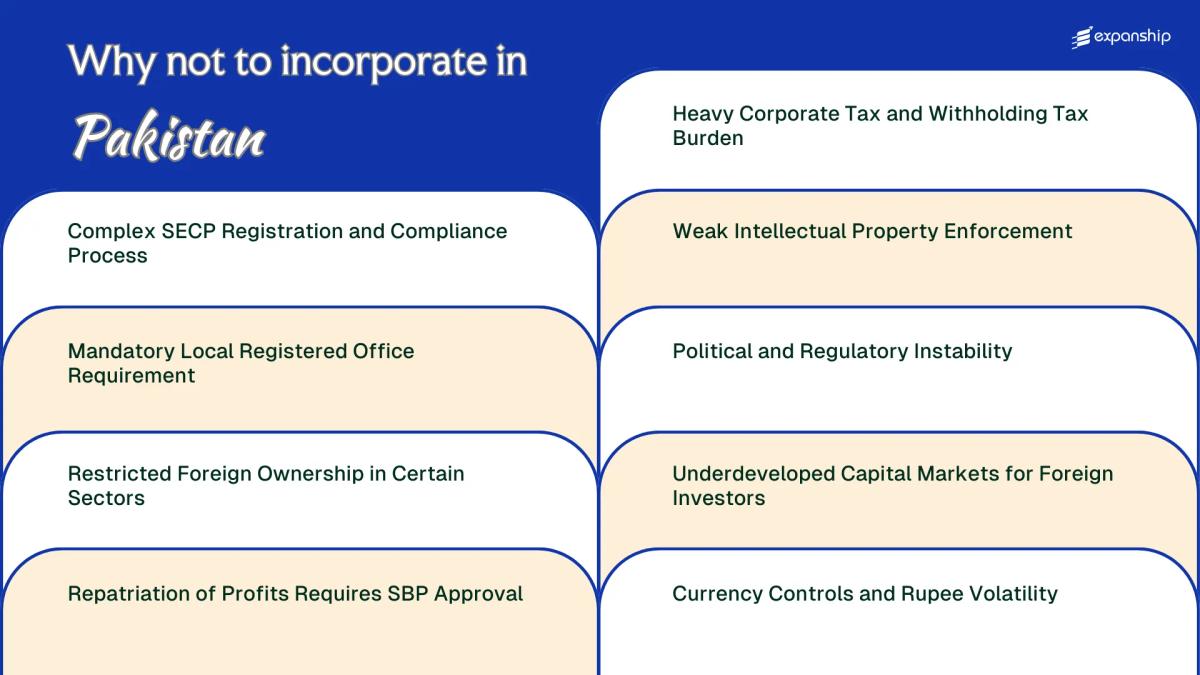
Complex SECP Registration and Compliance Process
SECP registration challenges Pakistan are more procedurally demanding than in many comparable emerging markets, creating real friction for foreign principals who are not embedded in the local regulatory system.
Registration Timelines and Document Burdens
Incorporating under the Companies Act, 2017 requires submissions to the Securities and Exchange Commission of Pakistan through its e-Services portal, but foreign directors must supply notarized and apostilled identity documents, which adds weeks to a process that is nominally digital. Each document discrepancy triggers a formal objection, restarting review cycles and extending your timeline unpredictably.
Post-registration, the firm must file annual returns, audited accounts, and director disclosures with SECP on fixed statutory deadlines, and late submissions attract per-day penalties under Section 478 of the Companies Act.
Ongoing Compliance Costs
A foreign-owned entity typically requires a local company secretary familiar with SECP filing requirements to avoid procedural defaults, which is a recurring operational cost with no equivalent in single-window jurisdictions. Exemptions from certain filings exist for small companies, but foreign-controlled entities rarely qualify given paid-up capital thresholds.
Foreign directors without a local compliance representative face compounding penalty exposure under SECP enforcement, as objections and missed deadlines are not automatically communicated outside the portal.
Mandatory Local Registered Office Requirement
Every company incorporated under the Companies Act, 2017 must maintain a registered office address within Pakistan from the date of incorporation. This address must be formally notified to the Securities and Exchange Commission of Pakistan (SECP) and kept current at all times — any change requires filing Form 21 within the prescribed timeline.
For a foreign business owner without a physical presence in the country, satisfying this requirement means incurring costs before operations even begin.
- Securing a compliant registered address forces you to contract with a local service provider or lease physical space, adding recurring overhead with no direct operational value.
- If your registered address changes and Form 21 is not filed in time, your firm becomes exposed to penalties under the Companies Act, 2017, even if the underlying business is otherwise compliant.
- Regulatory correspondence from SECP and tax authorities is directed to the registered office, so a non-functional or unmonitored address can cause your entity to miss critical notices.
Branch offices of foreign companies face the same obligation. There is no provision for a virtual-only or foreign address to satisfy this requirement.

Company Incorporation in Pakistan
Set up your Pakistan entity with registered office compliance handled from the start.
Restricted Foreign Ownership in Certain Sectors
Foreign ownership restrictions across Pakistan sectors represent one of the more tangible barriers foreign investors encounter when structuring an entry into the market. Under the Board of Investment's policy framework, most industries permit 100% foreign equity, but several sectors impose hard caps that force you to take on a local partner regardless of your preference.
Media and broadcasting is capped at 25% foreign equity. Agriculture-related businesses involving land ownership are effectively closed to foreign nationals under provincial land laws. Private security companies are restricted to a maximum of 51% foreign ownership, and certain defence-related industries are entirely off-limits.
| Sector | Foreign Equity Cap | Practical Implication |
|---|---|---|
| Electronic Media / Broadcasting | 25% | Majority control permanently held by Pakistani nationals |
| Private Security Services | 51% max | Minority stake not possible without local partner holding majority |
| Agricultural Land Ownership | Prohibited for foreign nationals | No direct land acquisition under provincial land laws |
| Defence / Strategic Industries | 0% (fully restricted) | No foreign participation permitted |
The equity cap problem compounds when you factor in partner dependency. Holding a minority stake means your local partner retains decision-making power over distributions, governance, and exit terms. There is no general statutory framework under the Companies Act 2017 that compels equal shareholder protections in privately negotiated joint ventures, leaving minority foreign shareholders exposed when disputes arise.
Repatriation of Profits Requires SBP Approval
Profit repatriation risks Pakistan SBP oversight creates represent a structural friction that most foreign investors underestimate before entering the market. Under the Foreign Exchange Regulation Act and the State Bank of Pakistan's (SBP) directives, foreign investors must obtain SBP approval before remitting dividends, profits, or capital gains abroad.
This is not a formality. Processing times can extend for weeks, and delays directly affect your ability to return earnings to parent companies or shareholders on any predictable schedule.
Remittances must be routed through authorized dealers, and the supporting documentation requirements — audited accounts, tax clearance certificates, and board resolutions — are extensive. Any gap in documentation triggers rejection or additional rounds of review.
Your business cannot initiate a dividend remittance without first demonstrating that all applicable withholding taxes have been settled. This creates a sequential dependency that adds both time and cost before any funds leave the country.
- SBP approval is mandatory before any foreign profit remittance is processed
- Authorized dealer banks must intermediate all outward remittances
- Tax clearance from FBR must be obtained prior to repatriation
- Audited financial statements are required as supporting documentation
- Repatriation timelines are subject to SBP's internal review schedules, which are not fixed
The SBP's FX regulations governing outward remittances outline the full scope of conditions that apply to dividend transfers.
Did You Know? Even fully foreign-owned companies incorporated under SECP with unrestricted ownership structures are still subject to the same SBP repatriation approval process as locally controlled firms.
Heavy Corporate Tax and Withholding Tax Burden
Pakistan's corporate tax burden drawbacks extend beyond a single headline rate. The combination of statutory corporate tax, a tiered withholding tax regime, and minimum tax provisions creates layered cost exposure that compounds for foreign-owned entities.
Statutory Rates and Minimum Tax Exposure
Under the Income Tax Ordinance, 2001, the standard corporate tax rate for companies is 29%, with banking companies taxed at 39%. A minimum tax under Section 113 applies on gross turnover even when a business reports a loss, meaning your firm owes tax regardless of profitability.
Withholding Tax as a Structural Cash Flow Problem
Withholding tax problems Pakistan companies face are not incidental — over 50 withholding tax codes exist under the Ordinance, applying to payments including dividends, royalties, service fees, and imports. For a foreign business, this creates persistent cash flow friction, since withheld amounts are deducted upfront and recovery through the refund mechanism administered by the Federal Board of Revenue is slow and procedurally demanding.
A foreign parent receiving dividends from a Pakistani subsidiary faces an additional 15% withholding on distributions, a charge that sits on top of the corporate-level tax already paid on underlying profits.
Addressing Pakistan's Tax Burden Before You Incorporate
Understand how Pakistan's corporate and withholding tax structure affects your specific business model before committing to incorporation.
Weak Intellectual Property Enforcement
Intellectual property risks in Pakistan are significant for foreign businesses, particularly those operating in technology, pharmaceuticals, media, or branded consumer goods. Enforcement gaps under the Trade Marks Ordinance 2001 and the Copyright Ordinance 1962 leave rights holders with limited practical recourse even when registrations are in place.
- The Intellectual Property Organization of Pakistan (IPO-Pakistan) handles registration, but limited judicial capacity means infringement cases can take years to resolve, exposing your brand to sustained commercial damage.
- Counterfeit goods and trademark squatting are documented problems, and the burden of pursuing civil remedies falls almost entirely on the rights holder.
- Criminal enforcement provisions exist under the Trade Marks Ordinance 2001, but weak IP enforcement in Pakistan means prosecutors rarely prioritize IP cases, reducing their deterrent effect.
- Border enforcement against infringing imports remains inconsistent, so your firm cannot reliably prevent counterfeit versions of its products from entering the market.
- Provisional protection during trademark examination offers limited coverage, creating a window of vulnerability between application and registration.
Political and Regulatory Instability
Political instability risks Pakistan business operations in ways that go beyond short-term uncertainty. Since 2022, the country has experienced successive government changes, military-judicial tensions, and constitutional crises that have directly disrupted legislative continuity and investor confidence.
Policy reversals are a structural problem, not an episodic one. Tax exemptions granted under one administration have been withdrawn by the next, leaving foreign firms with planning assumptions that no longer hold. Your investment thesis can shift materially between incorporation and the date your entity becomes operational.
Regulatory agencies compound this exposure. Bodies such as the Board of Investment and sector-specific regulators have issued contradictory directives during periods of political transition, creating compliance gaps that expose foreign entities to liability through no fault of their own.
- Frequent amendments to the Income Tax Ordinance 2001 have altered withholding tax schedules mid-fiscal year
- Policy instability foreign investors face is amplified by SRO-based regulatory changes, which bypass standard parliamentary scrutiny
- Federal and provincial jurisdictions regularly overlap, producing conflicting obligations for businesses operating across more than one province
Pakistan ranked 108th out of 190 economies in the World Bank's Doing Business 2020 report, with "protecting minority investors" and "enforcing contracts" among its lowest-scoring indicators — both directly influenced by institutional and regulatory inconsistency.
Underdeveloped Capital Markets for Foreign Investors
Pakistan capital market limitations for foreign investors are a structural reality, not a temporary gap. The Pakistan Stock Exchange (PSX) remains relatively thin by regional standards, with market capitalization well below comparable emerging markets such as Vietnam or Bangladesh. For a foreign firm seeking equity financing or a local listing, the shallow investor base translates directly into limited price discovery and poor exit liquidity.
Raising growth capital through public markets is genuinely constrained here. Domestic institutional participation is narrow, and retail investor depth does not compensate for the absence of large foreign portfolio flows.
Debt capital markets carry similar structural weaknesses. Corporate bond issuance is underdeveloped, so foreign entities incorporated locally cannot rely on bond markets as a realistic financing channel and are pushed toward bank credit, which carries its own concentration and collateral burdens.
The Securities and Exchange Commission of Pakistan (SECP) governs listed entities, but regulatory oversight alone cannot create market depth where underlying investor demand is insufficient. Your business cannot substitute regulatory compliance for the capital access that simply does not exist at scale in this market.
Foreign portfolio investors operating through the PSX are subject to repatriation rules linked to State Bank of Pakistan (SBP) approvals, meaning that even partial capital recovery can be delayed by external account conditions entirely outside your control.
Currency Controls and Rupee Volatility
Pakistan currency controls business risks are a direct structural concern for any foreign entity holding assets or earnings in PKR. The State Bank of Pakistan (SBP) governs all foreign exchange transactions under the Foreign Exchange Regulation Act (FERA) 1947, and outward transfers require prior SBP authorization in many cases.
PKR depreciation has been severe and sustained. The rupee lost roughly 50% of its value against the USD between 2021 and 2023 alone, meaning foreign investors holding local earnings absorb significant real losses when converting back to their home currency.
Periodic dollar shortages have also led to de facto import payment freezes, where firms waited months to execute basic foreign currency transactions. Your operational cash flow becomes directly exposed to monetary policy decisions that foreign businesses have no ability to anticipate or control.
Exporters and IT firms registered under special SBP schemes face somewhat different repatriation conditions, but most incorporated entities operate under the standard restrictive framework.
Strategies to Overcome These Obstacles
Overcoming Pakistan incorporation obstacles requires a structured approach built around regulatory sequencing and instrument selection, not workarounds. The challenges covered in this blog — from SECP compliance to SBP profit repatriation approvals — each have defined procedural responses within the existing legal framework.
- Register your entity through the SECP portal and confirm sector classification early to identify foreign ownership restrictions under the relevant sector-specific policy framework.
- Appoint a locally resident director or nominee to satisfy the registered office and local presence requirements under the Companies Act, 2017.
- Structure inward investment as foreign direct investment and obtain a Unique Identification Number from SBP to establish a documented repatriation record from the outset.
- File for tax registration with the Federal Board of Revenue and assess applicable withholding tax exposures under the Income Tax Ordinance, 2001 before committing to a corporate structure.
- Register trademarks and patents with the Intellectual Property Organization of Pakistan before commercial operations begin, given the enforcement gaps documented in this blog.
- Monitor REER fluctuations through SBP data and consider contractual USD-denomination clauses where permitted to reduce rupee volatility exposure.
These steps operate within a regulatory environment that continues to undergo reform, with periodic amendments to both the Companies Act and the Foreign Exchange Regulation Act affecting procedural requirements. Compliance timelines and approval thresholds can shift without extended notice, so maintaining current awareness of official SECP and SBP circulars is a practical necessity.
Pakistan's Overall Investment Potential
Pakistan's investment potential despite drawbacks is real, but unevenly distributed. The country's large consumer base, young workforce, and strategic geographic position between South Asia, Central Asia, and the Middle East create conditions that some foreign businesses find worth pursuing. The disadvantages covered in this blog are material, not marginal, and any decision to incorporate should weigh them against what the market actually offers your specific operation.
| Pros | Cons |
|---|---|
| Population of over 220 million provides a sizable domestic consumer market. | SECP registration involves multi-step procedural requirements that extend setup timelines. |
| No blanket restriction on 100% foreign equity in most sectors outside the restricted list. | Certain sectors cap or prohibit foreign ownership under the Investment Policy and sector-specific regulations. |
| Pakistan borders China, India, Iran, and Afghanistan, giving it transit and trade corridor value. | State Bank of Pakistan approval requirements create friction for profit repatriation. |
| Corporate tax rates align with regional peers in many respects. | Withholding tax obligations across multiple transaction types increase the administrative compliance burden. |
| Special Economic Zones offer tax incentives under the SEZ Act 2012. | Rupee volatility and currency controls expose foreign investors to unpredictable exchange rate risk. |
| The legal framework draws from common law traditions, providing some structural familiarity. | Intellectual property enforcement through FIA and the court system remains inconsistent in practice. |
Political and regulatory conditions have shifted repeatedly across administrations, and that pattern affects long-term planning. Capital markets remain shallow relative to peer economies, limiting exit options for foreign equity holders.
Corporate Compliance Services in Pakistan
Stay aligned with SECP filing requirements, annual return obligations, and ongoing regulatory duties for your Pakistan-registered entity.
Conclusion
The cons of Pakistan company registration are concentrated in a few structural areas that foreign investors must account for before committing capital. SBP approval requirements for profit repatriation and the persistent volatility of the Pakistani rupee create real capital risk. Tax exposure through corporate rates and withholding obligations adds further friction. Structural reforms under SECP and the broader regulatory framework remain works in progress. For businesses where market access justifies these constraints, qualified local legal and corporate advisory support becomes a practical necessity rather than an optional expense.
Expanship's Pakistan Expansion Services
From managing SECP registration requirements to maintaining SBP compliance for profit repatriation, Pakistan company formation services from Expanship are structured around the specific regulatory pressures this jurisdiction places on foreign-owned entities. Expanship works alongside your business to reduce the administrative burden these obligations create, particularly across corporate filings, sector-specific restrictions, and ongoing tax compliance under the Federal Board of Revenue.
Beyond incorporation, Expanship supports the full operational setup of your entity in Pakistan.
- Company registration is handled with full document preparation tailored to SECP requirements.
- A registered agent and local office address are provided to satisfy the mandatory presence requirement.
- Government filings and direct liaison with regulatory bodies are managed on your behalf.
- Post-incorporation compliance obligations are tracked and maintained on a continuing basis.
- Banking introduction assistance is available to support your account-opening process.
- Tax registration and coordination with the Federal Board of Revenue are handled as part of setup.
Contact Expanship Pakistan to discuss how your business can be structured for the Pakistani market.
Frequently Asked Questions (FAQ)
Restricted ownership applies to specific sectors rather than all industries, but those sectors are significant enough to affect a wide range of foreign investors. Telecommunications, media, defence-related manufacturing, and certain financial services all carry ownership caps or require prior government approval. Before registering, your legal counsel should cross-reference the Foreign Private Investment (Promotion and Protection) Act 1976 and the relevant sector-specific regulatory framework to confirm your industry's treatment.
Transferring profits abroad without State Bank of Pakistan authorisation violates foreign exchange regulations under the Foreign Exchange Regulation Act, and the transaction can be blocked or reversed. The firm may also face penalties and scrutiny from the SBP's Exchange Policy Department. Even routine dividend repatriation requires documentary compliance, including audited accounts and a tax clearance certificate, making ad-hoc transfers impractical.
Withholding tax in Pakistan operates across a wide range of transactions, including payments to non-residents for services, royalties, and dividends, with rates that can reach 20% or more depending on the transaction type and whether a tax treaty applies. For businesses without a Double Taxation Agreement between Pakistan and their home jurisdiction, the effective tax burden can significantly erode margins. The Income Tax Ordinance 2001 governs these deductions, and non-compliance by the withholding agent triggers its own penalties.
Pakistan's rupee has experienced sharper and more frequent devaluations than many regional peers, driven by recurring balance-of-payments crises and IMF programme conditions. Between 2022 and 2023 alone, the rupee lost over 40% of its value against the US dollar, directly reducing the dollar-equivalent value of retained earnings and assets held in-country. For businesses that price in rupees but have costs or obligations denominated in foreign currency, this exposure is a structural risk rather than a temporary one.
Trademark and patent registration through the Intellectual Property Organization of Pakistan (IPO-Pakistan) is possible, but enforcement through the courts is slow and inconsistent. Civil IP litigation can take years to resolve, and border enforcement against counterfeit goods is limited outside of major commercial hubs. For businesses whose core value sits in proprietary technology, branding, or content, Pakistan's enforcement environment creates a genuine commercial risk that registration alone does not mitigate.
Yes, policy reversals and regulatory changes have historically affected operational companies, not just those at the incorporation stage. Amendments to the Special Economic Zones Act, shifts in the Board of Investment's incentive structures, and abrupt changes to import tariffs have altered the commercial conditions for active businesses. Foreign companies have limited recourse when regulatory changes reduce their previously agreed benefits, particularly outside of formal investment protection treaty frameworks.
Legal Disclaimer
The information provided in this article is for general informational purposes only and does not constitute legal, tax, or professional advice. While we strive to ensure the accuracy and timeliness of the content, laws and regulations are subject to change, and the application of laws can vary widely based on specific facts and circumstances.
Readers should not act upon this information without seeking professional counsel tailored to their individual situation. Expanship and its authors disclaim any liability for actions taken or not taken based on the content of this article.
For specific advice regarding your business setup, compliance requirements, or any legal matters, please consult with qualified legal and tax professionals in the relevant jurisdiction.