
Key Takeaways
- Pakistan's Special Economic Zones Act 2012 enables qualifying companies to access multi-year tax holidays, making SEZ-based manufacturing and export operations materially cheaper to run than equivalent setups in comparable South Asian markets.
- With over 220 million people and a working-age population exceeding 60 percent of the total, the domestic consumer base offers scale that few emerging markets in the region can match.
- The Companies Act 2017 and the Income Tax Ordinance 2001 together form a legal framework that permits full foreign ownership across a broad range of sectors while leaving meaningful room for structuring decisions that affect tax position and repatriation rights.
- Administered by the SECP, Pakistan's digital company registration process reduces the procedural burden on foreign entrants, lowering the time and cost typically associated with establishing a private limited company in a developing-market jurisdiction.
Incorporating a company in Pakistan positions your business within a sovereign republic of over 220 million people, strategically placed at the intersection of South Asia, Central Asia, and the Middle East. The SECP — the Securities and Exchange Commission of Pakistan — serves as the primary regulatory authority overseeing company registration and corporate compliance. Foreign businesses entering the market most commonly do so through a Private Limited Company.
Pakistan operates a territorial-leaning tax system with treaty-based elements, and the government has maintained a generally open posture toward foreign direct investment across most sectors, with full foreign ownership permitted in a broad range of industries under applicable regulations.
This article examines the principal advantages that make company formation here a consideration for businesses targeting regional growth, cost efficiency, or access to emerging market consumers. The framework governing these advantages draws from the Companies Act 2017, the Income Tax Ordinance 2001, and various sector-specific investment policies administered at both federal and provincial levels.
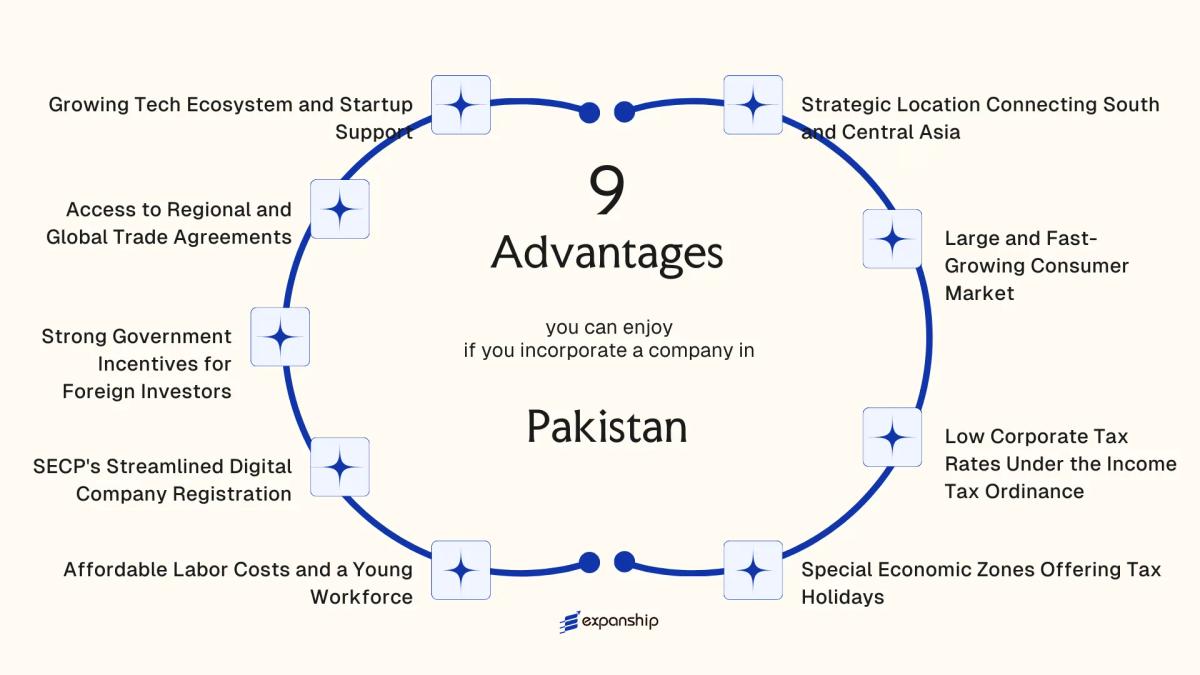
Strategic Location Connecting South and Central Asia
Pakistan's geographic position gives registered businesses direct physical and commercial access to two of the world's most populous regions simultaneously. That combination is the foundation of the Pakistan strategic location advantages for business that few other jurisdictions can replicate.
Gateway to Over 3 Billion Consumers
The China-Pakistan Economic Corridor (CPEC), a flagship component of China's Belt and Road Initiative, runs through Pakistani territory and connects Gwadar Port on the Arabian Sea to Xinjiang in western China. A company incorporated here can use that infrastructure to move goods between South Asian manufacturing centers and Central Asian markets without routing through multiple third-country customs regimes.
A Physical Trade Corridor With Commercial Infrastructure
Gwadar's deep-sea port gives your business access to sea lanes serving the Middle East, East Africa, and South Asia. Proximity to Afghanistan and the Central Asian republics means a Pakistan-registered trading or logistics firm can serve those markets with shorter supply chains than competitors based elsewhere in South Asia.
A company incorporated in Pakistan can position itself at the intersection of CPEC trade flows and regional overland routes without requiring a separate regional holding structure.
Large and Fast-Growing Consumer Market
With over 220 million people, Pakistan large consumer market for foreign businesses represents one of the most numerically significant sales environments in Asia. Urban centers such as Karachi, Lahore, and Islamabad concentrate substantial purchasing activity, and the growing middle class market opportunity extends into secondary cities where consumer spending on retail, food and beverage, and digital services has expanded steadily.
Median age in Pakistan sits below 23 years, which means a disproportionately large share of the population is entering its peak consumption years. For a foreign business, this demographic structure translates into long-duration market demand rather than a short-term sales window.
Formal market entry through a registered entity gives your business the legal standing to enter distribution agreements, hold local bank accounts, and invoice Pakistani buyers directly under the Companies Act 2017.
Several structural features make this consumer base accessible rather than theoretical:
- The State Bank of Pakistan permits profit repatriation for registered foreign entities, so revenue earned locally can be transferred abroad
- Consumer sectors including technology, e-commerce, and fast-moving goods operate under frameworks that do not restrict foreign ownership at the retail distribution level
- English is widely used in business and legal documentation, reducing transactional friction for foreign operators
- Urban internet penetration supports digital sales channels without requiring a physical retail presence from day one

Incorporate Your Company in Pakistan
Register a Pakistan-based legal entity and gain direct access to one of Asia's largest consumer markets under the Companies Act 2017.
Low Corporate Tax Rates Under the Income Tax Ordinance
Pakistan corporate tax rate advantages for businesses stem from a rate structure that is comparatively lower than many regional peers. Under the Income Tax Ordinance 2001, the standard corporate tax rate for companies is 29%. Small companies, defined under the Ordinance as entities meeting specific criteria including a paid-up capital and annual turnover ceiling, are taxed at a reduced rate of 20%. That distinction matters for early-stage foreign-owned firms: a structurally lower rate at formation keeps more capital inside the business during its growth phase.
| Entity Type | Applicable Tax Rate | Governing Instrument |
|---|---|---|
| Standard company | 29% | Income Tax Ordinance 2001 |
| Small company | 20% | Income Tax Ordinance 2001 |
| Banking company | 39% | Income Tax Ordinance 2001 |
Taxable income is calculated on a net basis, meaning allowable business deductions, including depreciation and operational expenses, reduce the amount subject to tax before the rate applies. For a foreign investor structuring operations carefully from the outset, this matters because the effective tax burden can fall meaningfully below the headline rate.
The Federal Board of Revenue administers corporate income tax and has digitized filing through its online portal, which reduces administrative overhead for entities without a large local presence. Tax year filings are based on a July-to-June fiscal year by default, though the Income Tax Ordinance 2001 permits an alternate tax year with prior approval, giving your business some flexibility in aligning local filings with your parent entity's reporting calendar.
Special Economic Zones Offering Tax Holidays
Pakistan Special Economic Zone tax holiday benefits are defined primarily by the SEZ Act 2012 and its subsequent amendments, which created a formal legal framework for zone-based investment. Under this regime, SEZ developer companies receive a ten-year income tax exemption, while zone enterprise investors receive a similar exemption from the date commercial operations begin.
For a foreign investor, this means your entity can operate for a full decade without incurring federal corporate income tax liability, a window that meaningfully accelerates capital recovery on initial investment.
Machinery and equipment imported for SEZ construction or production use is exempt from customs duties. This reduces setup costs in capital-intensive industries such as manufacturing, logistics infrastructure, and industrial processing, where equipment costs frequently represent the largest initial expenditure.
Keep the following in mind when structuring your SEZ investment:
- The exemption clock starts from the date of commercial production, not the date of registration
- Both developer and enterprise statuses carry separate eligibility criteria under the SEZ Act
- Federal Board of Revenue administers tax exemption certificates; documentation must be filed correctly to activate benefits
- Exemptions apply to SEZ-designated income only; revenue sourced outside the zone remains taxable under standard rules
- The Board of Investment maintains the official list of notified SEZ zones and eligible sectors
Zone enterprises in notified SEZs can import plant and machinery at zero customs duty regardless of the local manufacture status of that equipment, a provision that does not apply to businesses operating outside designated zones under standard import policy.
Affordable Labor Costs and a Young Workforce
Pakistan affordable labor costs for businesses translate directly into lower operational overheads, giving foreign-owned entities a measurable cost advantage from the first month of operation. With a population exceeding 230 million, more than 60 percent of which is under the age of 30, the available labor pool is large and continues to grow.
What the Numbers Mean for Your Payroll
Average monthly wages in Pakistan's formal sector remain significantly below those in comparable regional economies, including India and Bangladesh, for many skill categories. For a foreign firm hiring locally, this differential allows you to staff operations, including technical and managerial roles, at a fraction of the cost incurred in Western or East Asian markets.
The country produces a substantial annual output of graduates in engineering, information technology, and business disciplines from universities regulated under the Higher Education Commission (HEC). This means your business can access degree-qualified professionals without the recruitment costs typically associated with educated talent pools in higher-wage economies.
Labor Law Framework and Employer Obligations
Employment relationships in Pakistan are governed primarily by the Companies Act 2017, the Industrial Relations Act 2012, and provincial labor statutes that set minimum wage floors and conditions of service. Minimum wage rates are set provincially, and as of recent government notifications, these rates remain low relative to outputs in sectors like software development, manufacturing, and business process outsourcing.
Foreign investors should be aware that labor law compliance falls under the jurisdiction of provincial labor departments, so employer obligations vary by province.
Structure Your Pakistan Entry Around Its Workforce Advantage
Speak with Expanship's team about how to align your hiring structure, entity type, and compliance obligations to get the most from Pakistan's labor market.
SECP's Streamlined Digital Company Registration
The SECP digital company registration benefits Pakistan-based and foreign-owned companies alike by removing the procedural delays that once characterized the incorporation process. Through the Securities and Exchange Commission of Pakistan's eServices portal, a private limited company can be registered entirely online, from name reservation to certificate of incorporation, without requiring physical attendance at an SECP office.
The practical advantages this creates for foreign investors are specific and measurable:
- Registration can be completed within 24 to 48 hours for straightforward applications, which means your business can begin operating, opening bank accounts, and signing contracts far sooner than in jurisdictions where incorporation takes weeks.
- The eServices portal accepts digital signatures and online document submission, eliminating the need for a local representative to file on your behalf during the initial registration stage.
- Company name availability checks, fee payments, and status tracking are all accessible through a single portal, reducing coordination costs for overseas applicants managing the process remotely.
- The SECP's digital infrastructure connects directly to the Federal Board of Revenue for National Tax Number registration, which consolidates two mandatory steps into one administrative sequence rather than requiring separate filings with distinct agencies.
Each of these features reduces the time and cost your business incurs before it can operate in a formal, compliant capacity.
Strong Government Incentives for Foreign Investors
Pakistan government incentives for foreign investors are codified primarily through the Foreign Private Investment (Promotion and Protection) Act, 1976, and the Board of Investment Ordinance, 2001. These laws guarantee full repatriation of capital, profits, and dividends — meaning your returns are not trapped in the country after they are earned.
Under the 2013 Investment Policy, foreign investors receive national treatment, placing them on equal legal footing with domestic businesses in most sectors. No prior approval is required to bring capital in, and there is no cap on equity ownership in the majority of industries.
The Board of Investment (BOI) operates as a dedicated single-window facilitator, reducing the number of agencies a foreign firm must engage during setup.
Key statutory protections available to foreign entities include:
- Protection against nationalization or expropriation without fair compensation
- The right to import machinery and equipment against remittable foreign exchange
- Access to international arbitration for dispute resolution
A foreign-owned manufacturing firm repatriating USD 500,000 annually in profits faces no withholding restrictions under the Foreign Private Investment Act, 1976, retaining the full amount for transfer — a structural advantage absent in many comparable emerging markets where profit remittance is capped or subject to central bank approval queues.
Access to Regional and Global Trade Agreements
Pakistan trade agreements benefits for businesses are grounded in a network of preferential arrangements that directly affect export costs and market reach. The country holds GSP Plus status with the European Union, which grants zero tariff rates on over 66,000 product lines for eligible exporters. For a company registered here, this means manufactured goods, textiles, and processed agricultural products can enter EU markets at a significant cost advantage over competitors from countries without equivalent access.
Under the China-Pakistan Economic Corridor framework, companies operating in designated zones gain preferential conditions tied to bilateral investment and trade protocols between the two countries. This creates practical advantages for firms involved in cross-border supply chains with Chinese counterparts.
Pakistan is also a signatory to several regional trade frameworks:
- South Asian Free Trade Area (SAFTA), covering preferential tariffs across SAARC member states
- Bilateral free trade agreements with China, Malaysia, and Sri Lanka
- Preferential Trade Agreements with Iran, Mauritius, and Indonesia
Each arrangement reduces the landed cost of goods in partner markets, which directly affects your entity's pricing competitiveness when exporting from a Pakistan-registered base.
GSP Plus status is conditional on Pakistan's continued compliance with 27 international conventions covering human rights and governance standards; a lapse in compliance can result in suspension of benefits.
Growing Tech Ecosystem and Startup Support
Pakistan's tech ecosystem benefits for startups extend well beyond low operating costs. The country produced over $500 million in IT exports in recent fiscal years, with the Pakistan Software Export Board (PSEB) actively registering and certifying technology firms to access government-backed incentives, export facilitation, and international market programs.
The National Incubation Center (NIC) network, with centers in Karachi, Lahore, Islamabad, and Peshawar, provides early-stage companies with physical workspace, mentorship, and access to investor networks. For a foreign firm establishing a local subsidiary or joint venture, proximity to this infrastructure accelerates market entry without building internal support structures from scratch.
Funding availability has expanded through the SECP's regulatory sandbox, which allows fintech and digital-first businesses to test products under a controlled framework before full licensing applies. This reduces the regulatory exposure that typically accompanies product launches in heavily regulated financial markets.
Key structural advantages for tech-oriented businesses include:
- PSEB registration qualifies firms for income tax exemptions on IT exports under the Income Tax Ordinance 2001
- The Special Technology Zones Authority (STZA) grants registered entities a 10-year income tax holiday, alongside exemptions on import duties for equipment
- Foreign nationals working within Special Technology Zones benefit from relaxed work permit conditions compared to standard visa categories
Pakistan's digital economy advantages for tech companies are also reinforced by a large base of English-proficient software developers, with NASSCOM and local estimates placing the country among the top global sources of freelance tech talent. This matters operationally: your firm can recruit qualified engineers locally rather than relying entirely on expatriate hires.
Why Pakistan Stands Out Against Competing Markets
Comparing Pakistan vs competing markets business advantages requires choosing reference points that reflect realistic investor decision-making. India, Bangladesh, and Vietnam are the most relevant benchmarks here: all three compete for similar foreign direct investment profiles, including manufacturing, technology services, and export-oriented businesses, and all share overlapping trade corridors or labor cost positioning with Pakistan.
Where the comparison becomes instructive is at the structural level. Bangladesh offers low labor costs but lacks the domestic consumer scale that a market of over 240 million provides. Vietnam attracts manufacturing FDI but operates outside South Asia's trade frameworks, including SAFTA and the ECO trade bloc, which affect supply chain routing decisions. India presents a larger market but carries a significantly higher corporate tax burden, with the base rate for foreign companies set at 40% before surcharges, compared to the 29% standard rate under Pakistan's Income Tax Ordinance 2001. For businesses prioritizing operating cost efficiency alongside consumer market access, that structural difference has direct implications for retained earnings.
| Parameter | Pakistan | India | Bangladesh | Vietnam |
|---|---|---|---|---|
| Standard Corporate Tax Rate | 29% (ITO 2001) | 40% (foreign cos.) | 27.5% | 20% |
| SEZ Tax Holiday | Up to 10 years | Varies by zone | Up to 10 years | Up to 4 years |
| Minimum Paid-Up Capital (Foreign Co.) | PKR 100,000 (approx.) | INR 1 lakh (approx.) | BDT 30,000 (approx.) | Sector-dependent |
| Digital Company Registration | Yes (SECP e-Services) | Yes (MCA21) | Partial | Yes |
| 100% Foreign Ownership Permitted | Yes (most sectors) | Sector-restricted | Sector-restricted | Sector-restricted |
Compliance Services for Companies in Pakistan
Ongoing regulatory compliance support for foreign-owned entities incorporated in Pakistan, covering SECP filings, tax obligations, and annual statutory requirements.
Conclusion
Pakistan's position as a incorporation destination rests on a combination of structural tax advantages, demographic scale, and institutional reforms that collectively reduce the cost and complexity of doing business here. The concessional tax rates available within SEZs established under the Special Economic Zones Act 2012, combined with a working-age majority population exceeding 60 percent of the total, create conditions that are difficult to replicate in comparable South Asian markets. For a foreign investor, this means lower operational overhead from day one alongside access to a consumer base that is still expanding.
Not every business will extract equal value from these conditions. A firm targeting manufacturing or export-oriented production will find the SEZ framework particularly relevant, while a technology company may benefit more from the growing startup support infrastructure and the SECP's digital registration procedures. The benefits of incorporating in Pakistan are real, but their weight varies depending on your sector, structure, and intended markets.
Getting the entity type and registration approach right from the outset determines how effectively your business accesses these advantages. The legal and procedural requirements under the Companies Act 2017 leave room for structuring decisions that can either expand or limit your tax position, foreign ownership rights, and repatriation options. Sound initial structuring is what converts a jurisdiction's regulatory framework into a practical business advantage.
Let Expanship Handle Your Pakistan Company Formation
Forming a company in Pakistan requires direct engagement with the Securities and Exchange Commission of Pakistan, and the Pakistan company formation benefits with Expanship lie in having a specialist manage that engagement from the outset. This blog has covered the structural advantages, from Special Economic Zone incentives to the Income Tax Ordinance's corporate tax provisions, and Expanship's role is to translate those advantages into a functioning, compliant entity for your business.
Expanship handles the full scope of the formation and post-incorporation process:
- Document preparation and notarization for SECP filings
- Registered office and agent provision within Pakistan
- Government liaison for incorporation through the SECP's eServices portal
- Post-incorporation compliance management, including annual return filings
- Corporate bank account introduction assistance with local financial institutions
- Ongoing statutory maintenance to keep your entity in good standing
Expanship Pakistan is available to handle your incorporation from entity selection through to full operational readiness.
Frequently Asked Questions (FAQ)
The Securities and Exchange Commission of Pakistan processes straightforward incorporations within one to two working days through its e-Services portal. This timeline applies when all documents are in order and the proposed company name clears the availability check. Delays typically arise from incomplete submissions or name conflicts rather than processing backlogs.
Under the Income Tax Ordinance, 2001, the standard corporate tax rate for a private limited company is 29%. Small companies meeting the criteria set by the Federal Board of Revenue qualify for a reduced rate, currently set at 20%. The applicable rate depends on your company's size and structure at the time of filing.
Tax holidays under the Special Economic Zones Act, 2012 extend beyond the first year. Qualifying enterprises operating within notified SEZs are entitled to a ten-year income tax exemption on profits. Equipment and machinery imported for SEZ operations are also exempt from customs duties, which is a separate benefit from the income tax holiday.
Pakistan's preferential trade arrangements, including the China-Pakistan Free Trade Agreement and the EU's GSP Plus scheme, are not restricted by company size. A small exporting firm can access reduced or zero tariff rates on eligible goods to EU member states under GSP Plus, provided it meets the rules of origin requirements. The practical advantage depends on the specific product category and the export destination.
Failure to file annual returns or financial statements with the SECP can result in penalties under the Companies Act, 2017, and the company may be flagged as non-compliant. Persistent non-filing can lead to the company being struck off the register, which would dissolve the legal entity. Directors, including foreign nationals, may also face personal liability for compliance defaults under the Act.
SEZ status under the Special Economic Zones Act, 2012 does not automatically restrict sales to domestic or international markets, but specific zone regulations and the nature of the enterprise's approval may impose conditions. Sales into the domestic tariff area from an SEZ can attract duties and taxes that would not apply to export transactions. Reviewing the enterprise approval terms issued by the Board of Investment is necessary to determine applicable sales restrictions.
Legal Disclaimer
The information provided in this article is for general informational purposes only and does not constitute legal, tax, or professional advice. While we strive to ensure the accuracy and timeliness of the content, laws and regulations are subject to change, and the application of laws can vary widely based on specific facts and circumstances.
Readers should not act upon this information without seeking professional counsel tailored to their individual situation. Expanship and its authors disclaim any liability for actions taken or not taken based on the content of this article.
For specific advice regarding your business setup, compliance requirements, or any legal matters, please consult with qualified legal and tax professionals in the relevant jurisdiction.