
Key Takeaways
- Under Royal Decree No. 18/2019, foreign investors forming an LLC are typically required to secure an Omani national as a shareholder, which constrains full foreign ownership and introduces a structural dependency from the outset.
- Omanisation quotas mandate that businesses employ a prescribed percentage of Omani nationals across most sectors, creating an ongoing staffing obligation that limits workforce flexibility for foreign-owned entities.
- Sectors including oil and gas, fishing, and certain professional services remain partially or fully closed to foreign capital, narrowing the range of commercially viable structures available to multinational firms.
- All commercial documentation, registration filings, and legal proceedings must be conducted in Arabic, adding translation costs and procedural complexity that extend the timeline for establishing and maintaining compliance.
Oman operates under a structured regulatory framework governed primarily by the Commercial Companies Law (Royal Decree No. 18/2019), which sets out the legal conditions for business formation and ongoing compliance. The framework is actively maintained and updated, placing it among the more formally administered systems in the Gulf region.
The disadvantages of incorporating in Oman span several distinct areas, from ownership restrictions to labour obligations and documentation requirements.
How severely these drawbacks affect your business depends on factors such as the legal structure you choose, the sector you operate in, and whether your entity involves foreign capital. A sole foreign proprietorship faces a materially different set of constraints than a joint venture with an Omani partner.
This article is most relevant to foreign investors and multinational firms planning to establish a commercial presence through a Limited Liability Company or a branch entity under Omani jurisdiction.
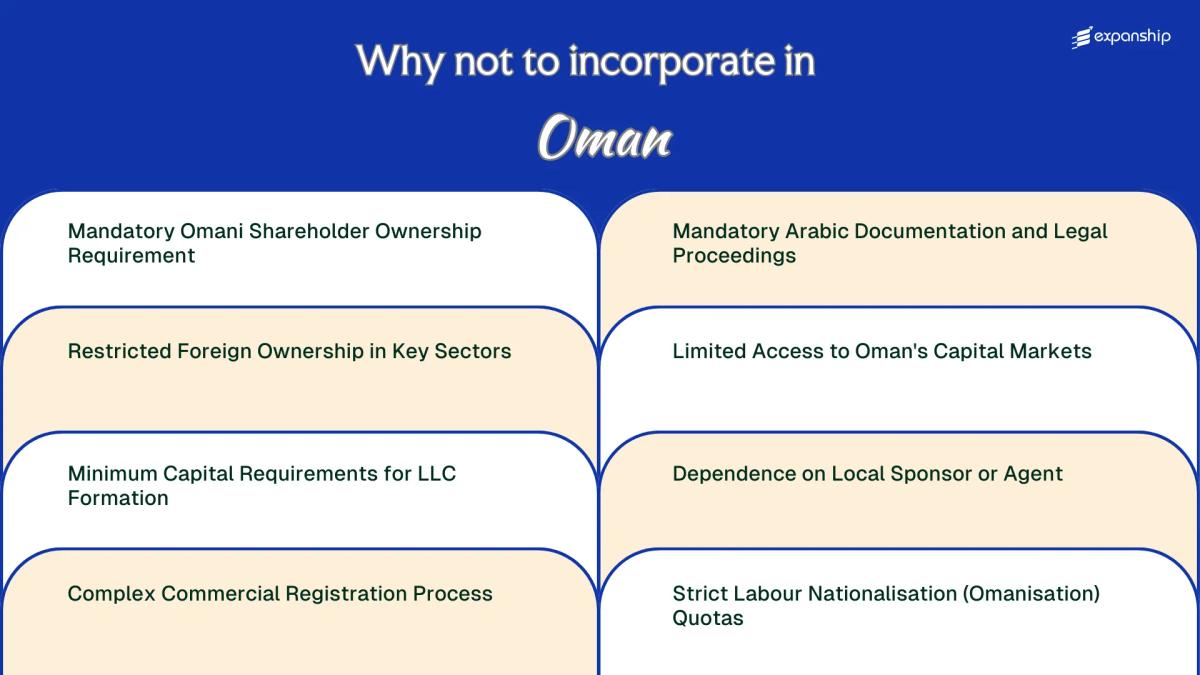
Mandatory Omani Shareholder Ownership Requirement
Under the Commercial Companies Law (Royal Decree 18/2019), a standard limited liability company formed in Oman must have at least one Omani national or wholly Omani-owned entity as a shareholder. Omani shareholder ownership restrictions mean that foreign investors cannot hold 100% of an LLC in most circumstances, which fundamentally alters the control structure of your business from the outset.
Profit Dilution and Structural Control
Equity shared with a mandatory local partner must reflect genuine ownership, not a nominal arrangement. In practice, this means profit distributions, voting rights on key decisions, and capital exit strategies are all subject to the Omani partner's entitlements under the shareholding agreement.
The Omani partner's minimum stake is typically 30%, though requirements vary by sector and activity. Any retained earnings, dividend policy, or reinvestment decision you make as a foreign investor is therefore constrained by a co-owner whose interests may not align with yours.
Legal Exposure and Dependence
Foreign ownership limitations in an Oman LLC create a structural dependence that cannot be resolved through internal company policy alone. If a dispute arises, resolution falls under Omani commercial law, where the local shareholder holds a legally recognised equity position.
Side agreements intended to override the local partner's rights are generally unenforceable under Omani law.
Your Omani partner holds legally enforceable equity rights that no side agreement can override, meaning any breakdown in the relationship directly threatens operational continuity and your ability to exit cleanly.
Restricted Foreign Ownership in Key Sectors
Restricted foreign ownership in Oman sectors is codified under the Foreign Capital Investment Law (Royal Decree 50/2019) and its accompanying negative list, which explicitly bars or limits non-Omani participation in designated industries. Sectors on this list are simply off-limits, regardless of capital size or investor profile.
The prohibited and restricted categories include activities where your firm faces either full exclusion or a foreign equity ceiling below majority control:
- Sectors tied to internal security and defence procurement block foreign entry entirely, meaning capital committed during planning stages cannot be redirected into those markets
- Retail and wholesale distribution activities below certain thresholds require Omani majority ownership, forcing you to cede controlling interest in day-to-day commercial decisions
- Real estate brokerage and some professional services require Omani citizenship, not merely residency, making it structurally impossible to hold a compliant licence as a foreign national
- Fishing and certain agricultural operations face nationality-based restrictions that prevent foreign-owned entities from accessing the operating licences needed to function legally
Even in partially open sectors, foreign equity is frequently capped at 70%, with Omani partners holding residual control rights. That ceiling directly affects dividend distribution, board composition, and exit terms.

Company Incorporation in Oman
Understand the ownership structures and sector restrictions that apply before you register your business in Oman.
Minimum Capital Requirements for LLC Formation
Oman LLC minimum capital requirements present a direct financial barrier before your business generates a single rial of revenue. Under the Commercial Companies Law (Royal Decree No. 18/2019), a limited liability company must meet a minimum share capital threshold set by the Ministry of Commerce, Industry and Investment Promotion (MOCIIP), and that capital must be fully subscribed at the time of incorporation.
| Requirement | Threshold / Condition | Practical Burden |
|---|---|---|
| Minimum share capital (standard LLC) | OMR 150,000 for foreign-owned entities in most cases | Significant upfront capital locked before operations begin |
| Capital subscription | Must be fully subscribed at incorporation | No phased contribution permitted |
| Sector-specific capital thresholds | Higher minimums apply in regulated sectors | Compounds the base requirement for many foreign investors |
| Currency | Omani Rial (OMR) | OMR 1 equals approximately USD 2.60, amplifying the real cost |
For a small or mid-sized foreign firm testing a new market, committing capital at this scale before revenue materialises carries genuine financial exposure. Unlike jurisdictions where nominal share capital suffices for registration, the LLC share capital restrictions here tie up working capital that could otherwise fund operations, staffing, or market entry costs.
The requirement is not uniformly applied across all entity types. Free zone structures operate under separate frameworks with different thresholds, which means the burden described above applies specifically to mainland LLC formation.
Complex Commercial Registration Process
The Oman commercial registration process challenges begin before your business opens a single account. Registration of a commercial entity is administered by the Ministry of Commerce, Industry and Investment Promotion (MOCIIP), and the process involves multiple sequential approvals rather than a single unified submission.
Each stage depends on the previous one clearing. A delay in name reservation, for instance, holds up the memorandum of association drafting, which in turn delays notarisation and MOCIIP final approval. Foreign investors accustomed to single-window registration systems in the UAE or Bahrain will find this sequencing unusually friction-heavy.
Certain business activities require additional approvals from sector-specific regulators before MOCIIP issues the commercial registration certificate. A firm in the healthcare sector, for example, must obtain clearance from the Ministry of Health independently. That approval is not integrated into the MOCIIP workflow.
Practical MOCIIP registration timelines routinely stretch beyond the official estimates, particularly where foreign shareholding structures require additional document verification.
- MOCIIP registration must be completed before any other licensing authority will process your application
- Activity-specific regulatory approvals are obtained separately and run on their own timelines
- All incorporation documents must be attested and submitted in Arabic
- Sector approvals do not pause the MOCIIP clock, creating potential conflicts in document validity periods
Oman does not operate a single integrated e-incorporation portal; commercial registration and sectoral licensing remain on separate systems with no automatic data sharing between ministries.
Mandatory Arabic Documentation and Legal Proceedings
Mandatory Arabic documentation Oman business requirements extend well beyond translation preferences. Under the Commercial Companies Law and directives from the Ministry of Commerce, Industry and Investment Promotion (MoCIIP), Arabic is the official language for all commercial registration documents, articles of association, and contractual filings.
Scope of the Language Requirement
Any document submitted to MoCIIP, the Royal Court Affairs, or the Muscat Court of First Instance must be in Arabic or accompanied by a certified Arabic translation. For your business, this means every founding document, shareholder resolution, and official correspondence with a government authority requires a licensed legal translator, adding recurring cost and time to routine corporate administration.
Consequences for Foreign Businesses in Disputes
Arabic is the exclusive language of Oman court proceedings, and foreign-language contracts hold no direct standing without certified translation. If a commercial dispute arises, your firm bears the full cost of translating evidence, contracts, and witness statements before they are admissible. While arbitration clauses can permit English in certain private proceedings, litigation before Omani civil courts offers no such flexibility.
Support for Overcoming Incorporation Challenges in Oman
Get guidance on managing Arabic documentation requirements, certified translation obligations, and court proceedings language restrictions when establishing your business in Oman.
Limited Access to Oman's Capital Markets
Limited capital market access in Oman presents a structural barrier that most foreign-incorporated entities cannot overcome through operational workarounds alone. Listing on the Muscat Stock Exchange (MSX) is governed by the Capital Market Authority (CMA) under the Capital Market Law (Royal Decree 80/1998), which imposes restrictions that effectively exclude most foreign firms from public capital raising.
- Foreign companies incorporated outside Oman cannot list directly on the MSX, cutting off access to public equity markets as a funding source.
- Even locally incorporated entities with significant foreign ownership face CMA scrutiny that can delay or block listing approval.
- The MSX remains a relatively shallow market by regional standards, limiting the capital volumes realistically available even to eligible issuers.
- Debt instruments and sukuk issuances through the MSX require CMA registration, adding a regulatory layer that increases time and compliance costs for foreign-backed firms.
- Qualifying for a public offering typically requires a track record of operations within the Sultanate, disadvantaging newly established foreign-owned entities.
Dependence on Local Sponsor or Agent
Oman local sponsor dependency risks are a structural concern for foreign businesses that cannot qualify for full foreign ownership under the Foreign Capital Investment Law (FCIL). Outside of free zones and a limited set of permitted activities, foreign companies are required to engage a local agent or partner who holds a controlling or significant ownership stake, creating an inherent power imbalance from the outset.
The local agent requirement drawbacks in Oman extend beyond shareholding. Your Omani partner or commercial agent can, in practice, block operational decisions, impede licence renewals, or withhold cooperation during disputes, and the legal resolution process through the Ministry of Commerce, Industry and Investment Promotion is neither fast nor straightforward.
Terminating a commercial agent relationship is particularly restrictive. Under the Commercial Agencies Law, an agent who has established a market presence may be entitled to compensation upon termination, even when the foreign principal is the aggrieved party.
A foreign firm paying a commercial agent a 5% commission on annual Omani revenues of OMR 500,000 would owe OMR 25,000 per year, plus potential termination compensation calculated on lost future earnings, before reclaiming operational independence.
Strict Labour Nationalisation (Omanisation) Quotas
Omanisation quota restrictions affect businesses across virtually every licensed activity, requiring firms to maintain a minimum percentage of Omani nationals in their workforce. These ratios are set by the Ministry of Labour and vary by sector, ranging from around 10% in some industries to 35% or higher in others, such as banking and insurance.
Hiring to meet a ratio rather than a business need increases payroll costs without a corresponding increase in productivity. In sectors where qualified Omani candidates are scarce, foreign companies often end up paying above-market salaries to attract local hires, simply to maintain their licence standing.
Non-compliance carries direct commercial consequences. Firms that fall below their required quota can face restrictions on new work permit approvals through the Integrated Government Clearance System (TARASSUD), effectively blocking the ability to bring in foreign staff.
The Oman labour nationalisation compliance challenges are compounded for small or specialised firms, where the pool of Omani professionals with niche technical qualifications is limited. Meeting the ratio on paper can require restructuring hiring priorities in ways that conflict with operational needs.
Certain free zone entities operate under modified rules, but mainland commercial registrations are subject to standard Ministry of Labour enforcement without exception.
Failure to meet your sector-specific Omanisation percentage can result in a block on new expatriate work permit applications through TARASSUD, directly restricting your ability to staff the business.
Mitigating These Incorporation Challenges
Mitigating these incorporation challenges requires structural preparation before engaging with the Ministry of Commerce, Industry and Investment Promotion.
- Appoint an Omani national or GCC-registered entity to hold the required ownership percentage under the Foreign Capital Investment Law, ensuring this arrangement is formalised through a notarised shareholders' agreement.
- Confirm your intended activity against the Negative List maintained by the Ministry of Commerce, Industry and Investment Promotion before selecting a legal structure, to identify sector-specific restrictions on foreign participation.
- Verify minimum capital thresholds for your chosen entity type with the Commercial Registration Directorate prior to initiating the LLC formation process.
- Retain a CIPA-accredited Arabic legal translator to manage mandatory documentation requirements throughout the commercial registration process.
- Build Omanisation quota compliance into your hiring structure from the outset, using the Musaned and MANPOWER portals to track nationalisation ratios against your licensed activity.
These steps address the most significant structural barriers within the current regulatory framework. Compliance obligations under the Commercial Companies Law and the Foreign Capital Investment Law interact, meaning gaps in one area can create downstream registration or licensing failures.
Oman's Overall Business Viability
Oman's regulatory environment presents real barriers for foreign investors — mandatory Omani shareholding, sector-specific ownership caps, Omanisation quotas, and minimum capital thresholds all add friction that simpler jurisdictions do not impose. That said, the country's strategic Gulf location, ongoing Vision 2040 diversification programme, and Special Economic Zones such as Duqm and Salalah Free Zone continue to attract foreign businesses with the right structure and long-term horizon.
| Pros | Cons |
|---|---|
| Access to Gulf markets and strategic position along major shipping routes | Most LLCs require a minimum 30% Omani shareholder, limiting full foreign control |
| Special Economic Zones offer more favourable ownership and tax conditions | Restricted or prohibited foreign ownership in sectors including media, insurance, and utilities |
| Stable political environment underpinned by consistent government policy | Minimum capital requirements for LLC formation create upfront financial barriers |
| Growing infrastructure and state investment under Vision 2040 | Omanisation quotas require sector-specific ratios of Omani nationals in your workforce |
| Double taxation treaties with multiple countries reduce cross-border tax exposure | Commercial registration through the Ministry of Commerce involves multiple sequential approvals |
Structural planning and sector selection largely determine whether these constraints are manageable or prohibitive for your business.
Corporate Compliance Services for Companies in Oman
Stay aligned with Oman's regulatory requirements, from Ministry of Commerce filings to annual renewal obligations and Omanisation reporting.
Conclusion
The cons of Oman company incorporation are real and structural, not incidental. Foreign ownership restrictions, Omanisation quotas, and mandatory local participation requirements are embedded in the regulatory framework governing business formation here. These constraints apply consistently across most entity types and sectors, regardless of your firm's size or origin. Structural barriers of this kind require deliberate planning before committing to registration. Professional guidance from advisors with direct experience in Omani corporate law and Ministry of Commerce and Industry procedures remains the most reliable way to manage these formation limitations effectively.
Expanship's Support for Your Oman Expansion
Expanship's Oman company formation support services are built around the specific compliance obligations that make setting up in this jurisdiction demanding for foreign investors. From managing the Omani shareholder ownership structure and minimum capital thresholds to handling Arabic-language documentation and coordinating with the Ministry of Commerce, Industry and Investment Promotion, Expanship reduces the operational weight of these requirements on your business.
Our service scope covers the full formation and post-incorporation cycle.
- Your company registration and document preparation are handled end to end.
- We provide a registered agent and local office address where required.
- Our team manages government filings and liaises directly with relevant regulatory authorities.
- Post-incorporation compliance obligations are tracked and managed on your behalf.
- We facilitate introductions to banking institutions suited to your business profile.
- Tax registration and liaison with local authorities are included in our scope.
Reach out to Expanship Oman to discuss your incorporation requirements.
Frequently Asked Questions (FAQ)
Omanisation quotas vary by sector and company size, set and enforced by the Ministry of Labour under the Omanisation policy framework. Some industries carry mandatory ratios as high as 35–50% Omani staffing, and failure to meet your designated quota can result in suspension of work permit approvals for expatriate hires. Smaller firms are not automatically exempt; the ministry assigns target percentages based on business activity classification.
The Ministry of Labour can place your company on a "red" classification under the Omanisation tracking system, which blocks new expatriate visa applications until compliance is restored. Beyond that administrative restriction, the firm may face fines and reputational consequences that affect your ability to bid on government contracts. Reinstatement to a compliant classification requires demonstrating improved Omani hire ratios, which takes time and involves formal ministry review.
Oman's standard minimum capital for an LLC is OMR 150,000 for foreign-owned entities in most commercial activities, which is considerably higher than requirements in jurisdictions such as Bahrain or the UAE's mainland, where thresholds for similar structures are lower or activity-dependent. This capital must be deposited and verified before the Commercial Registration is issued by the Ministry of Commerce, Industry and Investment Promotion. The requirement creates a genuine cash-flow commitment before your business generates a single rial of revenue.
Submissions to the Ministry of Commerce, Industry and Investment Promotion must be in Arabic, and errors or inconsistencies in translated documents can cause your application to be rejected or suspended without a straightforward correction pathway. You would need to obtain revised certified translations, which adds cost and delays the registration timeline. There is no informal correction process; each resubmission goes through the same formal review queue.
In most cases, no. Certain business activities and visa-related processes still require a registered Omani agent or sponsor, particularly for branch office registrations and professional service firms operating outside free zones. Omani free zones offer a partial workaround, but activities permitted within those zones are restricted to specific categories, and selling directly into the domestic Omani market from a free zone entity is subject to additional conditions. Structuring around the sponsorship requirement without qualifying for an explicit exemption carries legal and operational risk.
Foreign-incorporated entities face significant restrictions on listing on the Muscat Stock Exchange, regulated by the Capital Market Authority under the Capital Market Law. Direct access to public equity markets requires Omani legal presence with compliant ownership structures, and even then the process involves CMA approval, Omani audited financials, and Arabic-language prospectus requirements. For most foreign businesses, this effectively eliminates the local public capital market as a practical funding option in the short to medium term.
Legal Disclaimer
The information provided in this article is for general informational purposes only and does not constitute legal, tax, or professional advice. While we strive to ensure the accuracy and timeliness of the content, laws and regulations are subject to change, and the application of laws can vary widely based on specific facts and circumstances.
Readers should not act upon this information without seeking professional counsel tailored to their individual situation. Expanship and its authors disclaim any liability for actions taken or not taken based on the content of this article.
For specific advice regarding your business setup, compliance requirements, or any legal matters, please consult with qualified legal and tax professionals in the relevant jurisdiction.