
Key Takeaways
- Oman's Income Tax Law imposes corporate tax at a flat 15% rate, meaning business profits are taxed at one of the lowest statutory rates in the Gulf without additional layers of personal income tax on shareholder distributions.
- Free zone structures in Oman permit 100% foreign ownership, eliminating the local partner equity requirement that applies to mainland LLC formations under the Foreign Capital Investment Law.
- Because Oman levies no personal income tax, business owners can receive distributed profits from their Omani entity without a second tax event reducing the net return on those earnings.
- Regulated by the Ministry of Commerce, Industry and Investment Promotion (MOCIIP), Oman's commercial registration framework provides a codified, single-authority structure that reduces jurisdictional ambiguity for foreign investors establishing a presence in the region.
Oman is a sovereign nation on the southeastern coast of the Arabian Peninsula, bordered by Saudi Arabia, the UAE, and Yemen, with coastline along both the Arabian Sea and the Gulf of Oman. Company registration for foreign investors falls under the authority of the Ministry of Commerce, Industry and Investment Promotion (MOCIIP), which administers business licensing and commercial registration. The most common vehicle through which foreign businesses establish a presence is the Limited Liability Company.
From a tax standpoint, the sultanate operates a low-tax regime with no personal income tax and a corporate tax structure that applies only to business profits above a defined threshold. Foreign direct investment is actively supported through both onshore frameworks and designated free zones, where full foreign ownership is permitted under specific conditions.
The benefits of incorporating in Oman extend across tax efficiency, market access, and regulatory structure. This article examines those advantages in detail, drawing on the current legal and commercial framework that governs business formation in the country.
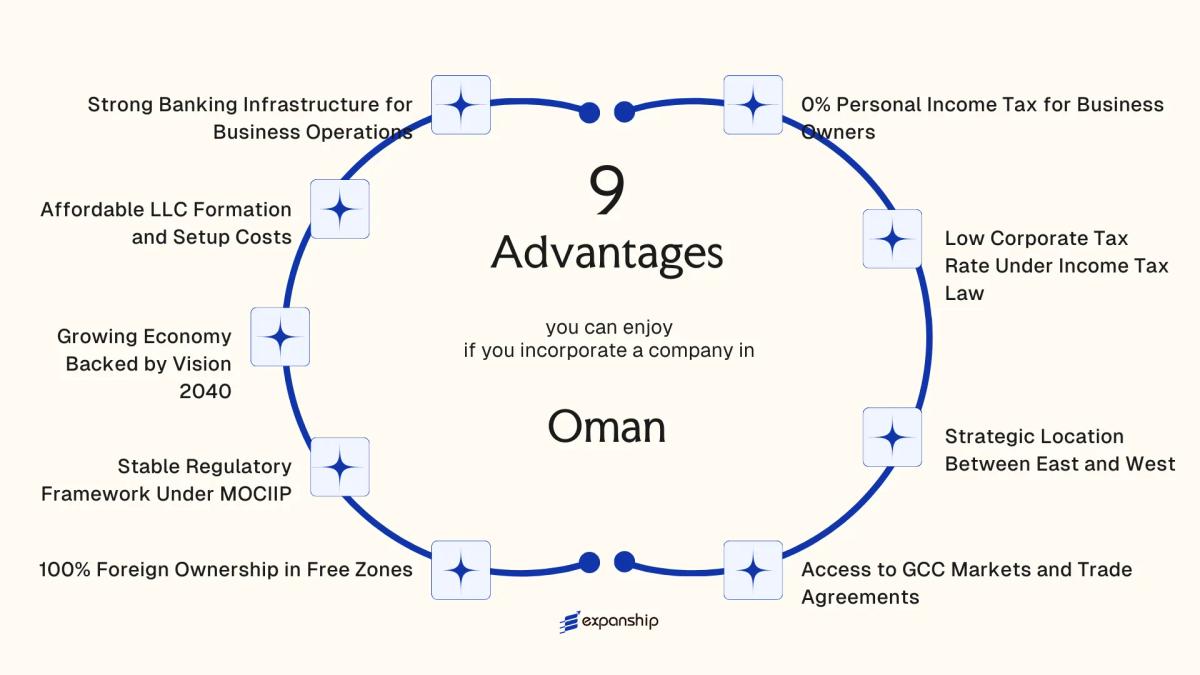
0% Personal Income Tax for Business Owners
Oman's zero personal income tax benefit applies to all resident individuals, including business owners and foreign nationals who draw income from a locally registered entity. There is no personal income tax legislation in force, meaning salary, dividends, and profit distributions are not subject to individual-level taxation.
What the Law Actually Says
Under Oman's Income Tax Law, issued by Royal Decree No. 28/2009 and its subsequent amendments, taxation is imposed on juridical persons, not on natural persons receiving personal income. A foreign entrepreneur who draws a salary or dividend from their Omani company retains the full amount at the personal level, with no withholding obligation on distributions to resident individuals.
Why This Structure Benefits Foreign Owners
For shareholders in an Omani LLC or a free zone entity, the absence of personal-level taxation means after-tax corporate profits can be extracted without a secondary tax layer reducing the final return. This is structurally different from jurisdictions in Europe or North America, where corporate profits face taxation again upon distribution to shareholders. Eligibility is not conditional on nationality, so foreign owners benefit on equal terms with Omani nationals.
Profits distributed from your Omani company reach you as an individual without any personal income tax deducted at source.
Low Corporate Tax Rate Under Income Tax Law
Oman's corporate tax rate, governed by the Income Tax Law (Royal Decree No. 28/2009 and its amendments), is set at a flat 15% on taxable income for most companies. Small businesses meeting specific thresholds benefit from a reduced rate of 3%. For foreign investors, this structure means a predictable, contained tax burden from the outset, without the graduated rates or surtaxes common in many OECD jurisdictions.
The flat-rate model removes ambiguity from financial planning. Rather than calculating liability across multiple income brackets, your business operates under a single applicable rate, which simplifies annual tax provisioning and reduces the cost of local compliance work.
Under the Income Tax Law, several features make the corporate tax position particularly workable for foreign-owned entities:
- Taxable income is calculated after deducting allowable business expenses, meaning your effective rate is applied to net profit, not gross revenue
- The 3% reduced rate applies to entities with gross income below a defined threshold, benefiting lean or early-stage operations
- Free zone companies may qualify for tax exemptions during their exemption period, depending on the zone authority's terms
- Tax losses can be carried forward for up to five years, providing relief during lower-revenue periods
Oman does not impose a branch profits tax on top of the standard corporate rate, which matters when structuring regional operations through a local branch rather than a subsidiary.

Incorporate a Company in Oman
Set up your Oman business entity with full compliance support, from trade name registration to tax enrollment under the Income Tax Law.
Strategic Location Between East and West
Oman's geographic position gives your business a physical advantage that most corporate registrations simply cannot replicate. Sitting at the southeastern tip of the Arabian Peninsula, the country borders the Arabian Sea, the Gulf of Oman, and the Red Sea corridor, placing it within a four-hour flight radius of markets spanning South Asia, East Africa, and the broader Middle East. For businesses that depend on physical trade flows, that reach translates directly into reduced transit times and lower logistics costs.
The Port of Salalah operates as a transshipment hub connecting Asia-Europe shipping lanes, while the Port of Sohar, developed under a joint venture with the Port of Rotterdam, handles industrial and bulk cargo at scale. Together, these facilities give registered businesses access to deep-water infrastructure without relying on congested regional alternatives.
| Port / Zone | Primary Function | Connected Trade Corridor |
|---|---|---|
| Port of Salalah | Transshipment and container handling | Asia-Europe shipping lanes |
| Port of Sohar | Industrial, bulk, and general cargo | Gulf and Indian Ocean routes |
| Muscat International Airport | Air freight and passenger connectivity | South Asia, GCC, East Africa |
| Duqm Port and SEZ | Industrial and energy sector logistics | Arabian Sea access |
Duqm, a special economic zone administered under the Special Economic Zone Authority at Duqm (SEZAD), adds a third deep-water option positioned along open ocean routes rather than the narrower Gulf shipping channels. For firms moving goods between Asian suppliers and European or African buyers, a registered presence here can shorten the supply chain at the point of transit rather than at either end.
Access to GCC Markets and Trade Agreements
Oman GCC market access benefits sit at the heart of why many foreign businesses choose to incorporate here rather than elsewhere in the Gulf. As a full member of the Gulf Cooperation Council, a business registered in Oman can move goods across Bahrain, Kuwait, Qatar, Saudi Arabia, and the UAE under a unified customs framework, without facing the tariff barriers that apply to non-member entities.
Under the GCC Customs Union, goods manufactured or substantially processed within member states circulate at a 0% intra-GCC tariff rate. For a foreign-owned firm producing or trading from Oman, this means your products enter five additional national markets without additional duties at each border — a direct cost advantage over companies routing through third-party distributors outside the bloc.
Beyond the GCC, Oman holds a bilateral Free Trade Agreement with the United States, which came into force in 2009. This gives qualifying goods exported from your Oman-registered entity preferential access to the US market, a channel that most other GCC-incorporated businesses do not have independently.
Keep the following in mind:
- GCC tariff-free movement applies to goods meeting the rules of origin criteria set under the GCC Customs Union
- The US-Oman FTA covers goods trade; services and investment provisions carry separate qualifying conditions
- Pan-Arab Free Trade Area (PAFTA) membership extends preferential access to a further set of Arab League countries
- Preferential tariff treatment under any agreement depends on proper certificate of origin documentation
Oman is one of only two GCC member states with an individual bilateral free trade agreement with the United States, giving Oman-based exporters a market access route that neither Dubai nor Riyadh can offer on the same terms.
100% Foreign Ownership in Free Zones
100% foreign ownership in Oman free zones removes the requirement for a local Omani partner, which has historically been the default condition for mainland company formation. For foreign investors, this distinction is material: it means full control over equity, profit distribution, and operational decisions without structural dependency on a third party.
Free Zones Where Full Ownership Applies
Designated economic zones such as the Salalah Free Zone, Sohar Freezone, and the Knowledge Oasis Muscat operate under separate regulatory frameworks from the mainland. Each zone is governed by its own authority and enabling legislation, granting foreign-owned entities within their boundaries a legal basis for 100% ownership that does not exist under the general Foreign Capital Investment Law applicable to mainland businesses.
This structural separation matters because it gives your entity a defined legal footing rather than an informal arrangement. The applicable zone authority, not a local partner, becomes your primary regulatory counterpart.
What Full Ownership Means in Practice
Retaining 100% equity means your firm's profits, voting rights, and exit options remain entirely within your control. Dividend repatriation, shareholder decisions, and potential future sale of the entity are not subject to co-owner consent.
Free zone companies are also generally permitted to hire foreign staff and import goods for processing or re-export under preferential customs terms. These operational freedoms compound the ownership benefit by reducing friction across the full business cycle.
Structure Your Oman Free Zone Company the Right Way
Get guidance on choosing the right free zone, ownership structure, and regulatory requirements for your business in Oman.
Stable Regulatory Framework Under MOCIIP
The Ministry of Commerce, Industry, and Investment Promotion (MOCIIP) serves as the central regulatory authority overseeing company registration and ongoing compliance for businesses operating in Oman. The Oman MOCIIP regulatory framework benefits foreign businesses primarily through its predictability: rules governing commercial registration, licensing, and corporate governance are codified and consistently applied, reducing the administrative uncertainty that affects operations in less structured markets.
- Commercial registration and licensing procedures are governed by the Commercial Companies Law (Royal Decree No. 18/2019), which establishes clear legal definitions for entity types, capital requirements, and ownership structures. You gain legal certainty from the outset rather than navigating discretionary interpretation.
- MOCIIP maintains a centralized digital registry, allowing businesses to track registration status, file amendments, and renew licenses through a single government portal. This reduces dependency on intermediaries for routine compliance tasks.
- Regulatory requirements are publicly documented and applied uniformly, meaning your firm faces the same compliance standards as any other registered entity, regardless of origin.
- Amendments to the Commercial Companies Law in 2019 modernized governance requirements, aligning them closer to internationally recognized corporate standards. For foreign investors accustomed to OECD-style disclosure norms, this structural familiarity reduces the operational adjustment required when establishing a local presence.
Growing Economy Backed by Vision 2040
Oman Vision 2040 business opportunities stem from a deliberate, government-led restructuring of the national economy away from oil dependency. Announced in 2019, Vision 2040 identifies tourism, logistics, manufacturing, mining, and fisheries as priority sectors for foreign and domestic investment. Each priority sector has corresponding regulatory and financial incentives tied to it, meaning your business can benefit from directed government support rather than navigating a neutral regulatory environment.
The sultanate's GDP grew by approximately 4% in 2022, driven by both hydrocarbon revenues and expanding non-oil sectors, according to World Bank data. Non-oil GDP has been rising steadily as a share of total output, which signals a maturing economic base with durable commercial demand across multiple industries.
Sectoral development zones, such as the Special Economic Zone at Duqm and the Sohar Freezone, were established with Vision 2040 goals embedded in their operating mandates. Businesses that align with priority sectors can access land allocations, infrastructure subsidies, and simplified licensing through the Public Authority for Special Economic Zones and Free Zones (OPAZ).
A business established in the Duqm Special Economic Zone within a Vision 2040 priority sector can qualify for a 10-year corporate tax exemption and reduced customs duties on imported materials, making the effective cost of entry substantially lower than in comparable Gulf free zones.
Affordable LLC Formation and Setup Costs
Oman LLC formation cost advantages become apparent when you look at the actual capital and fee structures involved. The minimum share capital for a standard Limited Liability Company registered through the Ministry of Commerce, Industry and Investment Promotion (MOCIIP) is OMR 150,000 for most commercial activities, though this threshold is significantly lower for certain categories of businesses. That capital sits in your company rather than disappearing as a fee, which means the outlay is an asset, not an expense.
Government registration and licensing fees are structured on a fixed-scale basis, which removes the unpredictability common in jurisdictions where notarial and administrative costs vary widely by deal complexity.
For foreign investors, the practical implication is a more predictable setup budget. Your entity can be fully registered and commercially licensed without engaging multiple intermediary bodies at each stage, since MOCIIP centralizes commercial registration, licensing, and related approvals under one regulatory framework.
- Annual renewal fees are modest relative to comparable Gulf jurisdictions.
- Physical office requirements are generally satisfied by a registered commercial address.
- No stamp duty applies on share capital at incorporation.
The OMR 150,000 minimum capital requirement does not apply uniformly; specific activity codes and foreign ownership structures may carry different thresholds under the Commercial Companies Law.
Strong Banking Infrastructure for Business Operations
Oman's banking sector is regulated by the Central Bank of Oman (CBO), established under the Banking Law promulgated by Royal Decree 114/2000. The CBO sets capital adequacy requirements, governs foreign currency transactions, and oversees both conventional and Islamic banking operations. For a foreign business owner, this regulatory clarity means your corporate accounts operate within a well-defined legal structure rather than an opaque system.
Corporate banking access in the sultanate covers multi-currency accounts, trade finance facilities, letters of credit, and international wire transfers through correspondent banking networks. Banks such as Bank Muscat, HSBC Oman, and Ahli Bank offer business accounts specifically structured for corporate entities, including those incorporated in free zones. This directly affects how quickly your firm can receive client payments, settle supplier invoices, and repatriate funds.
The CBO maintains the Omani Rial's peg to the US Dollar at a fixed rate of approximately 0.3845 OMR per USD, a peg that has held since 1986. For businesses that invoice or source internationally in USD, this eliminates currency conversion risk on a significant portion of transactions.
Oman banking infrastructure business advantages also extend to digital services. The Electronic Fund Transfer System (EFTS) and the Real-Time Gross Settlement (RTGS) system facilitate domestic interbank transfers with same-day settlement. Your business operations are not slowed by processing delays that affect corporate activity in less developed financial systems.
- Multi-currency corporate accounts available through licensed commercial banks
- Islamic banking windows and standalone Islamic banks available under CBO licensing
- RTGS system enables same-day domestic settlement
- USD peg removes exchange rate exposure on dollar-denominated transactions
Why Oman Stands Out Among Gulf Jurisdictions
Among the Gulf Cooperation Council members, the Oman advantages over other Gulf jurisdictions become clearest when viewed through the lens of cost, ownership structure, and treaty access. The UAE remains the default reference point for most foreign investors, but its free zone licensing fees and the 9% federal corporate tax introduced in 2023 under Federal Decree-Law No. 47 shift the cost calculation meaningfully. Saudi Arabia's Vision 2030 has attracted significant capital, yet its foreign ownership rules outside designated zones remain more restrictive, and the regulatory entry process is generally longer. Qatar and Bahrain round out the realistic comparison set for an investor weighing incorporation options across the region.
What the comparison reveals is less about headline rates and more about structural consistency. The Income Tax Law administered by the Tax Authority sets a standard 15% corporate rate with defined SME relief thresholds, which provides predictability rather than requiring ongoing restructuring to maintain a favourable position. Ownership provisions under the Foreign Capital Investment Law allow 100% foreign ownership in defined sectors on the mainland, a threshold that several Gulf states still restrict outside their own special economic zones.
| Parameter | Oman | UAE | Saudi Arabia |
|---|---|---|---|
| Standard Corporate Tax Rate | 15% | 9% (federal, from 2023) | 20% (non-GCC foreign investors) |
| 100% Foreign Ownership (Mainland) | Yes, in permitted sectors | Yes, post-2021 reform | Restricted in many sectors |
| Personal Income Tax | 0% | 0% | 0% |
| Free Zone Availability | Yes (SEZAD, Sohar, Duqm) | Extensive (40+ zones) | Growing (NEOM, KAEC) |
| Double Tax Treaties | 35+ | 130+ | 50+ |
| GCC Market Access | Full member | Full member | Full member |
Compliance Services for Companies in Oman
Maintain your Oman entity in good standing with MOCIIP and the Tax Authority. Expanship manages filing deadlines, annual renewals, and regulatory requirements on your behalf.
Conclusion
Oman's position as a Gulf incorporation destination rests on a combination of structural tax advantages and regulatory clarity that few regional alternatives can match. The benefits of incorporating in Oman are grounded in codified law: a 15% corporate tax rate under the Income Tax Law, no personal income tax on distributions, and free zone structures that permit full foreign ownership without a local partner requirement.
For a foreign business owner, these features interact in a practically significant way. Profits earned through an Omani entity can be distributed to shareholders without a personal tax layer reducing the final return. Free zone entities add a further dimension, removing the equity-sharing constraints that apply to mainland LLC structures under the Foreign Capital Investment Law.
The suitability of this jurisdiction depends on your business model, target markets, and operational requirements. A firm focused on GCC distribution will weigh the country's trade access differently than one using a free zone structure for re-export or holding purposes. Vision 2040's active sector diversification also means that the regulatory environment is continuing to develop, particularly in areas relevant to foreign investment.
Determining how these factors apply to your specific structure requires review of current licensing categories, free zone eligibility, and applicable tax treaty positions. Professional guidance at the formation stage reduces the risk of structural decisions that are difficult to reverse once the entity is registered and operational.
Start Your Oman Company With Expanship Today
Expanship Oman company formation services cover the full scope of what a foreign business owner needs to establish and maintain a legal presence in the country. From structuring your entity under the Commercial Companies Law to fulfilling the annual filing obligations monitored by the Ministry of Commerce, Industry and Investment Promotion (MOCIIP), each stage of the process carries specific documentation, timeline, and compliance requirements that vary by entity type and activity.
Expanship handles the practical work across every stage of that process:
- Document preparation, attestation, and legalization for submission to MOCIIP and other relevant authorities
- Registered agent and registered office provision to satisfy local presence requirements
- Government filing and liaison with the Oman Business Center (Markaz) and Commercial Registry
- Post-incorporation compliance management, including annual renewals and regulatory reporting
- Banking introduction assistance to support account opening with local financial institutions
- Coordination with free zone authorities such as SEZAD or Sohar Port and Freezone where applicable
Expanship Oman is available to answer your questions and begin the formation process for your business.
Frequently Asked Questions (FAQ)
Under the Income Tax Law (Royal Decree No. 28/2009, as amended), the standard corporate income tax rate is 15% on net taxable income. Small and medium enterprises meeting specific criteria, including a capital threshold, may qualify for a reduced rate of 3%. Free zone entities may be eligible for tax exemptions on profits for a defined period, subject to the terms of their zone authority agreement.
Free zone entities operate under the regulatory authority of their respective zone administrators, such as the Sohar Free Zone Authority or the Salalah Free Zone, rather than solely under the Ministry of Commerce, Industry and Investment Promotion (MOCIIP). This results in a distinct licensing process, separate foreign ownership rules, and potentially different tax treatment compared to mainland limited liability companies or joint stock companies registered through MOCIIP.
No personal income tax exists in Oman. Salary income, dividends, and profit distributions received by individual business owners are not subject to any personal income tax under current Omani law. This applies equally to Omani nationals and foreign residents, making the after-tax position for individual shareholders straightforward to calculate.
Oman is a member of the Gulf Cooperation Council (GCC), which allows goods manufactured in Oman to move tariff-free across GCC member states including Saudi Arabia, the UAE, Kuwait, Bahrain, and Qatar, subject to rules of origin requirements. Oman also has a bilateral Free Trade Agreement with the United States, which came into force in 2009, providing preferential access to the US market for qualifying goods. Membership in the Arab League and broader Arab trade frameworks extends additional preferential arrangements to regional markets.
The timeline for registering a mainland LLC through the Ministry of Commerce, Industry and Investment Promotion depends on document completeness, activity approvals, and whether additional regulatory clearances are required for the specific business activity. In straightforward cases where all documents are in order, commercial registration can be completed within a few business days through Oman's Invest Easy portal. Activities requiring sector-specific approvals from ministries such as the Capital Market Authority or the Central Bank of Oman will extend this timeline.
For a standard limited liability company incorporated on the mainland, the minimum share capital requirement is generally set at OMR 150,000 for companies with foreign ownership, though this figure can vary based on the nature of the business activity and applicable regulations. Fully Omani-owned LLCs face a lower threshold. Free zone authorities set their own capital requirements independently, which in some cases are lower, making free zone incorporation a consideration for investors seeking a reduced initial capital commitment.
Vision 2040 is a long-term national development plan, not a legislative instrument, so changes to corporate law or tax policy require formal royal decrees or amendments to existing statutes. Your company's rights are governed by the commercial registration it holds and the laws in force at the time of any amendment, with transition provisions typically included in new legislation. Monitoring updates from MOCIIP and the Tax Authority of Oman is the standard practice for staying current with any regulatory changes that affect existing entities.
Legal Disclaimer
The information provided in this article is for general informational purposes only and does not constitute legal, tax, or professional advice. While we strive to ensure the accuracy and timeliness of the content, laws and regulations are subject to change, and the application of laws can vary widely based on specific facts and circumstances.
Readers should not act upon this information without seeking professional counsel tailored to their individual situation. Expanship and its authors disclaim any liability for actions taken or not taken based on the content of this article.
For specific advice regarding your business setup, compliance requirements, or any legal matters, please consult with qualified legal and tax professionals in the relevant jurisdiction.