

Key Takeaways
- New Zealand's Companies Act 1993 provides a common law foundation that governs director duties, shareholder rights, and liability structures with a level of legislative maturity that reduces legal uncertainty for foreign-owned entities.
- A flat 28% corporate tax rate applies uniformly regardless of shareholder residency, eliminating the differential treatment that many jurisdictions impose on foreign-controlled companies.
- The absence of a minimum share capital requirement means early-stage businesses can register and operate a New Zealand limited liability company without locking capital into a statutory reserve.
- Membership in an extensive network of free trade agreements spanning the Asia-Pacific region gives New Zealand-incorporated firms preferential market access that purely offshore holding structures typically cannot claim.
New Zealand is an independent sovereign nation located in the southwestern Pacific Ocean, operating under a Westminster-style parliamentary system with a well-established common law tradition. The benefits of incorporating in New Zealand draw interest from founders and established businesses alike, particularly given the country's transparent regulatory environment and openness to foreign direct investment. Company registration is administered through the Companies Office, the government body responsible for maintaining the official register of all entities formed under New Zealand law.
Foreign businesses most commonly incorporate using the limited liability company structure. The tax framework is treaty-based, with New Zealand maintaining an extensive network of double tax agreements that govern how cross-border income is treated. There are no blanket restrictions on foreign ownership of locally registered firms, and non-resident individuals and entities are generally permitted to hold shares without prior approval in most sectors.
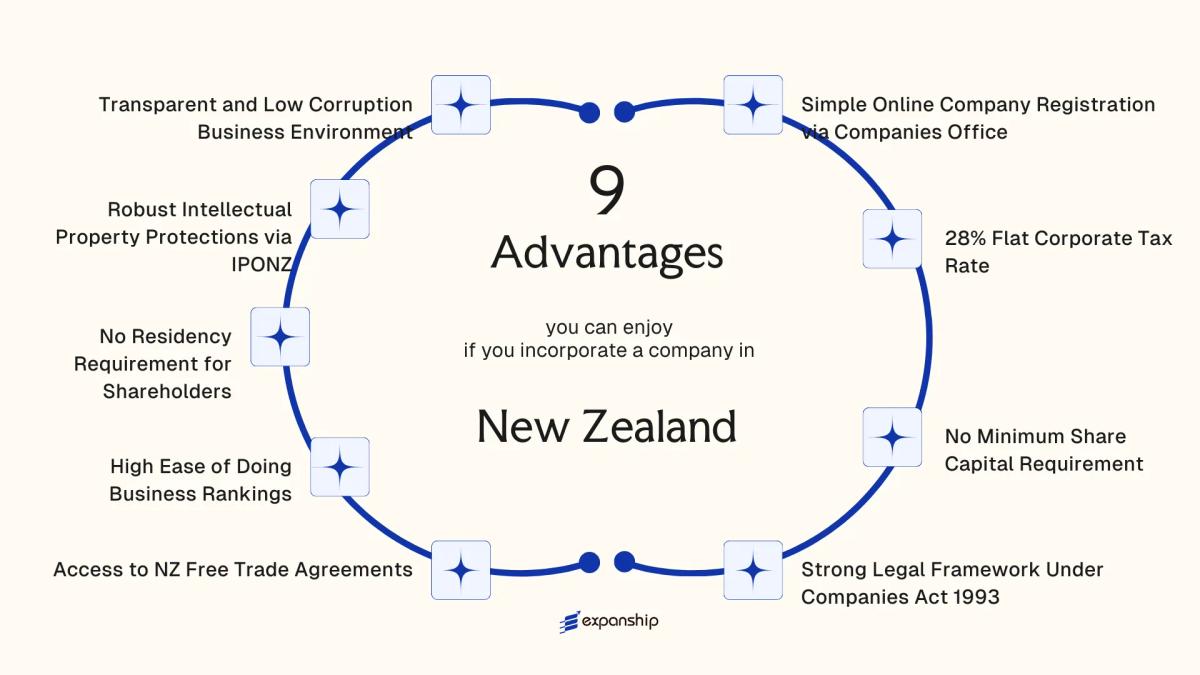
This article covers the principal advantages that make New Zealand company formation a consideration for internationally oriented businesses.
Simple Online Company Registration via Companies Office
New Zealand Companies Office online registration benefits start with something tangible: the entire incorporation process is handled through a single government portal at companies.govt.nz. For a foreign business owner, this means no in-country presence is required to establish a legal entity.
A Centralised Digital Registration System
Registering through the Companies Register issues your business a New Zealand Business Number (NZBN) automatically upon incorporation. That number functions as a universal identifier across government agencies, banks, and suppliers, eliminating redundant paperwork when setting up operational accounts or contracts.
NZBN registration benefits for businesses extend beyond identification. Because the register is publicly searchable and government-administered, your entity carries immediate credibility with local counterparties who can verify its status in real time.
Speed as a Structural Feature
Registration typically completes within one to two working days once documents are submitted. For foreign founders coordinating across time zones, this compressed timeline reduces the lag between deciding to enter the market and being legally authorised to operate.
The online company registration advantages here are structural rather than incidental, built into how the Companies Office was designed to function under the Companies Act 1993.
You can incorporate a New Zealand company remotely and receive a government-issued NZBN without ever setting foot in the country.
28% Flat Corporate Tax Rate
New Zealand's corporate tax rate sits at a flat 28%, applied uniformly to all resident companies regardless of size, sector, or ownership structure. For foreign business owners, this predictability matters: your tax liability can be calculated without navigating tiered brackets or threshold-based phase-outs.
Administered under the Income Tax Act 2007, the rate applies to net taxable income after allowable deductions. No graduated scale means a company earning NZD 500,000 faces the same marginal rate as one earning NZD 5 million. That consistency simplifies financial modelling and reduces exposure to unintended tax escalation as your business grows.
The 28% flat rate compares favourably to Australia's standard 30% corporate rate, and sits within a competitive range relative to many OECD economies where rates commonly exceed 30%. For a foreign-owned entity, this differential can have a measurable effect on post-tax returns over time.
Several structural features reinforce the NZ corporate tax rate advantage:
- Dividends paid to shareholders come with imputation credits attached, reducing the risk of economic double taxation on distributed profits
- The absence of capital gains tax on most asset disposals means retained earnings and exit proceeds are not subject to an additional layer of taxation
- Deductions for business expenses are calculated under well-established rules, reducing compliance ambiguity for new market entrants
Resident withholding tax on dividends paid to non-resident shareholders is subject to double tax agreement rates where applicable, which can reduce the effective tax cost of profit repatriation.

Incorporate a Company in New Zealand
Register your New Zealand company through Expanship and get structured guidance on tax residency, compliance obligations, and post-incorporation setup.
No Minimum Share Capital Requirement
There is no minimum share capital requirement for a New Zealand company under the Companies Act 1993. You can incorporate with a single share issued at any value, including $1, and the firm has no obligation to maintain a defined capital base before commencing operations. This directly removes a financial barrier that many jurisdictions impose before a business can legally begin trading.
| Feature | Rule |
|---|---|
| Minimum share capital | None |
| Minimum shares required | 1 |
| Minimum share value | No statutory minimum |
| Par value requirement | Abolished under Companies Act 1993 |
| Capital maintenance rule | Solvency-based, not capital-based |
Under the solvency test framework set out in the Companies Act 1993, a company's financial obligations are assessed based on its ability to pay debts as they fall due and whether its assets exceed its liabilities. Capital adequacy is therefore measured against actual financial position rather than a fixed paid-up threshold. For a foreign investor, this means the entity's capital structure can be tailored to genuine operational needs rather than regulatory minimums.
Shares can be issued in different classes, allowing your business to allocate economic rights, voting rights, or dividend entitlements separately across shareholder groups. This structural flexibility has practical value for joint ventures, holding structures, or phased investment arrangements where capital contributions and governance rights need to be configured independently.
Strong Legal Framework Under Companies Act 1993
New Zealand's Companies Act 1993 business advantages begin with a codified, single-statute framework that governs company formation, director duties, shareholder rights, and insolvency within one consolidated legal document. For a foreign business owner, this means legal obligations are traceable, predictable, and enforced uniformly across all registered entities.
Director duties under sections 131 to 138 are explicitly defined, covering good faith, proper purpose, and disclosure of conflicts. This statutory clarity reduces the risk of governance disputes escalating unpredictably, which matters particularly for multi-party foreign-owned structures.
Shareholder protections under Part 7 include minority rights provisions, allowing shareholders holding 5% or more of voting shares to requisition meetings and challenge decisions that prejudice their interests. These protections are statutory, not contractual, meaning they apply regardless of what a shareholders' agreement does or does not include.
Keep these points in mind:
- Director liability under sections 135 and 136 covers reckless trading and obligations relating to insolvent trading
- The Act requires companies to maintain a registered office and a New Zealand-based address for service
- Annual returns are filed through the Companies Office, and non-compliance triggers deregistration
- Companies Act 1993 protections for NZ businesses apply equally to foreign-owned registered companies
A company incorporated under the Companies Act 1993 does not require a local director, yet it still benefits from the same statutory governance protections as a domestically owned firm.
Access to NZ Free Trade Agreements
New Zealand free trade agreement benefits for businesses are among the most tangible structural advantages of incorporating here. The country has concluded FTAs with over 60 trading partners, including China, the ASEAN bloc, the Gulf Cooperation Council, the United Kingdom, and the European Union, with the NZ-EU FTA entering into force in 2024. For a company registered under the Companies Act 1993, these agreements can translate directly into reduced or eliminated tariffs on goods exported under a New Zealand entity.
Preferential Tariff Access Through an NZ Entity
To claim preferential rates under these agreements, exported goods must meet the rules of origin requirements specified in each FTA. A business incorporating in New Zealand for FTA access must ensure its products qualify as "originating goods" under the relevant agreement's criteria, which typically involves sufficient local processing or value addition. That requirement has a practical upside: it incentivises genuine operational activity within the jurisdiction, which can strengthen the entity's commercial substance for other regulatory purposes.
Strategic Positioning in Pacific and Asia-Pacific Trade Networks
New Zealand is a signatory to the Comprehensive and Progressive Agreement for Trans-Pacific Partnership (CPTPP), which covers markets including Japan, Canada, Mexico, and Vietnam. Membership in CPTPP gives a registered entity access to a combined market of roughly 500 million people under a single treaty framework. For businesses targeting Asia-Pacific supply chains, structuring through a New Zealand company can reduce the overhead of managing separate trade compliance obligations across multiple bilateral arrangements.
Structure Your Business to Access NZ Trade Agreements
Speak with Expanship to understand how incorporating in New Zealand can position your business to benefit from its FTA network, including CPTPP and the NZ-EU agreement.
High Ease of Doing Business Rankings
New Zealand's ease of doing business ranking has consistently placed it among the top performers globally, a position supported by measurable institutional factors rather than perception alone. The World Bank's Doing Business reports historically ranked the country first or second worldwide across multiple consecutive years, with particular strength in the "starting a business" and "enforcing contracts" indicators. For foreign investors, this matters because high rankings reflect low administrative friction, predictable regulatory enforcement, and a legal environment where commercial disputes are resolved through an independent judiciary.
Several structural factors drive this standing:
- Company registration through the Companies Office can be completed within one business day in most cases, reducing the time a foreign founder spends on formation rather than operations.
- The Overseas Investment Office applies screening requirements only to investments in sensitive land or significant business assets, meaning most standard commercial incorporations face no foreign ownership restrictions.
- Contract enforcement in New Zealand follows a well-established body of common law, giving foreign counterparties confidence that agreements will be upheld through predictable legal processes.
- Regulatory agencies publish clear compliance requirements publicly, which reduces the cost of obtaining local legal advice before committing to a structure.
- The country's score on Transparency International's Corruption Perceptions Index consistently places it in the top tier globally, which directly lowers the risk of non-market costs affecting your business operations.
No Residency Requirement for Shareholders
Under the Companies Act 1993, there is no residency requirement for New Zealand company shareholders. A foreigner can hold 100% of the shares in a New Zealand-registered company without establishing local presence, appointing a nominee shareholder, or restructuring ownership to meet any domestic participation threshold.
This matters because it gives you direct, undiluted control over the entity. Many jurisdictions require a local equity partner or impose foreign ownership caps in certain sectors — structures that dilute decision-making authority and complicate profit distribution. None of those constraints apply here at the shareholder level.
Ownership can be held by an individual or by a foreign corporate entity. The Companies Office, which administers the New Zealand Companies Register, records shareholder details as part of the public register, and foreign-held shares are treated identically to domestically held shares under the Act.
A hypothetical scenario: A sole foreign entrepreneur incorporates a New Zealand company and retains 100% of issued shares. No local co-owner is required. All dividend distributions and capital returns flow entirely to the foreign shareholder, with no mandatory local equity split reducing the economic return.
Note that while shareholders face no residency requirement, at least one company director must be resident in New Zealand or Australia under the Companies Act 1993.
Robust Intellectual Property Protections via IPONZ
Intellectual Property Office of New Zealand (IPONZ) administers trademark, patent, design, and plant variety rights under a unified national registry. For foreign businesses, IPONZ intellectual property protection benefits New Zealand-incorporated entities by granting exclusive, territorially enforceable rights from a single point of registration.
Trademarks registered through IPONZ are governed by the Trade Marks Act 2002, which provides a 10-year protection term, renewable indefinitely. Patents fall under the Patents Act 2013, which aligns with international standards including the Patent Cooperation Treaty (PCT), meaning your PCT application can designate New Zealand directly.
Key protections available to your business through IPONZ:
- Trademark registration with nationwide exclusivity
- Standard patents with up to 20 years of protection
- Registered designs under the Designs Act 1953
- Plant variety rights under the Plant Variety Rights Act 1987
Because New Zealand is a signatory to the Paris Convention, your business can claim priority from an earlier overseas filing within 12 months for patents and 6 months for trademarks. This preserves your filing date internationally, which reduces exposure during the gap between markets.
Priority claims under the Paris Convention must be filed within the prescribed windows from your original application date; missing these deadlines forfeits the priority benefit.
Transparent and Low Corruption Business Environment
New Zealand's transparent business environment advantages are well-documented in global indices. Transparency International's Corruption Perceptions Index has consistently ranked the country among the top three least corrupt nations worldwide, a standing that directly affects how reliably you can expect contracts to be enforced, licenses to be issued, and regulatory decisions to be made.
What This Means for Operational Predictability
Government agencies in New Zealand operate under the Official Information Act 1982, which gives businesses and individuals the legal right to request information held by public bodies. Regulatory decisions are therefore subject to scrutiny, which limits arbitrary or inconsistent treatment. For a foreign business owner, this means the rules applied to your firm are the same rules applied to domestic entities.
Institutional Integrity Across the Registry and Courts
The Companies Office, which administers the New Zealand Companies Register, maintains publicly searchable records of all registered entities, directors, and filings. This transparency reduces counterparty risk when forming local partnerships or engaging suppliers. The judiciary operates independently of political influence, and commercial disputes are resolved through a court system that foreign investors consistently rate as predictable.
How Integrity Rankings Affect Your Business Relationships
- Banks, trade partners, and institutional clients in other jurisdictions assess country-level corruption risk when onboarding new entities.
- A NZ-registered company benefits from the country's NZ business integrity ranking advantages during due diligence processes.
- Correspondent banking relationships and trade finance arrangements are more straightforward to establish from a low-risk jurisdiction.
How New Zealand Stacks Up Against Competing Jurisdictions
Compared to other jurisdictions in the Asia-Pacific region, New Zealand vs competing jurisdictions for incorporation is a comparison most commonly drawn against Singapore and Australia, both of which target a similar profile of foreign investor and serve as regional hubs for international business structuring. These three jurisdictions overlap considerably in their appeal to common law-based incorporation, English-language administration, and treaty network access, making them the most relevant reference points for a business evaluating this market.
What the comparison reveals is less about dramatic structural differences and more about where each jurisdiction holds a practical edge in specific parameters. Australia imposes a corporate tax rate of 30% for large companies, and Singapore's headline rate sits at 17%, though effective rates vary significantly based on available exemptions. On the question of director residency, Singapore requires at least one locally resident director under the Companies Act (Cap. 50), and Australia requires at least one director ordinarily resident in Australia under the Corporations Act 2001. Neither requirement applies to companies incorporated under the Companies Act 1993 here.
| Parameter | New Zealand | Singapore | Australia |
|---|---|---|---|
| Corporate Tax Rate | 28% flat | 17% (headline) | 30% (25% for base rate entities) |
| Resident Director Required | No | Yes (min. 1) | Yes (min. 1) |
| Minimum Share Capital | None | S$1 (nominal) | None |
| Company Registration Body | Companies Office | ACRA | ASIC |
| Corruption Perceptions Index Rank (2023) | 2nd | 5th | 13th |
| Free Trade Agreements | 15+ including CPTPP | 27+ | 17+ including CPTPP |
Compliance Services for Companies in New Zealand
Maintain your New Zealand company's good standing with ongoing compliance support, including annual return filings, registered office requirements, and Companies Office obligations.
Conclusion
New Zealand presents a structurally sound case for foreign incorporation: a transparent legal environment underpinned by the Companies Act 1993, a flat 28% corporate tax rate applied without distinction between resident and non-resident shareholders, and a registration system that can be completed entirely online through the Companies Office.
The absence of a minimum share capital requirement removes a common barrier that deters early-stage businesses in other jurisdictions, while the country's network of free trade agreements creates genuine market access advantages for firms trading across the Asia-Pacific region. These are not incidental features; they reflect a regulatory design that accommodates foreign ownership without imposing local presence requirements.
The right fit depends on your specific business model, tax residency position, and target markets. A holding entity may respond differently to New Zealand's framework than an operational firm with supply chain activity in the region. Understanding how these structural factors interact with your circumstances determines whether the benefits of incorporating in New Zealand translate into practical advantage for your business. The next step is working through that analysis with precision.
Let Expanship Handle Your New Zealand Company Formation
Expanship's New Zealand company formation service covers the full incorporation lifecycle for foreign investors, from name reservation through the Companies Office to issuing share certificates under the Companies Act 1993. The blog sections above have outlined specific structural advantages, including the flat 28% corporate tax rate, the absence of a minimum share capital requirement, and free trade agreement access. Expanship's role is to translate those statutory features into a functioning, compliant entity without requiring you to interpret New Zealand regulatory procedure independently.
The services Expanship provides for New Zealand business setup include:
- Preparation and legalization of incorporation documents, including the constitution where adopted
- Registered office and New Zealand agent provision to satisfy Companies Act 1993 address requirements
- Filing and liaison with the Companies Office and, where applicable, Inland Revenue for IRD registration
- Post-incorporation compliance management, including annual return filing obligations
- Assistance with director and shareholder register maintenance
- Banking introduction support for opening a New Zealand business account
Incorporate in New Zealand with Expanship New Zealand to discuss your entity requirements directly with a specialist.
Frequently Asked Questions (FAQ)
At least one director of a New Zealand company must be ordinarily resident in New Zealand, or the company must have a director who is ordinarily resident in Australia and is also a director of an Australian-registered company. This requirement is set out under the Companies Act 1993 and applies regardless of where the shareholders are located. If you are incorporating from abroad without existing ties to either country, appointing a nominee director who meets the residency test is a standard way to satisfy this obligation.
New Zealand's corporate income tax rate is 28%, applied on a flat basis to company profits. When profits are distributed to foreign shareholders as dividends, Non-Resident Withholding Tax (NRWT) applies, with the rate varying depending on whether a double tax agreement exists between New Zealand and the shareholder's country of residence. Under many of New Zealand's tax treaties, the NRWT rate on dividends is reduced below the default 15% rate.
Registration through the Companies Office online portal is typically completed within one to two business days once all required information is submitted. The process requires reserving a company name, providing director and shareholder details, and filing a consent to act from each director. There is no extended review period for foreign-owned applications compared to domestically owned ones.
A company operating from New Zealand can access preferential tariff rates and trade terms under agreements including the Comprehensive and Progressive Agreement for Trans-Pacific Partnership (CPTPP) and the ASEAN-Australia-New Zealand Free Trade Agreement (AANZFTA), among others. The specific benefit depends on the goods or services traded and whether the company meets the rules of origin criteria set out in each agreement. For businesses exporting to markets covered by these agreements, incorporation in New Zealand can reduce or eliminate tariffs that would otherwise apply.
A company that is no longer trading but remains registered must continue to file annual returns with the Companies Office and maintain a registered address and a current director who meets the residency requirement. Failure to file annual returns can result in the Registrar of Companies initiating removal of the company from the register. If the intention is to close the entity permanently, a formal removal or liquidation process must be followed under the Companies Act 1993.
Foreign applicants can file trademark, patent, and design applications directly with the Intellectual Property Office of New Zealand (IPONZ) without needing a locally incorporated entity. However, applicants based outside New Zealand are generally required to appoint a local agent or attorney to manage correspondence with IPONZ. Holding IP assets within a New Zealand company is a separate structuring decision that may offer advantages in terms of treaty access and how royalty income is treated under applicable double tax agreements.
Legal Disclaimer
The information provided in this article is for general informational purposes only and does not constitute legal, tax, or professional advice. While we strive to ensure the accuracy and timeliness of the content, laws and regulations are subject to change, and the application of laws can vary widely based on specific facts and circumstances.
Readers should not act upon this information without seeking professional counsel tailored to their individual situation. Expanship and its authors disclaim any liability for actions taken or not taken based on the content of this article.
For specific advice regarding your business setup, compliance requirements, or any legal matters, please consult with qualified legal and tax professionals in the relevant jurisdiction.