

Key Takeaways
- Niue's offshore framework, governed by the Niue International Business Companies Act, has undergone limited legislative modernisation, leaving entities subject to a regulatory structure that lacks the credibility and legal refinement found in more established offshore jurisdictions.
- The complete absence of double taxation treaties means that income flowing through a Niue entity may be taxed in full by the counterparty jurisdiction, with no mechanism to reduce or offset that liability through bilateral agreement.
- Businesses requiring active operations will find that Niue's minimal local professional services ecosystem and restricted banking infrastructure impose significant operational friction that passive holding structures are largely able to avoid.
- Poor global recognition of Niue-registered entities creates practical barriers when dealing with foreign banks, payment processors, and counterparties, who may treat such entities with heightened scrutiny or decline to engage with them entirely.
Niue operates under a lightly regulated offshore framework, governed primarily by the Niue Act 1966 and the Niue International Business Companies Act — a structure that has seen limited legislative modernisation compared to competing offshore jurisdictions.
The disadvantages of incorporating in Niue span several distinct categories, from banking access to international recognition, each carrying different levels of operational impact depending on your business model.
Not every drawback will affect every entity equally. A holding company with no active trading operations faces a different risk profile than a firm seeking payment processing or cross-border lending facilities.
This article is most directly relevant to foreign investors and business owners considering Niue company formation drawbacks for the first time, particularly those who intend to operate actively rather than use the entity purely for passive asset holding.
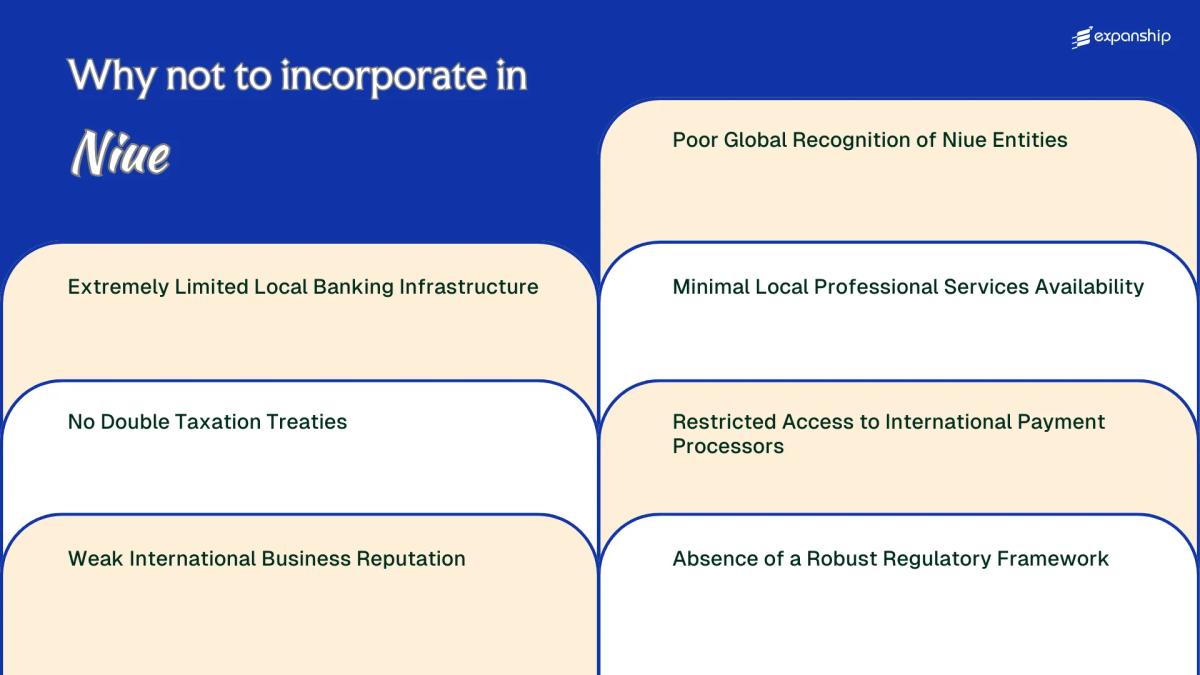
Extremely Limited Local Banking Infrastructure
Niue banking infrastructure limitations affect your company from day one. No licensed commercial banks operate on the island itself, meaning any entity incorporated under the Niue International Business Companies Act 1994 has no domestic banking system to draw on.
No Resident Banking Options for IBCs
Niue IBCs must establish banking relationships entirely offshore, typically through correspondent banks in New Zealand, Australia, or Pacific financial centres. Convincing those institutions to accept a Niue-registered entity is difficult, as many compliance departments apply heightened scrutiny to Pacific offshore jurisdictions with limited regulatory oversight.
Compounding Friction for Account Approval
Opening a bank account for a Niue company requires extensive due diligence documentation, and many banks outright decline such entities rather than investing resources in the onboarding process. The absence of a Financial Intelligence Unit with strong international standing weakens the credibility of your entity's compliance profile when presented to foreign institutions.
Most international banks will reject a Niue IBC application outright, leaving your company without a transactional account and effectively unable to operate.
No Double Taxation Treaties
Niue has no double taxation treaties with any country. This is not a minor administrative gap — it means your business income can be taxed in full by both the jurisdiction where the money is earned and by your home country, with no legal mechanism to offset one against the other.
For a foreign business owner, that exposure is direct. Dividends, royalties, or service fees paid out of a Niue entity to a foreign resident may face withholding or income tax abroad with zero credit available from the Niue side, since no bilateral agreement exists to allocate taxing rights.
This creates specific operational burdens:
- Profits repatriated to high-tax jurisdictions like Germany or Australia face full domestic taxation, with no treaty relief to reduce the effective rate.
- Shareholders in countries that tax foreign corporate income on a controlled foreign corporation basis have no treaty protection to limit their exposure.
- Cross-border service contracts involving a Niue company may trigger withholding obligations in the counterparty's country, increasing transaction costs with no offsetting relief.
The absence of any tax information exchange agreements compounds the uncertainty, as foreign tax authorities may treat Niue structures with heightened scrutiny.

Company Incorporation in Niue
Understand the full regulatory and tax implications before registering a company in Niue.
Weak International Business Reputation
Niue offshore company reputation risks extend well beyond tax considerations. The jurisdiction operates under the Niue International Business Companies Act, but the legislation has not attracted the volume of legitimate commercial activity needed to build credibility with foreign counterparties. Banks, auditors, and institutional partners in Europe, North America, and Asia frequently treat Niue-registered entities with heightened suspicion simply because the jurisdiction lacks a recognized track record in mainstream commerce.
| Counterparty Type | Typical Response to Niue Entity | Practical Consequence |
|---|---|---|
| Correspondent banks | Enhanced due diligence or outright refusal | Account opening delays or rejections |
| EU-based institutional investors | Require additional legal opinions | Increased professional fees |
| Payment platforms (Stripe, PayPal) | Flag or restrict merchant accounts | Operational disruption |
| Trade finance providers | Decline or impose higher risk premiums | Reduced access to credit facilities |
Niue jurisdiction business trust issues are structural, not incidental. The island does not appear on major international whitelists maintained by bodies such as the OECD's Global Forum, and its absence from treaty networks means there is no framework signaling compliance alignment to third parties. Foreign banks conducting AML screening frequently classify Niue-incorporated firms under elevated risk categories without further investigation.
Your counterparties bear the cost too. Due diligence requirements imposed on their side translate directly into delays, rejected transactions, or demands for documentation that a Delaware or Singapore entity would never face. That friction compounds over time, making routine commercial relationships harder to sustain.
Poor Global Recognition of Niue Entities
Poor global recognition of Niue entities is a structural problem that surfaces almost immediately once your company attempts to operate beyond the island's borders.
Niue IBCs are incorporated under the Niue Act 1966 and its subsequent amendments, but this legislative framework carries little weight with counterparties in major commercial jurisdictions. Banks in the EU, UK, US, and Singapore routinely flag or reject entities from Niue during due diligence, not because of a specific sanction, but because the jurisdiction lacks the institutional credibility those markets expect.
The absence of bilateral recognition agreements means your entity has no automatic legal standing in foreign courts. Enforcing a contract or recovering a debt abroad requires starting from scratch with local counsel in each target market.
Niue company acceptance limitations abroad extend to corporate relationships too. Foreign partners, suppliers, and institutional clients frequently require additional legal opinions or refuse engagement entirely when presented with a Niue-incorporated entity.
- Foreign courts do not automatically recognize the legal personality of a Niue IBC
- Third-party due diligence processes in most OECD markets classify Niue as a non-standard offshore jurisdiction
- Corporate counterparties may contractually require re-incorporation in a recognized jurisdiction before executing agreements
- No mutual recognition framework exists between Niue and major trading blocs
Niue was one of the earliest Pacific jurisdictions to offer IBCs in the 1990s, yet it never developed the international treaty network that gave competing jurisdictions like the BVI or Cayman Islands lasting commercial credibility.
Minimal Local Professional Services Availability
Niue professional services availability limitations affect foreign business owners at a practical level that documentation alone cannot resolve. The island's population sits below 2,000 residents, which structurally constrains the supply of qualified corporate service professionals.
A Thin Professional Market
Qualified lawyers, accountants, and company secretaries familiar with Niue's corporate legislation, including the Niue International Business Companies Act, are not based on the island in any meaningful number. Your entity will almost certainly depend on offshore intermediaries, most of whom operate from New Zealand, adding coordination delays and cost layers that would not exist in larger offshore centres.
Consequences for Ongoing Compliance
Niue local legal services drawbacks become most apparent when your company requires timely compliance support, such as annual return filings or registered agent updates under the Companies Act 2006. Securing specialist advice for less routine matters, including corporate restructuring or director changes, can involve extended turnaround times given the absence of a local professional ecosystem to draw on.
Managing Corporate Compliance Challenges in Niue
Understand the structural service limitations of maintaining a Niue entity and get guidance on how to address compliance requirements through the right channels.
Restricted Access to International Payment Processors
Niue company payment processor restrictions are not incidental; they follow directly from the island's exclusion from mainstream correspondent banking networks and its absence from FATF's list of cooperative jurisdictions. Major processors, including Stripe, PayPal, and Adyen, do not support merchant accounts registered under Niue IBCs.
- Your business cannot open a Stripe or PayPal merchant account using a Niue-registered entity, blocking direct online revenue collection from the outset.
- Correspondent banks that gateway access to SWIFT-connected payment rails routinely decline Niue offshore entities due to unresolved compliance risk classifications.
- Fintech platforms operating under EU or UK e-money licences are prohibited from onboarding entities incorporated in jurisdictions without equivalent AML supervisory standards, which excludes most Niue structures.
- Acquiring banks that underwrite card payment acceptance require verifiable local regulatory oversight, a requirement your Niue entity cannot satisfy under the current Niue International Business Companies Act framework.
- Processing workarounds through third-party nominee arrangements carry their own KYC rejection risk, compounding the original access problem rather than resolving it.
Absence of a Robust Regulatory Framework
Niue weak regulatory framework risks are a practical concern for any foreign business owner seeking institutional credibility. The jurisdiction's primary legislation governing offshore entities, the Niue International Business Companies Act, establishes basic incorporation procedures but provides limited ongoing supervisory mechanisms compared to regulated offshore centers such as the Cayman Islands or BVI.
The Financial Intelligence Unit (FIU) of Niue holds nominal anti-money laundering oversight responsibilities, yet the island's enforcement capacity remains constrained by its population size and resource base. This gap means that your company operates in an environment where regulatory guidance, enforcement precedent, and compliance clarification are difficult to obtain when disputes or ambiguities arise.
Absent a functioning financial services regulator with dedicated IBC oversight, your entity carries a higher burden of self-directed compliance. Third-party counterparties, including banks and institutional investors, frequently view this structural absence as a risk signal rather than a neutral fact.
A foreign-owned Niue IBC seeking to open a correspondent banking relationship is asked to provide audited financials and a regulator-issued certificate of good standing. With no dedicated financial services authority issuing such certificates in a recognized format, the business owner must engage costly legal counsel across multiple jurisdictions to produce equivalent documentation, potentially adding USD 3,000 to 6,000 in preparatory compliance costs before a single account application is submitted.
How to Navigate These Incorporation Challenges
Navigating Niue incorporation challenges requires structural planning before the entity is ever registered, not after problems surface. The gaps in banking access, treaty coverage, and regulatory depth are not incidental — they reflect the jurisdiction's foundational limitations as an offshore destination.
- Register your IBC under the Niue Act 1966 framework and verify current standing with the Niue Government's corporate registry before conducting any cross-border transactions.
- Open correspondent banking accounts in a third-country jurisdiction with established financial infrastructure to compensate for the absence of local banking options.
- Structure international contracts to account for the lack of double taxation treaty protection, using domestic tax residency in a treaty-enabled jurisdiction for relief claims.
- Engage payment processors through parent or subsidiary entities incorporated in recognised jurisdictions, given Niue companies face systematic rejection from major processors.
- Appoint a registered agent with verifiable credentials, as local professional service availability is limited and agent quality varies considerably.
These steps address discrete structural gaps but do not resolve the underlying absence of a formal financial regulatory authority or internationally recognised supervisory framework in this jurisdiction. Mitigation is possible in theory; in practice, the structural constraints remain.
Weighing the Value of Niue Incorporation
Weighing Niue incorporation risks vs benefits requires accepting a clear-eyed picture: the jurisdiction operates under the Niue International Business Companies Act and offers genuine privacy protections and low administrative costs, but the structural gaps covered throughout this blog are real and recurring. For the right business profile, those trade-offs may be acceptable. For many others, they represent friction that compounds over time.
| Pros | Cons |
|---|---|
| No corporate tax on income sourced outside Niue | No double taxation treaties, exposing income to full foreign tax liability |
| Strong statutory privacy protections under the IBC Act | Poor global recognition limits the entity's practical usability |
| Low formation and annual maintenance costs | Minimal local professional services require managing everything remotely |
| Fast incorporation with minimal bureaucratic requirements | No access to local banking infrastructure for operational accounts |
| Flexible corporate structures with few residency requirements | International payment processors routinely decline or restrict Niue entities |
Deciding whether Niue company formation is worth it depends heavily on how your business intends to operate, bank, and contract internationally. The absence of a developed regulatory framework means fewer compliance burdens on paper, but it also means less institutional credibility when counterparties conduct due diligence.
Compliance Services for Niue Companies
Understand your ongoing compliance obligations for a Niue IBC, including annual filings, registered agent requirements, and good standing maintenance.
Conclusion
A Niue company formation disadvantages summary must account for the structural realities covered throughout this article. The absence of any double taxation treaties leaves your business exposed to full withholding taxes in counterparty jurisdictions. Compounding this, the near-total lack of local banking infrastructure forces most entities to seek correspondent arrangements abroad, with inconsistent results. Poor recognition of Niue-registered firms among foreign counterparties and financial institutions further limits operational utility. For businesses weighing the cons of Niue IBC incorporation, professional guidance on jurisdiction selection and ongoing compliance management becomes a practical necessity rather than a preference.
Expanship Simplifies Your Niue Expansion
Incorporating under Niue's International Business Companies Act involves specific obligations that are easy to underestimate without local knowledge. Expanship's Niue company incorporation support services are designed to reduce the operational burden of managing those requirements, from working within the registry's documentation expectations to addressing the banking introduction challenges and reputational considerations covered throughout this blog.
Beyond the formation process itself, our service scope covers the full post-incorporation cycle.
- Your company is registered with all documents prepared to meet Niue's registry requirements.
- A registered agent and local office address are provided in compliance with IBC regulations.
- Government filings are handled and regulatory liaison managed on your behalf.
- Ongoing compliance obligations are monitored and met after incorporation.
- Banking introduction support is coordinated given the limited local infrastructure.
- Tax registration and any required liaison with local authorities is managed for your entity.
Reach out to Expanship Niue to discuss your requirements.
Frequently Asked Questions (FAQ)
The banking situation for a Niue IBC is more severe than most comparable offshore structures. Unlike jurisdictions such as the British Virgin Islands or Seychelles, Niue has no domestic banking sector capable of servicing international business companies, forcing every entity to seek correspondent banking arrangements abroad — a process that has become significantly harder as global anti-money laundering standards tighten. Many international banks now apply enhanced due diligence or outright decline accounts linked to Niue-registered entities due to the jurisdiction's limited regulatory profile.
The impact falls most heavily on businesses with active income flows between Niue and treaty-network countries. Niue has no double taxation agreements in force, meaning withholding taxes on dividends, royalties, and interest paid across borders cannot be reduced through treaty relief, and foreign tax credits may be unavailable depending on the counterparty jurisdiction's domestic rules. A purely asset-holding structure with no cross-border income streams faces less immediate impact, but the exposure increases substantially once commercial activity begins.
Niue IBCs are governed by the Niue International Business Companies Act 1994. While the Act provides a basic incorporation framework, it has not kept pace with the compliance expectations set by the Financial Action Task Force or the OECD's Base Erosion and Profit Shifting standards, which is a primary reason why Niue entities attract heightened scrutiny from foreign regulators and financial institutions.
Yes, Niue-registered entities face a higher rejection rate from payment processors than firms incorporated in more established offshore centres. Processors such as Stripe and PayPal apply jurisdiction-level risk assessments, and Niue's limited regulatory infrastructure places it outside the acceptable range for most platforms. Even processors that do not explicitly blacklist the jurisdiction will often decline onboarding upon reviewing the entity's registration documentation.
Foreign counterparties — including banks, suppliers, and institutional clients — frequently have no framework for recognising a Niue entity, which creates friction at the contract execution and account-opening stages. Without a recognised legal standing in major commercial markets, your company may be required to provide extensive additional documentation that firms from other jurisdictions are not asked to supply, adding both cost and delay. In some cases, counterparties refuse to transact with Niue entities entirely, regardless of the underlying business legitimacy.
It can, particularly where the Niue International Business Companies Act 1994 requires ongoing administrative filings or statutory records that must be maintained by a registered agent on the island. The pool of licensed service providers in Niue is extremely small, and if your appointed agent ceases operations or becomes non-responsive, locating a replacement quickly is difficult. Delays in agent succession can leave a company technically non-compliant with its registered agent obligations under the Act.
There is no fixed cost, but businesses routinely spend significantly more on alternative financial arrangements than they would with an entity incorporated in a jurisdiction that carries normal banking access. Securing an EMI account or a third-party payment solution capable of accepting a Niue entity typically involves higher monthly fees, elevated transaction costs, and additional compliance documentation requirements. These ongoing costs frequently exceed the initial savings gained from Niue's low incorporation fees.
Niue is not currently on the FATF grey or black list, so its reputational disadvantage operates differently from jurisdictions that carry a formal adverse listing. The problem is one of obscurity and perceived regulatory insufficiency rather than an explicit sanctions designation, but the commercial outcome is often similar — counterparties apply the same caution they would to a listed jurisdiction because Niue lacks the visibility and compliance infrastructure needed to reassure them. This ambiguity can be harder to address than a clear listing, since there is no formal remediation pathway to point to.
Legal Disclaimer
The information provided in this article is for general informational purposes only and does not constitute legal, tax, or professional advice. While we strive to ensure the accuracy and timeliness of the content, laws and regulations are subject to change, and the application of laws can vary widely based on specific facts and circumstances.
Readers should not act upon this information without seeking professional counsel tailored to their individual situation. Expanship and its authors disclaim any liability for actions taken or not taken based on the content of this article.
For specific advice regarding your business setup, compliance requirements, or any legal matters, please consult with qualified legal and tax professionals in the relevant jurisdiction.