

Key Takeaways
- Under the Niue International Business Companies Act 1994, offshore income is subject to zero corporate tax, meaning retained earnings from international operations remain entirely within the structure rather than being reduced at the jurisdictional level.
- The absence of mandatory annual financial reporting eliminates a recurring administrative burden while keeping commercially sensitive financial data out of public registries.
- Because Niue imposes no exchange controls or currency restrictions, an IBC can hold and transfer capital across currencies and markets without requiring regulatory clearance from the jurisdiction.
- Capital gains from asset disposals face no tax liability under Niue's offshore framework, which directly affects how asset-heavy structures and investment portfolios can be organized and wound down.
Niue is a self-governing island nation in the South Pacific, operating in free association with New Zealand. Despite its small geographic footprint, it maintains an independent legal and regulatory framework that accommodates international business activity. Company registration falls under the oversight of the Niue Registry, which administers corporate filings for foreign-incorporated entities. The most common vehicle used by international investors is the International Business Company, formed under the Niue International Business Companies Act 1994.
From a tax perspective, the jurisdiction operates on a zero-tax basis for offshore income earned outside its territory, making it a straightforward choice when assessing the benefits of incorporating in Niue. Foreign ownership faces no material restrictions — non-residents can hold 100% of shares in a locally registered entity without requiring a domestic partner or government approval.
This article examines the principal advantages that the jurisdiction's corporate framework offers to foreign investors and business operators.
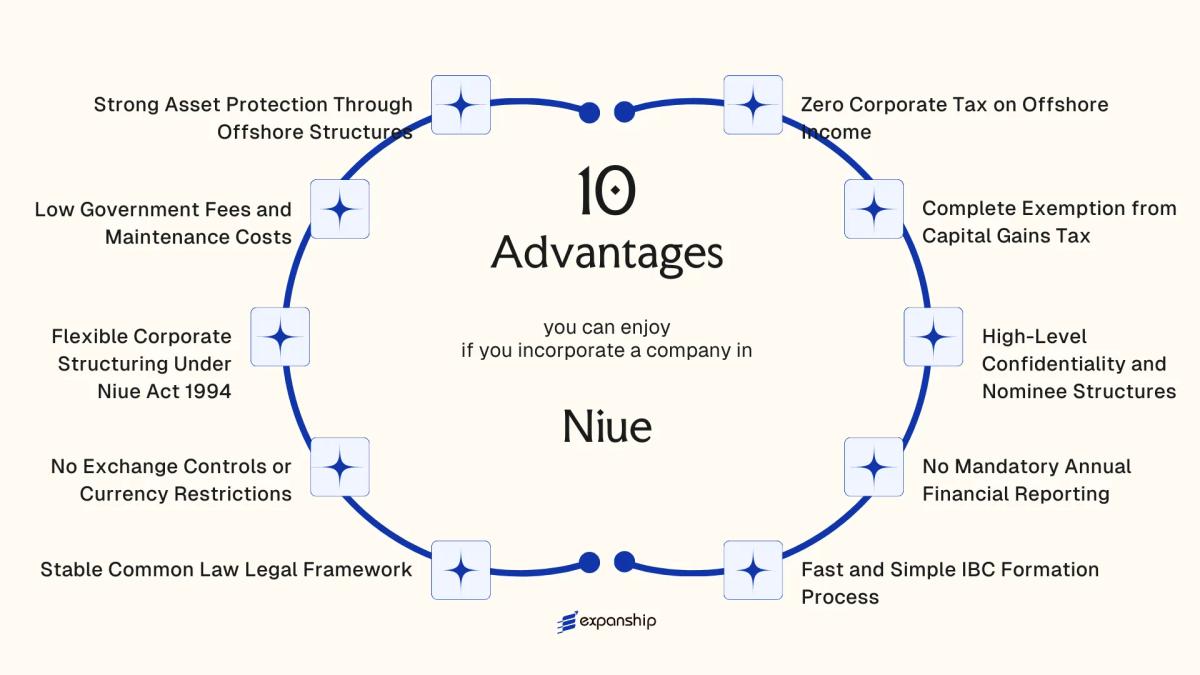
Zero Corporate Tax on Offshore Income
Niue zero tax on offshore income is the headline benefit of the jurisdiction's International Business Company regime, governed by the Niue International Business Companies Act 1994. For foreign business owners, this single rule determines how much of your international earnings remain working capital rather than tax liability.
How the Exemption Is Structured
Under the 1994 Act, an IBC incorporated in Niue pays zero corporate tax on income sourced outside the jurisdiction. The exemption applies by statute, not by administrative discretion, which means it is consistent and not subject to annual renegotiation.
What This Means in Practice
For an entity conducting trading, consulting, or holding activities with non-Niue counterparties, all qualifying offshore profits are retained in full. Standard corporate tax rates across OECD member states range from 19% to 30%, making the contrast with a Niue IBC corporate tax exemption structurally significant for businesses operating across borders.
Eligibility depends on maintaining the IBC's activities outside Niue and ensuring that income is genuinely foreign-sourced under the terms of the Act. Resident income does not qualify for the offshore exemption.
Every dollar earned offshore stays in your business — no portion is redirected to corporate tax on qualifying IBC income.
Complete Exemption from Capital Gains Tax
Niue capital gains tax exemption benefit sits at the core of why IBCs registered under the Niue Act 1994 attract internationally mobile investors. Under the Act, international business companies are fully exempt from capital gains tax on disposals of assets, investments, or shareholdings — regardless of where those assets are located or how the gain arises.
For a foreign investor holding equity stakes, property portfolios, or financial instruments through a Niue IBC, this means the full value of any appreciation is retained at the point of sale. No portion of the gain is eroded by a local tax charge on exit.
This exemption applies specifically to income and gains sourced outside the jurisdiction. The practical scope is broad:
- Gains on share disposals are not subject to any local levy, removing a cost that routinely reduces net returns in higher-tax jurisdictions
- Disposal of intellectual property held through the entity generates no local tax liability on the uplift in value
- Investment portfolio rebalancing can occur without triggering a taxable event at the company level
- Reinvestment of realised gains back into the structure faces no withholding at source within Niue
The exemption is not conditional on a minimum holding period, which gives your business full flexibility over the timing of asset disposals.

Incorporate a Company in Niue
Register your Niue IBC and access full capital gains tax exemption under the Niue Act 1994.
High-Level Confidentiality and Nominee Structures
Niue offshore company confidentiality benefits are grounded in statute rather than administrative discretion. Under the Niue International Business Companies Act 1994, neither the names of shareholders nor those of directors are required to be entered into any publicly accessible register. Ownership information is held privately by the registered agent, which means third parties have no routine legal mechanism to identify who controls a given entity.
Nominee structures reinforce this further. A licensed registered agent in Niue may act as nominee shareholder or nominee director on behalf of the beneficial owner, with the underlying ownership documented through a private declaration of trust or nominee agreement. This separation means your name does not appear in any filing that is accessible outside the confidential corporate record.
| Feature | Position Under Niue IBC Act 1994 |
|---|---|
| Shareholder register | Private; not publicly disclosed |
| Director register | Private; not publicly disclosed |
| Nominee shareholders permitted | Yes |
| Nominee directors permitted | Yes |
| Beneficial owner disclosure (public) | Not required under domestic law |
For business owners operating in jurisdictions where commercial or political exposure is a concern, this statutory privacy layer provides a formal and enforceable barrier rather than a discretionary one. The confidentiality provisions apply to both individuals and corporate shareholders, so structuring through an intermediate holding entity is also supported. Disclosure obligations may arise where Niue cooperates with foreign authorities under specific mutual legal assistance arrangements.
No Mandatory Annual Financial Reporting
Under the Niue International Business Companies Act 1994, IBCs registered in the jurisdiction face no mandatory annual financial reporting requirement to any government authority. There is no obligation to file audited accounts, prepare statutory financial statements, or submit annual returns containing financial data. For a foreign business owner, this translates directly into lower recurring costs and significantly reduced administrative burden year over year.
Most established corporate jurisdictions require annual audits, sometimes costing several thousand dollars per year. Removing that obligation means your company's operational budget is not tied up in compliance overhead that produces no commercial output.
The Niue Act 1994 does not prescribe a mandatory accounting standard, audit firm appointment, or submission deadline for financial records to a regulator. You are still expected to maintain internal records sufficient to reflect the company's financial position, but the decision on format, frequency, and disclosure remains entirely internal.
Keep the following in mind:
- Internal financial records should still be maintained to support banking relationships and due diligence requests
- No public disclosure of accounts is required under the 1994 Act
- The Niue IBC reporting exemption applies specifically to offshore income-generating structures, not necessarily locally-operating entities
- Registered agent records are kept private and are not accessible through any public registry
Niue IBCs are not required to appoint an auditor at incorporation or at any subsequent point, a requirement that is standard even in many other well-known offshore centers.
Fast and Simple IBC Formation Process
Niue IBC fast formation benefits stem directly from how the jurisdiction has structured its registration framework. Under the Niue International Business Companies Act 1994, incorporating an international business company requires minimal documentation, and the process can typically be completed within one to two business days through a licensed registered agent based on the island.
Why Speed Translates to a Practical Advantage
For a foreign business owner, the short formation timeline means your entity can be legally constituted and operational before time-sensitive transactions close. Many competing offshore jurisdictions require notarization, apostilles, or multi-stage government approvals that add weeks to the process.
No physical presence is required during registration. All incorporation filings are handled through the registered agent, which eliminates the cost and delay of in-person procedures.
What the Simple Requirements Mean for Your Structure
The documentation threshold is low: a company name, the intended objects or general commercial purpose, details of at least one director and one shareholder, and a registered office address in Niue. There is no requirement to submit a business plan, prove source of funds at the registration stage, or obtain pre-approval from a regulatory authority.
Because the Niue International Business Companies Act 1994 allows corporate directors and shareholders, a single holding entity can satisfy both requirements simultaneously. This structural flexibility shortens setup time further, reducing the administrative burden on foreign founders who prefer to act through existing corporate structures rather than appointing individuals.
Get Started with Your Niue IBC Incorporation
Speak with our corporate services team about incorporating your international business company in Niue and ensuring full compliance from day one.
Stable Common Law Legal Framework
Niue common law legal framework benefits extend from the jurisdiction's foundational legal heritage as a self-governing territory in free association with New Zealand. The legal system is grounded in English common law principles, which carry direct practical weight for how contracts are interpreted, disputes are resolved, and corporate structures are enforced.
- Predictability in contract enforcement is a concrete operational advantage. Common law jurisdictions apply precedent-based reasoning, meaning courts interpret agreements according to established doctrine rather than ad hoc statutory discretion. For a foreign business owner, this reduces legal uncertainty when structuring cross-border transactions or agreements through your Niue entity.
- Corporate structures formed under the Niue Act 1994 are governed within a legal tradition familiar to businesses, attorneys, and counterparties across the UK, Australia, Canada, and other common law jurisdictions. This shared legal vocabulary reduces friction when dealing with foreign counsel or institutional partners who need to assess your offshore structure.
- New Zealand's legal influence on Niue's statutory development means the underlying legislative drafting follows common law standards of clarity and consistency. Foreign investors operating across multiple common law jurisdictions can apply familiar legal reasoning when working with a Niue-incorporated entity, without needing to relearn a civil law framework from the ground up.
No Exchange Controls or Currency Restrictions
Niue imposes no exchange controls on IBCs, meaning your business can send and receive funds in any currency without prior approval from a regulatory authority. This absence of restriction is embedded in the framework established under the Niue Act 1994, which governs offshore entities and does not subject them to domestic monetary controls. For a firm operating across multiple currencies or markets, this eliminates a category of administrative friction that affects companies incorporated in many regulated jurisdictions.
Practical access to capital is the core advantage here. Transferring profits abroad, repatriating investment returns, or settling international invoices requires no government authorization. Your company holds full discretion over the timing, currency, and destination of fund movements.
This freedom also extends to how accounts are structured. An offshore entity can maintain bank accounts denominated in foreign currencies without conversion requirements, which preserves value in volatile exchange rate environments.
Hypothetical scenario: A trading company incorporated in Niue invoices clients in USD, EUR, and SGD across three continents. Because no conversion mandate or repatriation rule applies, the firm retains balances in their original currencies, avoiding conversion losses that would otherwise apply in jurisdictions with mandatory local-currency settlement requirements. Over a 12-month period with moderate exchange rate fluctuation, this could preserve 2-4% of gross receivables that would otherwise be lost to forced conversion spreads.
Flexible Corporate Structuring Under Niue Act 1994
Niue IBC Act 1994 flexible corporate structuring provisions give foreign business owners significant latitude in designing how their entity is governed and owned. The Act permits a single shareholder and a single director, who may be the same person, removing the need to bring in additional parties purely to satisfy formation requirements.
Share capital arrangements are equally permissive:
- No minimum paid-up capital is required at incorporation
- Bearer shares are permitted under the Act, subject to applicable registry conditions
- Shares may be issued in any currency, which matters for businesses operating across multiple currency zones
Nominee arrangements for both shareholders and directors are recognised under the framework, allowing the beneficial owner to separate legal title from operational control. This separation has practical value for estate planning, joint ventures, and multi-layered holding arrangements.
Voting rights and dividend entitlements can be structured across different share classes, giving you control over how profits and decisions are allocated among participants. Comparable flexibility in EU jurisdictions typically requires more complex constitutional documentation and regulatory filings.
Bearer share provisions under the Niue IBC Act 1994 may be subject to conditions tied to anti-money laundering compliance requirements; confirm current eligibility with your registered agent before relying on this feature.
Low Government Fees and Maintenance Costs
Niue low government fees offshore company structures are governed under the Niue International Business Companies Act 1994, which sets a fixed, low-cost fee framework for incorporation and annual renewal. These fees are established by statute rather than discretionary administrative schedules, which means your costs remain predictable from year to year.
Incorporation Fees
Government registration fees for an International Business Company are modest by international standards. More practically, the fixed nature of these fees means there are no variable charges tied to authorized share capital in the way many other offshore jurisdictions apply them, removing one of the more common sources of cost escalation during the formation process.
Annual Renewal Costs
The annual government renewal fee required to keep an IBC in good standing is low relative to comparable offshore structures in jurisdictions such as the British Virgin Islands or Cayman Islands, where annual fees can reach several hundred to over a thousand US dollars. Keeping a firm active costs less, which matters when you maintain multiple entities across a holding structure.
What This Means for Foreign Business Owners
- Annual compliance costs do not scale with company activity or revenue, so a dormant or early-stage entity carries no financial penalty for existing.
- The absence of mandatory audited accounts filing eliminates the recurring professional fees that audit-requiring jurisdictions impose annually.
- Total annual cost of maintaining an IBC, including government fees and basic registered agent services, generally falls within a range accessible to small and mid-sized businesses.
Strong Asset Protection Through Offshore Structures
Niue offshore asset protection benefits stem from a structural design that keeps foreign-sourced assets legally separated from domestic claims, enforcement actions, and creditor reach in the owner's home country.
Under the Niue Act 1994, an International Business Company (IBC) is treated as a distinct legal entity with no beneficial ownership disclosure obligations to public registries. Because the IBC holds assets in its own name rather than in the name of the individual, personal creditors in your home jurisdiction typically cannot assert direct claims against company-held property without first piercing the corporate veil, a standard that varies by home jurisdiction but generally requires evidence of fraud or co-mingling.
The practical implications for asset shielding are meaningful:
- Shareholding and directorship information is not publicly accessible, reducing the exposure surface for pre-litigation asset searches.
- The firm can hold financial instruments, intellectual property, or real estate titles, placing multiple asset classes behind a single corporate structure.
- No statutory requirement exists under Niue's IBC framework for the entity to maintain local bank accounts or register assets domestically, allowing flexibility in where protected assets are custodied.
- Nominee arrangements are permitted, adding a further structural layer between the beneficial owner's identity and any publicly visible corporate record.
Because Niue is not party to most mutual legal assistance treaties covering civil asset recovery, foreign civil judgments do not automatically convert into enforceable local orders. Enforcement would require fresh proceedings under local law, which creates a procedural barrier that adds time and cost to any recovery attempt.
Why Niue Stands Out Among Offshore Jurisdictions
Situated in the South Pacific and governed by the Niue Act 1994, this jurisdiction is most directly comparable to other small-island IBC centres that target the same category of foreign investor: those seeking zero-tax offshore structures with minimal reporting obligations. The three competitors selected — Vanuatu, Cook Islands, and Samoa — operate within the same Pacific region and present similar incorporation profiles, meaning a foreign business owner evaluating one would typically research all four. The comparison below focuses on parameters where this jurisdiction holds a neutral or favourable position.
What the table reflects, beyond the individual data points, is a consistency across several variables simultaneously. A jurisdiction may offer a zero-tax rate but impose mandatory audits, or provide confidentiality but carry higher annual fees. The combination of tax exemption, absence of audit requirements, no exchange controls, and relatively low government fees within a single common law framework is what gives this offshore centre its comparative position among Pacific IBC destinations.
| Feature | Niue | Vanuatu | Cook Islands | Samoa |
|---|---|---|---|---|
| Corporate Tax on Offshore Income | 0% | 0% | 0% | 0% |
| Capital Gains Tax | None | None | None | None |
| Mandatory Annual Financial Audit | No | No | No | Yes (in some structures) |
| Common Law Legal System | Yes | Hybrid | Yes | Yes |
| Exchange Controls | None | None | None | None |
| Government Annual Fee | Low | Low–Moderate | Moderate | Moderate |
| Bearer Shares Permitted | No | No | No | No |
Compliance Services for Niue Companies
Maintain your Niue IBC in good standing with our end-to-end compliance support, covering annual filings, registered agent requirements, and regulatory obligations under the Niue Act 1994.
Conclusion
The benefits of incorporating in Niue rest on a coherent statutory foundation rather than a patchwork of incentives. The Niue International Business Companies Act 1994 creates a structure where zero tax on offshore income and no capital gains liability are not policy preferences but codified legal positions, each with direct consequences for how retained earnings and asset disposals are treated within your corporate structure.
Two features carry particular weight for foreign business owners. The absence of mandatory annual financial reporting reduces both administrative cost and ongoing exposure of commercially sensitive information. Combined with the absence of exchange controls, this gives your entity freedom in how it holds, moves, and deploys capital across currencies and markets without regulatory interference at the jurisdictional level.
That said, the suitability of a Niue IBC depends on the nature of your operations, the tax residency of your beneficial owners, and the regulatory environment in the countries where your business generates income. Substance requirements and controlled foreign corporation rules in your home jurisdiction will shape what the structure can legally achieve. A clear-eyed assessment of those factors determines whether the Niue IBC formation benefits for businesses translate into practical advantage in your specific case. For those whose circumstances align with what the jurisdiction offers, the next step is working through the formation process with advisors who understand both the local framework and the cross-border compliance picture.
Start Your Niue Company with Expanship Today
Expanship manages the full formation process for International Business Companies incorporated under the Niue International Business Companies Act 1994, handling everything from name reservation through to registration with the Niue Island Government's registrar. The benefits covered throughout this blog — including tax exemptions, confidentiality provisions, and the absence of exchange controls — require precise document preparation and accurate regulatory filings to take effect as intended. Each engagement is structured around the specific obligations and exemptions that apply to your entity under Niuean law.
Expanship's services for your Niue IBC registration cover the following:
- Preparation and legalization of incorporation documents
- Registered agent and registered office provision in Niue
- Government filing and liaison with the registrar on your behalf
- Post-incorporation compliance management, including annual renewal filings
- Nominee director and shareholder arrangements where applicable
- Banking introduction assistance for corporate account setup
To discuss your requirements with Expanship Niue, submit an enquiry through the contact page.
Frequently Asked Questions (FAQ)
Income derived from sources outside Niue is subject to zero corporate tax under the International Business Companies Act 1994. This exemption applies to trading profits, royalties, dividends received, and interest income generated offshore. The zero-rate treatment is a statutory feature of the IBC regime, not a discretionary concession.
Formation is generally completed within one to two business days once the required documentation is submitted to the registered agent. The Niue Act 1994 does not impose a mandatory waiting period or government pre-approval process for standard incorporations. Timelines can extend slightly if additional due diligence documentation is required.
No statutory obligation exists under the Niue International Business Companies Act 1994 to file annual financial statements, audited accounts, or tax returns with any government authority. Records must be maintained by the company, but there is no public filing or submission requirement directed at offshore IBCs. This distinguishes the regime from jurisdictions that mandate annual reporting even for dormant entities.
Niue has implemented international anti-money laundering standards and maintains a financial intelligence framework aligned with regional compliance expectations in the Pacific. Whether a specific bank or counterparty will accept a Niue IBC depends on that institution's internal policies, the nature of the business activity, and the ultimate beneficial ownership structure. Engaging a reputable registered agent and maintaining clean corporate records materially improves banking acceptance outcomes.
Confidentiality protections under Niue's IBC framework apply to public disclosure; they do not override valid court orders issued by competent foreign jurisdictions in the context of legal proceedings. If a foreign court issues a disclosure order and enforcement mechanisms are engaged, the structural privacy afforded by nominee arrangements may not provide absolute protection. The practical effect depends on the specific bilateral relationships and applicable conflict-of-law rules.
Niue imposes no exchange controls on IBCs, meaning your company can hold accounts in any currency, repatriate profits freely, and conduct cross-border transfers without seeking regulatory approval. This is a statutory feature of the offshore regime rather than a policy position subject to ministerial discretion. There are no reporting thresholds or prior authorization requirements tied specifically to the movement of funds by an IBC.
Legal Disclaimer
The information provided in this article is for general informational purposes only and does not constitute legal, tax, or professional advice. While we strive to ensure the accuracy and timeliness of the content, laws and regulations are subject to change, and the application of laws can vary widely based on specific facts and circumstances.
Readers should not act upon this information without seeking professional counsel tailored to their individual situation. Expanship and its authors disclaim any liability for actions taken or not taken based on the content of this article.
For specific advice regarding your business setup, compliance requirements, or any legal matters, please consult with qualified legal and tax professionals in the relevant jurisdiction.