
Key Takeaways
- Norway imposes a 22% corporate tax rate alongside a 37.84% effective tax on distributed dividends, creating a dual-layer burden that reduces post-tax returns for foreign shareholders compared to many competing European jurisdictions.
- Under the aksjeloven, forming a private limited company (AS) requires a minimum share capital of NOK 30,000, which must be fully paid up before registration — a liquidity constraint absent in several other Nordic incorporation regimes.
- The Brønnøysund Register Centre enforces ongoing filing and disclosure obligations that apply regardless of company size or activity level, meaning even dormant entities face administrative overhead to maintain good standing.
- Sectors including financial services, aquaculture, and certain natural resource industries are subject to Norwegian foreign ownership restrictions, which can materially limit the structural options available to non-EEA investors.
Norway operates under a heavily regulated corporate framework, and understanding the disadvantages of incorporating in Norway is relevant before committing to a formal structure there. The Private Limited Companies Act (aksjeloven) governs the primary vehicle used by foreign investors — the aksjeselskap (AS) — and sets the procedural and financial baseline for formation and ongoing compliance.
Several categories of disadvantage exist across tax, capital, labor, and regulatory dimensions. Not all of them apply equally to every business; a sole-operator consulting firm faces a different compliance burden than a manufacturing entity with local employees.
This article is most relevant to foreign entrepreneurs and non-EEA investors considering a Norwegian private limited company as their entry point into the Scandinavian market.
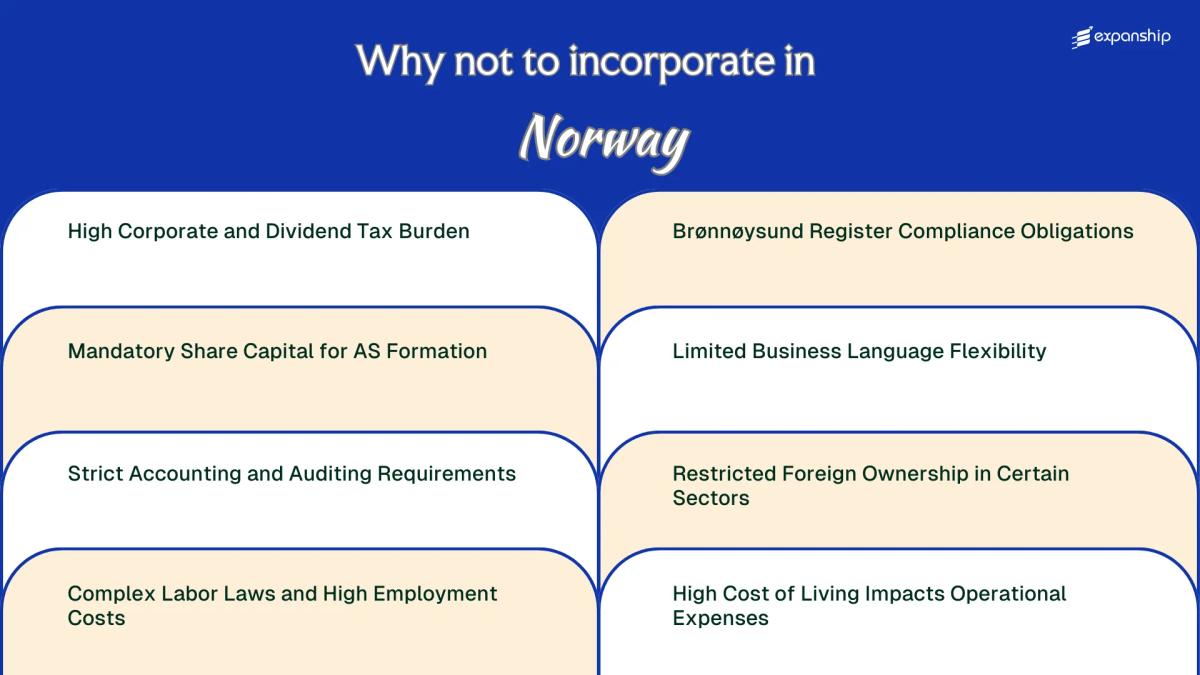
High Corporate and Dividend Tax Burden
The Norway corporate tax burden sits at 22% on company profits, which is moderate on its own but becomes significantly more expensive once dividend distributions are factored in.
Corporate Tax Combined with Shareholder-Level Taxation
Under the Norwegian Tax Act, dividends paid to personal shareholders are subject to an additional tax after a risk-free return allowance (skjermingsfradrag) is deducted. The effective combined rate on distributed profits can approach 51.5%, making retained earnings a structurally different decision from profit extraction.
For a foreign owner operating through a Norwegian aksjeselskap (AS), this layered taxation directly reduces the after-tax return on investment compared to jurisdictions with flat or single-level corporate tax regimes.
The Dividend Tax Drawbacks for Foreign Investors
Dividends paid to foreign shareholders may also be subject to Norwegian withholding tax, typically at 25% under domestic law, though tax treaties can reduce this rate. Without a favorable treaty in place, the gross tax friction on distributing profits offshore is a material cost that can erode the business case for the structure.
The high tax challenges of running a Norway AS compound when corporate profits are modest, since fixed compliance costs remain regardless of profitability.
Foreign business owners without a qualifying tax treaty with Norway may face withholding tax of up to 25% on dividend distributions, layered on top of the 22% corporate tax already paid at the entity level.
Mandatory Share Capital for AS Formation
Norway AS share capital requirements catch many foreign founders off guard. Under the Companies Act (aksjeloven), forming a private limited company (AS) requires a minimum share capital of NOK 30,000, which is approximately EUR 2,600 at current exchange rates. That figure may appear modest, but it must be fully paid up before registration is complete.
The real friction comes from timing. Capital must be deposited into a Norwegian bank account in the company's name before the Brønnøysund Register Centre processes the incorporation, and opening that account as a foreign national is not straightforward.
For a foreign business owner, this requirement creates several layers of practical burden:
- You cannot begin formal operations until capital is verified and deposited, extending your timeline significantly.
- Accessing a Norwegian corporate bank account as a non-resident often requires in-person verification or a local representative.
- Any undercapitalization after formation can trigger personal liability exposure for directors under aksjeloven provisions.
- Currency conversion from foreign accounts adds transaction costs that erode the initial capital before the entity is even active.
Sole traders or smaller foreign operators may find the liquidity lock-up disproportionate relative to the business volume they intend to generate initially.

Company Incorporation in Norway
Set up your Norwegian AS with full guidance on share capital deposit, bank account opening, and Brønnøysund registration.
Strict Accounting and Auditing Requirements
Norway accounting auditing obligations for an aksjeselskap (AS) extend well beyond basic bookkeeping. Under the Norwegian Accounting Act (Regnskapsloven) and the Auditing and Auditors Act (Revisorloven), most AS entities are required to prepare annual financial statements in accordance with Norwegian Generally Accepted Accounting Principles (NGAAP) and submit them to the Brønnøysund Register Centre. For a foreign operator unfamiliar with NGAAP, this typically means hiring a local Norwegian accountant, adding a fixed overhead cost from day one.
| Requirement | Threshold / Detail | Burden for Foreign Operators |
|---|---|---|
| Statutory audit obligation | Applies to most AS companies below certain size thresholds unless exemption applies | Mandatory licensed auditor (revisor) fee required annually |
| Annual accounts submission | Must be filed within 6 months of financial year-end | Late filing triggers daily fines from Brønnøysund |
| Accounting standards | NGAAP (or IFRS for larger entities) | Incompatible with home-country reporting; dual accounting often needed |
| Auditor qualification | Must be state-authorized under Finanstilsynet oversight | Cannot use an auditor from outside Norway |
Small AS companies can apply for a statutory audit exemption if they fall below specific revenue, balance sheet, and employee thresholds. However, many foreign-owned entities exceed at least one threshold, which disqualifies them from this relief. Engaging a Finanstilsynet-registered auditor (revisor) is not inexpensive, and annual audit fees in Norway reflect the country's high professional service rates. The combination of mandatory local expertise and strict submission deadlines creates a recurring compliance cost that foreign business owners cannot easily absorb through their existing finance teams abroad.
Complex Labor Laws and High Employment Costs
Norway employment law challenges create a meaningful compliance burden before your business even makes its first hire. The Working Environment Act (arbeidsmiljøloven) sets extensive statutory minimums covering working hours, termination procedures, notice periods, and employee representation rights, all of which impose direct costs on foreign operators unfamiliar with the framework.
Dismissing an employee is structurally difficult. Termination requires objectively justifiable grounds under the Act, and employees have the right to request a formal meeting before dismissal, receive written notice, and in some cases continue working during a dispute period while the case is heard in court.
Employer costs extend well beyond base salary. Payroll taxes under the Norwegian social security contribution system (arbeidsgiveravgift) vary by geographic zone but reach up to 14.1% of gross wages in most commercial regions, adding directly to the cost of every hire.
- Employers must pay arbeidsgiveravgift on all employee wages, with rates determined by the municipality where work is performed
- The Working Environment Act mandates written employment contracts before work begins
- Employees are entitled to a minimum of 25 working days of annual leave under the Holiday Act
- Collective agreements (tariffavtaler) may impose additional obligations beyond statutory minimums
- Parental leave entitlements are partially employer-funded through advance payment obligations
Norway's geographic payroll tax zones mean two businesses in the same industry can face significantly different employer tax rates based solely on where their employees are physically located.
Brønnøysund Register Compliance Obligations
Brønnøysund Register compliance burdens extend well beyond a one-time registration filing. For a foreign-owned aksjeselskap, the ongoing reporting obligations are both time-sensitive and administratively demanding.
What the Register Requires
The Brønnøysund Register Centre administers several interlocking registries, including the Entities Register (Enhetsregisteret) and the Register of Business Enterprises (Foretaksregisteret), each with distinct Norway company register obligations. Any change to your company's board composition, registered address, share structure, or articles of association must be formally reported, with filing fees and deadlines that vary by notification type.
Why This Creates Burden for Foreign Owners
Filings are conducted through the Altinn digital portal, which operates primarily in Norwegian, making the process genuinely difficult for directors without local language capability or a resident representative. Missing a reporting deadline can result in enforcement fines issued under the Companies Act (aksjeloven), which accumulate on a daily basis until the breach is remedied.
Annual confirmation filings are still required even when no structural changes have occurred, meaning administrative costs persist regardless of your entity's activity level.
Support with Brønnøysund Register Filings in Norway
Our team assists foreign-owned entities in meeting their Brønnøysund Register reporting obligations accurately and on time, reducing exposure to enforcement fines under Norwegian law.
Limited Business Language Flexibility
Norway business language restrictions create a concrete operational burden that is easy to underestimate during company formation planning.
- All official filings submitted to the Brønnøysund Register Centre must be completed in Norwegian, meaning foreign founders must either hire a local agent or translator for every submission.
- The Companies Act (aksjeloven) and the Accounting Act (regnskapsloven) set statutory requirements in Norwegian, so misreading translated versions of these laws carries direct legal risk.
- Annual accounts must be prepared in Norwegian under the Accounting Act, which adds translation costs for any foreign parent entity that consolidates financials in another language.
- Correspondence with the Norwegian Tax Administration (Skatteetaten) is conducted in Norwegian, creating dependency on bilingual professionals for routine compliance tasks.
- Employment contracts, while not strictly mandated to be in Norwegian by a single statute, are expected to comply with Norwegian labor law terminology, which creates drafting complexity for foreign HR teams.
- Unlike jurisdictions that accept English as an official filing language, Norway offers no formal English-language registration pathway for the aksjeselskap (AS) structure.
Restricted Foreign Ownership in Certain Sectors
Norway foreign ownership restrictions apply across several strategically sensitive industries, and for foreign investors, these constraints can limit both entry and control.
Under the Norwegian Security Act (sikkerhetsloven), acquisitions in sectors deemed critical to national security require prior notification to the government. This includes defense, energy infrastructure, and telecommunications. If authorities determine that a transaction poses a security risk, they can block or reverse it.
The Petroleum Activities Act governs foreign participation in offshore oil and gas operations, where the state-owned entity Petoro holds significant interests and the Ministry of Energy retains licensing discretion. A foreign firm cannot simply incorporate and acquire upstream assets without regulatory clearance.
Fishing and aquaculture present some of the most rigid limits. Under the Participation Act (deltakerloven), fishing vessel ownership is restricted to Norwegian nationals or entities majority-owned by Norwegian citizens.
- Foreign ownership above certain thresholds in financial institutions requires approval from Finanstilsynet, the Financial Supervisory Authority of Norway.
- Real estate acquisition near border zones or military installations may also trigger review under security legislation.
A foreign investor acquiring a 40% stake in a Norwegian aquaculture firm may find that operational licensing under the Aquaculture Act is conditioned on Norwegian majority ownership, effectively reducing the foreign party to a minority position with limited governance rights.
High Cost of Living Impacts Operational Expenses
Norway's high cost of living business impact is felt most directly in the fixed costs your entity cannot avoid: office leases, professional services, and day-to-day operational spending. Oslo consistently ranks among the most expensive cities in Europe for commercial real estate, and that cost floor applies regardless of company size or revenue stage.
Accounting firms, legal advisors, and corporate secretarial services charge rates that reflect local wage expectations, which are among the highest in the OECD. A foreign firm accustomed to service costs in Central or Eastern Europe will find the equivalent work priced substantially higher here.
Even routine expenses compound the burden:
- Commercial office space in Oslo can exceed what comparable space costs in Amsterdam or Stockholm
- Local professional fees for statutory filings, audits, and board-level compliance work are priced to match Norwegian wage benchmarks
- Bank account maintenance, notary services, and translation requirements each carry costs that are disproportionate relative to many peer jurisdictions
Operational expense challenges in Norway incorporation are not temporary. They reflect structural wage and price levels anchored in a high-income economy, meaning your cost base does not compress as the business matures.
Cost projections based on your home market or another EU jurisdiction will materially underestimate operational expenses in Norway, and no legal structure or entity type exempts your business from the underlying price environment.
Overcoming These Incorporation Challenges
Overcoming these incorporation challenges in Norway requires structural preparation rather than reactive fixes. The regulatory environment is well-documented, and most obstacles have defined procedural paths through official channels.
- Register your aksjeselskap with the minimum NOK 30,000 share capital through the Brønnøysund Register to satisfy formation requirements from the outset.
- Elect audit exemption status if your AS qualifies under the thresholds in the Norwegian Auditors Act to reduce mandatory auditing obligations.
- Structure employment contracts in full alignment with the Working Environment Act before hiring to address statutory labor compliance from the start.
- Apply for a D-number or Norwegian organisation number early, as both are prerequisites for tax registration and banking access.
- Review sector-specific foreign ownership restrictions under Norwegian law before selecting your business activity and ownership structure.
Each of these steps operates within a tightly integrated compliance framework where the Foretaksregisteret, the Tax Administration, and sector regulators function in coordination. Gaps in one area routinely trigger obligations in another.
Norway's Overall Business Appeal
Despite the disadvantages covered across this blog, Norway remains a credible destination for foreign incorporation when the business profile aligns with what the jurisdiction actually offers: political stability, a transparent legal system, and access to the European Economic Area.
| Pros | Cons |
|---|---|
| EEA membership provides access to the European single market without EU membership constraints | Corporate tax at 22% combined with the shareholder model's dividend taxation creates a high total tax burden |
| Norway's legal and regulatory framework is transparent and consistently enforced | The mandatory NOK 30,000 share capital requirement for an AS raises the entry cost compared to many competing jurisdictions |
| Strong rule of law reduces counterparty and contractual risk for foreign investors | Statutory accounting and audit obligations under the Norwegian Accounting Act and Auditors Act add recurring compliance costs |
| The Brønnøysund Register Centre provides a centralized, publicly accessible registry that simplifies due diligence | Labor laws under the Working Environment Act and high wage expectations significantly increase the cost of hiring locally |
| High GDP per capita supports premium pricing across most sectors | Foreign ownership is restricted in sectors including financial services, aquaculture, and certain energy activities |
Operating costs remain elevated across the board, partly because Norway's high cost of living flows directly into salaries, office space, and professional services. For a business that can absorb those costs, the structural reliability of the jurisdiction may offset them.
Corporate Compliance Services in Norway
Manage your Norwegian AS compliance obligations, from annual reporting with the Brønnøysund Register Centre to accounting requirements under the Norwegian Accounting Act.
Conclusion
The cons of Norway company formation are real and, for some business models, material. High combined tax exposure on corporate income and dividends, the mandatory NOK 30,000 share capital requirement for an Aksjeselskap, and the cost pressures tied to mandatory employment terms represent the most structurally significant constraints. Operational costs remain elevated regardless of sector. Firms considering Norway incorporation drawbacks summary-style analysis should weigh these factors against their specific revenue model and staffing requirements. Professional guidance on Brønnøysund Register filings and ongoing compliance obligations can reduce administrative exposure considerably.
Expanship's Norway Incorporation Support
Expanship's Norway incorporation support services are built around the specific compliance obligations that make forming a Norwegian AS demanding for foreign founders. From coordinating with the Brønnøysund Register Centre to managing annual reporting under the Norwegian Accounting Act, Expanship helps reduce the administrative weight these requirements place on your business.
Our team handles the full incorporation process and beyond. Services include:
- Preparing and filing all company registration documents with the relevant Norwegian authorities
- Providing a registered agent and local office address for your entity
- Liaising directly with government bodies on your behalf for filings and approvals
- Managing post-incorporation compliance obligations as your business evolves
- Facilitating introductions to banking institutions suited to your firm's structure
- Registering your company for tax purposes with Skatteetaten and other local authorities
Reach out to Expanship Norway to discuss how we can support your incorporation process.
Frequently Asked Questions (FAQ)
Norway's corporate tax rate sits at 22%, which is broadly in line with Western European averages, but the combined effect of corporate tax and the 37.84% withholding tax on dividends paid to foreign shareholders makes the overall extraction cost significantly higher than in jurisdictions like the Netherlands or Ireland. For foreign investors holding shares through a non-treaty structure, the effective tax on distributed profits can erode returns substantially. Treaty relief is available, but only where a qualifying double tax agreement applies and beneficial ownership conditions are met.
Yes, the NOK 30,000 minimum share capital requirement under the Norwegian Private Limited Liability Companies Act (aksjeloven) applies regardless of whether the shareholders are Norwegian or foreign nationals. There is no exemption or reduced threshold for foreign investors. The capital must be fully paid up before registration with the Brønnøysund Register Centre is completed.
Failure to file annual accounts with the Brønnøysund Register Centre on time can result in compulsory fines (tvangsgebyr) issued against the company and its board members personally. Persistent non-filing can ultimately lead to forced dissolution of the entity. The Norwegian Accounting Act (regnskapsloven) sets out the statutory obligations, and the consequences escalate the longer a firm remains non-compliant.
Norway's Working Environment Act (arbeidsmiljøloven) is among the most employee-protective in the Nordic region, with strict rules on termination, working hours, and temporary employment that go beyond what some neighboring countries require. Danish and Swedish frameworks allow somewhat more flexibility around fixed-term contracts and dismissal procedures. For a foreign business unfamiliar with Norwegian labor law, the risk of inadvertent breach during the hiring phase is real and can trigger claims before the Labor Inspection Authority (Arbeidstilsynet).
The Brønnøysund Register Centre has authority to impose compulsory fees and, in persistent cases of non-compliance, initiate forced winding-up proceedings against the registered entity. Annual confirmation of company details, submission of financial statements, and notification of any changes to board composition or ownership must all be filed within statutory deadlines. Missing these deadlines does not simply result in a warning; financial penalties accrue automatically.
Holding structures do not circumvent the ownership restrictions that apply in sectors such as financial services, energy, and certain areas of the media industry, where Norwegian law imposes nationality or residency conditions on controlling shareholders. Regulatory bodies in these sectors assess ultimate beneficial ownership, not just the immediate shareholding layer. Attempting to use an intermediate entity to obscure foreign control can trigger regulatory scrutiny and potentially invalidate the license or authorization held by the Norwegian operating company.
For a small AS relying on locally hired staff, the combination of statutory employer social security contributions (currently 14.1% in most zones), mandatory occupational pension contributions under the Mandatory Occupational Pensions Act (OTP-loven), and Oslo-level office and salary costs can push total employment costs 40–60% above the base salary figure. This cost pressure is felt most acutely by service businesses where labor represents the primary expense. Foreign founders often underestimate this gap when benchmarking Norway against lower-cost EU jurisdictions.
Statutory filings with the Brønnøysund Register Centre must be submitted in Norwegian, and official communications from public authorities will be issued in Norwegian by default. While contracts between private parties can legally be drafted in English, any dispute submitted to Norwegian courts or regulatory bodies will require certified translation of non-Norwegian documents at the company's expense. For foreign directors unfamiliar with the language, the risk of missing a regulatory notice or misinterpreting a compliance obligation is a practical operational concern.
Legal Disclaimer
The information provided in this article is for general informational purposes only and does not constitute legal, tax, or professional advice. While we strive to ensure the accuracy and timeliness of the content, laws and regulations are subject to change, and the application of laws can vary widely based on specific facts and circumstances.
Readers should not act upon this information without seeking professional counsel tailored to their individual situation. Expanship and its authors disclaim any liability for actions taken or not taken based on the content of this article.
For specific advice regarding your business setup, compliance requirements, or any legal matters, please consult with qualified legal and tax professionals in the relevant jurisdiction.