
Key Takeaways
- Norway's 22% corporate tax rate, combined with an extensive double taxation treaty network, reduces the risk of cross-border income being taxed twice for foreign-owned entities operating internationally.
- The aksjeselskap structure, governed by the Companies Act of 1997, confines investor liability to the capital contributed, creating a defined legal boundary between personal and business exposure.
- EEA membership gives a Norwegian-registered company operational access to all 30 member states under the single market framework, without requiring incorporation within the European Union itself.
- Registration through the Brønnøysund Register Centre produces a publicly verifiable entity record that directly supports banking relationships, supplier negotiations, and client onboarding from the point of formation.
Incorporating a business outside your home country requires evaluating both legal structure and jurisdiction-specific conditions — and the benefits of incorporating in Norway are grounded in a well-defined regulatory environment rather than preferential tax arrangements. Norway is an independent sovereign state in Northern Europe and a member of the European Economic Area, giving businesses registered here access to the EEA's single market framework without EU membership. The Brønnøysund Register Centre is the authority responsible for company registration and maintains the official register of business entities operating in the country.
Foreign investors most commonly establish an Aksjeselskap when entering the Norwegian market. The country operates a standard corporate tax system with a treaty-based approach to cross-border income, underpinned by an extensive network of double taxation agreements. Norwegian law places no general restrictions on foreign ownership of private limited companies, and the regulatory framework actively accommodates foreign direct investment. This article outlines the key advantages your business can expect when setting up a company here.
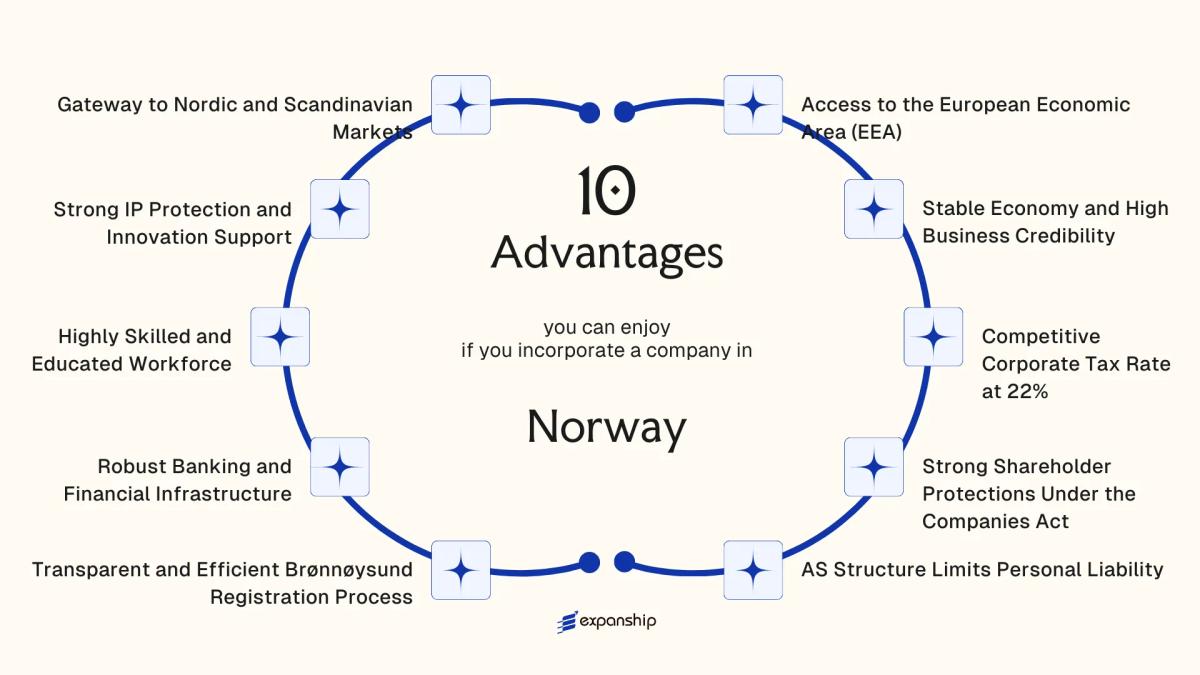
Access to the European Economic Area (EEA)
Norway's EEA membership benefits for businesses are grounded in a binding international agreement rather than EU accession. Under the Agreement on the European Economic Area, signed in 1992 and administered jointly by the EFTA Surveillance Authority and the EEA Joint Committee, Norwegian-registered companies gain access to the EU's internal market.
What EEA Participation Actually Grants Your Company
A company incorporated in Norway can sell goods, provide services, and move capital across all 30 EEA member states without encountering the customs procedures or market-access barriers that apply to third-country firms. This single market access operates under the four freedoms — goods, services, capital, and persons — giving your entity the same trading rights as one registered in Germany or France.
Regulatory Recognition Across Member States
Product standards, professional qualifications, and financial services authorisations obtained under EEA-aligned frameworks are recognised across member states. A firm passporting financial services under EEA rules, for example, can operate across the bloc without obtaining separate national licences in each target market, reducing both time and administrative cost significantly.
EEA membership means a Norway-based entity can access 450+ million consumers under a single regulatory framework, without EU membership obligations such as eurozone participation.
Stable Economy and High Business Credibility
Norway's stable economy and business credibility are grounded in measurable structural factors, not perception. The country holds a triple-A sovereign credit rating from all three major agencies — Moody's, S&P, and Fitch — a status that directly signals low sovereign risk to international counterparties and financial institutions. For your business, operating under a AAA-rated jurisdiction means banks, investors, and trade partners apply a higher baseline of trust to entities registered there.
Fiscal stability is underpinned by the Government Pension Fund Global, which functions as a sovereign wealth buffer that insulates the national economy from commodity price volatility. This structural buffer reduces the likelihood of abrupt regulatory or fiscal changes that could affect your entity's operating environment.
Credibility also carries practical consequences when you pursue commercial relationships:
- Contracts governed by Norwegian law are enforceable through a well-functioning court system with predictable outcomes
- Norwegian-registered entities face fewer due diligence barriers when opening accounts or entering agreements in other EEA markets
- The country's low corruption perception scores, consistently placed near the top of Transparency International's index, reduce legal exposure for foreign owners
- Compliance requirements under the Norwegian Accounting Act are transparent and consistently applied

Incorporate a Company in Norway
Register your Norwegian AS or ASA through Expanship with full compliance support and structured guidance at every step.
Competitive Corporate Tax Rate at 22%
At 22%, Norway's corporate income tax rate sits below the OECD average and applies uniformly to resident companies across most sectors. For a foreign entrepreneur establishing an Aksjeselskap (AS), this rate applies to net taxable profit as defined under the Norwegian Tax Act (skatteloven). The practical effect is that a meaningful share of operating profit remains within the company rather than flowing to the state.
| Parameter | Detail |
|---|---|
| Standard corporate tax rate | 22% |
| Governing legislation | Norwegian Tax Act (skatteloven) |
| Tax residency basis | Place of effective management |
| Financial sector rate | 25% (applies to financial institutions) |
| Tax year | Calendar year (1 Jan – 31 Dec) |
Tax residency in Norway is determined by where a company is effectively managed, not solely where it is registered. This distinction matters for foreign-owned entities: if central management and control operates from within the country, the firm is treated as a tax resident and taxed on worldwide income at the standard rate.
One sector-specific exception applies to financial institutions, which are subject to a 25% rate under current rules. For most operating businesses outside that classification, the 22% figure represents the actual liability threshold, giving you a predictable base for financial modelling and profit repatriation planning.
Strong Shareholder Protections Under the Companies Act
Norway Companies Act shareholder protections are codified in the Aksjeloven (the Private Limited Companies Act), which applies directly to all aksjeselskap (AS) entities. This legislation sets out enforceable rights that apply regardless of whether shareholders are domestic or foreign nationals.
Under the Aksjeloven, minority shareholders holding at least 10% of shares can demand a redemption of their shares if majority decisions cause unreasonable prejudice. For foreign investors who may have limited operational control, this exit mechanism provides a meaningful legal safeguard that is enforceable through Norwegian courts.
Shareholder meetings operate under statutory rules that require adequate notice, defined voting thresholds, and documented resolutions. General amendments to a company's articles of association require a two-thirds supermajority, which prevents controlling shareholders from unilaterally restructuring the entity in ways that dilute minority interests.
Every shareholder also holds a pre-emption right on new share issuances under the Aksjeloven, meaning your ownership percentage cannot be diluted without an explicit waiver or a formal shareholder resolution.
Keep the following in mind:
- Minority exit rights activate at the 10% ownership threshold
- Articles of association changes require a two-thirds supermajority vote
- Pre-emption rights apply automatically unless formally waived by resolution
- These protections apply equally to resident and non-resident shareholders
Foreign shareholders in a Norwegian AS hold the same statutory rights as Norwegian nationals, with no separate class of "foreign investor" restrictions embedded in the Aksjeloven itself.
AS Structure Limits Personal Liability
One of the direct Norway AS structure limited liability benefits is the statutory separation between shareholder obligations and company debt. Under the Norwegian Private Limited Liability Companies Act (aksjeloven), shareholders in an Aksjeselskap are not personally responsible for the firm's liabilities beyond their subscribed share capital. For foreign founders operating across borders, this separation defines the outer boundary of their financial exposure.
Capital Threshold and What It Means for Exposure
The minimum share capital requirement for an AS is NOK 30,000. Once that capital is contributed, your personal assets — foreign bank accounts, property held abroad, other business interests — fall outside the reach of Norwegian creditors pursuing claims against the entity.
Aksjeselskap personal liability protection in Norway is grounded in aksjeloven section 1-2, which codifies the principle that shareholders bear risk only to the extent of their investment. This statutory floor is fixed regardless of the company's debt load, meaning the ceiling on your liability is set at incorporation, not determined later by commercial outcomes.
Governance Structure and Director Liability
Directors carry a distinct duty of care under aksjeloven, and personal liability can arise where a director acts negligently or in breach of statutory obligations. That exposure, however, is specific to conduct, not a general extension of the company's financial losses to individuals.
For a foreign owner who appoints local or remote directors, understanding this distinction matters. The AS structure keeps ordinary commercial risk within the entity, while individual accountability attaches only to deliberate or negligent breach of duty.
Structure Your Norwegian AS for Full Liability Protection
Expanship can help you incorporate an AS in Norway and ensure your ownership and director structure is configured to maintain the statutory liability shield from day one.
Transparent and Efficient Brønnøysund Registration Process
The Brønnøysund Register Centre (Brønnøysundregistrene) serves as the central registry for all Norwegian business entities, and the Norway Brønnøysund Register business advantages are directly tied to how the system is structured for accessibility and public accountability.
- Registration of a private limited company (AS) can be completed online through the Altinn platform, which connects directly to the Register of Business Enterprises (Foretaksregisteret). This eliminates the need for physical submissions or in-person appearances, reducing the time and administrative cost for foreign founders.
- All registered entities are publicly searchable through the Brønnøysund Register Centre's open database. Counterparties, banks, and investors can independently verify your company's legal standing, ownership structure, and filed accounts without requiring documentation from you, which accelerates due diligence in commercial relationships.
- Annual accounts submitted to the Register of Accounts (Regnskapsregisteret) are publicly accessible. This statutory transparency means your business operates within a framework that third parties treat as credible by default, reducing friction in supplier and client onboarding.
- The registry system integrates with the national identification number (organisasjonsnummer), so once registered, your entity is simultaneously recognized across tax, VAT, and customs authorities without requiring separate filings to each body.
Robust Banking and Financial Infrastructure
Norway banking infrastructure benefits for companies are closely tied to the country's tightly regulated, well-capitalized financial system. Finanstilsynet, the Financial Supervisory Authority of Norway, oversees banks, insurance companies, and investment firms under a unified regulatory framework, which means your business operates within a system where counterparty risk is structurally low.
Corporate accounts can be opened with major institutions such as DNB, Nordea Norway, and SpareBank 1. These banks offer multi-currency accounts, international wire transfers, and trade finance facilities that foreign-owned entities can access once incorporated as an Aksjeselskap (AS).
Norway's participation in the European Economic Area means its financial institutions operate under EU financial directives, including MiFID II and the Payment Services Directive (PSD2). For your business, this translates to payment infrastructure that is interoperable with EU markets without requiring a separate EU-domiciled entity.
The fintech sector is also active, with the Oslo-based ecosystem producing licensed payment institutions and e-money firms regulated under Finanstilsynet's licensing regime.
According to the World Bank's Global Findex Database, Norway ranks among the highest globally for account ownership and digital payment adoption, with nearly universal banking access among its adult population. This directly reduces friction for businesses processing domestic transactions or payroll.
Highly Skilled and Educated Workforce
Norway skilled workforce advantages for businesses stem from a tertiary education system with consistently high enrollment rates. Statistics Norway (Statistisk sentralbyrå) reports that a significant share of the working-age population holds university-level qualifications, with particular concentration in engineering, marine technology, energy, and digital systems.
Proficiency in English is widespread across professional sectors. This reduces onboarding friction for foreign-owned entities operating in Norwegian-speaking environments, since day-to-day business communication rarely requires translation infrastructure.
The country's vocational training system, governed under the Education Act (Opplæringslova), produces technically certified workers who enter the labor market with verified competency standards. For a business requiring specialized technical roles, this means the hiring pipeline carries formal quality benchmarks rather than relying solely on employer-led assessment.
- Labor productivity figures from the OECD consistently place Norwegian workers among the higher-output economies in Europe, meaning output per hour worked compares favorably to many peer nations.
- The workforce spans sectors including offshore energy, maritime operations, aquaculture, and fintech, giving your business access to industry-specific human capital that is difficult to replicate in markets without that sectoral depth.
Employment contracts and working conditions in Norway are governed by the Working Environment Act (Arbeidsmiljøloven), which sets mandatory terms around working hours, termination procedures, and employee protections that all employers must comply with regardless of company origin.
Strong IP Protection and Innovation Support
Norway IP protection advantages for businesses are grounded in a well-established national framework administered by Patentstyret, the Norwegian Industrial Property Office. Patentstyret handles patent, trademark, and design registrations domestically, while also serving as the national entry point for international filings under the PCT (Patent Cooperation Treaty) and the Madrid System for trademarks.
As a member of the European Patent Convention (EPC), Norwegian patent protection aligns with the same standards applied across EPC member states. A patent granted through the European Patent Office can be validated in Norway, giving your business territorial coverage without requiring a separate national application.
Norway is also a signatory to the TRIPS Agreement, meaning IP rights registered here receive enforcement standards consistent with WTO obligations. This matters practically: your patents, trademarks, and designs are protected by a legal system with genuine enforcement capacity, not just paper registration.
For companies engaged in research and development, the Skattefunn scheme offers a tax deduction of up to 19% on eligible R&D costs, administered through the Research Council of Norway. Qualifying firms can claim this deduction directly against their tax liability, reducing the effective cost of innovation activities.
The types of IP protection available through Patentstyret include:
- Patents (up to 20 years)
- Trademarks (renewable every 10 years)
- Design registrations (up to 25 years with renewals)
- Utility models as a shorter-track protection option
Together, these mechanisms give IP-intensive businesses a structured and legally enforceable foundation for protecting proprietary assets.
Gateway to Nordic and Scandinavian Markets
Positioned at the edge of continental Europe with direct land and sea connections to Sweden, Denmark, and Finland, Norway offers a geographic and commercial entry point into a bloc of roughly 27 million consumers across the Nordic countries. That proximity is not incidental — for a foreign business establishing a legal entity here, it functions as a Norway gateway to Nordic markets advantage with structural underpinnings.
Scandinavian markets share deeply integrated supply chains, harmonised payment infrastructure, and aligned consumer expectations. A firm incorporated as an Aksjeselskap (AS) in Norway can conduct cross-border trade within this region without the regulatory discontinuity found in many other European corridors, partly because Sweden, Denmark, and Finland are EU members with whom Norway maintains aligned standards under the European Economic Area Agreement.
Cultural and linguistic proximity also carries commercial weight. Business norms, contract conventions, and financial reporting expectations across the Nordic region are close enough that a team operating from Oslo can manage client relationships in Stockholm or Copenhagen without significant structural adaptation.
- Norway's membership in the Nordic Council and related intergovernmental frameworks supports policy coordination across the region, reducing operational friction.
- The country shares the Single Euro Payments Area (SEPA) system, which allows your business to execute euro-denominated transfers across 36 participating countries at domestic rates.
- Intra-Nordic logistics networks are well-developed, with Oslo serving as a distribution node for goods moving between Northern Europe and Atlantic markets.
- Trade conventions under the EEA, combined with Norway's bilateral agreements, mean your entity faces fewer customs barriers when engaging with Nordic counterparts.
Why Norway Stands Out Among European Business Destinations
Among European business destinations, Norway draws comparison most naturally against the United Kingdom, the Netherlands, and Sweden. These three jurisdictions target a broadly similar profile of foreign investor: internationally mobile capital seeking a stable legal environment, treaty access, and credible institutional infrastructure. The comparison reveals that Norway holds a consistent and measurable position across several parameters that matter to foreign business owners, without relying on offshore structures or preferential tax regimes to do so.
What the table below shows is that Norway's position is not built on a single headline advantage. EEA membership without EU political exposure, a 22% corporate tax rate that sits below several comparable jurisdictions, and a registration process administered by the Brønnøysund Register Centre combine to create a formation environment that is structurally coherent rather than dependent on carve-outs or exceptions. For a foreign business owner, this matters because it reduces the risk of a benefit being withdrawn or restructured under political pressure.
| Parameter | Norway | United Kingdom | Netherlands | Sweden |
|---|---|---|---|---|
| Corporate Tax Rate | 22% | 25% | 25.8% | 20.6% |
| EEA / EU Market Access | EEA Member | No (post-Brexit) | EU Member | EEA Member |
| Minimum Share Capital (Private Co.) | NOK 30,000 | None (£0.01) | EUR 0.01 | SEK 25,000 |
| Business Registration Body | Brønnøysund Register Centre | Companies House | KVK (Chamber of Commerce) | Bolagsverket |
| Double Tax Treaties | 90+ | 130+ | 100+ | 85+ |
| Legal System | Civil Law | Common Law | Civil Law | Civil Law |
Compliance Services for Companies in Norway
Maintain your Norwegian entity in good standing with ongoing compliance support, including annual reporting, director obligations, and regulatory filings under Norwegian law.
Conclusion
Norway presents a distinctive case for foreign incorporation: a 22% corporate tax rate backed by an extensive double tax treaty network, liability protection through the aksjeselskap structure governed by the Companies Act of 1997, and unrestricted single-market access across all 30 EEA member states. These are not incidental features but structural conditions that directly affect how a foreign-owned business operates, costs, and scales.
That said, the benefits of incorporating in Norway align most strongly with businesses that have clear commercial ties to the Nordic region, require credibility in regulated industries, or employ knowledge workers in sectors where Norway's talent pool is concentrated. A holding company optimising for tax efficiency alone may find the cost base less suitable than one that also values legal predictability and institutional trust.
For businesses where those factors matter, Norway company formation advantages compound over time. The Brønnøysund Register Centre provides a public, verifiable record of your entity, which supports banking relationships, supplier negotiations, and client onboarding. Accessing that foundation from the outset, rather than retrofitting compliance later, is where the structural advantage of setting up here becomes most practical.
Start Your Norwegian Company Formation With Expanship
Norway company formation with Expanship covers the full process of establishing an Aksjeselskap (AS) under the Norwegian Private Limited Liability Companies Act (aksjeloven), from initial structuring decisions through to registration with the Brønnøysund Register Centre. The benefits outlined in this blog, ranging from the 22% corporate tax rate to EEA market access and the protections afforded by aksjeloven, each carry specific compliance obligations that require accurate documentation and timely filings to maintain good standing.
Expanship supports your business at each stage of that process:
- Preparation and legalization of incorporation documents, including the articles of association (vedtekter) and shareholder agreements
- Provision of a registered address and resident representative where required under Norwegian law
- Filing and liaison with the Brønnøysund Register Centre for entity registration
- Post-incorporation compliance management, including annual reporting obligations to Regnskapsregisteret (the Register of Company Accounts)
- Banking introduction assistance to support your firm's operational setup in Norway
- Ongoing registered agent services to maintain your entity's active status
Each service is handled with reference to the specific procedural and legal requirements that apply to foreign-owned entities under Norwegian corporate law.
To discuss your requirements directly, contact Expanship Norway.
Frequently Asked Questions (FAQ)
The standard corporate income tax rate for an AS is 22%, applied to net taxable profit. Financial institutions are subject to a higher rate under separate rules, but most ordinary commercial entities fall under the flat 22% rate. There are no general municipal surcharges on corporate income tax in Norway.
Online registration through the Brønnøysund Register Centre (Brønnøysundregistrene) is typically processed within a few business days when all documentation is in order. Paper-based submissions take longer, often several weeks. The minimum share capital requirement of NOK 30,000 must be confirmed as paid before the entity is formally registered.
The aksjeloven includes provisions that protect minority shareholders from decisions that unfairly favour the majority, including rules on equal treatment and restrictions on transactions that could dilute minority interests. Shareholders holding at least 10% of the share capital can, under certain conditions, demand redemption of their shares. These protections apply regardless of whether the shareholder is a Norwegian resident or a foreign investor.
Operationally, a Norwegian AS benefits from EEA Agreement rights including the free movement of goods, services, capital, and persons across EEA member states, which mirrors much of the access available to EU-incorporated entities. However, Norway is not an EU member, so the entity does not fall under EU institutions or certain EU-specific directives that apply exclusively to EU member states. In practice, for most cross-border commercial activities within the EEA, the distinction has limited operational impact.
In an AS, shareholder liability is limited to the amount of capital each shareholder has contributed, as established under the aksjeloven. Shareholders are not personally liable for the debts or obligations of the company beyond their subscribed share capital. This protection holds unless a court pierces the corporate veil in cases of fraud or improper conduct, which requires a separate legal determination.
Companies registered in Norway can file for trademark and patent protection through Patentstyret, the Norwegian Industrial Property Office. As a member of the European Patent Convention (EPC) and the Patent Cooperation Treaty (PCT), Norway allows filings that can extend protection across multiple jurisdictions from a single application. Rights granted through these frameworks are enforceable under Norwegian law and subject to standard term lengths aligned with international norms.
Legal Disclaimer
The information provided in this article is for general informational purposes only and does not constitute legal, tax, or professional advice. While we strive to ensure the accuracy and timeliness of the content, laws and regulations are subject to change, and the application of laws can vary widely based on specific facts and circumstances.
Readers should not act upon this information without seeking professional counsel tailored to their individual situation. Expanship and its authors disclaim any liability for actions taken or not taken based on the content of this article.
For specific advice regarding your business setup, compliance requirements, or any legal matters, please consult with qualified legal and tax professionals in the relevant jurisdiction.