

Key Takeaways
- Under the Companies and Allied Matters Act 2020, foreign companies must navigate ongoing compliance obligations administered by the Corporate Affairs Commission, adding layers of administrative burden beyond the initial registration process.
- Incorporating in Nigeria involves exposure to multiple overlapping tax obligations at the federal, state, and local levels, which increases both the cost of compliance and the risk of regulatory disputes.
- Foreign investors face sector-specific ownership restrictions that can limit equity stakes or require local partnerships, constraining the structural options available to multinationals entering the Nigerian market.
- Currency controls and restrictions on repatriating naira-denominated profits create practical barriers to capital mobility that can affect the financial viability of foreign-owned entities operating in the country.
Nigeria operates under an evolving but heavily regulated corporate framework, with oversight distributed across multiple federal agencies and sector-specific regulators. The disadvantages of incorporating in Nigeria span areas from registration procedures and ownership rules to tax obligations and infrastructure conditions.
Not every challenge applies equally to all businesses. The drawbacks you encounter will depend significantly on your industry, the corporate structure you choose, and whether your firm involves foreign capital.
Under the Companies and Allied Matters Act 2020, the Corporate Affairs Commission governs company registration and ongoing compliance obligations. This article is most relevant to foreign investors and multinational firms establishing a subsidiary, branch, or joint venture in the country for the first time.
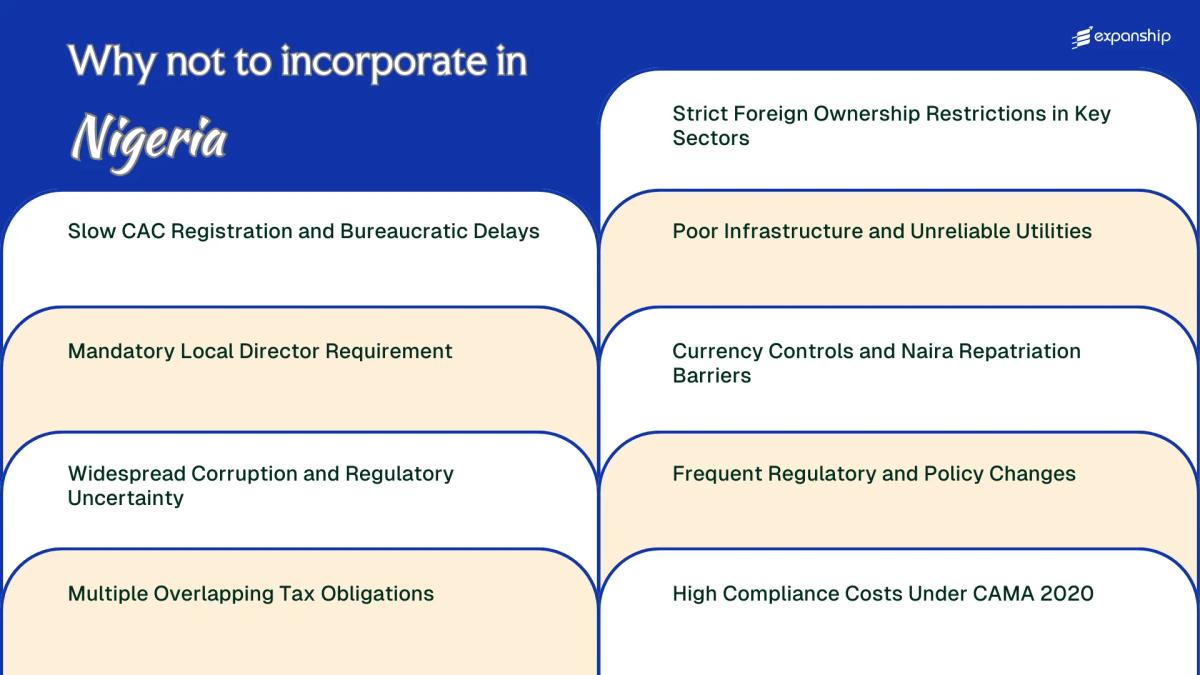
Slow CAC Registration and Bureaucratic Delays
CAC registration delays in Nigeria represent one of the most frequently cited operational frustrations for foreign businesses attempting to establish a legal presence in the country. Processing times that should take days routinely extend into weeks or months.
Systemic Backlog at the Corporate Affairs Commission
The Corporate Affairs Commission (CAC) is the sole body responsible for company incorporation under the Companies and Allied Matters Act (CAMA) 2020. Despite the introduction of an online registration portal, the system experiences frequent downtimes, document verification bottlenecks, and manual review stages that reintroduce the same delays the digital process was meant to eliminate. For a foreign investor with time-sensitive market entry plans, this unpredictability makes accurate operational timelines nearly impossible to establish.
The Practical Cost of Slow Registration
Until the CAC issues a Certificate of Incorporation, your business cannot open a corporate bank account, execute contracts, or obtain sector-specific licences. Each week of delay translates directly into deferred revenue, extended reliance on interim legal structures, and increased professional fees for local counsel managing the process. Foreign-incorporated entities without a registered Nigerian subsidiary also face restrictions on repatriating earnings, compounding the financial exposure of an already prolonged registration timeline.
Until the CAC issues a Certificate of Incorporation, your business has no legal standing in Nigeria, meaning every week of delay directly blocks trading, banking, and regulatory approvals.
Mandatory Local Director Requirement
Under the Companies and Allied Matters Act (CAMA) 2020, every private company incorporated with the Corporate Affairs Commission (CAC) must have at least two directors, and at least one must be ordinarily resident in Nigeria. This Nigeria local director requirement directly affects how foreign founders structure their entities from day one.
Finding a resident director is rarely straightforward. A qualified individual must be identified, vetted, and formally appointed before registration can proceed, adding time and cost before your business generates a single naira.
The practical burdens this creates for a foreign business owner include:
- Paying ongoing retainer fees to a nominee director service, which becomes a recurring compliance cost with no operational return
- Accepting legal exposure if a resident director acts outside agreed parameters, since their signature carries statutory authority
- Losing registration momentum when a suitable local candidate cannot be sourced quickly
The mandatory Nigerian director incorporation rules also mean your governance structure is shaped by a residency condition rather than by business logic. If your appointed resident director resigns, the firm falls out of compliance immediately.

Company Incorporation in Nigeria
Set up your Nigerian company with full CAC compliance, including resident director arrangements and post-incorporation filings.
Widespread Corruption and Regulatory Uncertainty
Corruption risks doing business in Nigeria represent one of the most tangible operational threats foreign investors face. Transparency International's Corruption Perceptions Index consistently ranks the country in the lower tier globally, and that ranking reflects daily business realities rather than abstract scores.
Bribery demands surface across licensing offices, port clearing processes, and tax audits. Even compliant firms encounter inflated facilitation expectations from mid-level officials, and refusal to engage can stall time-sensitive permits indefinitely.
| Pressure Point | Responsible Body | Implication for Foreign Firms |
|---|---|---|
| Anti-money laundering enforcement | EFCC (Economic and Financial Crimes Commission) | Broad investigative powers create unpredictable compliance exposure |
| Discretionary tax assessments | FIRS and State Inland Revenue Services | Assessments often exceed statutory liability without clear legal basis |
| Import/export facilitation demands | Nigeria Customs Service | Unofficial payments routinely delay cargo release |
| Business premises licensing | Local Government Authorities | Permit timelines are undefined; unofficial fees common |
EFCC compliance risks for foreign companies in Nigeria are substantial because the Commission's mandate covers both bribery and financial crimes, and its enforcement approach is largely discretionary. A firm that pays a facilitation demand to resolve a customs delay can itself become an EFCC investigation target under anti-corruption statutes.
Regulatory uncertainty compounds the problem. Policies issued by agencies like the Securities and Exchange Commission or the Nigerian Investment Promotion Commission sometimes conflict with one another. Resolving those conflicts typically requires legal counsel, adding recurring professional costs that are structurally unavoidable.
Multiple Overlapping Tax Obligations
Multiple tax obligations Nigeria companies face do not come from a single consolidated code. Obligations are distributed across federal, state, and local government layers, each administered independently.
The Federal Inland Revenue Service (FIRS) administers corporate income tax at 30% for large companies under the Companies Income Tax Act (CITA), alongside Value Added Tax, withholding tax, and the Education Tax levied at 2.5% of assessable profit. These are separate filings with separate deadlines.
State Internal Revenue Services collect personal income tax on employees under the Personal Income Tax Act, which your business is responsible for remitting. Local government authorities additionally impose levies that vary by location and have no standardised schedule.
This multi-agency structure means a single Nigerian company can face simultaneous filing obligations to three different tiers of government in any given period. Missing a state-level deadline does not excuse a federal default, as each authority enforces independently.
- FIRS corporate income tax returns are due within six months of the company's financial year-end
- Education Tax and VAT carry separate filing cycles under FIRS administration
- State payroll tax remittance obligations apply from the first employee, regardless of company size
- Local government levies are not published centrally and must be identified jurisdiction by jurisdiction
- Penalties for late filing accrue per obligation, not per tax period
You can review the FIRS tax schedule to confirm current filing deadlines across applicable taxes.
Nigeria imposes a separate Tertiary Education Tax on company profits that many foreign incorporators first discover only after their initial tax assessment, not during pre-incorporation due diligence.
Strict Foreign Ownership Restrictions in Key Sectors
Foreign ownership restrictions in Nigeria's key sectors represent one of the more structurally limiting obstacles for foreign business owners, directly capping how much equity your company can hold in certain industries under frameworks enforced by the Nigerian Investment Promotion Commission (NIPC).
Sectors Closed or Capped Under Nigerian Law
The Nigerian Enterprises Promotion Act and the NIPC Act designate specific sectors where foreign participation is either prohibited outright or subject to equity ceilings. Broadcast media restricts foreign ownership to 20%, while certain defence-related activities and the retail and wholesale trading sector are fully closed to foreign entities unless conditions under the NIPC framework are met.
Practical Consequences for Foreign Investors
If your business model depends on majority control, these restrictions force a structural dependency on Nigerian partners who must hold the qualifying equity stake. This exposes you to governance risk, profit-sharing obligations, and potential disputes over operational decisions that a fully foreign-owned entity would not face. The restrictions apply regardless of the size or capitalisation of the foreign firm, leaving no threshold-based exemption for smaller operators.
Expert Guidance on Foreign Ownership Restrictions in Nigeria
Understand which sectors are restricted, how equity caps apply to your business structure, and what legal options exist before you commit to incorporating in Nigeria.
Poor Infrastructure and Unreliable Utilities
Poor infrastructure challenges Nigeria business operations in ways that directly inflate costs and reduce operational reliability for foreign-owned entities.
- Erratic grid power from the Transmission Company of Nigeria forces most commercial operations to run diesel generators full-time, adding a significant and recurring operational expense that businesses in more stable markets rarely face.
- Unreliable utilities Nigeria company operations depend on extend beyond electricity to include inconsistent water supply and underdeveloped road networks that slow logistics and increase freight costs.
- Nigeria power supply problems for businesses are structural, not incidental — the national grid regularly operates well below its installed capacity, meaning planned production schedules cannot be reliably met.
- Bandwidth inconsistency across much of the country undermines digital operations and cloud-dependent business functions, particularly outside Lagos and Abuja.
- Infrastructure deficits in port handling at Apapa and Tin Can Island create customs clearance delays that extend lead times and disrupt import-dependent supply chains.
Currency Controls and Naira Repatriation Barriers
Nigeria currency controls repatriation barriers represent one of the most persistent operational risks for foreign-owned businesses. The Central Bank of Nigeria (CBN) governs all foreign exchange transactions, and its policies have historically made converting naira profits into hard currency both slow and unpredictable.
Foreign firms must route dividend repatriation through authorised dealer banks, and approval timelines are subject to CBN discretion rather than fixed statutory deadlines. Delays of months are not uncommon, meaning capital earned in Nigeria can remain effectively stranded while exchange rates move against you.
The CBN operates a managed exchange rate system, which has produced significant gaps between official and parallel market rates. For a business pricing services in naira but reporting to a foreign parent in dollars or euros, that spread directly erodes reported earnings.
Certificates of Capital Importation (CCIs) are required to legally repatriate both capital and profits. Without a valid CCI issued at the time of the original inward investment, your entitlement to repatriate is legally compromised regardless of the underlying business performance.
A foreign investor who brought in $500,000 without obtaining a CCI at the point of entry would have no documentary basis to repatriate that capital under CBN rules, effectively locking the original investment inside the jurisdiction until a resolution is negotiated with an authorised dealer bank.
Frequent Regulatory and Policy Changes
Nigeria regulatory changes represent one of the more structurally disruptive risks for foreign businesses, because policy shifts frequently occur without adequate transition periods. Your compliance posture can become outdated within months of incorporation, through no fault of internal management.
The Corporate Affairs Commission, the Securities and Exchange Commission, and sector regulators like the Central Bank of Nigeria have each issued material rule changes outside predictable legislative cycles. A directive issued administratively can alter reporting obligations, fee structures, or permitted activities before your legal team has time to respond.
Tax policy adds another layer of instability. The Finance Acts introduced in 2019, 2020, 2021, and 2023 each amended substantive provisions of existing tax statutes, meaning compliance frameworks that were accurate at the time of incorporation may no longer reflect current obligations.
For a foreign-owned entity, this creates disproportionate costs. Local businesses often absorb regulatory shifts through existing professional relationships; foreign firms typically incur additional advisory fees to reinterpret obligations that were already resolved at setup.
Regulatory changes in certain sectors, particularly telecoms, financial services, and oil and gas, can also affect the terms under which your business originally received its operating licence.
Policy changes in Nigeria can originate from executive orders, ministerial directives, or Central Bank circulars, none of which require legislative approval, meaning a foreign entity has no advance notice mechanism and no predictable compliance window before obligations take effect.
High Compliance Costs Under CAMA 2020
CAMA 2020 compliance costs in Nigeria accumulate quickly for foreign businesses. The Companies and Allied Matters Act 2020 introduced requirements that, while modernising corporate governance, carry recurring financial obligations that many foreign-owned entities underestimate before entry.
Statutory audit requirements apply to all companies, regardless of size, and must be conducted by auditors registered with the Institute of Chartered Accountants of Nigeria (ICAN). Engaging qualified local professionals adds a fixed annual cost that cannot be avoided through internal reporting.
Annual returns must be filed with the Corporate Affairs Commission (CAC), with penalties for late submission that compound over time. Separate compliance filings with the Securities and Exchange Commission apply if your firm falls under its regulatory scope, creating parallel obligations.
Small companies meeting specific thresholds under CAMA 2020 are exempt from some requirements, but most foreign-incorporated subsidiaries operating at commercial scale will not qualify for those exemptions.
Navigating These Challenges Successfully
Overcoming Nigeria incorporation challenges requires structural preparation before your entity is registered, not reactive fixes after problems arise. The obstacles covered in this blog are systemic, and addressing them means building compliance and risk management into your operational framework from day one.
- Register your company through the CAC portal and verify all post-incorporation filings are completed within the statutory timelines prescribed under CAMA 2020.
- Appoint a qualified Nigerian resident director who meets the requirements set by the Corporate Affairs Commission before submitting incorporation documents.
- Structure your sector allocation to account for the Nigerian Investment Promotion Commission's restricted and prohibited investment lists before committing capital.
- Open a domiciliary account with a CBN-licensed commercial bank to manage foreign currency holdings and reduce exposure to naira volatility.
- Establish a tax compliance calendar covering obligations to FIRS, state-level revenue authorities, and any applicable sectoral regulators.
These steps address documented regulatory requirements under Nigerian law, but they do not eliminate the structural risks tied to policy unpredictability, infrastructure gaps, or enforcement inconsistency that characterise the current operating environment.
Nigeria's Overall Investment Potential
Despite the disadvantages covered across this blog, Nigeria remains a credible incorporation destination for foreign businesses with high risk tolerance and a long-term market view. With a population exceeding 200 million and one of Africa's largest GDP figures, the commercial case for market entry is grounded in scale, not speculation.
| Pros | Cons |
|---|---|
| Access to one of Africa's largest consumer markets by population and GDP | CAC registration is subject to significant bureaucratic delays, extending timelines beyond published targets |
| The CAMA 2020 framework introduced modern corporate governance provisions, including single-member companies | High compliance costs under CAMA 2020 place a recurring administrative burden on foreign-owned entities |
| Nigeria's geographic position supports distribution across West Africa | Foreign ownership is prohibited or capped in sectors including oil prospecting, broadcasting, and retail trading |
| A broad tax treaty network exists with select jurisdictions | Multiple overlapping tax obligations across federal, state, and local tiers increase the effective cost of operations |
| A large, young, and increasingly urbanised workforce supports labour availability | Currency controls and CBN repatriation restrictions limit how and when profits can be moved offshore |
Corporate Compliance Services in Nigeria
Manage your ongoing statutory obligations under CAMA 2020, including annual returns, registered office requirements, and CAC filings.
Conclusion
The Nigeria company incorporation drawbacks summary is clear: this is a jurisdiction with genuine commercial scale, but one that imposes substantial structural friction on foreign-owned entities. CAC registration delays, the currency control framework administered by the Central Bank of Nigeria, and sector-specific foreign ownership caps under the Nigerian Investment Promotion Commission Act collectively create a challenging operating environment. Structural issues do not disappear with good intentions. For your business to function legally and efficiently here, operational planning must account for compliance obligations under CAMA 2020 well before incorporation begins.
Expanship's Nigeria Expansion Support
Registering and maintaining a company in Nigeria involves a defined set of obligations across multiple regulatory bodies, from the Corporate Affairs Commission under CAMA 2020 to the Federal Inland Revenue Service and sector-specific agencies. Expanship's Nigeria business expansion support services are structured around reducing the operational weight of those specific obligations, particularly for foreign investors managing CAC filings, local director requirements, and post-incorporation compliance from outside the country.
Beyond initial registration, our scope covers the full corporate lifecycle:
- Your company registration is handled end-to-end, including document preparation and CAC submission.
- A registered agent and compliant local office address are provided to satisfy Nigerian statutory requirements.
- We liaise directly with government agencies and regulatory bodies on your behalf for all required filings.
- Post-incorporation compliance management keeps your entity in good standing with ongoing statutory obligations.
- Banking introduction assistance connects your business with Nigerian financial institutions.
- Tax registration and coordination with the FIRS and relevant state revenue authorities are managed on your behalf.
Reach out through Expanship Nigeria to discuss how we can support your entry into this market.
Frequently Asked Questions (FAQ)
Under the Companies and Allied Matters Act 2020, every company incorporated in Nigeria must have at least one director who is ordinarily resident in the country, and this applies to all private and public companies regardless of the foreign ownership structure. There is no exemption for wholly foreign-owned entities registered outside restricted sectors. Appointing a nominee resident director is a common workaround, but it introduces its own governance and liability considerations.
Failure to register with the Nigeria Investment Promotion Commission before commencing business operations can result in fines and bars on repatriating profits or dividends through formal banking channels. The NIPC Act requires foreign enterprises to register before beginning operations, and non-compliance can also affect your ability to obtain an expatriate quota or business permits from the Ministry of Interior. In practice, this can block the entity from accessing the official foreign exchange window.
Annual compliance obligations under CAMA 2020 include filing annual returns with the Corporate Affairs Commission, maintaining a statutory audit, keeping a register of members and directors, and filing beneficial ownership information with the CAC portal. For a small foreign-owned entity, professional fees alone covering legal, accounting, and secretarial services typically range from several hundred thousand to over one million naira per year. That figure does not account for the multiple federal and state tax filings due separately to the Federal Inland Revenue Service and relevant state boards.
Nigeria's sector-specific restrictions are among the most extensive in the ECOWAS region. Broadcasting, firearms, production of arms, and certain agricultural activities are fully closed to foreign participation, while other industries require minimum local equity stakes under the Nigerian Investment Promotion Commission Act. By comparison, Ghana and Côte d'Ivoire impose fewer blanket prohibitions, though they maintain their own restricted-sector lists. The combination of sector bans and CAMA 2020 residency requirements creates a layered barrier that is more demanding than most regional peers.
Profit repatriation is legally permitted under the NIPC Act for registered foreign enterprises, but the practical barrier is access to foreign currency through the Central Bank of Nigeria's official exchange window. Nigeria has historically operated multiple exchange rate mechanisms, and when the gap between the official and parallel market rates widens, businesses face real losses on conversion. Repatriation delays of several months are reported even for compliant companies, and the process requires documentation including tax clearance certificates, making it operationally burdensome.
The Corporate Affairs Commission imposes daily penalty fees on companies that file annual returns after the statutory deadline, and these accrue until the filing is completed. For small companies the base filing fee is modest, but the penalty surcharges can compound significantly if returns are missed across multiple years, which is a common scenario for foreign-owned entities that underestimate local administrative demands. Persistent non-compliance can ultimately result in the CAC striking the company off the register, which triggers its own reinstatement costs and legal process.
It is a structural risk. Nigeria's tax framework has seen repeated amendments to the Finance Act annually since 2019, each introducing changes to corporate income tax obligations, VAT treatment, and withholding tax rates without extended transition periods. The Federal Inland Revenue Service also issues practice notices and information circulars that carry practical authority even when they lack the force of primary legislation. For a foreign business planning multi-year operations, this level of policy volatility makes accurate financial modelling genuinely difficult.
Legal Disclaimer
The information provided in this article is for general informational purposes only and does not constitute legal, tax, or professional advice. While we strive to ensure the accuracy and timeliness of the content, laws and regulations are subject to change, and the application of laws can vary widely based on specific facts and circumstances.
Readers should not act upon this information without seeking professional counsel tailored to their individual situation. Expanship and its authors disclaim any liability for actions taken or not taken based on the content of this article.
For specific advice regarding your business setup, compliance requirements, or any legal matters, please consult with qualified legal and tax professionals in the relevant jurisdiction.