

Key Takeaways
- Nigeria's Companies and Allied Matters Act 2020 (CAMA 2020) provides foreign investors with a codified legal identity through CAC registration, enabling 100% foreign ownership across most sectors without requiring a local partner.
- Qualifying businesses can eliminate corporate income tax liability for an initial period under Pioneer Status relief granted through the Industrial Development (Income Tax Relief) Act, making early-stage capital retention structurally more predictable.
- Membership in the ECOWAS trade bloc gives Nigerian-registered entities preferential access to a regional market spanning 15 countries, reducing tariff exposure on cross-border trade within West Africa.
- Double taxation treaties administered by the Federal Inland Revenue Service, combined with profit repatriation provisions under CAMA 2020, allow foreign-owned companies to move earnings across borders without facing dual tax liability in both Nigeria and the home jurisdiction.
Incorporating a business in Nigeria — Africa's most populous nation and largest economy by GDP — offers a distinct set of structural and commercial advantages that attract foreign investors across sectors. Nigeria is a sovereign federal republic situated in West Africa, governed under a constitutional framework that formally recognizes and protects private enterprise. The body responsible for company registration is the CAC, the Corporate Affairs Commission, which operates under the Companies and Allied Matters Act 2020 (CAMA 2020).
Foreign businesses entering the market most commonly do so through a Private Limited Liability Company. The country operates a territorial-leaning tax system with treaty-based elements, administered by the Federal Inland Revenue Service. Foreign direct investment is formally welcomed under the Nigerian Investment Promotion Commission Act, which permits 100% foreign ownership across most sectors. This article examines the key advantages of registering a business entity here, drawing on the current regulatory and commercial framework.
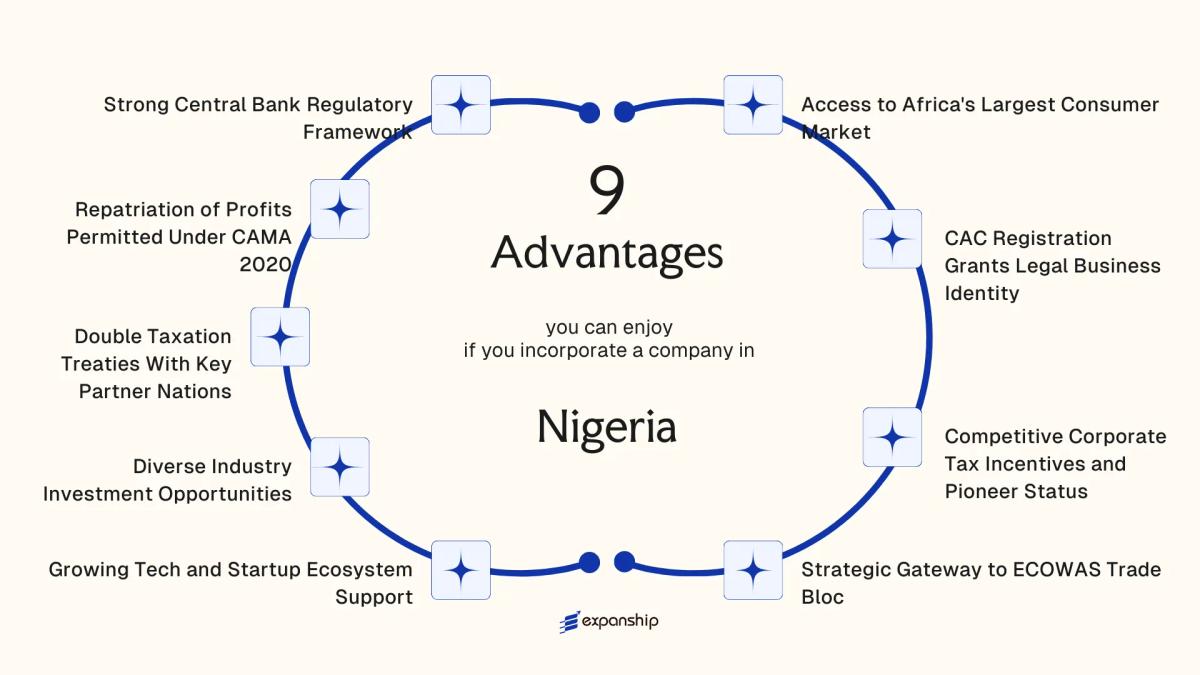
Access to Africa's Largest Consumer Market
Nigeria's population of approximately 220 million people represents the single largest consumer base on the continent, and registering a business entity there places your company inside that market as a recognized local participant rather than a foreign exporter.
What Market Scale Actually Means for Revenue Potential
A registered firm can enter supply contracts, retail distribution networks, and government procurement processes that are legally restricted to locally incorporated entities. The Nigerian Investment Promotion Commission Act and the Companies and Allied Matters Act (CAMA) 2020 together define which business activities require local incorporation, making formal registration a precondition for accessing certain sectors directly.
Urban Concentration and Consumer Purchasing Power
Lagos alone accounts for an estimated GDP comparable to several smaller African nations, concentrating significant purchasing activity within a single metropolitan economy. This density means your business can reach a substantial portion of the addressable market without proportional investment in nationwide distribution infrastructure.
Foreign companies operating through an unregistered presence cannot enforce commercial contracts under Nigerian law, which creates a direct legal incentive for formal incorporation before market entry.
Formal incorporation is a legal prerequisite for contract enforcement and direct market participation under Nigerian law.
CAC Registration Grants Legal Business Identity
Registering a company with the Corporate Affairs Commission (CAC) grants your business a distinct legal identity separate from its owners. This separation, established under the Companies and Allied Matters Act (CAMA) 2020, means the entity can own property, enter contracts, sue, and be sued in its own name. For a foreign investor, that distinction eliminates personal liability exposure on commercial obligations incurred by the Nigerian operation.
Without CAC registration, your business cannot open a corporate bank account, bid for government contracts, or receive payments from regulated institutions. Legal business identity in Nigeria is therefore not a formality; it is the operational foundation for every commercial activity you intend to conduct.
The registration process itself reflects conditions that favour foreign participation:
- Foreign nationals can hold 100% shareholding in most sectors without a local partner requirement
- The minimum share capital for a private company is relatively modest, set at one naira under CAMA 2020
- The CAC's online portal allows document submission without physical presence in the country
- A registered address requirement can be met through a local service provider
Once incorporated, the company receives a Certificate of Incorporation and a Corporate Affairs Commission registration number, both of which are recognised by banks, tax authorities, and counterparties across the country.

Incorporate Your Company in Nigeria
Register your Nigerian company with the Corporate Affairs Commission through Expanship, with full support from document preparation to certificate issuance.
Competitive Corporate Tax Incentives and Pioneer Status
Under the Industrial Development (Income Tax Relief) Act, companies granted pioneer status receive a corporate income tax holiday for an initial period of three to five years. This is the foundation of the Nigeria pioneer status tax incentive benefits framework, and for a foreign investor, it means your entity operates free of the standard 30% Companies Income Tax during its qualifying years, directly improving early-stage cash flow without requiring complex tax structuring.
The Nigeria Investment Promotion Commission (NIPC) administers the programme and maintains a list of designated pioneer industries and products. Eligibility is tied to operating in a qualifying sector, so the benefit is structured rather than discretionary.
| Feature | Detail |
|---|---|
| Administering Body | Nigeria Investment Promotion Commission (NIPC) |
| Governing Legislation | Industrial Development (Income Tax Relief) Act |
| Standard CIT Rate Avoided | 30% |
| Initial Tax Holiday Period | 3 years |
| Maximum Extended Period | Up to 5 years |
Beyond the tax holiday itself, approved pioneer companies are also permitted to carry forward losses incurred during the relief period into post-pioneer years. That provision reduces the tax burden your firm faces once the holiday expires, extending the financial benefit beyond the initial window. For capital-intensive businesses with slow revenue ramp-up periods, this carryforward mechanism materially affects long-term tax exposure under Nigerian corporate tax incentives for businesses.
Strategic Gateway to ECOWAS Trade Bloc
Nigeria ECOWAS trade bloc gateway advantage stems from a structural fact: as a founding member of the Economic Community of West African States, a company registered here operates under the ECOWAS Trade Liberalisation Scheme (ETLS), which eliminates customs duties on qualifying goods traded among the 15 member states. That single provision opens a combined market of over 400 million people to your entity without the tariff barriers that would apply from outside the bloc.
ETLS approval is product-specific and requires registration through the ECOWAS Commission, but once granted, your goods move duty-free across member borders. For manufacturers, distributors, and trading firms, that means a West Africa trade advantage that no non-member entity can replicate through a bilateral arrangement alone.
Geography reinforces this. Sharing land borders with Benin, Niger, Chad, and Cameroon, a business incorporated here reaches francophone West and Central African markets by road, which matters significantly for supply chains where air freight is cost-prohibitive.
Keep these points in mind when relying on this benefit:
- ETLS status applies to the product or category, not the company registration alone
- Your firm must meet local value-added content rules to qualify goods under ETLS
- ECOWAS rules of origin requirements must be satisfied for duty-free treatment
- Non-compliance with ETLS product approval can result in duties being applied at the border
Confirm current ETLS criteria directly via the ECOWAS Commission.
Nigeria's naira-denominated costs mean that ETLS-registered manufacturers here can price goods competitively across the bloc during periods of naira depreciation, effectively gaining a cost advantage over regional competitors priced in more stable currencies.
Growing Tech and Startup Ecosystem Support
Nigeria's startup ecosystem benefits for businesses go well beyond networking opportunities. The Startup Act of 2022 established a formal legal framework through which qualifying firms can obtain "Startup Label" certification from the National Information Technology Development Agency (NITDA), unlocking access to tax reliefs, accelerator programs, and government grants. Foreign-owned entities registered with the Corporate Affairs Commission (CAC) are eligible to apply, provided they meet the Act's criteria on revenue stage and innovation focus.
Lagos as a Structural Advantage
Lagos concentrates a disproportionate share of the continent's venture capital activity. Yaba, the city's primary tech cluster, houses co-working infrastructure, incubator networks, and a talent pool produced by institutions such as the University of Lagos and Covenant University. For a foreign firm entering the market, proximity to this cluster reduces the cost and timeline of building local operational capacity.
Fintech Access and Regulatory Pathways
The Central Bank of Nigeria's regulatory sandbox, introduced under its fintech and innovation guidelines, allows financial technology firms to test products under controlled conditions before full licensing. This reduces early-stage compliance exposure for foreign fintech entrants. The ecosystem's scale also matters: with over 200 active fintech companies and some of Africa's highest mobile money penetration rates, a firm incorporated here gains direct access to one of the continent's most developed digital finance markets.
Structure Your Entry into Nigeria's Tech Ecosystem
Get guidance on Startup Label eligibility, CAC registration, and the regulatory pathways relevant to your business model in Nigeria.
Diverse Industry Investment Opportunities
Nigeria's economy spans multiple high-output sectors, and the country's regulatory framework has created distinct entry points for foreign companies across several of these industries. The Nigeria industry investment opportunities advantages available to incorporated entities are structured through specific laws, licensing regimes, and government incentive programs rather than general open-door policies.
- Oil and gas: Under the Petroleum Industry Act (PIA) 2021, incorporated entities can access upstream, midstream, and downstream licensing. The Act restructured fiscal terms and established the Nigerian Upstream Petroleum Regulatory Commission (NUPRC), giving foreign firms a defined regulatory counterpart for licensing and compliance.
- Agriculture: The Nigerian Investment Promotion Commission (NIPC) Act permits 100% foreign ownership in agribusiness, and federal programs such as the Anchor Borrowers Programme have formalized smallholder supply chains that larger foreign processors can integrate with.
- Technology: The National Information Technology Development Agency (NITDA) regulates the sector, and an incorporated tech firm gains eligibility for the NITDA Startup Support and Engagement Portal, which links businesses to public procurement pipelines.
- Manufacturing: Companies incorporated under CAMA 2020 and registered with NIPC can apply for Pioneer Status, suspending corporate income tax for up to five years depending on product classification under the Industrial Development (Income Tax Relief) Act.
Double Taxation Treaties With Key Partner Nations
Nigeria double taxation treaty benefits apply to companies incorporated under the Companies and Allied Matters Act (CAMA) 2020, giving them access to reduced withholding tax rates on dividends, interest, and royalties paid across borders. Without treaty protection, foreign investors face the standard withholding tax rates under the Companies Income Tax Act (CITA), which can reach 10% on dividends. Treaties can reduce that exposure significantly, depending on the partner country.
Existing treaties cover several major trade and investment partners, including the United Kingdom, France, Belgium, the Netherlands, Pakistan, Romania, Canada, and South Africa. For a UK-resident parent company receiving dividends from a Nigerian subsidiary, the applicable treaty rate may be lower than the domestic rate, directly reducing the cost of profit extraction.
Treaty eligibility generally requires that your company qualifies as a tax resident under Nigerian law, which means it must be incorporated locally or managed and controlled from within the country.
A foreign-owned Nigerian company paying dividends to a UK parent could reduce its withholding tax liability under the Nigeria-UK Double Taxation Agreement compared to the standard 10% domestic rate under CITA — a material difference when repatriating profits at scale.
Repatriation of Profits Permitted Under CAMA 2020
One of the direct Nigeria profit repatriation benefits under CAMA 2020 is that foreign investors are legally entitled to remit dividends, profits, and proceeds from the sale of shares out of the country. This removes a common structural risk for international investors: the possibility of capital being locked within the jurisdiction of operation.
The Companies and Allied Matters Act 2020, combined with the Nigerian Investment Promotion Commission (NIPC) Act, guarantees unconditional transferability of funds in freely convertible currency. For your business, this means earnings are not subject to discretionary government approval before remittance.
Transfers are processed through authorized dealers licensed by the Central Bank of Nigeria (CBN), using the official foreign exchange market. This established channel gives transactions a documented, regulation-backed path rather than relying on informal arrangements.
- Dividends, debt service payments, and proceeds from liquidation are all covered under the repatriation framework
- Foreign currency must be sourced through CBN-authorized channels for the remittance to qualify
- The foreign enterprise must be registered with the NIPC to access these protections
Repatriation rights under CAMA 2020 apply specifically to companies registered with the NIPC; firms operating without that registration may not be entitled to invoke these transfer protections.
Strong Central Bank Regulatory Framework
The Central Bank of Nigeria regulatory framework benefits foreign businesses through a formally structured monetary and financial oversight system that creates predictable conditions for banking, capital flows, and currency management. The CBN operates under the Central Bank of Nigeria Act 2007 and administers sector-specific regulations that govern how licensed financial institutions serve corporate clients.
Monetary Policy and Exchange Rate Management
The CBN sets and publishes its Monetary Policy Rate (MPR) through a standing committee, giving businesses a visible benchmark for credit pricing and financial planning. This transparency reduces uncertainty when projecting operational costs tied to local financing.
Licensing and Banking Supervision
Foreign-owned entities benefit from operating within a banking sector where institutions are required to meet minimum capital adequacy ratios set by the CBN. Because your firm's local bank counterpart is subject to formal prudential supervision, the risk of dealing with an undercapitalized financial institution is materially reduced.
Foreign Exchange Regulation
The CBN administers foreign exchange transactions under the Foreign Exchange (Monitoring and Miscellaneous Provisions) Act. This legal framework means that FX operations follow a defined regulatory process rather than an ad hoc arrangement, which matters when repatriating earnings or settling cross-border invoices.
Key CBN-regulated areas relevant to incorporated businesses include:
- Trade finance documentation requirements
- International payment settlement channels
- Anti-money laundering (AML) compliance obligations for corporate bank accounts
- Documentary requirements for capital importation certificates
Capital importation certificates, issued through authorized dealer banks under CBN guidelines, also serve as the formal mechanism that enables profit repatriation, giving the regulatory framework a direct commercial function for foreign investors.
How Nigeria Stacks Up Against Other African Incorporation Destinations
Comparing Nigeria vs other African incorporation destinations requires selecting jurisdictions that target a similar investor profile. Ghana, Kenya, and South Africa are the most relevant benchmarks — each attracts foreign direct investment through English-language legal systems, established company registries, and access to regional trade networks. The comparison below focuses on structural parameters where Nigeria holds a neutral or favourable position, drawing on publicly available regulatory and statutory data.
What the table reveals, and the numbers alone cannot, is that Nigeria's combination of market scale, ECOWAS membership, and a modernised Companies and Allied Matters Act creates a structural context that smaller markets cannot replicate by tax rate alone. A firm incorporated in Accra or Nairobi may face lower administrative friction at entry, but neither market offers the same domestic demand depth or the same access to a 400-million-person trade bloc through a single registration.
| Parameter | Nigeria | Ghana | Kenya | South Africa |
|---|---|---|---|---|
| Governing Company Law | CAMA 2020 | Companies Act 2019 | Companies Act 2015 | Companies Act 71 of 2008 |
| Corporate Tax Rate | 30% (large companies) | 25% | 30% | 27% |
| Pioneer Status / Tax Holidays | Yes, via NIPC | Yes, via GIPC | Limited sectoral reliefs | Limited sectoral incentives |
| Minimum Share Capital (Foreign-Owned) | USD 100,000 (NIPC threshold) | Sector-dependent | KES 100,000 (~USD 775) | None mandated |
| Regional Bloc Membership | ECOWAS | ECOWAS | EAC, COMESA | SADC, AU |
| Domestic Market Size | ~220 million | ~34 million | ~55 million | ~60 million |
| Company Registry | CAC | ORC | Business Registration Service | CIPC |
Compliance Services for Companies in Nigeria
Ongoing statutory compliance, annual filings, and regulatory reporting for foreign-owned entities registered with the CAC.
Conclusion
The benefits of incorporating in Nigeria converge on a single, well-structured argument: the country offers a large domestic market, a defined legal framework under CAMA 2020, and treaty-backed profit repatriation rights that together reduce the structural risk typically associated with frontier market entry. These are not incidental advantages — they are codified features of the Nigerian corporate environment.
Pioneer Status relief under the Industrial Development (Income Tax Relief) Act and the double taxation treaties administered through the Federal Inland Revenue Service represent the clearest fiscal upside for foreign-owned entities. Both mechanisms are grounded in enforceable legislation, which means the benefit exists independent of administrative discretion.
Your business structure, sector, and home jurisdiction will determine how much of this framework applies directly to your situation. A technology firm seeking Pioneer Status faces different eligibility thresholds than a manufacturing entity pursuing ECOWAS trade access. Understanding which provisions apply to your specific model is the prerequisite for converting the regulatory environment into a practical advantage, and that determination shapes every subsequent compliance and structuring decision.
Let Expanship Handle Your Nigeria Company Registration
Expanship assists foreign businesses and investors with the full cycle of Nigeria company registration benefits with Expanship, from selecting the appropriate entity type under the Companies and Allied Matters Act (CAMA) 2020 to maintaining annual compliance with the Corporate Affairs Commission (CAC). The specific structures, tax incentives, ECOWAS trade access, and profit repatriation rights covered in this blog each carry distinct procedural and documentary requirements that Expanship manages directly.
Engaging Expanship means your business receives structured support across every stage of establishment and ongoing compliance:
- Preparation and legalization of incorporation documents, including the Memorandum and Articles of Association
- Registered agent and registered office provision, satisfying CAC's local address requirements
- Direct liaison with the CAC for filing, approval tracking, and certificate collection
- Post-incorporation compliance management, including annual returns and statutory filings
- Tax Identification Number (TIN) registration coordination with the Federal Inland Revenue Service (FIRS)
- Banking introduction assistance to support your entity's operational setup in-country
Each service is delivered with knowledge of the local regulatory framework, including the CAC online registration portal, FIRS requirements, and applicable CAMA 2020 provisions, so your entity is structured correctly from the outset rather than corrected later.
To discuss your incorporation requirements, contact Expanship Nigeria directly.
Frequently Asked Questions (FAQ)
The Corporate Affairs Commission (CAC) processes standard private company registrations through its online portal, and timelines typically range from a few days to a few weeks depending on document completeness and name availability. Reserved company names must be secured before filing, and any discrepancy in submitted documents can extend the process. Post-registration steps, such as obtaining a Tax Identification Number from the Federal Inland Revenue Service, add to the overall setup timeline.
Pioneer Status is a tax holiday granted under the Industrial Development (Income Tax Relief) Act, exempting qualifying companies from corporate income tax for an initial period of three years, extendable to five. It applies to businesses operating in industries officially designated as "pioneer industries" by the Nigerian Investment Promotion Commission, which periodically updates the eligible list. Capital-intensive or technology-driven sectors have historically featured on that list, though eligibility is determined on a case-by-case application basis.
Yes, CAMA 2020 and the Foreign Exchange (Monitoring and Miscellaneous Provisions) Act permit repatriation of dividends, profits, and capital by foreign investors, provided the original investment was brought in through authorised dealer banks and documented accordingly. The Central Bank of Nigeria issues a Certificate of Capital Importation, which serves as the instrument that entitles the investor to convert and transfer funds abroad. Without that certificate, repatriation through official banking channels is not straightforward.
Nigeria is a founding member of the Economic Community of West African States (ECOWAS), and a locally registered company can access preferential trade terms under the ECOWAS Trade Liberalisation Scheme (ETLS). The scheme reduces or eliminates tariffs on qualifying goods traded among the 15-member bloc, covering a combined population exceeding 400 million people. ETLS eligibility requires that products meet defined rules of origin criteria, so the benefit is most direct for manufacturers and goods producers rather than pure service businesses.
Nigeria has concluded double taxation agreements with a number of countries including the United Kingdom, Canada, the Netherlands, South Africa, and China, among others. These treaties typically reduce withholding tax rates on dividends, interest, and royalties below the standard domestic rates set by the Companies Income Tax Act. The applicable rate depends on the specific treaty in force with the investor's home country, so the benefit varies and should be confirmed against the relevant bilateral agreement before structuring profit distributions.
Under CAMA 2020, a private limited company must have at least two directors, but the law does not currently mandate that any director be a Nigerian national or resident for a standard private company. That said, regulated industries, including banking and insurance, may impose residency or citizenship conditions on directorship under their sector-specific legislation. Ensuring at least one director with reliable local availability can also assist with regulatory correspondence and CAC filings in practice.
The standard corporate income tax rate under the Companies Income Tax Act is 30% of taxable profits for large companies. Small companies with annual turnover below 25 million Nigerian naira are taxed at 0%, and medium-sized companies with turnover between 25 million and 100 million naira are taxed at 20%. These thresholds make Nigeria's tax structure relatively tiered, and the applicable rate depends on the company's annual revenue as assessed by the Federal Inland Revenue Service.
Legal Disclaimer
The information provided in this article is for general informational purposes only and does not constitute legal, tax, or professional advice. While we strive to ensure the accuracy and timeliness of the content, laws and regulations are subject to change, and the application of laws can vary widely based on specific facts and circumstances.
Readers should not act upon this information without seeking professional counsel tailored to their individual situation. Expanship and its authors disclaim any liability for actions taken or not taken based on the content of this article.
For specific advice regarding your business setup, compliance requirements, or any legal matters, please consult with qualified legal and tax professionals in the relevant jurisdiction.