
Key Takeaways
- Niger's incorporation process requires mandatory registration through the RCCM (Registre du Commerce et du Crédit Mobilier), a procedural step that introduces delays absent in more streamlined jurisdictions and compounds the compliance burden already imposed by the OHADA Uniform Act on commercial companies.
- Foreign investors operating in Niger face sector-specific ownership restrictions that limit or prohibit full foreign participation in certain industries, reducing the structural flexibility available to multinational entities.
- Corruption risks are materially elevated by Niger's large informal economy, which creates uneven enforcement conditions and increases the compliance exposure for formally registered businesses operating alongside unregulated competitors.
- The combination of poor transportation networks and underdeveloped banking infrastructure raises operational costs and restricts access to reliable financial services, creating practical barriers that affect day-to-day business viability beyond the initial formation process.
Niger operates under the OHADA (Organisation pour l'Harmonisation en Afrique des Affaires) framework, an evolving supranational business law system that governs commercial activity across member states, including company formation, insolvency, and arbitration. The OHADA Uniform Act on commercial companies provides the primary legislative basis for incorporation. Understanding the disadvantages of incorporating in Niger requires reading that framework alongside Niger's own administrative and sectoral regulations, which add another layer of procedural complexity.
The drawbacks of company formation in Niger span regulatory, infrastructural, financial, and security categories. How severely these affect your business depends on the industry, the intended structure of the entity, and the level of foreign participation involved.
This article is most directly relevant to foreign investors, multinational firms, and entrepreneurs from outside the ECOWAS region who are evaluating Niger as an operational or holding jurisdiction for the first time.
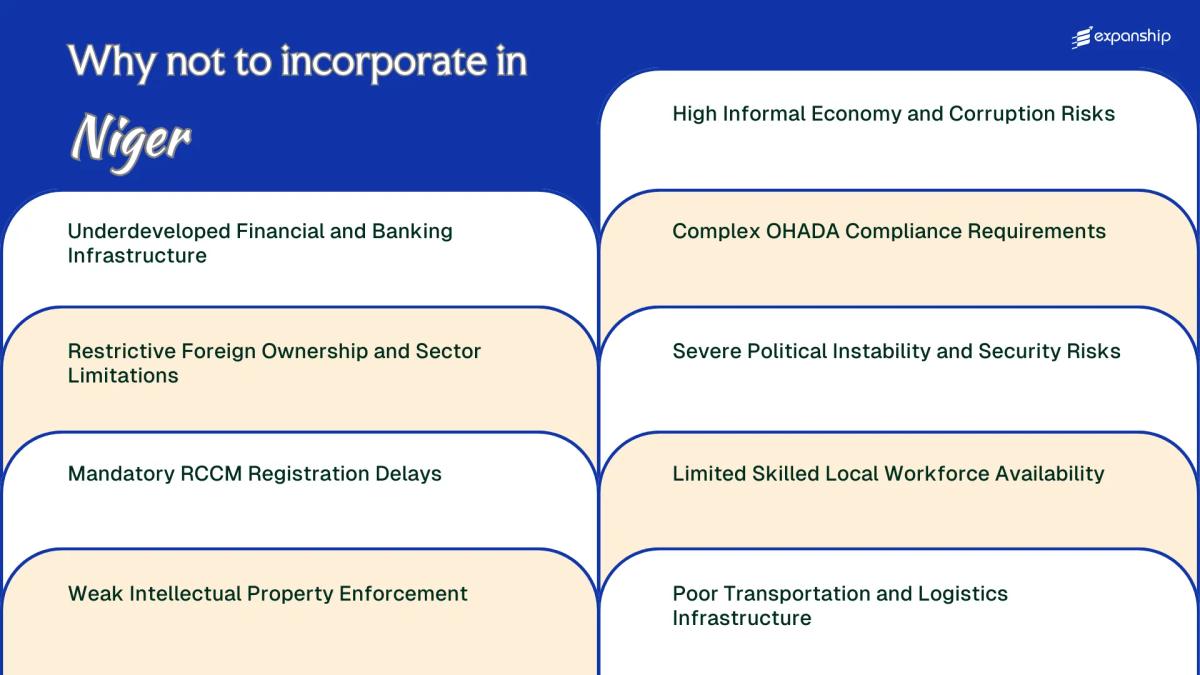
Underdeveloped Financial and Banking Infrastructure
Niger banking infrastructure limitations directly affect your ability to operate, collect payments, and move funds as a foreign business owner. Access to formal financial services remains structurally constrained, creating operational friction that persists well beyond the incorporation stage.
Limited Correspondent Banking and Payment Systems
Niger's banking sector is served by a small number of commercial banks, most operating under the regulatory oversight of the Banque Centrale des États de l'Afrique de l'Ouest (BCEAO). While BCEAO membership provides a regional monetary framework, the domestic banking network is thin, and correspondent banking relationships with international institutions are limited, meaning cross-border fund transfers frequently face delays, rejections, or elevated transaction costs.
Foreign firms often find that standard treasury operations, such as repatriating profits or settling supplier invoices abroad, take significantly longer than in more developed markets.
Corporate Credit and Trade Finance Barriers
Financial sector risks in Niger business extend to credit availability. Local banks apply conservative lending criteria, and trade finance instruments like letters of credit are difficult to obtain without substantial collateral or established relationships.
For a newly incorporated foreign entity with no local credit history, securing working capital through Niger's formal banking system is unlikely in the early stages of operations.
Inadequate correspondent banking access means your firm may be unable to process routine international payments reliably, directly disrupting vendor relationships and operational continuity from the outset.
Restrictive Foreign Ownership and Sector Limitations
Foreign ownership restrictions in Niger present direct structural barriers to full business control. Under the Investment Code (Ordonnance No. 97-001), certain sectors require mandatory local participation, limiting the equity share a foreign investor can hold. This constraint forces you into partnership arrangements with local shareholders, regardless of your operational preferences.
Strategic sectors face the tightest restrictions. Mining, telecommunications, and natural resource extraction all carry conditions that can require state participation or impose caps on foreign equity stakes. Your ability to consolidate profits, make unilateral management decisions, or exit cleanly is reduced when the ownership structure is prescribed by law rather than commercial negotiation.
The practical friction this creates for a foreign business owner includes:
- Local partners may lack the capital, technical capacity, or governance standards your firm requires, yet their participation is non-negotiable in restricted sectors
- Profit repatriation becomes more complex when ownership is split, as local shareholder agreements may create competing claims on dividends
- Exiting a joint structure requires regulatory approval and local partner consent, adding cost and delay to any divestment process
- Minority foreign ownership positions reduce your leverage in disputes, particularly given Niger's underdeveloped commercial arbitration infrastructure
Niger sector limitations apply unevenly, so a foreign investor in services or retail may face fewer equity constraints than one in extractive industries. That distinction, however, offers limited relief given how heavily investment interest concentrates in the resource sector.

Company Incorporation in Niger
Understand equity structures, sector restrictions, and registration requirements before committing to a Niger incorporation.
Mandatory RCCM Registration Delays
RCCM registration delays in Niger represent one of the most immediate friction points for any foreign business owner attempting to establish legal presence. The RCCM — Registre du Commerce et du Crédit Mobilier — is administered under the OHADA Uniform Act on General Commercial Law, and registration through the Centre de Formalités des Entreprises (CFE) is a mandatory prerequisite before a company can operate, open a bank account, or sign commercial contracts.
In practice, the process routinely exceeds its official timeframes. Understaffing at the CFE in Niamey, inconsistent document verification, and manual processing bottlenecks mean that registration which should take days can extend into weeks or months.
| Registration Stage | Official Timeframe | Reported Actual Delay | Impact on Operations |
|---|---|---|---|
| CFE document submission | 1-3 days | 1-2 weeks | Delays legal entity activation |
| RCCM number issuance | 3-5 days | 2-6 weeks | Blocks bank account opening |
| Tax ID (NIF) registration | 3-5 days | 2-4 weeks | Prevents invoicing and contracting |
| Full incorporation completion | ~7 days | 4-10 weeks | Defers operational start date |
Until the RCCM number is issued, your entity has no legal standing to transact. Every week of delay directly translates to sunk operational costs without corresponding revenue activity.
Foreign firms with time-sensitive market entry windows face disproportionate exposure to these Niger business registration bureaucracy risks. No statutory compensation mechanism exists for delays caused by administrative backlog.
Weak Intellectual Property Enforcement
Intellectual property risks in Niger stem from a structural gap between legal text and institutional capacity. Niger is a member of the African Intellectual Property Organization (OAPI), which provides a regional framework for trademark, patent, and copyright registration. Membership does not translate into reliable enforcement at the national level.
Courts handling IP disputes lack specialized training, and case resolution timelines are unpredictable. For a foreign firm that depends on brand integrity or proprietary technology, this creates direct commercial exposure.
Counterfeit goods and unauthorized use of registered marks circulate with limited administrative intervention. Niger's enforcement agencies do not operate with the same frequency or resources as those in jurisdictions with dedicated IP tribunals.
Even a validly registered trademark through OAPI can be infringed without triggering a practical legal remedy within a reasonable timeframe. The cost of pursuing civil litigation often exceeds the recoverable damages, which further weakens your position as a rights holder.
- OAPI registration grants regional rights, but national-level enforcement depends on Niger's domestic judicial system
- No specialized IP court exists; disputes are handled by general civil courts with limited IP expertise
- Border enforcement against counterfeit imports operates with limited capacity
- Litigation costs and delays may make formal IP enforcement economically unviable
Niger's OAPI membership means a single registration filing covers 17 African states, yet enforcement still varies entirely by country, making regional coverage less meaningful than it appears on paper.
High Informal Economy and Corruption Risks
Corruption risks doing business in Niger rank among the most documented obstacles for foreign firms operating in the country. Transparency International's Corruption Perceptions Index consistently places Niger in the bottom quartile globally, reflecting systemic issues that extend well beyond isolated incidents.
Scale and Structural Nature of the Problem
Niger's informal economy accounts for a substantial share of total economic activity, which means many transactions, suppliers, and competitors operate outside regulated channels. Your formally incorporated entity will face competitors who carry none of the compliance costs you bear, creating a structurally uneven operating environment.
Bribery risks in Niger's business environment are concentrated at points of bureaucratic contact, including customs clearance, licensing renewals, and public procurement. Refusing such payments is legally protected under OHADA principles and Niger's domestic anti-corruption statutes, but enforcement mechanisms are weak enough that refusal frequently results in administrative delays rather than resolution.
Exposure for Foreign-Incorporated Entities
Foreign investors face a compounded risk: home-country anti-bribery legislation, such as the U.S. Foreign Corrupt Practices Act or the UK Bribery Act, applies extraterritorially. A payment made in Niamey to expedite a permit can trigger prosecution in your home jurisdiction, creating dual legal exposure.
Managing Compliance and Corruption Risks When Incorporating in Niger
Understand the regulatory and legal exposure your business faces when entering Niger's market, and how to structure your entity to reduce compliance risk from the outset.
Complex OHADA Compliance Requirements
OHADA compliance challenges Niger create a disproportionate administrative burden for foreign businesses, largely because the uniform regional framework intersects with thin local institutional capacity. Enforcement and procedural norms diverge significantly from what the OHADA Uniform Acts prescribe on paper.
- Under the OHADA Uniform Act on Commercial Companies (AUSCGIE), your firm must maintain statutory accounts conforming to the OHADA Uniform Act on Accounting Law (AUDCIF), requiring local-standard bookkeeping that most foreign accountants are not trained to produce.
- Annual general meetings, capital variation procedures, and director appointment formalities all require notarized documentation, generating recurring notary fees that compound operational costs year on year.
- The OHADA Uniform Act on Simplified Recovery Procedures provides creditor protections in theory, but local judicial application is inconsistent, exposing your receivables to prolonged enforcement delays.
- Any modification to company statutes must be filed with the RCCM and published in a legal gazette, adding procedural layers that slow routine corporate restructuring.
Severe Political Instability and Security Risks
Political instability risks in Niger business operations became acute following the July 2023 military coup, in which the Presidential Guard overthrew President Mohamed Bazoum. The junta, operating under the Conseil National pour la Sauvegarde de la Patrie (CNSP), suspended the constitution and dissolved elected institutions, creating a structurally unpredictable legal environment for any foreign entity registered under Nigerien law.
Operational risk extends well beyond Niamey. Armed groups affiliated with both al-Qaeda and the Islamic State operate across the Tillabéri, Tahoua, and Diffa regions, and several western zones have been classified as high-risk by the French Ministry of Foreign Affairs and the U.S. State Department.
Foreign investors face a compounding problem: sanctions imposed by ECOWAS following the coup disrupted cross-border trade, and the country's suspension from certain international financial arrangements limits the instruments available to protect your capital.
- Suspended constitutional order creates legal uncertainty around existing investor protections
- Active insurgencies in multiple regions restrict physical operations and staff deployment
- International sanctions exposure increases compliance scrutiny for firms transacting through Nigerien entities
A foreign-owned firm operating in the Tillabéri region would likely require private security contracts, crisis evacuation coverage, and political risk insurance — costs that can collectively exceed $80,000–$120,000 annually for a small operation, before any productive activity begins.
Limited Skilled Local Workforce Availability
Skilled workforce limitations in Niger stem from one of the lowest adult literacy rates in the world, estimated at under 35% according to UNESCO data, which directly constrains the pool of qualified candidates available to foreign employers. For roles requiring technical, financial, or legal expertise, your business will almost certainly need to source talent externally.
Expatriate hiring carries its own friction. Work permit approvals in Niger involve the Ministry of Civil Service and Labor, and obtaining authorization for foreign workers is neither fast nor administratively straightforward, adding payroll costs and operational delays.
The formal higher education system produces limited graduates annually in fields such as engineering, accounting, and information technology. Sector-specific talent shortages mean that even competitive salary offerings may not resolve recruitment gaps quickly.
- Vocational training infrastructure is underdeveloped relative to the economy's scale.
- French-language proficiency requirements can further narrow the eligible candidate pool for specialized roles.
- Local hiring obligations under Niger's Labor Code (Ordonnance No. 96-039) mean you cannot default entirely to expatriate staffing without legal exposure.
Niger's Labor Code imposes local hiring priority requirements, meaning your firm cannot freely substitute expatriate staff for roles where qualified Nigerien candidates are deemed available by the Ministry of Civil Service and Labor.
Poor Transportation and Logistics Infrastructure
Logistics infrastructure problems Niger presents to foreign businesses stem from a fundamental geographic reality: the country is landlocked, with no rail connection to any port. Goods moving to or from Niamey depend almost entirely on road corridors through neighboring countries, primarily via Benin through the Cotonou port route, adding transit time and cost that erodes thin margins.
The national road network is largely unpaved outside major urban centers. During the rainy season, secondary routes become impassable, cutting off supply chains to interior regions for weeks at a time.
Air freight capacity through Niamey's Diori Hamani International Airport is limited, with few scheduled cargo services. This restricts time-sensitive imports and makes last-mile distribution expensive relative to the volume of goods moved.
For companies in manufacturing, distribution, or resource extraction, these Niger supply chain drawbacks translate directly into higher per-unit logistics costs and unreliable delivery schedules that complicate contracts with international buyers or suppliers.
Strategies to Overcome These Disadvantages
Overcoming Niger incorporation challenges requires structural preparation rather than reactive responses after problems emerge. The mitigating risks of doing business Niger demands that foreign entities address regulatory, security, and compliance vulnerabilities before committing capital.
- Register your company through the RCCM early and in parallel with sector-specific licensing applications to reduce cumulative delays.
- Establish banking relationships with regional institutions operating under BCEAO oversight, as these carry more operational continuity than smaller domestic banks.
- Structure your entity under the OHADA Uniform Act on Commercial Companies to ensure your governance framework meets enforceable regional standards.
- Obtain political risk and security insurance through multilateral providers such as MIGA before deploying assets in-country.
- File intellectual property registrations with OAPI, the regional body covering Niger under the Bangui Agreement, rather than relying on domestic enforcement mechanisms.
- Conduct formal anti-corruption due diligence aligned with UNODC guidelines before entering supplier or government procurement relationships.
These steps address the structural dimensions of Niger's regulatory environment without eliminating the underlying risks documented throughout this analysis. The OHADA framework and BCEAO monetary union provide a degree of supranational legal consistency, but domestic enforcement gaps remain a practical constraint for foreign firms.
Niger's Investment Potential in Perspective
Niger's documented disadvantages are real and material. For a foreign business weighing Niger investment risks and opportunities, the picture is not uniformly discouraging — uranium, gold, and agricultural sectors retain economic relevance, and OHADA membership provides a regional legal framework that many of Niger's peers lack entirely.
| Pros | Cons |
|---|---|
| OHADA membership provides a regionally harmonized commercial law framework | RCCM registration delays extend the entity formation timeline unpredictably |
| Natural resource sectors offer long-term commercial potential | The 2023 military coup has suspended constitutional governance and increased sanctions exposure |
| Membership in ECOWAS and WAEMU creates a broader regional trade context | Foreign ownership restrictions apply across key sectors, limiting control structures |
| The informal economy remains large enough to create real market demand | Corruption risks and weak contract enforcement raise transaction costs significantly |
| Low baseline operating costs in certain input categories | Intellectual property protections exist formally under OAPI but enforcement remains negligible |
Structural weaknesses documented across this blog, from logistics deficits to workforce constraints, do not disappear with the right entry strategy. They represent fixed costs that your business must price into any operational model before committing capital to the market.
Corporate Compliance Services in Niger
Ongoing compliance obligations for companies registered in Niger include RCCM maintenance, OHADA-aligned reporting, and tax filings with the Direction Générale des Impôts. This service covers the key requirements your entity must meet to remain in good standing.
Conclusion
The cons of Niger company formation span structural, institutional, and security dimensions that meaningfully affect operational viability. Among the most consequential barriers are the political instability following the 2023 coup, delays inherent in the RCCM registration process, and the persistent corruption risks that complicate day-to-day business conduct. These factors collectively shape a risk profile that demands careful pre-entry assessment. Firms that proceed do so with clear-eyed awareness of what the regulatory and operating environment requires, and with country-specific legal and administrative support already in place before entity formation begins.
Expanship's Niger Expansion Support Services
From managing OHADA-compliant documentation to liaising with Niger's RCCM and local tax authorities, your Niger business expansion support services requirements carry real operational weight. Expanship works alongside your team to reduce the administrative burden these obligations create, particularly where local procedural knowledge and in-country relationships make a measurable difference.
Our service scope covers the full incorporation and post-formation cycle:
- Your entity registration is handled from document preparation through to formal submission with the relevant authorities.
- A registered agent and local office address are provided to satisfy Niger's physical presence requirements.
- We manage government filings and maintain direct liaison with regulatory bodies on your firm's behalf.
- Ongoing compliance obligations are monitored and managed after your company is incorporated.
- Banking introductions are facilitated to help your business establish a functional local account.
- Tax registration and coordination with local fiscal authorities are handled as part of the setup process.
Reach out to Expanship Niger to discuss how we can support your incorporation process.
Frequently Asked Questions (FAQ)
OHADA law governs all commercial entities incorporated in Niger, regardless of size or sector, since Niger is a member state of the Organisation pour l'Harmonisation en Afrique des Affaires du Droit des Affaires. This means your company must comply with the OHADA Uniform Acts covering commercial companies, accounting standards, and insolvency procedures, in addition to Niger's domestic regulations. Non-compliance with OHADA requirements can expose directors to personal liability under the Acte Uniforme relatif au Droit des Sociétés Commerciales et du Groupement d'Intérêt Économique.
RCCM registration at the Registre du Commerce et du Crédit Mobilier routinely extends the incorporation process well beyond the statutory timeframes, often by several weeks due to administrative backlogs and inconsistent document processing. In practice, foreign founders frequently encounter requests for additional documentation after submission, restarting portions of the review period. Combined with notarization requirements, the full incorporation timeline can stretch to two months or longer.
It is a tangible financial risk, particularly for firms bringing proprietary technology, branded products, or creative works into the market. Niger's membership in the Organisation Africaine de la Propriété Intellectuelle (OAPI) provides a regional registration framework, but domestic enforcement capacity is limited, and civil litigation for IP violations moves slowly through the court system. Counterfeit goods and unauthorized use of trademarks are common in the informal sector, which accounts for a substantial share of Niger's economy.
A formally registered business operating in Niger faces direct competitive disadvantage against informal operators who avoid tax obligations, licensing fees, and labor regulations. The informal sector's dominance also increases corruption exposure, as dealings with suppliers, distributors, or local officials may involve undocumented payments that create legal risk under both Niger's anti-corruption framework and the foreign company's home jurisdiction laws. Conducting proper due diligence on local partners is difficult when a significant portion of commercial activity is unregistered.
Restrictions are concentrated in strategic sectors, including mining, telecommunications, and certain agricultural activities, where Nigerien state participation or local partnership requirements apply. However, even outside these sectors, foreign investors should be aware that the Investment Code may impose conditions on profit repatriation and currency conversion, particularly given the CFA franc's dependence on the BCEAO monetary framework and current sanctions-related banking constraints. The practical scope of these limitations has widened since the 2023 political transition.
Niger is landlocked, and its road network outside Niamey is poorly maintained, making freight movement to export markets or between regions expensive and unreliable. Port access depends entirely on transit corridors through neighboring countries, adding customs and transit fees that erode margins on imported inputs and exported goods. For businesses dependent on physical goods, these logistics costs can materially affect the viability of operations and need to be built into financial projections from the outset.
Legal Disclaimer
The information provided in this article is for general informational purposes only and does not constitute legal, tax, or professional advice. While we strive to ensure the accuracy and timeliness of the content, laws and regulations are subject to change, and the application of laws can vary widely based on specific facts and circumstances.
Readers should not act upon this information without seeking professional counsel tailored to their individual situation. Expanship and its authors disclaim any liability for actions taken or not taken based on the content of this article.
For specific advice regarding your business setup, compliance requirements, or any legal matters, please consult with qualified legal and tax professionals in the relevant jurisdiction.