
Key Takeaways
- Niger's membership in the OHADA legal framework gives foreign-incorporated entities access to a standardised commercial law system recognised across 17 member states, reducing the legal unpredictability that typically accompanies cross-border investment in West Africa.
- Companies registered through the Centre de Formalités des Entreprises can leverage Niger's Investment Code to access sector-specific tax incentives that directly lower the effective cost of early-stage operations in priority industries such as mining, agribusiness, and logistics.
- Businesses incorporated in Niger gain preferential market access across ECOWAS member states, turning a single registration into a regional commercial foothold that spans one of the largest trading blocs on the continent.
- Niger's position bordering seven countries across the Sahel and sub-Saharan Africa makes a locally registered entity structurally useful for corridor logistics and trade operations that depend on overland connectivity between coastal and landlocked markets.
Incorporating a company in Niger places your business within a landlocked West African nation that functions as an independent sovereign state, sharing borders with seven countries across the Sahel and sub-Saharan regions. Company registration falls under the oversight of the Centre de Formalités des Entreprises, the administrative body responsible for processing and formalizing business entities in the country. Foreign businesses entering the market most commonly do so through the Société à Responsabilité Limitée.
Niger operates within the OHADA legal framework and applies a general corporate tax posture that is territorial in orientation, with rates and incentive structures governed by the national investment code. The country maintains a generally open position toward foreign direct investment, with no blanket restrictions on foreign ownership across most commercial sectors, though certain regulated industries carry specific authorization requirements.
This article examines the concrete advantages that Niger company formation presents for businesses seeking a formal operational or holding presence in the region.
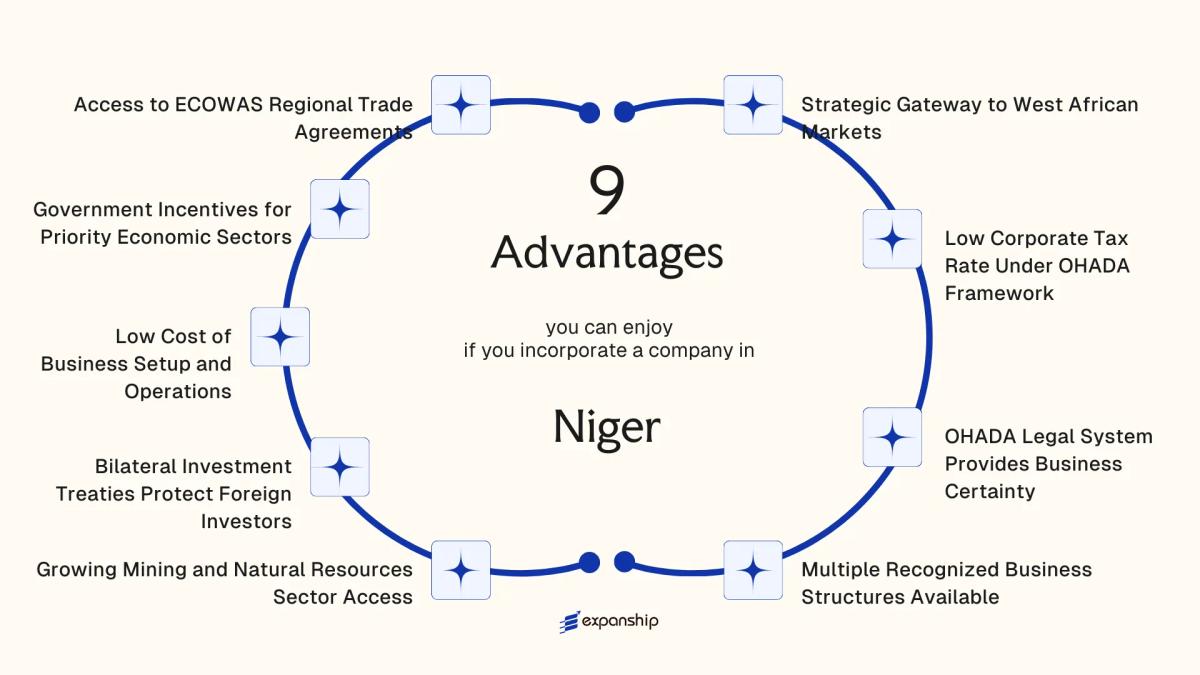
Strategic Gateway to West African Markets
Niger sits at the geographic center of West Africa, sharing borders with seven countries including Nigeria, Algeria, Mali, and Chad. Positioning your business here means operating from a single registration point with territorial reach across multiple regional economies.
Central Position Within the ECOWAS Zone
As a founding member of the Economic Community of West African States, Niger grants registered entities access to a market of approximately 400 million people under ECOWAS protocols on the free movement of goods and persons. That access is not theoretical — ECOWAS trade liberalization provisions reduce tariff friction for goods originating within member states, which directly affects the cost structure of regional distribution for a Niger-registered company.
Connectivity to the Sahel Corridor
The trans-Saharan trade routes passing through Agadez connect the entity to North African markets, extending commercial reach beyond ECOWAS borders. Niger gateway to West African markets value becomes concrete when you consider that landlocked neighbors such as Mali, Burkina Faso, and Chad rely on transit corridors that run through Nigerien territory, creating structural dependency that benefits firms operating out of Niamey.
A Niger-registered entity can serve as a regional hub for both ECOWAS member states and Sahel-adjacent markets from a single legal base.
Low Corporate Tax Rate Under OHADA Framework
Niger's corporate income tax rate sits at 30%, applied to the net taxable profits of resident companies and permanent establishments. While that figure alone is not exceptional, the OHADA framework gives it meaning: because OHADA member states share a unified accounting standard (the OHADA Uniform Act on Accounting Law and the SYSCOHADA chart of accounts), your tax base is calculated using a legally defined, predictable methodology rather than one subject to local interpretive variation.
This predictability has a direct practical value. Foreign shareholders and holding structures can model their effective tax burden with confidence, since the rules governing what counts as a deductible expense and how profits are measured are set at the supranational level.
Several features of the tax treatment under this regime work in favour of foreign-owned entities:
- Tax treaties with France and other partners reduce withholding tax exposure on dividends, interest, and royalties paid across borders
- SYSCOHADA-based accounting reduces the cost of compliance by aligning with standards already familiar to francophone finance teams
- The unified OHADA framework limits the scope for ad hoc regulatory reinterpretation of your declared taxable income
- Priority sector investments may qualify for reduced rates or exemptions under Niger's Investment Code administered by the Centre de Formalités des Entreprises
Companies subject to the minimum flat tax (Impôt Minimum Forfaitaire) should account for this floor when projecting tax obligations in early operating years.

Company Incorporation in Niger
Set up your business entity in Niger with full compliance support under the OHADA framework and local regulatory requirements.
OHADA Legal System Provides Business Certainty
Niger is a member of OHADA, the Organisation pour l'Harmonisation en Afrique des Affaires, which unifies commercial law across 17 member states through a single, supranational legal framework. The OHADA legal framework benefits Niger-based businesses by removing the uncertainty that typically arises when operating under a purely national legal code with limited precedent or inconsistent enforcement. For foreign investors, this means the rules governing your company are not unique to one jurisdiction but part of a tested, codified system applied across the region.
| Uniform Act | Subject Matter | Year of Current Version |
|---|---|---|
| Uniform Act on General Commercial Law | Commercial registration, contracts | 2010 |
| Uniform Act on Commercial Companies | Company formation, governance | 2014 |
| Uniform Act on Simplified Recovery | Debt recovery procedures | 1998 |
| Uniform Act on Arbitration | Dispute resolution mechanisms | 2017 |
OHADA's Uniform Acts carry direct legal force in Niger without requiring separate domestic legislation, which means the text your legal counsel reads is the same text a court applies. Disputes can be referred to the Common Court of Justice and Arbitration, known as the CCJA, seated in Abidjan, giving foreign investors access to a supranational tribunal rather than relying solely on domestic courts. This structure provides a defined, predictable channel for resolving commercial disagreements. Niger business legal stability under OHADA also means that substantive company law, accounting obligations, and insolvency rules are aligned with those in neighboring member states, reducing the compliance complexity your firm faces when operating across multiple West African markets.
Multiple Recognized Business Structures Available
Niger business structures for foreign investors fall under the OHADA Uniform Act on Commercial Companies, which defines a standardized menu of legal forms recognized across all 17 OHADA member states. This uniformity means a structure you use in Niger carries legal recognition and conceptual familiarity across the region.
The Société à Responsabilité Limitée (SARL) requires a minimum of one shareholder and carries limited liability, which insulates your personal assets from business obligations. Niger SARL company advantages include relatively low capital requirements and a simplified governance structure, making it a practical entry point for small-to-mid-scale foreign operations.
For larger ventures or those seeking equity investment, the Société Anonyme (SA) accommodates multiple shareholders and allows share issuance. Niger SA entity formation benefits are most relevant when you anticipate institutional investors or require a formal board structure.
Other recognized Niger legal entity types under OHADA include the Société en Nom Collectif (SNC) for partnerships and the Groupement d'Intérêt Économique (GIE) for joint economic ventures, each carrying distinct liability and governance rules.
- Confirm minimum capital requirements with the Centre de Formalités des Entreprises (CFE) before filing
- Verify that your chosen structure aligns with your planned activity and shareholder count
- Foreign directors may face residency or notarization requirements depending on the entity type
A single individual can legally form and fully own a SARL in Niger, making sole-founder foreign incorporation possible without a local partner requirement under OHADA rules.
Growing Mining and Natural Resources Sector Access
Niger holds some of the largest uranium reserves in the world, consistently ranking among the top global producers. That resource base creates direct entry points for foreign companies seeking Niger mining sector investment advantages, particularly in uranium, gold, and coal extraction across the Agadez and Tillabéri regions.
Resource Access Through a Defined Legal Framework
Mining operations in the country are governed by Ordinance No. 93-016, the Mining Code, which has been updated to reflect investment protections and concessionary frameworks. Foreign entities can obtain exploration permits, research permits, and exploitation concessions through the Ministry of Mines, giving your business a structured path to resource access that is grounded in codified law rather than administrative discretion. Permit holders operating under a valid exploitation concession receive fiscal stabilization guarantees for the duration of the concession, which shields your firm from mid-project tax regime changes.
Strategic Positioning for Extractive Industry Operations
Investing in Niger extractive industries positions your company at the source of supply chains that feed European nuclear energy markets and regional gold trading hubs. The country's membership in the Economic Community of West African States further enables cross-border movement of equipment and personnel under regional protocols. Small and mid-sized mining firms benefit from this because entry costs remain lower than in comparable uranium-producing jurisdictions such as Kazakhstan or Canada, where licensing processes involve additional federal-level regulatory layers.
Plan Your Mining Sector Entry in Niger
Speak with Expanship's corporate specialists about structuring your extractive industry entity and securing the right permits under Niger's Mining Code.
Bilateral Investment Treaties Protect Foreign Investors
Niger bilateral investment treaties protection gives foreign investors a meaningful layer of legal security that sits above domestic law. The country has signed BITs with several nations, including France, Germany, Switzerland, and China, among others. Each treaty typically guarantees fair and equitable treatment, protection against expropriation without compensation, and the right to transfer profits and capital freely across borders.
- These treaties override ordinary domestic risk by establishing binding obligations under international law. If the government takes an action that harms your investment, the treaty gives you a direct legal claim that does not depend on local courts.
- Most Niger BITs include access to international arbitration through ICSID (International Centre for Settlement of Investment Disputes). That means disputes are resolved under a neutral forum, not exclusively within the national judiciary.
- Fair and equitable treatment clauses prevent the host government from changing the rules of your investment after entry in ways that are arbitrary or discriminatory, protecting the conditions under which your business originally committed capital.
- Profit repatriation protections written into these treaties allow you to transfer dividends and proceeds without facing restrictions imposed unilaterally by domestic regulation.
Eligibility for BIT protections generally depends on your entity being genuinely incorporated or owned in a treaty-partner country, so structuring your investment correctly at the outset is material to accessing these rights.
Low Cost of Business Setup and Operations
Niger low cost business operations advantages stem partly from registration fees that remain among the lower tiers in the OHADA zone. Incorporating a Société à Responsabilité Limitée (SARL) through the Centre de Formalités des Entreprises (CFE) consolidates multiple administrative steps into a single filing point, reducing the time and professional fees typically associated with multi-agency registration processes in other West African jurisdictions.
Minimum capital requirements for a SARL under the OHADA Uniform Act on Commercial Companies are set at XOF 1,000,000 (approximately USD 1,600). For a foreign investor establishing an operating subsidiary or a trading entity, this threshold keeps initial capital commitment contained relative to many comparable markets.
Ongoing overhead costs also reflect the country's economic structure. Office space, local staffing, and utility costs are generally lower than in coastal hubs such as Abidjan or Dakar, which directly reduces your firm's fixed cost base during the early operational phase.
A foreign-owned SARL incorporating through the CFE with a single director and minimal share capital could realistically complete registration for under USD 500 in state fees, with annual compliance costs remaining modest given the absence of mandatory statutory audit requirements below certain revenue thresholds under OHADA rules.
Government Incentives for Priority Economic Sectors
Niger government incentives for priority sectors are formalized through the Investment Code, which grants fiscal advantages to qualifying businesses in agriculture, mining, energy, and manufacturing. Approval is administered through the Agence de Promotion des Investissements du Niger (API-Niger), the body responsible for processing investment applications and conferring incentive status.
Businesses operating under an approved investment regime can access:
- Exemptions from customs duties on capital equipment imports during the establishment phase
- Corporate tax holidays or reductions tied to the project's classified investment tier
- VAT relief on qualifying inputs for businesses in priority industrial categories
These benefits reduce the effective cost of capital deployment, particularly for capital-intensive operations that require significant equipment procurement before generating revenue. The investment tier assigned by API-Niger determines the duration and depth of the tax relief, so the actual fiscal advantage depends on the project size and sector classification.
Eligibility is not automatic. Your entity must formally apply to API-Niger and receive a written approval decision before any incentive takes effect.
Incentive status under Niger's Investment Code is granted by API-Niger on a project-by-project basis; benefits do not apply retroactively to investments made before approval is issued.
Access to ECOWAS Regional Trade Agreements
Niger ECOWAS trade agreement benefits derive directly from the country's founding membership in the Economic Community of West African States, established by the Treaty of Lagos in 1975. As a member state, companies registered here can move goods across 15 member countries under the ECOWAS Trade Liberalization Scheme (ETLS), which eliminates customs duties on qualifying originating products. That translates to tariff-free distribution across a regional market of over 400 million people.
ETLS Originating Status
To access duty-free treatment under the ETLS, your products must meet the scheme's rules of origin requirements, which generally require a minimum level of local value addition or processing. A company incorporated in the country and approved under the ETLS can export manufactured or agricultural goods to other member states without paying import duties at the destination border.
Qualifying products must be registered with the ECOWAS Commission and receive an ETLS certificate of origin. This certification process grants your business formal recognition as an originating enterprise across all participating states.
ECOWAS Free Movement and Regional Market Advantages
Incorporating in Niger for ECOWAS access also carries benefits under the Protocol on Free Movement of Persons, Right of Residence and Establishment. This allows businesses to post personnel across member territories with fewer visa restrictions than would apply to firms based outside the bloc.
- Goods covered under the ETLS face zero tariffs at intra-regional borders
- The ECOWAS Common External Tariff (CET) governs trade with non-member states
- Member state disputes over trade can be referred to the ECOWAS Court of Justice
How Niger Stacks Up Against Regional Competitors
Evaluating Niger against its West African peers requires selecting jurisdictions a foreign investor would realistically weigh in parallel. Nigeria, Senegal, and Côte d'Ivoire represent the most relevant comparators: Nigeria for its economic scale and anglophone profile, Senegal for its political stability and investor reputation, and Côte d'Ivoire for its position as the dominant francophone commercial hub. On parameters like OHADA membership, corporate tax rate, and setup cost, the comparison reveals meaningful structural differences that affect how quickly and affordably a foreign entity can become operational.
When evaluating Niger vs West Africa competitors incorporation options, the practical differentiators are less about headline policy and more about cost friction, legal uniformity, and sector access. Niger's alignment with the OHADA Uniform Acts means its company law is drawn from the same statutory source as Senegal and Côte d'Ivoire, reducing legal translation risk for investors already familiar with that framework. Nigeria, operating outside OHADA under the Companies and Allied Matters Act, presents a distinct legal environment with higher baseline operating costs.
| Parameter | Niger | Nigeria | Senegal | Côte d'Ivoire |
|---|---|---|---|---|
| OHADA Member | Yes | No | Yes | Yes |
| Standard Corporate Tax Rate | 30% | 30% | 30% | 25% |
| ECOWAS Member | Yes | Yes | Yes | Yes |
| Minimum Share Capital (SARL) | Low / No statutory minimum | Varies by sector | CFA 1,000,000 | CFA 1,000,000 |
| Official Language of Legal System | French | English | French | French |
| Foreign Ownership Restriction (General) | None (general sectors) | Restricted in some sectors | None (general sectors) | None (general sectors) |
Compliance Services for Companies in Niger
Stay aligned with Niger's OHADA obligations, tax filings, and regulatory requirements through structured compliance support.
Conclusion
The benefits of incorporating in Niger are most compelling for businesses with a clear regional mandate or sector focus. The OHADA framework removes the legal uncertainty that often discourages foreign direct investment in West Africa, while the Investment Code's sector-specific incentives reduce the effective cost of establishing and running operations during the early years of activity.
Access to ECOWAS trade agreements and the country's position as a corridor between coastal and landlocked markets gives incorporated entities a structural commercial advantage that purely domestic registration cannot replicate. These are not incidental features; they are embedded in Niger's treaty commitments and codified legal architecture.
The right fit depends on your industry, ownership structure, and how your business will generate revenue across the region. A firm operating in extractive industries faces a different regulatory and tax environment than one focused on agribusiness or logistics. Formalising your entity through the correct legal structure, under the applicable OHADA provisions and local registry requirements, is where the practical work begins.
Start Your Niger Company Formation With Expanship
Niger company formation with Expanship covers the full lifecycle of establishing a legal presence under OHADA's Uniform Act on Commercial Companies, from selecting the appropriate entity type — whether a SARL, SA, or SAS — through registration with the Centre de Formalités des Entreprises (CFE) and the RCCM (Registre du Commerce et du Crédit Mobilier). Each stage involves specific documentation thresholds, notarial requirements, and statutory filings that vary by structure and sector.
Expanship's services for foreign investors establishing a business in Niger include:
- Preparation and legalization of incorporation documents, including notarized statutes and shareholder agreements
- Registered agent and registered office provision to satisfy OHADA domiciliation requirements
- Liaison with the CFE and RCCM for company registration and certificate issuance
- Post-incorporation compliance management, including annual filings and SYSCOHADA-standard accounting obligations
- Assistance with tax identification registration at the Direction Générale des Impôts
- Banking introduction support to facilitate corporate account opening with local financial institutions
Contact Expanship Niger to discuss your incorporation requirements directly with a specialist familiar with the CFE process and Niger's current regulatory environment.
Frequently Asked Questions (FAQ)
Yes, foreign nationals can hold 100% ownership in a Nigerien company under the OHADA Uniform Act on Commercial Companies. There is no general statutory requirement for local shareholding in standard commercial structures such as the SARL or SA. Certain regulated sectors, including mining, may impose specific ownership or local participation conditions under their sector-specific legislation, so the applicable rules depend on the industry you are entering.
The standard corporate income tax rate in Niger is 30% of net taxable profit. Companies operating in priority sectors under the Investment Code may qualify for reduced rates or temporary exemptions during an approved incentive period. The Direction Générale des Impôts is the body responsible for administering corporate tax obligations.
Niger's bilateral investment treaties generally provide foreign investors with protections including fair and equitable treatment, protection against expropriation without compensation, and access to international arbitration mechanisms such as ICSID. These protections apply once your investment is formally established and recognized under the treaty with your home country. The specific remedies available depend on the terms of the relevant treaty and whether your business qualifies as a covered investment under that agreement.
Yes, as a member state of OHADA, Niger applies the OHADA Uniform Acts directly, without the need for separate national implementing legislation. This means the Uniform Act on Commercial Companies governs entity formation, shareholder rights, and corporate governance for firms registered in the country. The CCJA serves as the supreme arbitral and judicial body for OHADA-related commercial disputes across all member states, including Niger.
Company registration in Niger is processed through the Centre de Formalités des Entreprises, which operates as a one-stop shop for business registration formalities. The timeline can vary depending on the business structure and whether all documentation is submitted correctly, but registration through this mechanism is generally achievable within a few business days under standard conditions. Delays may occur if sector-specific approvals or additional licensing are required.
Niger is a member of ECOWAS, and companies registered in the country can benefit from the ECOWAS Trade Liberalization Scheme, which reduces or eliminates tariffs on qualifying goods traded among member states. To access these benefits, your products must meet the rules of origin requirements established under the ECOWAS framework. This provides a registered Nigerien entity with a defined legal basis for preferential market access across the broader West African region.
Under the OHADA Uniform Act on Commercial Companies, foreign investors in Niger can establish several recognized structures, including the Société à Responsabilité Limitée (SARL), the Société Anonyme (SA), and the Société par Actions Simplifiée (SAS). Each structure carries different minimum capital requirements, governance obligations, and liability arrangements. The SAS offers comparatively flexible internal governance rules, making it a common choice for investor-controlled entities, while the SA is typically used for larger ventures or those intending to raise capital from multiple shareholders.
Legal Disclaimer
The information provided in this article is for general informational purposes only and does not constitute legal, tax, or professional advice. While we strive to ensure the accuracy and timeliness of the content, laws and regulations are subject to change, and the application of laws can vary widely based on specific facts and circumstances.
Readers should not act upon this information without seeking professional counsel tailored to their individual situation. Expanship and its authors disclaim any liability for actions taken or not taken based on the content of this article.
For specific advice regarding your business setup, compliance requirements, or any legal matters, please consult with qualified legal and tax professionals in the relevant jurisdiction.