
Key Takeaways
- The Sociedade por Quotas is the most commonly registered entity in Mozambique, favoured for its manageable capital requirements and straightforward governance structure.
- Company registration in Mozambique is processed through the Conservatória do Registo das Entidades Legais (CREL), with tax obligations administered by the Autoridade Tributária de Moçambique under a territorial-based tax system.
- Branch offices allow foreign companies to operate in Mozambique without establishing a separate legal person, whereas representative offices are restricted strictly to non-commercial activity.
- Sole proprietorships (Empresa em Nome Individual) carry unlimited personal liability, limiting their suitability to low-risk, owner-operated businesses.
Introduction to Entity Types in Mozambique
Mozambique is an independent republic located on the southeastern coast of Africa, bordered by Tanzania, Malawi, Zambia, Zimbabwe, South Africa, and Eswatini. Its eastern coastline runs along the Indian Ocean, positioning the country within the Southern African Development Community (SADC) economic bloc.
Company registration falls under the authority of the Instituto para a Promoção de Investimentos e Exportações (IPEX) and is processed through the Conservatória do Registo das Entidades Legais (CREL), the official registry responsible for the incorporation of legal entities. Tax obligations are administered by the Autoridade Tributária de Moçambique (AT), which applies a territorial-based tax system.
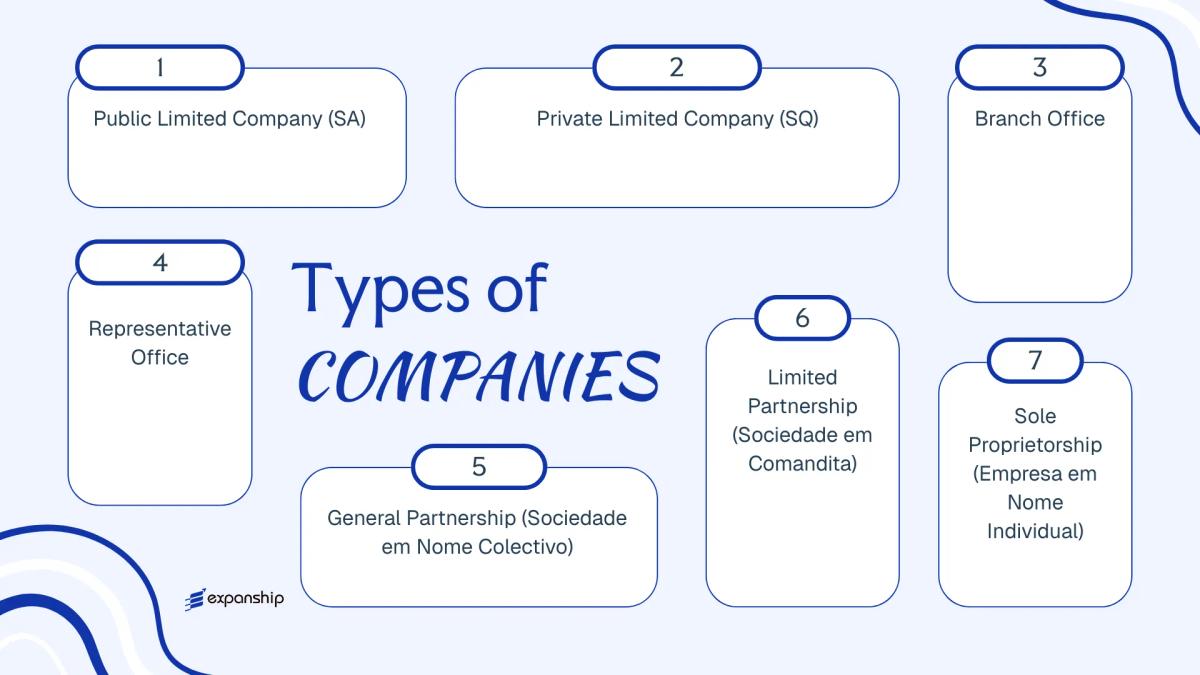
Several legal entity types are available to both local and foreign investors:
- Sociedade Anónima (SA)
- Sociedade por Quotas (SQ)
- Sociedade em Nome Colectivo
- Sociedade em Comandita
- Empresa em Nome Individual
- Branch Office
- Representative Office
Each structure carries distinct requirements around share capital, liability, governance, and foreign ownership. This article examines each of these corporate structures in detail — covering formation requirements, shareholder rules, and practical considerations relevant to your business.
An Overview of Business Structures in Mozambique
Mozambican commercial law recognises several distinct entity types, each governed primarily by the Commercial Code (Código Comercial), which has been revised through successive legislative updates, and supplemented by the Companies Law. Available business structures in Mozambique overview range from locally incorporated entities to foreign presence vehicles, with each form carrying different liability, governance, and tax implications. The sections that follow examine each in full.
Business Structures at a Glance
| Entity Type | Legal Form | Liability | Tax Treatment | Local Trading | Minimum Members | Regulatory Authority | Governing Act |
|---|---|---|---|---|---|---|---|
| Sociedade Anónima (SA) | Public limited company | Limited to share capital | Corporate tax applies | Yes | 1 shareholder | CMER / Conservatória | Commercial Code |
| Sociedade por Quotas (SQ) | Private limited company | Limited to quota value | Corporate tax applies | Yes | 2 quotaholders | CMER / Conservatória | Commercial Code |
| Branch Office | Extension of foreign entity | Parent bears liability | Corporate tax applies | Yes | N/A | CMER / Conservatória | Commercial Code |
| Representative Office | Non-trading presence | Parent bears liability | Generally exempt | No | N/A | CMER / Conservatória | Commercial Code |
| Sociedade em Nome Colectivo | General partnership | Unlimited, joint | Corporate tax applies | Yes | 2 partners | CMER / Conservatória | Commercial Code |
| Sociedade em Comandita | Limited partnership | Mixed liability | Corporate tax applies | Yes | 2 partners | CMER / Conservatória | Commercial Code |
| Empresa em Nome Individual | Sole proprietorship | Unlimited, personal | Personal income tax | Yes | 1 individual | CMER / Conservatória | Commercial Code |
Each of these structures is examined in full in the sections below.
Sociedade Anónima (SA) — Public Limited Company
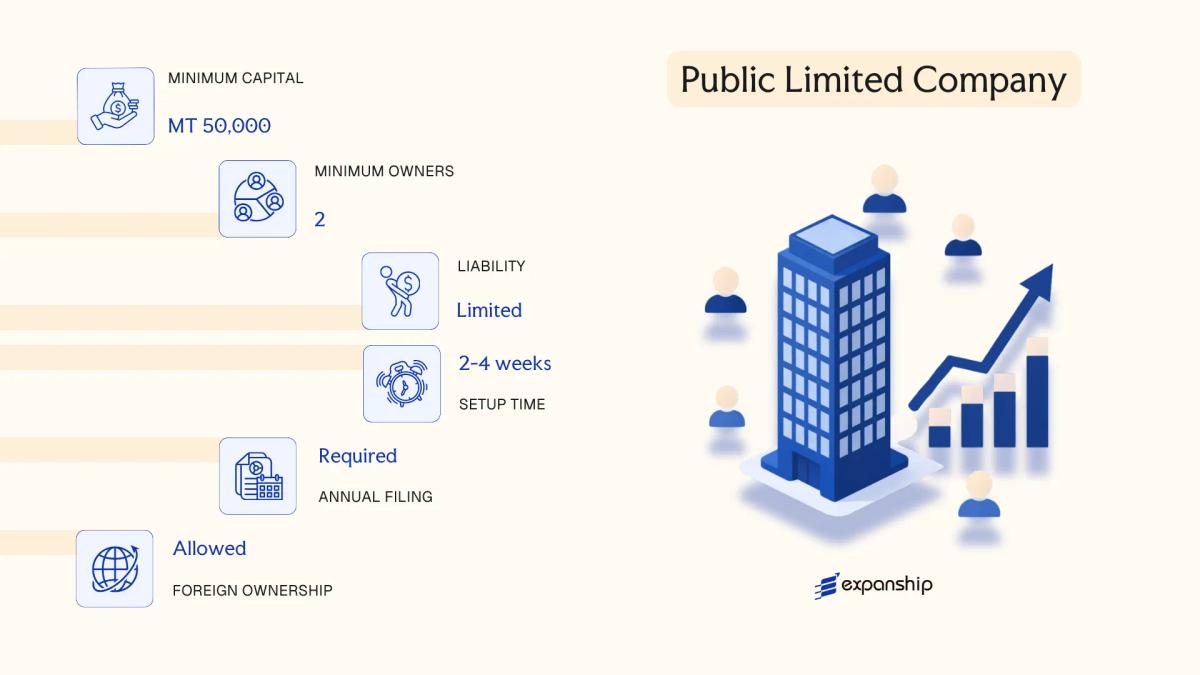
The Sociedade Anónima Mozambique SA structure is governed by the Commercial Code (Código Comercial), as reformed by Decree-Law No. 2/2005, and carries full separate legal personality from its shareholders. Liability is limited to the value of subscribed shares, making it structurally distinct from other local entity forms.
Shares in an SA are freely transferable unless the articles of association impose restrictions, which gives the entity considerable capital mobility. This structure is commonly adopted by larger enterprises, financial institutions, and businesses intending to raise capital from multiple investors.
Key Characteristics
| Requirement | Detail | Notes |
|---|---|---|
| Legal Form | Public Limited Company (Sociedade Anónima) | Separate legal personality; limited liability |
| Members | Shareholders — minimum 2, no statutory maximum | Shareholders may be individuals or legal entities |
| Directors | Board of Directors (Conselho de Administração) — minimum 3 directors | Single director permitted in smaller SAs under certain conditions |
| Local Presence | Registered office in Mozambique required | No mandatory local director, but a registered address is obligatory |
| Share Capital | Minimum MZN 1,000,000 (approx. USD 15,000) | Must be fully subscribed at incorporation; 30% paid up on registration |
| Share Transfer | Shares freely transferable by default | Restrictions may be imposed via articles of association |
| Privacy | Shareholders and directors disclosed in the Boletim da República | Limited privacy; public record upon registration |
Focus Points
- Taxation: Corporate income tax (IRPC) applies at 32%; VAT at 17% on taxable supplies; withholding tax on dividends is 20% for non-residents; stamp duty applies to certain transactions.
- Annual Compliance: Audited financial statements required annually; submission to the Conservatória do Registo das Entidades Legais and tax filings with the Autoridade Tributária de Moçambique (AT).
- Economic Substance: No formal substance regime comparable to offshore jurisdictions, but operational presence is implied by local registration requirements.
- Treaty Access: Mozambique has a limited tax treaty network; SA entities can access applicable double taxation agreements where in force.
- Conversion: An SA may be converted to a Sociedade por Quotas subject to shareholder approval and compliance with the Commercial Code conversion procedures.
Closing
The SA is suited to large-scale trading operations, financial services firms, and businesses seeking to attract institutional investment or list on capital markets. Its primary advantage is unrestricted share transferability; the principal drawback is the higher minimum capital threshold and mandatory audit requirements, which increase ongoing compliance costs.
Best suited for established businesses, joint ventures with multiple investors, or entities planning to access external capital markets in or through Mozambique.

Company Incorporation in Mozambique
Incorporate a Sociedade Anónima or other business entity in Mozambique with end-to-end support from Expanship.
Sociedade por Quotas (SQ) — Private Limited Company
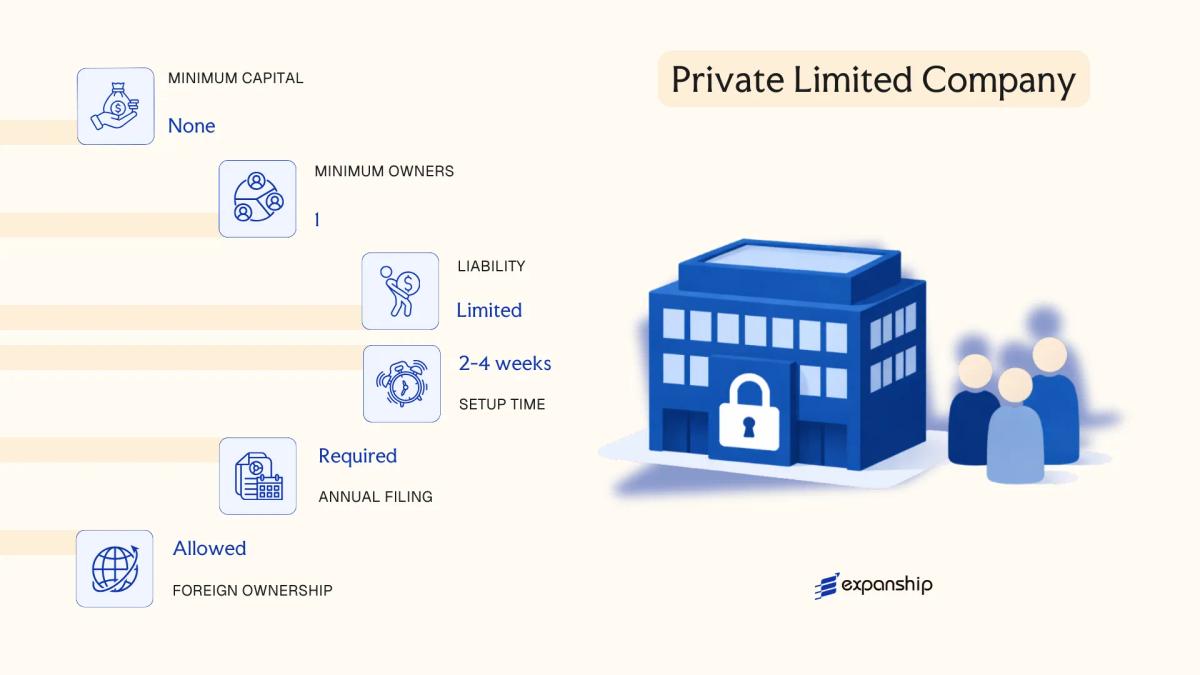
The Sociedade por Quotas Mozambique SQ is the most widely used corporate structure for private investment in the country. Governed by the Commercial Code (Código Comercial), last substantially revised in 2005, it offers limited liability to its members and holds a separate legal personality distinct from those who own it.
This hybrid structure combines elements of both partnership and corporate law. Liability is capped at each member's subscribed quota, meaning personal assets remain protected from company debts in most circumstances.
Key Characteristics
| Requirement | Detail | Notes |
|---|---|---|
| Legal Form | Private limited company (Lda) | Quotas are not publicly tradeable |
| Members | Referred to as sócios (quota holders) | Minimum 2, maximum 30 |
| Management | Managed by one or more gerentes (managers) | Need not be shareholders; foreign nationals permitted |
| Local Presence | Registered office required in Mozambique | No statutory registered agent requirement |
| Capital | Minimum MZN 20,000 | Contributions in cash or in-kind permitted |
| Privacy | Quota ownership recorded in commercial registry | Not publicly listed on any exchange |
Focus Points
- Taxation: Subject to corporate income tax (IRPC) at 32%; VAT applies at 17% on taxable supplies; withholding tax rates vary by payment type and recipient residency.
- Annual Compliance: Annual financial statements must be filed with the Conservatória do Registo das Entidades Legais; annual general meetings are required.
- Quota Transfer: Transfers to third parties outside the existing membership require prior consent from other sócios.
- Treaty Access: Mozambique has a limited network of double tax agreements; treaty benefits depend on the specific counterparty jurisdiction.
- Conversion: An SQ may be converted into a Sociedade Anónima once the applicable capital and membership thresholds are met.
Closing
The SQ suits trading operations, joint ventures, and holding structures where control needs to remain with a defined group of investors. Its straightforward governance keeps administrative overhead lower than a public company, though the 30-member cap restricts equity broadening significantly.
Best suited for small-to-medium foreign or domestic investors seeking limited liability with close control over ownership and management.
Foreign Business Structures in Mozambique [Branch Office, Representative Office]
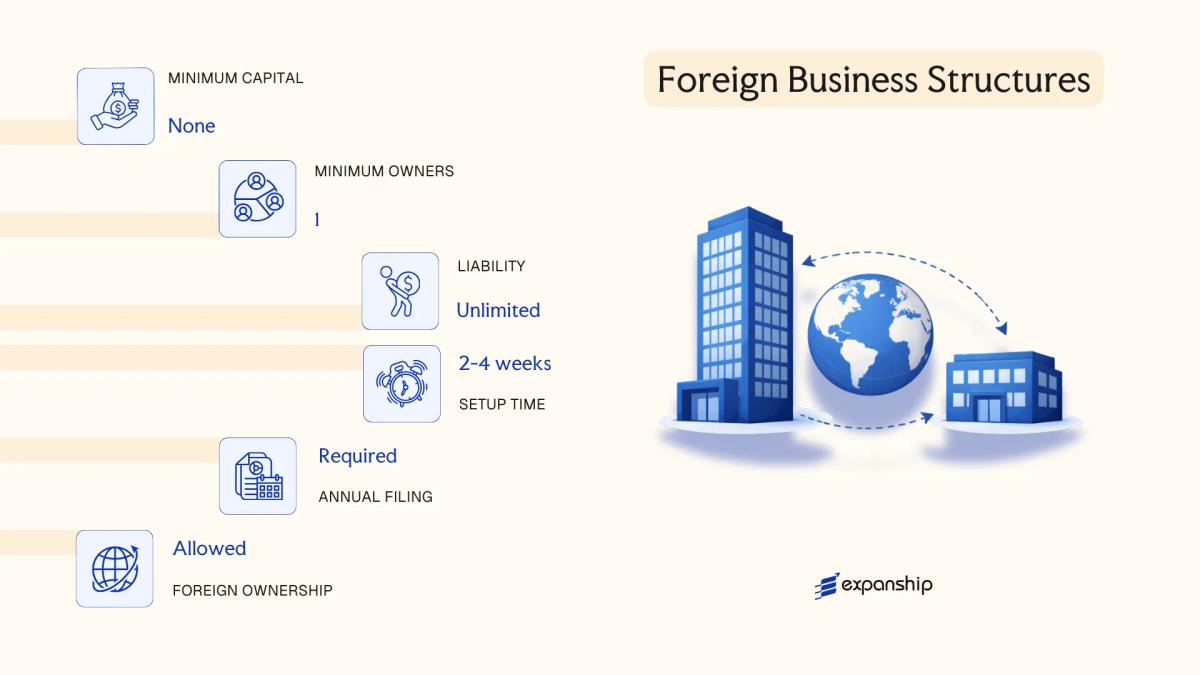
Foreign companies seeking to establish operations without incorporating a new local entity have two primary options: a branch office or a representative office. Foreign branch office registration Mozambique falls under the Commercial Code (Código Comercial) and the Investment Law No. 3/93, as amended, with oversight from the Business Environment Improvement Office (GPIE) and the Conservatória do Registo das Entidades Legais for registration formalities.
A branch has no separate legal personality from its parent company — the foreign entity bears full liability for the branch's obligations. A representative office, by contrast, is restricted to non-commercial activities such as market research and liaison functions, and cannot generate revenue or enter commercial contracts in its own right.
Key Characteristics
| Requirement | Branch Office | Representative Office |
|---|---|---|
| Legal Personality | None — extension of parent company | None — extension of parent company |
| Liability | Parent bears unlimited liability | Parent bears unlimited liability |
| Commercial Activity | Permitted | Not permitted |
| Management | Resident representative (mandatory) | Resident representative (mandatory) |
| Share Capital | No minimum prescribed; parent capital applies | Not applicable |
| Registration Body | Conservatória do Registo das Entidades Legais | GPIE / Conservatória |
| Privacy | Parent company details publicly disclosed | Parent company details publicly disclosed |
Focus Points
- Taxation: Branch profits are subject to Corporate Income Tax (IRPC) at 32%; VAT at 17% applies to taxable supplies; withholding tax applies to remittances of profits to the parent at standard rates under domestic law or applicable tax treaties.
- Treaty Access: Access to Mozambique's double tax treaties depends on the parent entity's jurisdiction of incorporation, not the branch itself.
- Annual Compliance: Annual financial statements and tax returns must be filed; branch accounts are typically consolidated with locally generated activity.
- Restrictions: Representative offices cannot invoice clients, hold inventory, or conclude sales contracts; any commercial activity triggers a requirement to register as a branch or incorporate locally.
- Conversion: A branch can be converted into a locally incorporated entity, though this involves a separate registration process and potential tax implications on transferred assets.
Sub-Types
Branch Office
A branch is operationally active and can enter contracts, employ staff, and generate taxable revenue. It is the standard structure for foreign firms conducting ongoing commercial activity without establishing a separate legal entity.
Representative Office
Mozambique representative office setup is appropriate solely for preparatory or auxiliary functions. Its scope is formally limited, and any drift into revenue-generating activity exposes the parent to compliance risk and potential reclassification by tax authorities.
A branch suits foreign companies testing market entry or executing project-based work, with the key advantage of avoiding the full incorporation process; the primary limitation is that the parent company carries unlimited liability for all branch obligations.
Foreign companies with defined, time-limited projects or those conducting pre-investment market assessment before committing to full local incorporation.
Partnerships in Mozambique [General Partnership (Sociedade em Nome Colectivo), Limited Partnership (Sociedade em Comandita)]
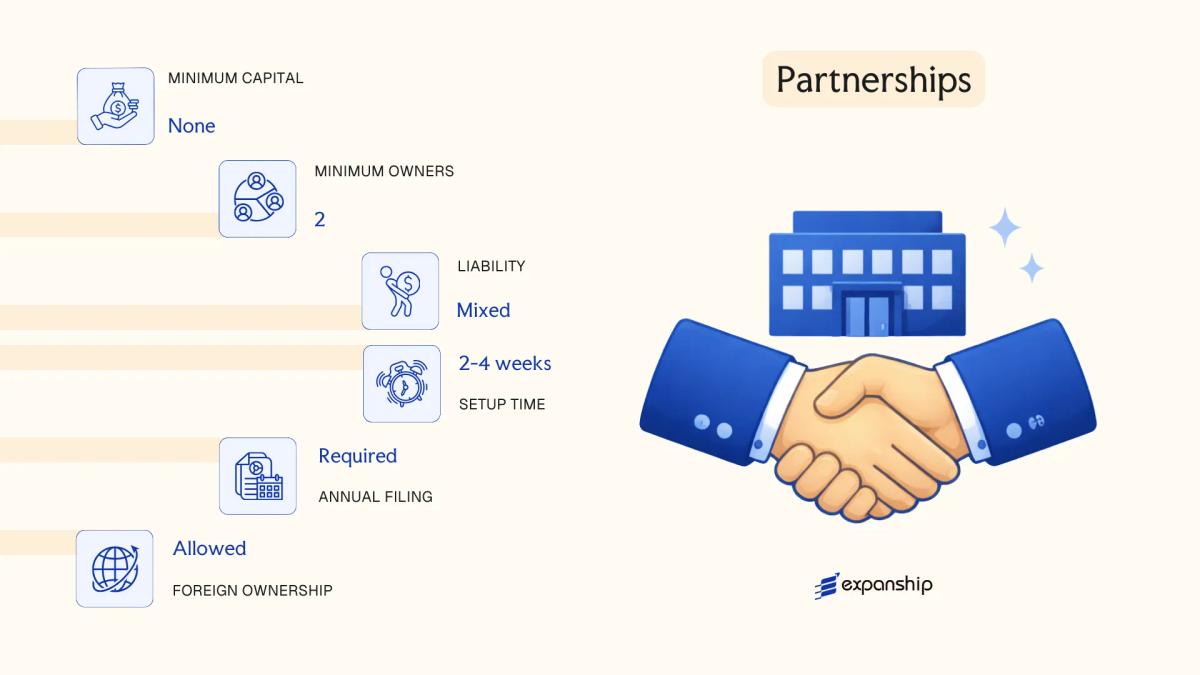
Mozambique recognises two partnership company structures under the Commercial Code (Código Comercial), as revised through successive legislative amendments: the Sociedade em Nome Colectivo and the Sociedade em Comandita. Both forms carry separate legal personality once registered with the Conservatória do Registo das Entidades Legais, yet they differ materially in how liability is distributed among partners.
Partnerships are relatively uncommon in practice, partly because the liability exposure for at least one class of partner is unlimited. Professional services firms and family-owned trading businesses account for most active registrations.
Key Characteristics
| Requirement | General Partnership (Sociedade em Nome Colectivo) | Limited Partnership (Sociedade em Comandita) |
|---|---|---|
| Legal Form | Separate legal personality; all partners bear unlimited joint liability | Separate legal personality; two-tier liability structure |
| Members | Partners (Sócios); minimum 2, no statutory maximum | General partners (Sócios Comanditados) — unlimited liability; Limited partners (Sócios Comanditários) — liability capped at contribution; minimum 1 of each class |
| Minimum Capital | No statutory minimum prescribed | No statutory minimum prescribed |
| Local Presence | Registered office in Mozambique required | Registered office in Mozambique required |
| Privacy | Partner names typically appear in public registration records | General partner names disclosed; limited partner details may appear in the articles |
Focus Points
- Taxation: Subject to corporate income tax (IRPC) at the standard 32% rate; VAT at 17% applies to taxable supplies; withholding tax obligations arise on dividends, interest, and royalties paid to non-residents at rates governed by domestic law or applicable double taxation agreements.
- Annual Compliance: Annual accounts must be filed with the tax authority (Autoridade Tributária de Moçambique); statutory bookkeeping obligations apply.
- Treaty Access: Mozambique's double taxation treaty network is limited; treaty benefits depend on the specific counterparty jurisdiction.
- Restrictions: Foreign nationals may act as partners subject to applicable investment and immigration regulations under the Lei de Investimentos.
- Conversion: Conversion to another legal form is possible through a formal amendment process at the Conservatória, subject to creditor notification requirements.
Sub-Types
Sociedade em Nome Colectivo (General Partnership)
Every partner holds unlimited, joint, and several liability for the firm's obligations. This structure is typically used by small professional or trading businesses where partners maintain close operational control and mutual trust is the basis of the arrangement.
Sociedade em Comandita (Limited Partnership)
Liability is divided between general partners, who manage the business and bear unlimited liability, and limited partners, whose exposure is restricted to their agreed capital contribution. Sociedade em Comandita por Acções is a recognised variant in which the limited partners' interests are represented by shares rather than quotas, though this form is rarely used in practice.
Closing
Partnerships suit family businesses, professional practices, or joint ventures where at least one party is prepared to accept unlimited liability in exchange for full operational control. The two-tier liability structure of the Sociedade em Comandita offers limited partners capital protection, but the unlimited exposure of general partners remains a significant structural constraint.
These structures are most appropriate for small, closely held businesses or professional practices where all partners know each other and operational simplicity outweighs the need for liability protection.
Sole Proprietorship (Empresa em Nome Individual)
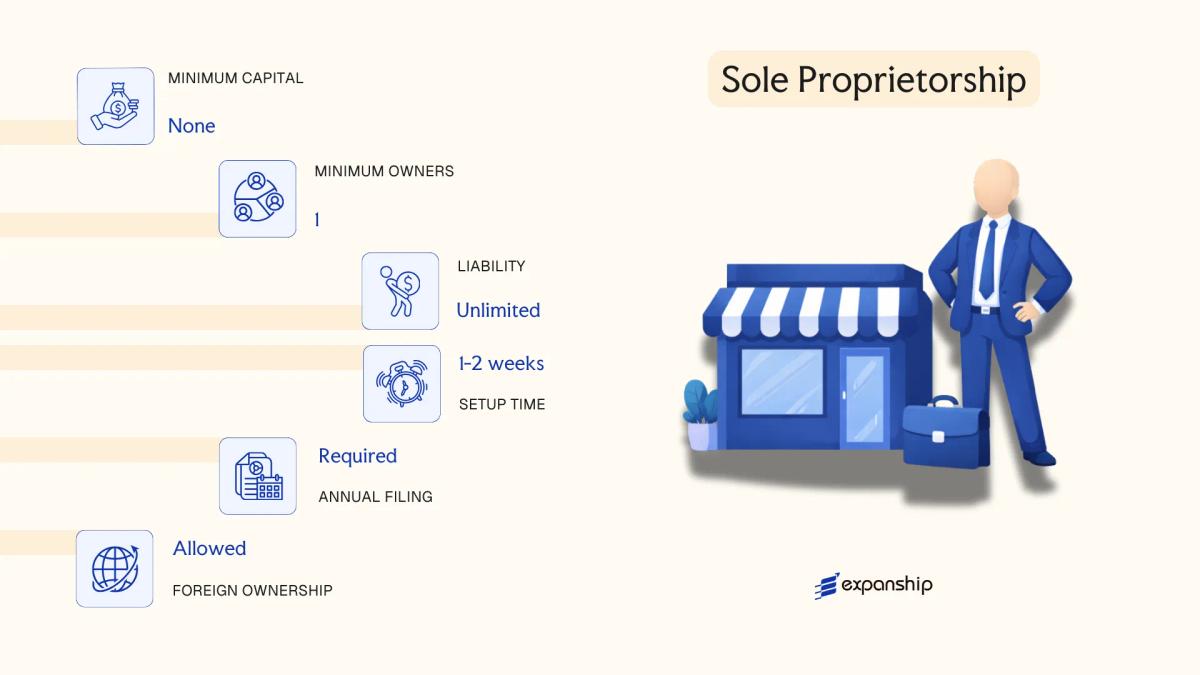
The Empresa em Nome Individual is the simplest form of business registration available to individuals in Mozambique. Governed by the Commercial Code (Código Comercial) and regulated through the Balcão de Atendimento Único (BAU), this structure allows a single person to conduct commercial activity under their own name or a registered trade name. It carries no separate legal personality — the proprietor and the business are treated as one legal subject.
Because no distinction exists between personal and business assets, the owner bears unlimited personal liability for all debts and obligations of the enterprise. This is a structurally significant point for anyone considering this path for self-employed business in Mozambique.
Key Characteristics
| Requirement | Detail | Notes |
|---|---|---|
| Legal Form | Sole Proprietorship | No separate legal personality from the owner |
| Member Reference | Proprietor | Single individual only; no partners or shareholders |
| Membership | 1 proprietor (minimum and maximum) | Must be a natural person; no corporate proprietors |
| Local Presence | Registered business address required | Must maintain a physical address in Mozambique |
| Capital | No statutory minimum | Capital is not formally declared or registered |
| Liability | Unlimited personal liability | Personal assets are exposed to business creditors |
| Privacy | Owner's name appears in public registration | Limited privacy; identity is publicly linked to the firm |
Focus Points
- Taxation: Subject to personal income tax (Imposto sobre o Rendimento das Pessoas Singulares, IRPS) on business profits; VAT registration required once turnover thresholds are exceeded; simplified tax regimes may apply to small operators under Mozambican revenue authority (Autoridade Tributária de Moçambique) guidelines.
- Annual Compliance: Annual accounts and tax declarations must be filed; bookkeeping obligations apply, though simplified accounting rules cover small-scale operators.
- Treaty Access: As a pass-through structure with no separate legal personality, access to double tax treaty benefits is limited and generally assessed at the individual proprietor level.
- Conversion: The structure can be converted into a Sociedade por Quotas or other commercial entity through a formal registration process at the BAU, though this requires meeting the applicable formation requirements of the target entity type.
- Restrictions: Foreign nationals face restrictions on registration as sole proprietors and must comply with applicable foreign investment and work permit requirements under Mozambican law.
Closing
This structure suits resident individuals operating small-scale trading, service, or artisanal businesses where administrative simplicity outweighs the need for liability protection. The primary advantage is low formation cost and minimal regulatory burden; the clear drawback is full personal exposure to business risk with no liability shield.
Best suited for Mozambican resident individuals running low-risk, small-scale commercial operations who do not require external investors or liability separation.
How to Choose the Right Entity Type in Mozambique
Choosing the right company type in Mozambique shapes your tax position, liability exposure, and operational capacity from day one.
Why Your Entity Choice Matters
The structure you register has binding legal consequences that are difficult to reverse after incorporation.
- Forming a Sociedade por Quotas when your activity requires a licence under a regulated sector — such as banking or insurance, overseen by the Banco de Moçambique or ISSM respectively — may result in registration being refused or subsequently invalidated.
- Registering a branch office to conduct trading activity without meeting the requirements set out under the Commercial Code can expose the parent entity to penalties and administrative sanctions.
- Selecting an entity structure that mandates statutory audit when your business is a single-person consultancy introduces annual compliance costs that a Empresa em Nome Individual would not incur.
- Choosing a structure that lacks legal personality can create personal liability for commercial debts that a limited liability entity would have ring-fenced.
Key Factors to Consider
- Business Activity: Active trading, passive asset holding, and regulated sectors each correspond to distinct entity types under Mozambican company law, so your primary revenue model should drive the initial structure decision.
- Ownership Configuration: A sole founder who wants operational simplicity points toward an SQ, while multi-investor arrangements requiring transferable share capital point toward an SA.
- Tax Objectives: Your eligibility for IRPC (Corporate Income Tax) treatment, sector-specific incentives under the Investment Law, or withholding obligations depends on which entity category you form.
- Regulatory Oversight: Certain activities require prior authorisation from bodies such as the Banco de Moçambique, and only specific entity types satisfy those licensing prerequisites.
- Liability Exposure: Consider whether unlimited personal liability — as carried by general partners or sole proprietors — is acceptable given your risk profile.
- Exit and Restructuring: If you anticipate future redomiciliation or conversion, confirm whether the Commercial Code (Lei n.º 2/2005) permits that path for your chosen structure before you commit.
Compliance Services for Companies in Mozambique
Ongoing compliance support for Mozambican entities, including statutory filings, annual returns, and regulatory reporting obligations.
Conclusion
Mozambique company incorporation summary points to one clear conclusion: the right structure depends on your operational scope, ownership intentions, and appetite for regulatory exposure. The Sociedade por Quotas remains the most commonly registered entity, favoured by small and mid-sized operators for its manageable capital requirements and straightforward governance. The Sociedade Anónima suits larger ventures requiring share transferability or external investment. Branch offices serve foreign firms testing the market without establishing a separate legal person, while representative offices are confined strictly to non-commercial activity. General and limited partnerships address specific co-ownership arrangements, and sole proprietorships carry unlimited personal liability, making them suitable only for low-risk, owner-operated activity.
Governed primarily by the Commercial Code and overseen by CEMPRE for registration, the framework continues to evolve as Mozambique works to align its investment climate with regional standards. Expanship tracks these regulatory developments across all active jurisdictions.
How Expanship Can Assist You
Expanship's company formation services Mozambique cover the full registration journey — from selecting between a Sociedade por Quotas and a Sociedade Anónima to filing with the Instituto de Promoção de Investimentos e das Exportações (IPEX) and the Conservatória do Registo das Entidades Legais. Every structure discussed in this blog comes with distinct compliance requirements, and our team handles the specifics of each.
From document preparation to ongoing post-incorporation obligations, Expanship supports your business at every stage:
- Document preparation, notarization, and legalization
- Registered agent and local office provision
- Government filing and registrar liaison
- Post-incorporation compliance management
- Banking introduction assistance
Reach out through our Expanship Mozambique contact page to discuss your registration requirements directly with our team.
Frequently Asked Questions (FAQ)
The Sociedade por Quotas (SQ) is the most widely used structure. Its lower capital requirements and straightforward governance make it the practical default for small to mid-sized domestic and foreign-owned businesses.
A Branch Office is not a separate legal entity; it operates as an extension of its foreign parent and carries that parent's full liability. An SQ, by contrast, has distinct legal personality under the Commercial Code, limiting member liability to their quota contributions. Compliance obligations are broadly comparable, though an SQ files independently while a Branch reports through its parent's structure.
The Sociedade por Quotas does not publish shareholder quota values in accessible public registries in the same detail as an SA. An SA's share capital and shareholder structure face broader disclosure requirements under the Commercial Code. Nominee arrangements are legally permissible for both, subject to beneficial ownership rules under anti-money laundering regulations.
No. A Sociedade em Nome Colectivo and a Sociedade em Comandita each require at least two partners. An SQ can be formed by a single quotaholder, and a Sociedade Anónima requires a minimum of one shareholder under current rules.
Foreign nationals may register an SQ, SA, or Branch Office. Certain sectors require prior approval from APIEX, the investment promotion agency, and foreign participation thresholds may apply in regulated industries under the Investment Law.
Conversion between entity types is permitted under the Commercial Code through a formal transformation process, which requires amended articles of association and re-registration with CRER. An SQ converting to an SA, for example, must meet the minimum share capital threshold applicable to the target structure.
No. A Branch Office and a Representative Office do not hold separate legal personality; both remain extensions of their parent company. An SQ, SA, Sociedade em Nome Colectivo, and Sociedade em Comandita each constitute distinct legal persons upon registration.
Legal Disclaimer
The information provided in this article is for general informational purposes only and does not constitute legal, tax, or professional advice. While we strive to ensure the accuracy and timeliness of the content, laws and regulations are subject to change, and the application of laws can vary widely based on specific facts and circumstances.
Readers should not act upon this information without seeking professional counsel tailored to their individual situation. Expanship and its authors disclaim any liability for actions taken or not taken based on the content of this article.
For specific advice regarding your business setup, compliance requirements, or any legal matters, please consult with qualified legal and tax professionals in the relevant jurisdiction.