

Key Takeaways
- Under the Companies Act 2016, foreign-owned companies in Malaysia must appoint at least one ordinarily resident local director, which limits the ability of non-resident founders to maintain full operational control without establishing local ties.
- Foreign investors seeking majority ownership in licensed industries such as financial services, construction, and telecommunications face sector-specific equity caps enforced by regulatory bodies outside SSM, adding a layer of approval complexity beyond standard incorporation.
- Malaysia's transfer pricing rules require companies engaged in related-party transactions to maintain contemporaneous documentation, creating a recurring compliance burden that increases administrative costs for multinational structures.
- Certain sectors impose Bumiputera equity participation requirements that restrict the ownership structure available to foreign shareholders, narrowing the range of viable entry strategies for businesses operating in those regulated industries.
Malaysia operates under a structured and actively enforced corporate regulatory framework, administered primarily through the Companies Commission of Malaysia (SSM) under the Companies Act 2016. The disadvantages of incorporating in Malaysia span ownership restrictions, director requirements, capital thresholds, compliance obligations, and licensing processes.
Not every constraint applies equally to all business types. A fully foreign-owned technology firm faces a different set of challenges than a joint venture operating in a licensed financial or construction sector.
This article is most relevant to foreign investors and business owners seeking majority or full ownership of a Malaysian entity, particularly those unfamiliar with the regulatory conditions that SSM and sector-specific authorities impose on non-resident shareholders and directors.
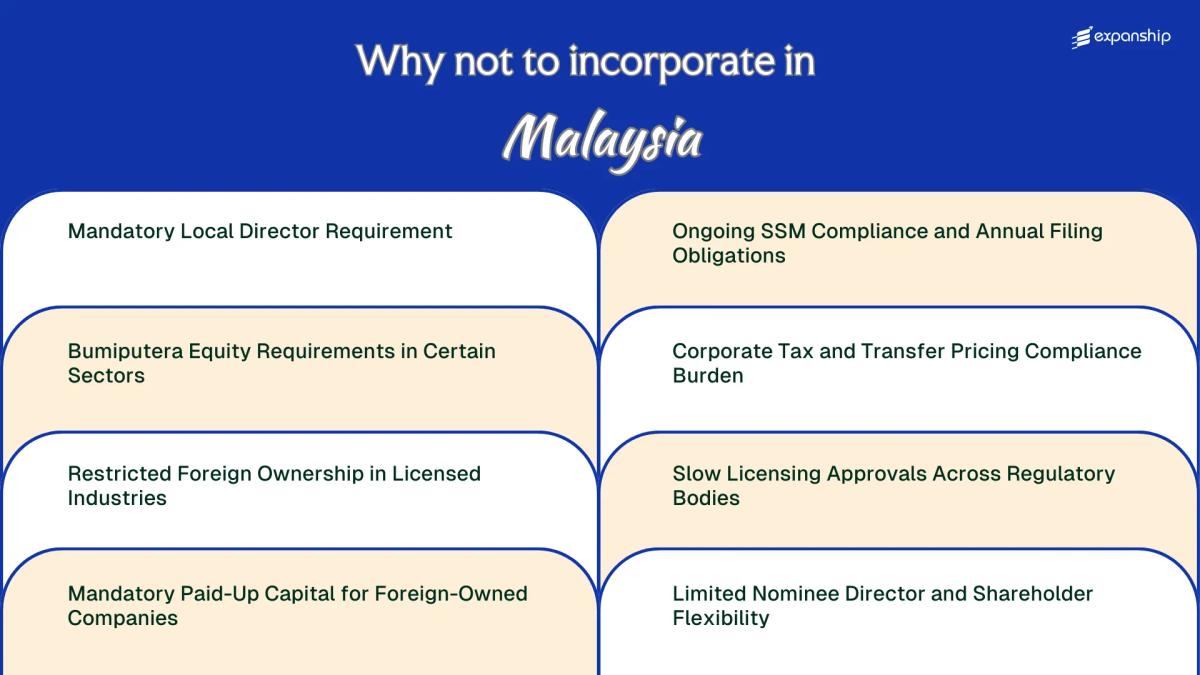
Mandatory Local Director Requirement
Under the Companies Act 2016, every Sdn Bhd must appoint at least one director who is ordinarily resident in Malaysia. The Malaysia local director requirement restrictions this creates are immediate and structural for any foreign founder operating remotely.
Finding a Qualified Resident Director
Sourcing a compliant resident director is not straightforward. The individual must be ordinarily resident in Malaysia, meaning a foreign national based elsewhere cannot satisfy this requirement regardless of their involvement in the business, forcing you to either hire locally or engage a professional director service at ongoing cost.
Professional nominee directors typically charge annual retainer fees, and reputable providers often impose conditions on the types of companies they will serve.
Control and Liability Exposure
Because the resident director carries statutory duties under the Companies Act 2016, any misalignment between their obligations to the company and your operational instructions creates legal friction. If the director acts in good faith but contrary to your instructions, disputes over authority become a real operational risk.
This dynamic limits how much effective control you can retain from outside the country.
A foreign business owner who cannot identify a reliable resident director before incorporation has no compliant path to registering an Sdn Bhd, regardless of capital or shareholder structure.
Bumiputera Equity Requirements in Certain Sectors
Bumiputera equity requirements Malaysia imposes on certain industries trace their origins to the New Economic Policy introduced in 1971. The NEP was designed to restructure corporate ownership in favour of the Bumiputera community, and its conditions persist in sector-specific licensing and approval frameworks today.
Under these requirements, foreign-owned firms operating in designated sectors must allocate a defined percentage of equity to Bumiputera shareholders, with the threshold commonly cited at 30%. Your business cannot simply acquire this equity from any local partner; the shareholder must qualify as Bumiputera under Malaysian legal definitions, which narrows the available pool significantly.
These NEP equity conditions create friction at multiple points in your business setup:
- Finding a qualifying Bumiputera equity partner within a commercially reasonable timeframe delays incorporation, since candidates with both capital and relevant industry experience are limited in supply.
- The 30% equity dilution directly reduces the economic return available to foreign shareholders, affecting dividend distributions and exit valuations.
- Malaysia Bumiputera shareholding compliance requires ongoing governance attention, as the equity ratio must be maintained through subsequent share issuances and investor changes.
- Enforcement sits across multiple bodies depending on sector, including MIDA and sector-specific ministries, meaning your firm may face layered approval obligations rather than a single clearance process.
Sectors commonly subject to these conditions include construction, distributive trade, and certain professional services. Some exemptions apply to companies operating exclusively in free industrial zones or under specific investment promotion incentives, but these carve-outs are narrow.

Company Incorporation in Malaysia
Understand the structural requirements before you incorporate, including equity conditions that apply to your sector.
Restricted Foreign Ownership in Licensed Industries
Restricted foreign ownership Malaysia licensed sectors extends well beyond the Bumiputera equity framework. Certain industries are subject to hard foreign equity caps enforced through sector-specific licensing bodies, meaning your company structure must satisfy ownership thresholds before a licence will even be issued.
Under Malaysia's licensing regime, regulators including the Communications and Multimedia Commission (MCMC), Bank Negara Malaysia (BNM), and the Securities Commission (SC) each impose independent foreign equity limits tied directly to licensing eligibility. Foreign ownership restrictions by industry vary significantly, but several commercially active sectors cap foreign participation at levels that prevent majority ownership.
| Sector | Regulator | Foreign Equity Ceiling |
|---|---|---|
| Commercial Banking | Bank Negara Malaysia | Up to 70% (subject to BNM approval) |
| Insurance and Takaful | Bank Negara Malaysia | Up to 70% |
| Broadcasting | MCMC / MCMC Act 1998 | Up to 49% |
| Telecommunications | MCMC | Up to 49% in certain licence categories |
| Legal Services | Bar Council / Legal Profession Act | Restricted to specific qualified arrangements |
For a foreign investor targeting majority control, a 49% ceiling in broadcasting or telecoms removes operational autonomy before the business begins trading. Structuring around these caps requires a compliant local partner, and the dependency that creates carries ongoing commercial risk.
Licensing approvals are conditional on ownership compliance being verified upfront. Any restructuring after the fact requires fresh regulatory consent, which can delay operations by months.
Mandatory Paid-Up Capital for Foreign-Owned Companies
Foreign ownership in a Malaysian private limited company (Sdn Bhd) triggers capital requirements that domestic-only entities are not always subject to. Under guidelines administered by the Malaysia Investment Development Authority (MIDA), foreign-owned companies in many sectors must meet a minimum paid-up capital threshold of RM 500,000. That capital must be deposited before certain approvals and licences are issued, creating an upfront cash obligation that directly affects your firm's liquidity from day one.
This is not a nominal administrative fee. For smaller foreign businesses or early-stage operations, committing RM 500,000 in paid-up capital before generating any local revenue is a real financial barrier.
Certain sectors demand even higher thresholds. A foreign-owned company in trading or professional services can face requirements of RM 1,000,000 or more depending on the business activity classification assigned during registration.
- Paid-up capital must be deposited in a Malaysian bank account prior to licence issuance in most regulated sectors.
- The RM 500,000 threshold applies specifically to foreign-owned entities; locally owned firms face lower or no equivalent minimum.
- Trading companies with 100% foreign ownership face a separate, higher threshold under distributive trade policies.
- Capital requirements are assessed per business activity, meaning multi-activity companies may face compounded obligations.
A foreign-owned Sdn Bhd conducting e-commerce can still be subject to the RM 500,000 capital rule even if it has no physical retail presence in the country.
Ongoing SSM Compliance and Annual Filing Obligations
SSM compliance obligations Malaysia drawbacks are ongoing and add recurring cost to operating a local entity, regardless of whether the business is actively generating revenue.
What the Companies Act 2016 Requires
Under the Companies Act 2016, every Sdn Bhd must lodge an annual return with the Suruhanjaya Syarikat Malaysia within 30 days of each anniversary of incorporation, accompanied by updated particulars of directors, shareholders, and the registered address. A licensed company secretary, who must be a member of a body approved by the Companies Commission, is mandatory throughout the life of the entity — you cannot self-administer secretarial functions as a foreign owner.
The Cost Burden for Foreign Operators
Retaining a qualified company secretary, filing audited financial statements with SSM annually, and maintaining statutory registers generates a fixed administrative overhead that applies even to dormant companies. Audit exemptions exist for certain qualifying private companies, but foreign-owned entities frequently fall outside those thresholds, making annual audit fees a non-negotiable expenditure.
Managing SSM Compliance Obligations for Your Malaysia Entity
Understand the ongoing secretarial, filing, and audit requirements under the Companies Act 2016 before committing to incorporation.
Corporate Tax and Transfer Pricing Compliance Burden
Malaysia corporate tax compliance challenges are disproportionately demanding for foreign-owned entities, particularly those with cross-border related-party transactions subject to scrutiny by Lembaga Hasil Dalam Negeri (LHDN).
- The standard corporate tax rate sits at 24% for companies with paid-up capital above MYR 2.5 million, creating a meaningful tax cost that requires precise structuring to avoid overpayment.
- Transfer pricing rules under the Income Tax Act 1967 (Section 140A) require contemporaneous documentation, meaning you must prepare and maintain records before filing, not after an audit is triggered.
- LHDN can adjust intercompany pricing under the arm's length principle, exposing your entity to retrospective tax assessments, penalties, and interest charges if documentation is deemed insufficient.
- The transfer pricing documentation threshold applies broadly to related-party transactions, and smaller foreign-owned firms without dedicated tax counsel frequently fail to meet the required standard.
- Filing obligations under the self-assessment system place full compliance responsibility on your company, with no administrative guidance from LHDN unless a dispute or audit arises.
Slow Licensing Approvals Across Regulatory Bodies
Slow licensing approvals Malaysia incorporation processes create unpredictable timelines that directly affect your ability to begin operations. Unlike SSM registration, which is relatively fast, sector-specific approvals involve multiple agencies operating under separate mandates, each with its own processing schedule.
Depending on your industry, your firm may require sign-off from MIDA, the Central Bank of Malaysia (Bank Negara), the Securities Commission, the Ministry of Communications, or state-level authorities. Each body processes applications independently, meaning delays at one agency do not pause the clock at another, yet your business cannot operate until all approvals are secured.
MIDA licensing process challenges in Malaysia often stem from documentation requirements that differ by sector and are not consolidated into a single submission window. A manufacturing entity, for example, may wait months for its manufacturing licence under the Industrial Co-ordination Act 1975 before it can engage any other regulator.
For foreign businesses, this fragmentation has a direct cost:
- Capital is committed but generating no revenue during the approval period
- Local staff hired in anticipation of launch remain unproductive
- Office or facility leases accumulate costs before legal operations begin
A foreign-owned company that commits to a 12-month office lease and hires five local staff at an average monthly salary of MYR 5,000 before receiving all regulatory clearances could incur over MYR 360,000 in fixed costs with zero operational revenue if approvals take six months beyond the expected timeline.
Limited Nominee Director and Shareholder Flexibility
Malaysia nominee director limitations foreign companies create a structural constraint that many foreign founders underestimate at the outset. Unlike some offshore jurisdictions that permit fully nominee-driven setups, a Sdn Bhd requires at least one director who is ordinarily resident in the country, under Section 196 of the Companies Act 2016. That resident director must be a genuine participant in the company's governance, not a passive placeholder.
The Companies Commission of Malaysia (SSM) has increased scrutiny of nominee arrangements following the introduction of the beneficial ownership framework in 2020. Nominee shareholder restrictions in Malaysia mean that any person holding shares on behalf of another must be disclosed under the Beneficial Ownership Registry, reducing the confidentiality that nominee structures once provided.
For foreign investors accustomed to holding company structures with layered anonymity, this disclosure obligation materially limits the utility of a nominee setup. The practical cost is twofold: you must identify and engage a qualified resident director, and you must also register the true beneficial owner, eliminating the structural separation many holding arrangements depend on.
This disadvantage applies regardless of company size or industry sector.
Under Malaysia's beneficial ownership framework, any nominee shareholder arrangement must disclose the ultimate beneficial owner to SSM, meaning nominee structures cannot be used to conceal the identity of the controlling foreign party.
How to Overcome These Incorporation Challenges
Overcoming Malaysia incorporation challenges requires structural planning before registration, not reactive adjustments after the fact.
- Confirm whether your intended business activity falls under a sector with Bumiputera equity requirements by reviewing the Foreign Investment Committee guidelines published by MIDA.
- Structure your company to meet the RM1,000,000 paid-up capital threshold if foreign equity exceeds 50%, as required under the Companies Act 2016.
- Appoint a resident director who ordinarily resides in Malaysia, satisfying the minimum requirement under Section 196 of the Companies Act 2016.
- Register for corporate tax with the Inland Revenue Board (LHDN) and establish a transfer pricing policy before commencing intercompany transactions.
- Account for multi-agency licensing timelines by submitting applications to bodies such as Bank Negara Malaysia or the Communications and Multimedia Commission well ahead of your intended operational date.
- Set up a calendar for annual SSM filings and statutory returns to avoid penalties under the Companies Act 2016.
These steps address the core structural and compliance requirements specific to this jurisdiction's regulatory framework. None of them eliminate the underlying constraints; they reduce the risk of non-compliance or delayed operations.
Malaysia Still Worth Considering for Expansion
The disadvantages covered in this blog are real and, depending on your sector, can add meaningful cost and administrative weight to operating in Malaysia. That said, the country maintains a creditable position as a regional business hub, backed by a structured legal framework under the Companies Act 2016, a network of bilateral investment treaties, and consistent enforcement through established bodies like SSM and the MIDA.
| Pros | Cons |
|---|---|
| Companies Act 2016 provides a clear, codified framework for company formation and ongoing governance. | Foreign-owned Sdn Bhd companies must meet minimum paid-up capital thresholds, typically RM500,000. |
| Corporate tax is levied at a flat rate of 24%, with defined treaty networks to manage double taxation. | Certain sectors require Bumiputera equity participation, restricting full foreign ownership. |
| Malaysia operates a territorial tax system, limiting exposure on foreign-sourced income in many cases. | Licensing approvals across agencies such as MIDA, BNM, and sector-specific bodies can extend setup timelines. |
| SSM's online filing infrastructure supports remote compliance management. | Transfer pricing documentation obligations under the Income Tax Act add compliance overhead for related-party transactions. |
| The jurisdiction permits 100% foreign ownership in many manufacturing and services sectors. | At least one locally resident director is required under the Companies Act 2016. |
Malaysia company formation risks worth considering do not disqualify the jurisdiction. They require informed planning before committing.
Company Compliance Services in Malaysia
Manage your SSM filings, annual returns, and statutory obligations for your Malaysian entity with structured compliance support.
Conclusion
A Malaysia incorporation drawbacks summary reflects a jurisdiction with genuine structural constraints. Bumiputera equity requirements in protected sectors, the mandatory local resident director under the Companies Act 2016, and transfer pricing documentation obligations under the Income Tax Act 1967 each impose real administrative and operational weight on foreign-owned entities. These are not theoretical risks. Practical management of these requirements demands local legal knowledge and ongoing regulatory attention. Foreign businesses that approach this market without that foundation typically encounter delays, compliance gaps, or structuring problems that erode early-stage efficiency.
Expanship Simplifies Your Malaysia Expansion
Handling Malaysia company incorporation compliance support means working across multiple regulatory bodies simultaneously. Expanship assists foreign businesses in managing the administrative load that comes with SSM filings, sector-specific licensing approvals, and ongoing statutory obligations under the Companies Act 2016, without replacing your legal counsel or guaranteeing specific outcomes.
Beyond registration, Expanship supports your business across the full operational setup process:
- Preparing and filing your Sdn Bhd registration documents with SSM.
- Providing a registered agent and a compliant local office address in Malaysia.
- Handling government submissions and liaising directly with relevant regulatory bodies on your behalf.
- Managing your post-incorporation statutory filings and annual compliance obligations.
- Introducing your firm to banking partners familiar with foreign-owned entities in Malaysia.
- Completing tax registration with LHDN and coordinating with local authorities as required.
Reach out to Expanship Malaysia to discuss how we can support your setup process.
Frequently Asked Questions (FAQ)
The requirement does not apply universally, but it is triggered across a significant range of sectors including construction, retail, and certain professional services. Under guidelines issued by the relevant licensing authorities and the Economic Planning Unit, foreign-owned businesses in these sectors must allocate a defined percentage of equity to Bumiputera shareholders, which directly limits your ownership structure. The threshold varies by industry and licence type, so the actual restriction depends on which regulated activity your business falls under.
Failing to lodge annual returns or audited financial statements with the Companies Commission of Malaysia (SSM) on time can result in compounds and fines under the Companies Act 2016. Directors are personally liable for non-compliance, not just the company itself, which means your exposure extends beyond a corporate penalty. Repeat failures can trigger further enforcement action, including prosecution.
The standard minimum paid-up capital for a locally owned Sdn Bhd is RM1, but foreign equity participation changes this significantly. Companies with foreign shareholders in non-exempt sectors are generally required to maintain a higher paid-up capital, with figures that can range depending on the ownership percentage and industry classification. This capital must be genuinely injected and cannot simply exist on paper, which creates a real upfront financial commitment before the business generates revenue.
Malaysia's transfer pricing rules, governed by the Income Tax Act 1967 and the Transfer Pricing Rules 2012, require contemporaneous documentation, meaning records must exist at the time transactions occur rather than being prepared after the fact. This is a stricter standard than what some neighbouring jurisdictions impose, and the Inland Revenue Board (LHDN) has actively increased audit activity in this area. For a foreign-owned Sdn Bhd transacting with related overseas entities, the documentation burden is ongoing and professionally resource-intensive.
Operating in a licensed industry without the required approvals from the relevant regulatory body, whether MDTCC, Bank Negara Malaysia, or a sector-specific authority, constitutes a violation of the applicable licensing legislation and can result in forced cessation of operations, fines, or criminal liability for directors. The licensing approval process itself can take several months, which means the company may be incorporated but legally unable to trade in the interim. There is no blanket grace period that protects a company from enforcement simply because an application is pending.
Using nominee arrangements to conceal the true beneficial owner of shares, thereby circumventing foreign equity caps imposed by sector-specific regulations, is not a legitimate workaround and carries legal risk. Malaysian authorities treat such structures as potentially fraudulent if their purpose is to misrepresent ownership to a licensing body or regulator. Disclosure of beneficial ownership is also increasingly enforced under the Companies Act 2016 through the register of beneficial owners, which reduces the practical scope for nominee arrangements to obscure foreign control.
There is no single timeline, as approval durations vary by regulator and sector, but delays of three to six months are common for industries requiring sign-off from bodies such as the Economic Planning Unit, the relevant ministry, or Bank Negara Malaysia. Some licences require proof of incorporation before they can be applied for, which means the business is locked into a sequential process rather than a parallel one. This sequencing can significantly extend the period between committing to the Malaysian market and actually being authorised to operate.
Legal Disclaimer
The information provided in this article is for general informational purposes only and does not constitute legal, tax, or professional advice. While we strive to ensure the accuracy and timeliness of the content, laws and regulations are subject to change, and the application of laws can vary widely based on specific facts and circumstances.
Readers should not act upon this information without seeking professional counsel tailored to their individual situation. Expanship and its authors disclaim any liability for actions taken or not taken based on the content of this article.
For specific advice regarding your business setup, compliance requirements, or any legal matters, please consult with qualified legal and tax professionals in the relevant jurisdiction.