
Key Takeaways
- Malaysia's territorial tax system means foreign-sourced income falls outside the corporate tax net entirely, giving internationally active Sdn Bhd structures a legitimate basis for reducing their effective tax burden below the 24% headline rate.
- Full foreign equity participation is permitted across a broad range of sectors without a mandatory local partner, a right codified under the Companies Act 2016 and administered through SSM registration.
- Pioneer Status under the Promotion of Investments Act 1986 provides qualifying companies with a partial or full tax holiday on statutory income, making the incentive framework binding in law rather than discretionary in practice.
- Businesses operating through Labuan can access a separate tax and regulatory regime designed specifically for international structures, functioning as a distinct layer within Malaysia's broader incorporation architecture rather than a simple variation on the Sdn Bhd model.
Malaysia is an independent sovereign nation in Southeast Asia, bordered by the South China Sea and sharing land borders with Thailand, Indonesia, and Brunei. Company registration falls under the purview of the SSM, the Companies Commission of Malaysia, which administers incorporations under the Companies Act 2016. Foreign businesses most commonly establish a Sendirian Berhad to operate within the country.
From a tax posture standpoint, the country operates a territorial system, meaning only income sourced locally is subject to corporate tax — a structure that carries direct implications for internationally active businesses. Foreign direct investment is broadly welcomed, with various sectors permitting full foreign equity participation, though some regulated industries retain ownership thresholds under specific ministry guidelines.
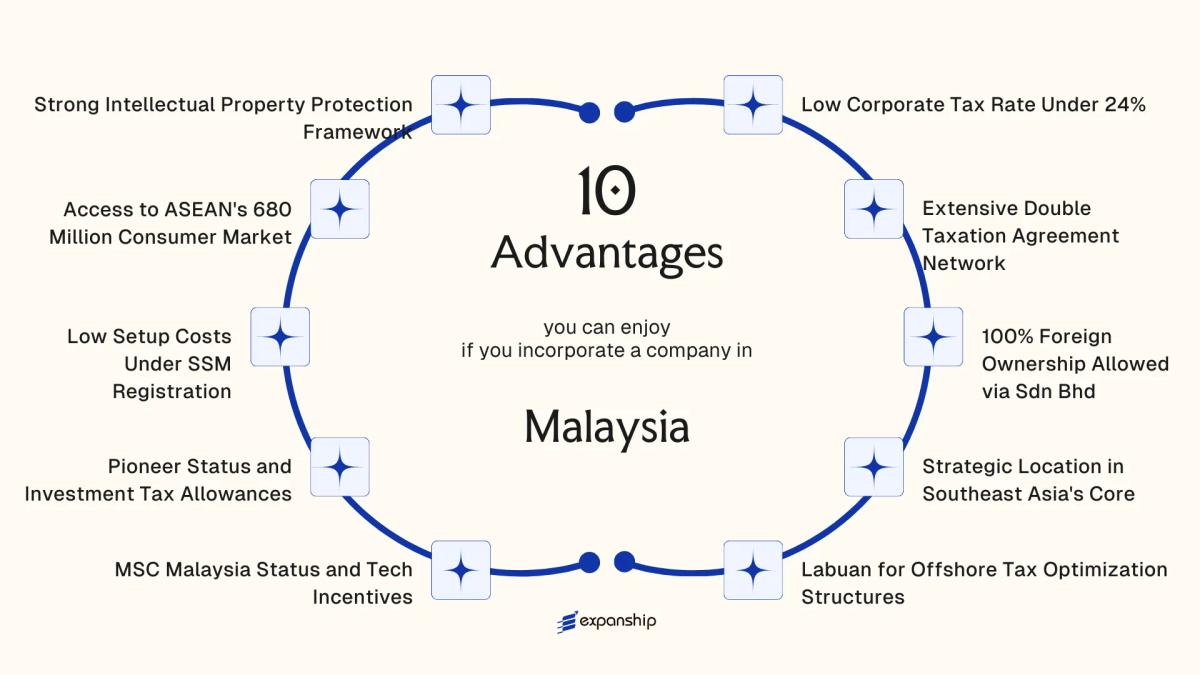
The benefits of incorporating in Malaysia are material and span tax efficiency, ownership flexibility, incentive frameworks, and market access. This article examines those advantages in structured detail, drawing on the regulatory and legislative framework that governs business formation and operation here.
Low Corporate Tax Rate Under 24%
Malaysia's low corporate tax rate advantages are most visible when you examine the headline rate in context: the standard corporate income tax rate sits at 24%, governed under the Income Tax Act 1967.
Reduced Rate for Smaller Entities
Resident companies structured as Sdn Bhd with paid-up capital not exceeding RM2.5 million qualify for a tiered rate — 17% on the first RM600,000 of chargeable income, with the remainder taxed at 24%. For a foreign-owned small or mid-sized business, this tiered structure means a materially lower effective tax burden during early-stage operations, when preserving capital matters most.
What the Rate Means in Practice
The 24% ceiling already sits below the global average corporate tax rate, which the OECD has tracked above 25% across many developed economies. Beyond the headline figure, the Inland Revenue Board of Malaysia (LHDN) administers a range of deductions and capital allowances under the same Act, which further reduce taxable income. Your actual effective rate can fall well below the statutory ceiling depending on your firm's expenditure profile and applicable incentives.
A resident Sdn Bhd with paid-up capital within the RM2.5 million threshold pays just 17% on its first RM600,000 of profit — not 24%.
Extensive Double Taxation Agreement Network
Malaysia has signed over 70 bilateral tax treaties under its network of Double Taxation Agreements, making Malaysia double taxation agreement benefits directly accessible to foreign-incorporated entities operating across major trade and investment corridors. These treaties follow the OECD Model Tax Convention framework and are administered through the Inland Revenue Board of Malaysia (LHDN). For a foreign business owner, this means income earned across treaty countries is not taxed twice — once at source and again in the home jurisdiction.
Treaty provisions typically reduce or eliminate withholding taxes on dividends, interest, and royalties paid between treaty partners. A firm structured through a Malaysian Sdn Bhd can, depending on the applicable treaty, pay reduced withholding rates to foreign shareholders or service providers rather than the standard domestic rate. This directly reduces the cost of cross-border profit repatriation.
The practical value of these treaties becomes clear when you consider the country's treaty partners:
- Treaty coverage includes major economies such as China, Japan, the United Kingdom, the United States, and Germany, giving your business access to reduced rates in markets where withholding taxes would otherwise be significant
- Agreements with Gulf Cooperation Council states reduce friction for businesses connecting Southeast Asian and Middle Eastern operations
- Treaties with ASEAN neighbours such as Singapore, Indonesia, and Thailand support regional holding and operating structures without layered withholding exposure
- Several treaties include provisions on permanent establishment definitions, which directly affect how your cross-border activities are characterised for tax purposes
Treaty benefits are not automatic. Your entity must meet the residency and beneficial ownership conditions specified in the relevant agreement to qualify for reduced rates.

Incorporate a Company in Malaysia
Set up a Malaysian Sdn Bhd and position your business to access the country's extensive treaty network across 70+ jurisdictions.
100% Foreign Ownership Allowed via Sdn Bhd
Under the Companies Act 2016, foreign nationals can own 100% of a Sendirian Berhad (Sdn Bhd) without requiring a local partner or shareholder in most sectors. This ownership structure gives you direct control over decision-making, profit distribution, and long-term capital allocation without dilution by a mandatorily appointed resident co-owner.
The practical significance is that your business operates as a fully foreign-owned legal entity, rather than a joint venture arranged to satisfy a regulatory threshold. Full ownership means dividend repatriation and internal governance reflect your priorities alone.
| Sector Category | Foreign Ownership Permitted | Governing Authority |
|---|---|---|
| Most manufacturing and services | Up to 100% | Companies Commission of Malaysia (SSM) |
| Wholesale and retail trade | Up to 100% (subject to conditions) | Ministry of Domestic Trade |
| Financial services | Restricted; equity caps apply | Bank Negara Malaysia |
| Oil and gas upstream | Restricted; Petronas licence required | Petronas |
Certain regulated industries, including banking, insurance, and upstream energy, retain foreign equity restrictions governed by sector-specific regulators, so your Sdn Bhd ownership rights depend on the business activity declared during registration.
For eligible sectors, foreign investor ownership rights under an Sdn Bhd are reinforced by the fact that the entity is a locally incorporated private limited company with full legal standing, meaning it can hold assets, enter contracts, and employ staff under Malaysian law without a foreign company branch structure.
Strategic Location in Southeast Asia's Core
Malaysia's strategic location in Southeast Asia places your business at the center of a region that accounts for a significant share of global trade flows. Positioned along the Strait of Malacca, one of the world's busiest shipping lanes, the country connects East Asia, South Asia, and the Middle East within a single operating radius. For companies building regional distribution or supply chain networks, that physical centrality reduces transit times and logistics costs in measurable terms.
Kuala Lumpur functions as a recognized base for regional headquarters, with MIDA (Malaysian Investment Development Authority) administering incentive programs specifically for firms that coordinate ASEAN operations from within the country. This matters because a regional hub designation is not just geographic convenience; it often unlocks operational cost structures that a single-market entity cannot access.
The country holds ASEAN membership alongside nine other economies, and its bilateral trade agreements extend market access well beyond the immediate neighborhood.
Keep these points in mind:
- MIDA's Regional Headquarters (RHQ) program has specific eligibility thresholds for headcount and annual spending
- Logistics and distribution companies benefit from proximity to Port Klang, the region's major transshipment port
- Air connectivity through KLIA supports time-sensitive executive and cargo movements across ASEAN
- RHQ tax incentives are subject to periodic review and must be applied for; they are not automatic upon incorporation
Malaysia sits within a seven-hour flight radius of roughly half the world's population, a geographic fact that makes it one of the few ASEAN capitals equidistant from both Chinese and Indian megacities.
Labuan for Offshore Tax Optimization Structures
Labuan IBFC (International Business and Financial Centre) operates under a distinct legal framework from peninsular Malaysia, governed by the Labuan Business Activity Tax Act 1990 (LBATA). For foreign investors structuring international operations, Labuan offshore tax optimization benefits are available through a qualified Labuan entity that conducts trading or non-trading activities — each taxed at separate rates.
Preferential Tax Treatment on Qualifying Income
A Labuan trading company pays 3% tax on net audited profits, while non-trading activities — such as holding investments, managing intellectual property, or receiving dividends — are taxed at zero percent. This distinction matters because a foreign holding structure can accumulate returns from regional subsidiaries with no tax imposed at the Labuan level. Eligibility requires genuine economic substance: at least two full-time employees based in Labuan and annual operating expenditure of no less than MYR 50,000 within the territory.
Substance requirements were tightened under the Labuan Business Activity Tax (Requirements for Labuan Business Activity) Regulations 2018, partly in response to OECD Base Erosion and Profit Shifting (BEPS) recommendations. Meeting these thresholds is not administratively burdensome, but they do mean a purely paper entity no longer qualifies for the concessionary rate.
Access to Malaysia's Tax Treaty Network from Labuan
Labuan entities can, under defined conditions, access Malaysia's network of over 70 double taxation agreements. Structuring regional equity holdings or royalty flows through a Labuan holding firm can reduce withholding tax exposure in counterparty jurisdictions. Your firm should confirm treaty eligibility for specific transaction types with qualified tax counsel before relying on this position.
Structure Your Labuan Entity the Right Way
Discuss how a Labuan company fits your international tax structure with our Malaysia incorporation specialists.
MSC Malaysia Status and Tech Incentives
MSC Malaysia status tech incentives benefits are administered under the Multimedia Super Corridor framework, a government-designated zone and incentive scheme established in 1996 and overseen by the Malaysia Digital Economy Corporation (MDEC). Tech-focused companies that obtain MSC Malaysia Status gain access to a structured set of fiscal and operational privileges that directly reduce the cost of operating a technology business in the country.
- A 10-year income tax exemption applies to qualifying MSC-status companies on statutory income derived from MSC-designated activities, which eliminates a significant portion of early-stage tax liability during the growth phase.
- Approved status allows your firm to employ foreign knowledge workers without quota restrictions, removing a common barrier for tech companies that rely on specialized global talent.
- MSC-status entities are permitted to freely source capital globally and are exempt from local ownership requirements under the incentive framework, giving foreign investors structural flexibility that standard Sdn Bhd incorporation does not automatically provide.
- High-speed connectivity infrastructure within designated MSC zones is provided under a government guarantee, which reduces your operational dependency on third-party providers.
Eligibility requires that the company operate within a designated Cyber City or Cyber Centre and conduct activities on MDEC's approved list, which includes software development, data analytics, and shared services.
Pioneer Status and Investment Tax Allowances
Malaysia Pioneer Status tax allowance benefits are administered by the Malaysian Investment Development Authority (MIDA) under the Promotion of Investments Act 1986. Two distinct incentives exist under this framework: Pioneer Status and Investment Tax Allowance (ITA).
Under Pioneer Status, qualifying companies receive a 70% tax exemption on statutory income for five years. Promoted activities or products in high-priority sectors can qualify for a full 100% exemption over the same period.
The Investment Tax Allowance offers an alternative structure. Qualifying capital expenditure incurred within five years attracts a 60% allowance, which can be offset against 70% of statutory income each year. For promoted activities, both figures rise to 100%.
These incentives are not automatic. Your business must apply to MIDA and receive approval before operations begin in the qualifying activity. Sector eligibility is tied to Malaysia's Promoted Activities and Promoted Products lists, which MIDA updates periodically.
For a foreign manufacturer setting up a qualifying electronics facility, Pioneer Status could effectively eliminate federal corporate tax liability for the full five-year period, preserving capital that would otherwise be paid at the standard 24% rate during the earliest and most capital-intensive phase of operations.
A company granted 100% Pioneer Status exemption on MYR 5 million in statutory income over five years avoids MYR 1.2 million in corporate tax at the standard 24% rate, with zero deferral, zero clawback during the exemption window, and the full amount retained for reinvestment.
Low Setup Costs Under SSM Registration
Malaysia SSM company registration cost advantages begin at the statutory level. Incorporating a private limited company (Sdn Bhd) under the Companies Act 2016 involves a registration fee paid to the Suruhanjaya Syarikat Malaysia (SSM), which administers all company formation filings. The base registration fee for an Sdn Bhd is currently RM1,000, a figure that reflects a deliberate policy of accessibility rather than revenue generation from entry-level business activity.
Beyond the SSM filing fee, the mandatory minimum paid-up capital for a standard Sdn Bhd is RM1. This removes the capital-lock requirement that affects incorporation in jurisdictions where minimum share capital thresholds run into thousands of dollars, freeing up working capital from day one.
For foreign-owned entities, the MyCoID online portal allows company name searches and filings to be submitted digitally, reducing reliance on in-person intermediaries and the associated administrative overhead.
- No minimum capital above RM1 for standard Sdn Bhd structures
- SSM registration fee fixed at RM1,000 under the Companies Act 2016
- Digital filing via MyCoID reduces third-party processing costs
Certain licensed or regulated business activities, such as financial services or specific professional services, carry additional licensing fees and minimum capital requirements set by sector regulators, independent of SSM registration costs.
Access to ASEAN's 680 Million Consumer Market
Malaysia ASEAN consumer market access benefits are directly tied to the country's founding membership in the Association of Southeast Asian Nations, which came into effect in 1967. As an original ASEAN signatory, a company incorporated here operates within a trade bloc covering ten nations and a combined consumer base exceeding 680 million people.
Preferential Trade Within the Bloc
Under the ASEAN Trade in Goods Agreement (ATIGA), qualifying goods traded between member states attract tariff rates reduced to zero or near-zero. For a foreign-owned Sdn Bhd exporting manufactured goods to Thailand, Indonesia, or Vietnam, this tariff structure materially reduces the landed cost of products compared to exporting from outside the region.
ASEAN's External Free Trade Agreements
ASEAN has concluded free trade agreements with China, Japan, South Korea, India, Australia, and New Zealand. A business incorporated here can use these agreements to access markets far beyond Southeast Asia, since trade originating from an ASEAN member state qualifies for preferential treatment under these frameworks subject to rules-of-origin requirements.
Regional Production and Distribution Positioning
- Manufacturers benefit from supply chain access across member economies with lower inter-regional logistics costs
- Service firms can use a Malaysian entity to contract with clients across multiple ASEAN jurisdictions under a single regional legal presence
- E-commerce businesses gain proximity to some of the fastest-growing digital retail markets globally, including Indonesia and the Philippines
Strong Intellectual Property Protection Framework
Protecting intellectual property in Malaysia is underpinned by a dedicated statutory and institutional framework that gives foreign businesses enforceable rights from the moment of registration. The Malaysia intellectual property protection benefits available to incorporated entities extend across trademarks, patents, industrial designs, and copyright, each governed by separate legislation and administered through the Intellectual Property Corporation of Malaysia, known as MyIPO.
Trademark registration under the Trademarks Act 2019 grants exclusive rights for ten years, renewable indefinitely. Registration through MyIPO also opens access to international filing via the Madrid Protocol, which Malaysia acceded to, allowing your firm to extend trademark protection across multiple jurisdictions from a single application.
Patent protection is governed by the Patents Act 1983. A granted patent confers exclusive rights for twenty years from the filing date, providing a defined commercial window during which competitors cannot exploit the protected invention without a licence.
Key IP protections available to registered companies in Malaysia include:
- Trademarks registered under the Trademarks Act 2019, valid for ten years and renewable
- Patents under the Patents Act 1983 with a twenty-year exclusivity period
- Industrial designs protected under the Industrial Designs Act 1996 for up to twenty-five years in total
- Copyright protection arising automatically under the Copyright Act 1987 without formal registration
Enforcement mechanisms include civil litigation through the High Court and criminal prosecution for counterfeiting offences under the respective statutes. For foreign businesses holding IP assets, incorporating a local Sdn Bhd entity allows those rights to be held, licensed, and monetised within a jurisdiction that participates in the TRIPS Agreement under the WTO framework.
Why Malaysia Stands Out Among Asian Incorporation Hubs
Compared to Singapore and Hong Kong, Malaysia draws a different profile of foreign investor — one weighing cost efficiency, ownership flexibility, and tax incentive access against pure prestige or financial centre proximity. These three jurisdictions are the most common comparison points for foreign investors evaluating an Asian incorporation strategy, and the parameters below reflect areas where structural differences carry practical consequence.
What the comparison surfaces is not just pricing variance, but a difference in legal architecture. Singapore imposes a 17% headline corporate tax rate but provides fewer sector-specific incentive programmes accessible to early-stage foreign-owned entities. Hong Kong's territorial tax system suits trading businesses but offers no DTAs with several ASEAN economies where Malaysian firms hold treaty coverage. For businesses requiring dual-structure tax planning, the Labuan International Business and Financial Centre operates under a separate statutory framework unavailable in either competitor jurisdiction.
| Parameter | Malaysia | Singapore | Hong Kong |
|---|---|---|---|
| Headline Corporate Tax Rate | 24% | 17% | 16.5% |
| 100% Foreign Ownership | Yes (Sdn Bhd) | Yes (Pte Ltd) | Yes (Limited Co.) |
| Pioneer Status / Tax Holiday | Yes (MIDA-administered) | Limited (EDB-administered) | Not available |
| Offshore Holding Structure | Labuan (3% or flat RM20,000) | No equivalent | No equivalent |
| DTA Network | 75+ treaties | 90+ treaties | 45+ treaties |
| ASEAN Market Access | Direct member | Direct member | Associate only |
| Minimum Paid-Up Capital | RM1 | SGD1 | HKD1 |
Compliance Services for Companies in Malaysia
Stay current with SSM filing deadlines, annual return obligations, and statutory requirements for your Malaysian entity.
Conclusion
Malaysia's position as a viable incorporation destination rests on a combination of structural tax advantages, genuine foreign ownership rights, and treaty-backed income protections that translate into measurable outcomes for international businesses. The Sdn Bhd's allowance for full foreign equity without a local partner requirement, combined with the 24% corporate tax ceiling and access to incentive frameworks such as Pioneer Status under the Promotion of Investments Act 1986, gives your business a foundation that many comparable Asian jurisdictions do not offer in the same configuration.
Not every structure fits every business. A technology firm seeking MSC Malaysia status operates under different eligibility criteria than a trading entity using Labuan as an offshore holding layer. The advantages covered here are real, but their applicability depends on your industry classification, ownership structure, and the nature of income your entity will generate.
What makes this jurisdiction compelling for foreign incorporators is not any single provision, but how its components work together within a defined regulatory framework administered by bodies such as the Securities Commission, MIDA, and SSM. Identifying which combination applies to your structure is the step that determines how much of that framework you actually access.
Start Your Malaysia Company Incorporation With Expanship
Expanship assists foreign entrepreneurs with Sdn Bhd formation under the Companies Act 2016, covering the full registration process with the Companies Commission of Malaysia (SSM) through to ongoing statutory compliance. The benefits covered across this blog, from SSM's low setup costs to Labuan's tax structures and MSC Status incentives, each carry their own documentation, eligibility filings, and annual obligations that require accurate execution from the outset.
Expanship's scope of services for your Malaysia entity includes:
- Preparation and legalization of incorporation documents required by SSM
- Provision of a registered agent and local registered office address
- Government filing and direct liaison with SSM and relevant regulatory authorities
- Post-incorporation compliance management, including annual returns and statutory filings
- Banking introduction assistance to support your business account setup in Malaysia
Reach out to Expanship Malaysia to discuss your incorporation requirements.
Frequently Asked Questions (FAQ)
The Companies Commission of Malaysia (SSM) typically processes Sdn Bhd incorporation within one to three business days when documents are submitted through the MyCoID portal. The timeline assumes the company name has been approved and all director and shareholder particulars are in order. Post-incorporation steps — such as opening a corporate bank account — generally add additional time.
No. The 17% rate on the first RM 600,000 of chargeable income applies to resident companies with paid-up capital of RM 2.5 million or below, provided no associated company exceeds that threshold. Firms above that capitalisation level are subject to the standard 24% rate on all chargeable income under the Income Tax Act 1967.
Pioneer Status is granted by the Malaysian Investment Development Authority (MIDA) to companies in promoted industries or producing promoted products. Qualifying firms receive a tax exemption on 70% to 100% of statutory income for a period of five to ten years, depending on the activity and location. Applications must demonstrate that the business activity aligns with MIDA's current Promoted Activities and Products list.
A Labuan entity is governed by the Labuan Business Activity Tax Act 1990, whereas a Sdn Bhd falls under the Income Tax Act 1967. Trading activities conducted through a Labuan company are taxed at 3% of net audited profits, while a Sdn Bhd is subject to the standard corporate rate of up to 24%. The Labuan framework is intended for international business and does not permit the entity to conduct business with Malaysian residents except in limited, permitted circumstances.
MSC Malaysia Status grants qualifying technology companies a full income tax exemption for up to ten years or an Investment Tax Allowance of 100% on qualifying capital expenditure for five years. The status also carries operational guarantees, including no restrictions on employing foreign knowledge workers. Both incentive tracks are administered through the Malaysia Digital Economy Corporation (MDEC), and renewal or extension is subject to continued compliance with MSC conditions.
Yes, the breadth of agreements matters significantly for repatriation of dividends, royalties, and service fees from Malaysian subsidiaries to a foreign parent. Malaysia's tax treaty network — covering over 70 countries — can reduce withholding tax rates on outbound payments below the domestic rate. The applicable rate depends on the specific treaty in force between Malaysia and the jurisdiction where the recipient entity is tax resident, and treaty benefits are not automatic; they require a certificate of tax residency from the relevant foreign authority.
Legal Disclaimer
The information provided in this article is for general informational purposes only and does not constitute legal, tax, or professional advice. While we strive to ensure the accuracy and timeliness of the content, laws and regulations are subject to change, and the application of laws can vary widely based on specific facts and circumstances.
Readers should not act upon this information without seeking professional counsel tailored to their individual situation. Expanship and its authors disclaim any liability for actions taken or not taken based on the content of this article.
For specific advice regarding your business setup, compliance requirements, or any legal matters, please consult with qualified legal and tax professionals in the relevant jurisdiction.