

Key Takeaways
- Incorporating in Mexico requires every formation act to be authorized by a Notario Público, adding a legally mandated intermediary step that increases both the cost and timeline of company registration compared to jurisdictions with self-filing systems.
- Foreign investors operating under the Ley General de Sociedades Mercantiles must navigate sector-specific ownership caps that can prohibit or significantly limit direct foreign control in industries such as energy, aviation, and media without a qualifying Mexican partner.
- Ongoing compliance with the Servicio de Administración Tributaria imposes layered monthly and annual reporting obligations — including electronic invoicing under the CFDI system — that require dedicated local accounting infrastructure from the moment of registration.
- Employers registered with the Instituto Mexicano del Seguro Social face mandatory social security contribution rates that represent a substantial addition to gross payroll costs, creating a structurally higher employment burden than in many comparable Latin American jurisdictions.
Mexico operates under a heavily regulated corporate framework, and the disadvantages of incorporating in Mexico span multiple areas — from notarial requirements and tax administration to sector-specific ownership restrictions and social security obligations. The primary legislation governing commercial entities is the Ley General de Sociedades Mercantiles.
The drawbacks your business encounters will differ depending on whether you are forming a Sociedad Anónima, entering a restricted sector, or operating as a foreign-owned entity without a local partner. No two structures face identical friction points.
This article is most relevant to foreign investors and multinational entities seeking direct ownership or operational presence in the country, particularly those unfamiliar with the Servicio de Administración Tributaria's compliance requirements or the role of the Registro Público de Comercio in the formation process.
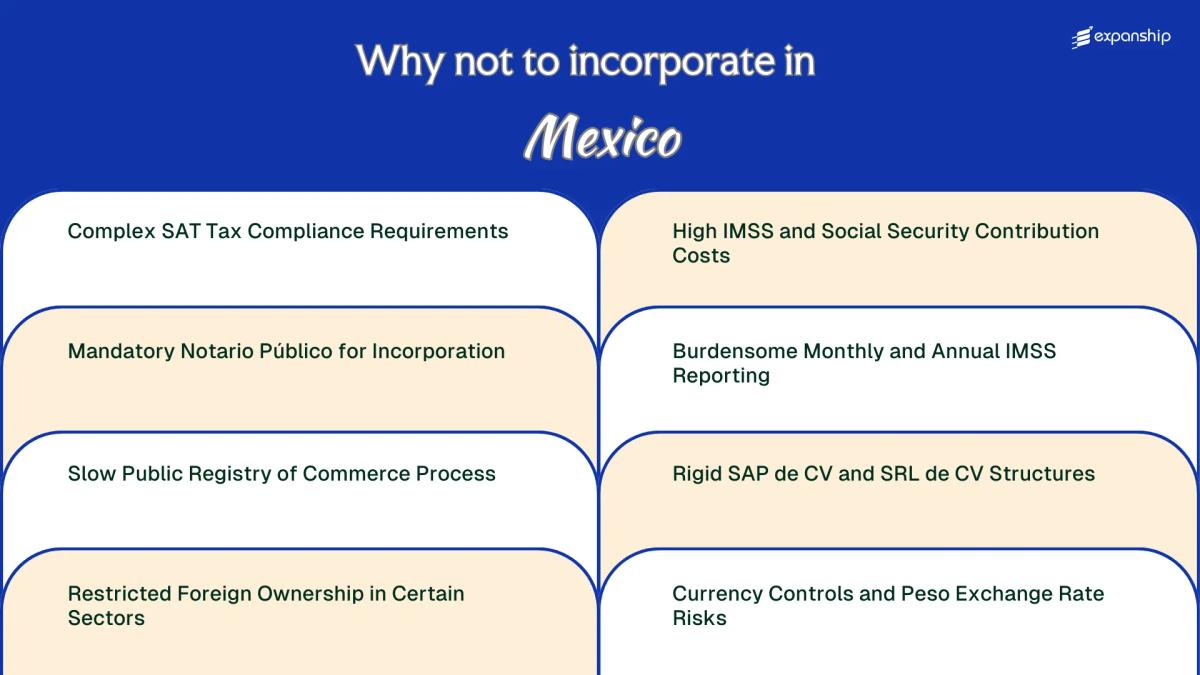
Complex SAT Tax Compliance Requirements
Mexico SAT tax compliance problems extend well beyond standard corporate tax filing. The Servicio de Administración Tributaria enforces one of the most administratively demanding tax regimes in Latin America, with obligations that begin before your entity issues its first invoice.
RFC Registration and CFDI Invoicing Obligations
Every legal entity must obtain a Registro Federal de Contribuyentes (RFC) from SAT before conducting any taxable activity. Your business cannot issue or receive valid invoices without an active RFC, and all invoicing must occur through the CFDI electronic system, which requires certified third-party providers known as PACs. A single lapse in CFDI compliance can render your invoices legally void, directly blocking accounts receivable collection.
Monthly Filing Frequency and Audit Exposure
SAT mandates monthly VAT (IVA) declarations, monthly provisional income tax payments, and DIOT informational returns detailing each supplier's tax status. Foreign-owned firms often underestimate the accounting infrastructure required to meet these recurring deadlines accurately. SAT cross-references CFDI data against filed declarations automatically, meaning discrepancies trigger audits with minimal human review.
Failure to reconcile CFDI records with SAT declarations can result in suspended tax certificates, which immediately blocks your entity from issuing invoices and halts business operations.
Mandatory Notario Público for Incorporation
Notario Público incorporation restrictions Mexico create a bottleneck that does not exist in most common-law jurisdictions. Unlike a standard notary, a Notario Público in Mexico is a highly specialized legal officer appointed by the state government, holding exclusive authority to execute and certify the constitutional documents of a Sociedad Anónima de Capital Variable (SA de CV) or Sociedad de Responsabilidad Limitada (SRL de CV).
Every incorporation requires this official's direct involvement. There is no online self-filing alternative, no registered agent workaround, and no simplified track for smaller companies.
For a foreign business owner, this mandatory notary requirement translates into concrete friction at every stage:
- Scheduling delays stretch timelines by weeks, since Notarios operate independently with limited availability and no standardized turnaround obligation
- Notarial fees are calculated on the declared share capital value, meaning a higher-capitalized entity generates disproportionately higher fees without any added procedural benefit
- All founding documents must be executed in Spanish, requiring certified translation of foreign shareholder credentials before the Notario will proceed
- Physical presence or a duly apostilled power of attorney is required, adding logistical cost for shareholders based outside the country
The Ley del Notariado governs these obligations at the state level, so requirements and fee schedules vary between Mexico City, Nuevo León, and other states.

Company Incorporation in Mexico
Understand the full process and requirements for forming a legal entity in Mexico, including Notario Público obligations and public registry procedures.
Slow Public Registry of Commerce Process
Mexico Public Registry of Commerce delays are among the most disruptive procedural obstacles foreign investors encounter after a notarial deed has been executed. The Registro Público de Comercio (RPC), administered at the state level through local delegations of the Secretaría de Economía, is responsible for formally recording a new entity before it can operate with full legal standing.
Processing times vary significantly by state. In high-volume offices such as Mexico City's delegation, registration can take four to ten weeks under normal conditions. Your business cannot issue formal invoices through the SAT, open a corporate bank account, or execute contracts in the company's name until the RPC inscription is confirmed.
| Delay Factor | Typical Impact | Practical Cost to Your Business |
|---|---|---|
| State-level RPC backlog | 4–10 weeks post-notarization | No RFC activation; invoicing blocked |
| Incomplete expediente rejection | Restarts processing clock | Additional notarial and administrative fees |
| Physical document submission requirement | No fully digital filing in most states | Travel or courier costs; risk of loss |
| Lack of unified federal processing | Timelines vary by state delegation | Unpredictable launch dates for operations |
The RPC operates without a single federal filing window, meaning a company incorporated in Jalisco faces different administrative realities than one registered in Nuevo León. For foreign investors planning a coordinated market entry, this unpredictability makes it genuinely difficult to commit to operational start dates.
Restricted Foreign Ownership in Certain Sectors
Mexico foreign ownership restrictions sectors are codified primarily under the Ley de Inversión Extranjera (Foreign Investment Law) and enforced through the Comisión Nacional de Inversiones Extranjeras (CNIE). The law divides economic activities into reserved, restricted, and open categories, and your business structure must comply before operations begin.
Certain sectors are fully reserved for the Mexican state or for Mexican nationals exclusively. Petroleum extraction, electricity generation under specific schemes, and control of ports and airports fall into this category, meaning foreign capital is constitutionally barred regardless of the corporate structure used.
Restricted sectors impose a foreign equity ceiling rather than an outright ban. Broadcasting, domestic air transport, and financial institutions each carry caps that typically range from 25% to 49%, requiring a Mexican majority shareholder to hold the controlling stake.
This ownership ceiling creates a structural dependency. Your firm cannot hold majority control, which directly affects governance rights, dividend distribution authority, and exit mechanisms when you eventually seek to transfer shares.
- Foreign equity caps in restricted sectors require a Mexican majority partner to hold controlling interest
- The CNIE must authorize foreign participation above the standard thresholds in certain activities
- Corporate bylaws must reflect the permitted ownership percentages at the time of incorporation
- Violations of these caps expose the entity to nullification of share transfers and regulatory sanctions
Even a wholly foreign-owned holding company structured abroad cannot bypass Mexico's sectoral caps if its underlying activity is classified as restricted under the Foreign Investment Law.
High IMSS and Social Security Contribution Costs
Mexico IMSS social security contribution costs represent one of the more significant payroll burdens facing foreign employers. Employer obligations under the Instituto Mexicano del Seguro Social framework extend well beyond a simple percentage of gross salary.
What Employers Are Required to Contribute
Under the Ley del Seguro Social, employers must fund multiple branches of IMSS coverage, including illness, maternity, disability, life insurance, retirement, and daycare. Total employer contributions typically range between 20% and 30% of an employee's integrated daily wage, depending on the risk classification assigned to the business activity, which means high employer payroll costs in Mexico are structural rather than incidental.
Contributions are calculated not on base salary alone but on the Salario Diario Integrado, which incorporates bonuses, vacation premiums, and other recurring payments. This broader base inflates the real cost of each hire beyond what a surface-level salary comparison would suggest.
Why This Disproportionately Affects Foreign Businesses
For a foreign firm establishing its first Mexican entity, the employer contribution burden often exceeds projections prepared using home-country payroll models. Combined with mandatory profit-sharing obligations under the Ley Federal del Trabajo, the all-in employee cost can substantially exceed the agreed gross salary figure.
Businesses classified under higher workplace risk categories face elevated IMSS rates that are revised annually by the IMSS itself, adding a layer of cost unpredictability that complicates multi-year financial planning.
Guidance on Managing Employer Cost Obligations in Mexico
Speak with our team about the real payroll cost implications of incorporating and hiring in Mexico before committing to a structure.
Burdensome Monthly and Annual IMSS Reporting
Mexico IMSS reporting requirements burdens extend well beyond contribution payments, creating a sustained administrative load that demands dedicated HR or payroll infrastructure.
- Employers must submit monthly payroll movements to the Instituto Mexicano del Seguro Social (IMSS) via the IDSE (IMSS Desde Su Empresa) system, reporting every hire, termination, and salary change within five business days or face per-worker fines.
- Each salary modification triggers a separate affidavit filing obligation, meaning high-turnover firms generate a disproportionate volume of individual submissions throughout the year.
- The annual Declaración Anual requires reconciling total payroll figures reported to IMSS against those filed with the SAT, and any discrepancy between the two agencies can trigger audits from both simultaneously.
- Failure to register a worker before their first shift, even by one day, carries retroactive contribution liability plus surcharges under the Ley del Seguro Social.
- Foreign-owned entities without a dedicated Mexican payroll specialist routinely incur penalties during the first compliance cycle due to system access delays and documentation requirements unfamiliar to non-resident operators.
Rigid SAP de CV and SRL de CV Structures
Both principal entity types available to foreign investors — the Sociedad Anónima Promotora de Inversión de Capital Variable (SAP de CV) and the Sociedad de Responsabilidad Limitada de Capital Variable (S de RL de CV) — carry structural constraints that limit operational flexibility. These constraints are embedded in the Ley General de Sociedades Mercantiles (LGSM), which governs how shares are transferred, how governance is arranged, and how equity can be restructured.
Under the LGSM, the S de RL de CV caps participation at 50 partners. For a firm expecting multiple institutional investors or a distributed equity structure, this ceiling can become a direct obstacle to growth.
Transferring equity interests in either entity is not a simple administrative act. Both structures require notarial intervention and, in many cases, the consent of other partners or shareholders, creating delays and legal costs that do not arise in more permissive jurisdictions.
The SAP de CV was designed to facilitate private equity participation, but its governance requirements around meetings, quorum thresholds, and capital increases still follow rigid statutory defaults unless your articles of incorporation explicitly override them. Drafting those overrides requires specialist legal input, adding to formation costs.
A foreign investor holding a 30% stake in an S de RL de CV who wishes to exit and sell their interest to a third party must typically obtain partner consent under Article 65 of the LGSM before any transfer is legally valid — a requirement that can stall a transaction for weeks or longer depending on partner availability and notarial scheduling.
Currency Controls and Peso Exchange Rate Risks
Mexico peso exchange rate risks represent a concrete operational cost for foreign-owned entities, not just an accounting variable. The Mexican peso is a freely floating currency with no fixed peg, which means your revenues in pesos can lose significant purchasing power against your home currency within a single fiscal year.
Unlike jurisdictions with formal capital controls, Mexico does not restrict the repatriation of profits. However, exchange rate volatility means the dollar or euro value of those profits at the time of repatriation may differ substantially from projections made at incorporation.
Foreign firms that invoice locally in pesos but carry liabilities in USD or EUR face a structural mismatch. A depreciation cycle compounds operating costs, particularly for businesses importing goods or equipment priced in foreign currency.
The Banco de México (Banxico) manages monetary policy and intervenes periodically to stabilize the peso, but intervention does not eliminate volatility. Periods of political uncertainty or shifts in U.S. monetary policy have historically triggered sharp peso movements, directly affecting reported earnings and dividend values for foreign shareholders.
If your business structure involves cross-border intercompany transactions, peso-denominated revenues will be subject to transfer pricing rules enforced by the SAT, and any exchange losses may face scrutiny if not properly documented under Mexican tax law.
Overcoming Mexico's Incorporation Challenges
Overcoming Mexico's incorporation challenges requires structural preparation before entity formation begins, not after problems arise.
- Select a legal structure aligned with your operational needs by reviewing the permitted forms under the Ley General de Sociedades Mercantiles before engaging a Notario Público.
- Obtain your RFC (Registro Federal de Contribuyentes) through the SAT portal promptly, as tax obligations begin from the moment of incorporation.
- Budget for IMSS contribution rates from the outset, factoring employer-side social security costs into your staffing financial model.
- Verify your industry against the Lista de Actividades Económicas Restringidas to identify any foreign investment restrictions under the Ley de Inversión Extranjera before committing capital.
- Establish a peso-denominated bank account early to reduce transactional exposure to exchange rate fluctuations affecting your operating costs.
Each of these steps operates within a layered regulatory framework administered by multiple federal bodies, including the SAT, IMSS, and the Registro Público de Comercio. Structural decisions made at formation directly affect your compliance obligations across all three.
Mexico Still a Viable Business Destination
Mexico remains a credible destination for foreign investment, backed by its proximity to the United States, USMCA trade access, and a manufacturing base that continues to attract cross-border supply chains. The disadvantages covered in this blog are real and measurable, but they do not uniformly disqualify the jurisdiction for every business profile.
| Pros | Cons |
|---|---|
| USMCA membership provides preferential tariff treatment for goods traded across North America | SAT tax compliance demands monthly filings, electronic invoicing via CFDI, and detailed audit exposure |
| A large domestic consumer market with a growing middle class | Notario Público involvement adds mandatory legal cost and time before the company can be registered |
| Strategic manufacturing and nearshoring geography relative to the U.S. market | The Registro Público de Comercio process can extend timelines significantly beyond initial projections |
| Established legal framework for foreign-owned entities under the Ley de Inversión Extranjera | Restricted sectors under foreign ownership rules limit participation in energy, media, and aviation |
| Competitive labor costs relative to other North American jurisdictions | IMSS contribution rates and monthly reporting obligations increase payroll administration burden |
Weighing Mexico company formation risks vs opportunities requires an honest read of both columns above. Certain structural costs are fixed regardless of company size, which affects how viable the destination is at early revenue stages.
Corporate Compliance Services in Mexico
Maintain good standing with SAT, IMSS, and the Registro Público de Comercio through structured compliance support covering filings, reporting obligations, and regulatory deadlines.
Conclusion
The disadvantages of Mexico company formation are material and well-documented. SAT's multi-layered tax compliance obligations, the mandatory involvement of a Notario Público in the incorporation process, and the recurring IMSS reporting and contribution costs collectively place a considerable administrative burden on foreign-owned entities. Structural constraints under the SA de CV and SRL de CV frameworks further limit operational flexibility. These are not incidental friction points — they reflect how the country's corporate and regulatory architecture is built. Specialist guidance from formation through ongoing compliance reduces exposure to procedural and financial risk.
Expanship's Mexico Company Formation Services
Expanship's Mexico company formation services are structured around the specific compliance demands your business faces in this jurisdiction — from coordinating with the Notario Público during incorporation to managing ongoing obligations with the SAT and IMSS. The firm reduces the operational burden of navigating the Registro Público de Comercio filings and sector-specific foreign ownership reviews, though the regulatory requirements themselves remain unchanged.
Our Mexico corporate services span the full lifecycle of your entity's establishment and maintenance.
- Preparing and filing all incorporation documents, including the deed of incorporation (escritura constitutiva) required by the Notario Público.
- Providing a registered agent and local address to meet legal domicile requirements.
- Liaising with the SAT, IMSS, and other relevant government bodies on your behalf.
- Managing post-incorporation compliance obligations as they arise.
- Facilitating introductions to banking institutions suitable for your entity type.
- Handling RFC tax registration and coordination with local authorities.
To discuss your requirements, contact Expanship Mexico.
Frequently Asked Questions (FAQ)
All standard Mexican corporate structures, including the SA de CV and SRL de CV, require a Notario Público to formalize the deed of incorporation (escritura constitutiva). This is not an optional step, and the notary must be a licensed Mexican professional, meaning you cannot substitute a foreign notary or a simple legal representative. The notarized deed must then be registered with the Registro Público de Comercio, adding another sequential step that extends the total formation timeline.
Failing to register employees or report payroll changes accurately to the Instituto Mexicano del Seguro Social can result in fines calculated as multiples of the daily minimum wage, back contributions, and surcharges. The IMSS has authority to conduct audits and impose retroactive assessments if discrepancies are found between reported and actual payroll. In cases of persistent non-compliance, the entity can face legal action that affects its tax standing with the SAT.
Restrictions are real and sector-specific under the Ley de Inversión Extranjera (Foreign Investment Law). Sectors including energy, certain transportation services, broadcasting, and some financial activities carry hard caps or require authorization from the Comisión Nacional de Inversiones Extranjeras. For businesses outside those regulated sectors, 100% foreign ownership is permitted, but identifying which activities fall under restricted classifications requires careful legal review before incorporation.
Employer contributions to the IMSS, combined with obligations under INFONAVIT and SAR, can add roughly 30% to 35% on top of an employee's base salary, though the exact figure varies by wage level and risk classification. This cost is often underestimated by foreign investors accustomed to lower employer-side burdens in other jurisdictions. The contributions are non-negotiable and apply from the first employee registered, with no startup exemptions.
Registration with the Registro Público de Comercio is mandatory for a Mexican company to have legal existence and third-party enforceability. Without it, the entity cannot open a corporate bank account, obtain an RFC (Registro Federal de Contribuyentes) from the SAT, or sign contracts with legal standing. Delays in the registry process, which can run several weeks depending on the state, effectively freeze all downstream operational steps.
Mexico's peso is a freely traded currency with moderate historical volatility, but profit repatriation and USD-denominated contracts carry real exposure given that the peso has experienced significant depreciation periods against the dollar. Unlike some jurisdictions that permit dual-currency accounting or USD-denominated share capital, Mexican corporations are required to maintain accounts in pesos under local GAAP. Companies with foreign parent structures must also account for transfer pricing rules enforced by the SAT when moving funds across borders.
A registered Mexican entity with an active RFC must file monthly and annual tax returns with the SAT regardless of whether it has generated any income. Zero-activity returns (declaraciones en ceros) are still mandatory, and missing them triggers automatic fines and can eventually lead to the RFC being flagged or suspended. This means your administrative and accounting costs begin at incorporation, not at the point of first sale.
Legal Disclaimer
The information provided in this article is for general informational purposes only and does not constitute legal, tax, or professional advice. While we strive to ensure the accuracy and timeliness of the content, laws and regulations are subject to change, and the application of laws can vary widely based on specific facts and circumstances.
Readers should not act upon this information without seeking professional counsel tailored to their individual situation. Expanship and its authors disclaim any liability for actions taken or not taken based on the content of this article.
For specific advice regarding your business setup, compliance requirements, or any legal matters, please consult with qualified legal and tax professionals in the relevant jurisdiction.