

Key Takeaways
- Mexico's membership in USMCA allows a single incorporated entity to access preferential trade terms across the U.S. and Canadian markets simultaneously, a structural position that most emerging market jurisdictions cannot replicate.
- Under the Ley de Inversión Extranjera, foreign nationals can hold 100% ownership across the majority of commercial sectors, removing equity dilution as a structural barrier to market entry.
- With SAT administering a general corporate income tax rate of 30% alongside a bilateral treaty network covering over 60 countries, withholding tax exposure on cross-border income flows can be materially reduced from the outset.
- The S.A. de C.V., formed under the Ley General de Sociedades Mercantiles, provides foreign investors with a limited liability framework and governance structure familiar enough to reduce legal risk during the incorporation and operational setup phase.
Incorporating a business in Mexico offers foreign investors access to one of Latin America's largest economies, governed by a clear statutory framework under federal commercial law. Mexico is a sovereign federal republic, and company registration falls under the oversight of the Secretaría de Economía, which administers the legal formation process through the Public Registry of Commerce. The S.A. de C.V. remains the most common legal vehicle through which foreign businesses establish a presence in the country.
From a tax posture, Mexico operates a territorial and treaty-based system administered by the Servicio de Administración Tributaria (SAT), with corporate obligations tied to domestic-source income and an expanding network of bilateral agreements. Foreign ownership is broadly permitted across most sectors, with the Ley de Inversión Extranjera establishing the general framework for foreign direct investment and sector-specific restrictions. Certain industries retain ownership caps, but the majority of commercial activities are fully open to non-resident shareholders.
This article examines the principal advantages that make Mexico company formation a considered option for businesses expanding into North American and Latin American markets.
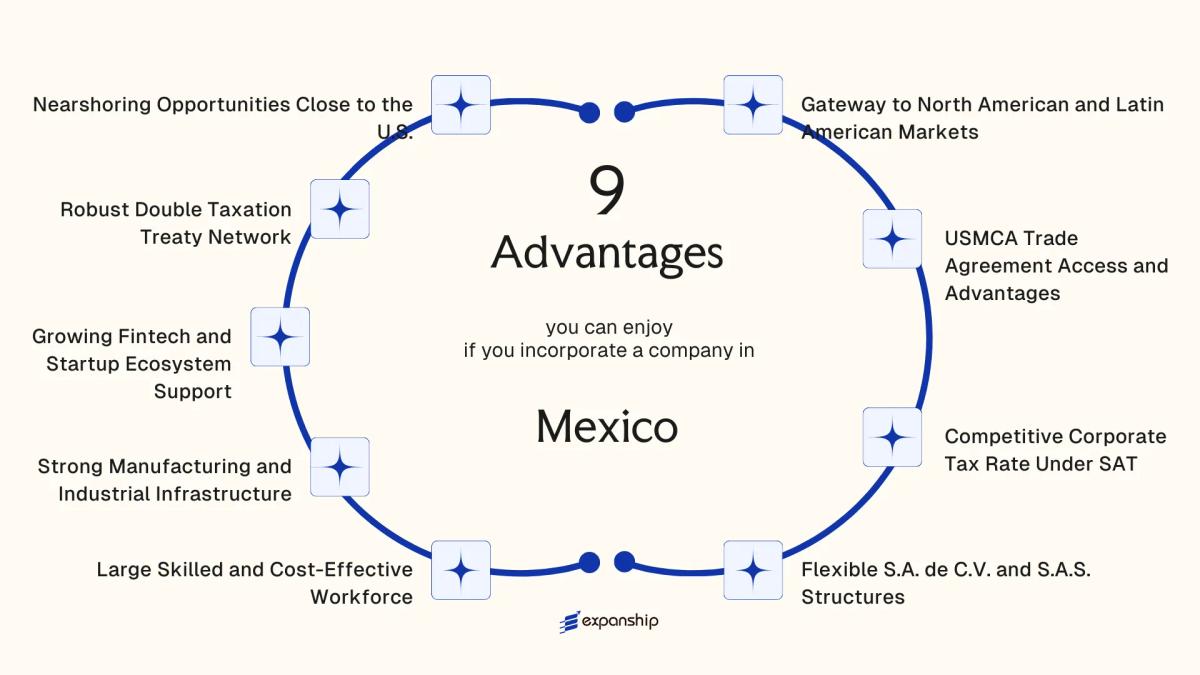
Gateway to North American and Latin American Markets
Mexico sits at a geographic intersection that gives incorporated entities direct commercial access to two of the world's largest regional trade blocs. That position translates into measurable operational and logistical advantages that few other jurisdictions can replicate.
Continental Access From a Single Registration
A company registered in Mexico can serve the U.S. and Canadian markets under USMCA while simultaneously engaging Latin American partners through Mexico's bilateral and regional trade agreements with over 50 countries. Your business operates from a single legal base rather than establishing separate entities across multiple jurisdictions.
Pacific and Atlantic coastlines support import-export activity in both directions. That dual-coast access means your supply chain is not dependent on a single trade corridor.
Regional Hub Status for Latin American Expansion
Mexico City functions as a regional headquarters location for multinationals entering Latin American markets, partly because Mexican commercial law under the Ley General de Sociedades Mercantiles permits foreign-owned entities to operate without a local majority shareholder. This allows you to consolidate Latin American operations under one holding structure.
One registered entity in Mexico can serve as your legal and commercial anchor for both North American and Latin American market access simultaneously.
USMCA Trade Agreement Access and Advantages
USMCA trade agreement benefits for Mexico companies go beyond tariff elimination. Under the United States-Mexico-Canada Agreement (T-MEC in Spanish), goods produced in Mexico and meeting defined rules of origin can enter U.S. and Canadian markets duty-free. For a foreign business establishing a manufacturing or trading entity here, that tariff-free access to a combined market of over 500 million consumers is a structural pricing advantage over competitors based outside the agreement zone.
Rules of origin under T-MEC require that a specified percentage of a product's content originate within the three member countries. Meeting these thresholds means your goods qualify for preferential treatment, which directly reduces landed costs in the U.S. market compared to suppliers shipping from Asia or Europe.
Foreign firms find the agreement's trade framework operationally accessible for several reasons:
- Customs procedures between member states are standardised, reducing administrative friction at the border
- Regional value content rules incentivise sourcing inputs locally, which supports supply chain consolidation
- The agreement includes dedicated chapters on digital trade and intellectual property, extending protections relevant to technology and services businesses
- Dispute resolution mechanisms are defined within the treaty, giving businesses a predictable framework for cross-border commercial conflicts
Automotive, electronics, agricultural, and textile sectors each carry sector-specific origin requirements under T-MEC, so verifying your product's classification before structuring your supply chain determines whether the preferential rates apply.

Incorporate Your Company in Mexico
Set up a legally compliant Mexican entity and position your business to access USMCA trade benefits from day one.
Competitive Corporate Tax Rate Under SAT
Mexico imposes a flat corporate income tax rate of 30% under the Impuesto Sobre la Renta (ISR), governed by the Ley del Impuesto Sobre la Renta (LISR). While that figure may appear modest rather than aggressive, the Mexico corporate tax rate advantages SAT framework delivers become clearer when examined against what the system actually permits: a broad set of deductible expenses, depreciation allowances on fixed assets, and the ability to carry forward net operating losses for up to ten fiscal years.
| Parameter | Detail |
|---|---|
| Corporate ISR Rate | 30% flat rate |
| Administering Authority | Servicio de Administración Tributaria (SAT) |
| Loss Carryforward Period | Up to 10 fiscal years |
| Dividend Withholding Tax | 10% on distributions to individuals or foreign residents |
| Tax Year | Calendar year (January to December) |
For a foreign-owned entity, the deductibility rules under the LISR mean that operating costs, salaries, and qualifying investment expenditures reduce the taxable base before the 30% rate ever applies. Your effective rate, therefore, frequently falls below the statutory figure. SAT Mexico tax benefits for businesses also extend to maquiladora structures operating under IMMEX programs, which carry specific ISR safe harbor provisions that limit exposure on intercompany pricing arrangements. Eligibility for those provisions requires maintaining an Advance Pricing Agreement or meeting the safe harbor margins prescribed by SAT annually.
Flexible S.A. de C.V. and S.A.S. Structures
Mexico's General Law of Commercial Companies (Ley General de Sociedades Mercantiles, LGSM) governs the two most widely used corporate forms for foreign investors: the Sociedad Anónima de Capital Variable (S.A. de C.V.) and the Sociedad por Acciones Simplificada (S.A.S.). Each serves a distinct operational purpose, and understanding that distinction is where the Mexico S.A. de C.V. flexible structure benefits become tangible.
The S.A. de C.V. allows variable capital, meaning shareholders can increase or decrease the firm's capital base without a full notarial deed amendment each time. For a foreign-owned business scaling operations or managing investor rounds, this reduces both legal cost and administrative delay significantly.
Introduced under a 2016 reform to the LGSM, the S.A.S. offers an online formation process administered through the Secretaría de Economía. Formation can be completed without a notary public, which is an exception to the standard rule for Mexican entities. Annual revenue must not exceed MXN 5 million, and the entity cannot be listed on a stock exchange.
- S.A. de C.V. requires at least two shareholders; no maximum is set by statute
- S.A.S. is restricted to natural persons as shareholders only
- Variable capital provisions in an S.A. de C.V. must be specified in the corporate bylaws
- S.A.S. formation and filings are managed through the Secretaría de Economía portal
An S.A.S. in Mexico can be incorporated entirely online in under 24 hours, making it one of the few Latin American jurisdictions where notarial involvement is not required for company formation.
Large Skilled and Cost-Effective Workforce
Mexico skilled workforce advantages for businesses are rooted in both scale and structure. The country's labor force exceeds 58 million people, with a median age of approximately 29 years, producing a working-age population that continues to grow. For foreign companies, this translates directly into sustained hiring depth across industries without the wage inflation pressures common in more mature economies.
Talent Supply Across Technical and Professional Sectors
Mexico's national higher education system produces over 130,000 engineering graduates annually, one of the highest outputs in the Americas. The Secretaría de Educación Pública (SEP) oversees degree programs aligned to industrial and technology sectors, meaning technical graduates enter the workforce with credentials that meet international hiring standards. For a foreign firm establishing operations, access to this pipeline reduces both recruitment timelines and dependence on expatriate staffing.
Wages are governed by the Ley Federal del Trabajo, which sets minimum wage floors through the Comisión Nacional de los Salarios Mínimos (CONASAMI). General minimum wage levels, while subject to annual revision, remain significantly below those in the United States or Canada. A mid-level engineer in manufacturing or technology commands a fraction of an equivalent salary in most OECD economies, allowing your business to control payroll costs without reducing technical capability.
Cost Structure Under Mexican Labor Law
Employer social security contributions are administered through the Instituto Mexicano del Seguro Social (IMSS). Statutory benefits, including profit sharing under the PTU scheme, are defined obligations, but total employment costs per skilled worker remain cost-effective relative to comparable North American markets.
Plan Your Workforce Strategy in Mexico
Speak with Expanship to understand how Mexico's labor framework and talent base align with your hiring and incorporation plans.
Strong Manufacturing and Industrial Infrastructure
Mexico's manufacturing infrastructure advantages are anchored in a legal and institutional framework designed specifically for foreign-owned production operations. The IMMEX program, governed by the Secretaría de Economía and administered in coordination with SAT, allows qualifying entities to temporarily import raw materials, components, and machinery duty-free for use in manufacturing or export services. This directly reduces input costs for companies running export-oriented operations.
- IMMEX maquiladora benefits extend to VAT certification under Rule 8.3 of the Miscellaneous Fiscal Resolution, allowing certified companies to obtain VAT and IEPS tax credits on temporary imports, improving cash flow throughout the production cycle.
- Over 300 industrial parks are distributed across key manufacturing corridors in Nuevo León, Querétaro, Guanajuato, and Baja California, many operating under private management with established utilities, logistics connections, and customs infrastructure already in place. For a foreign firm, this means reduced setup time and capital expenditure on facilities.
- Industrial parks benefits for businesses include co-location with established supply chains in automotive, aerospace, and electronics sectors, which reduces supplier lead times and procurement complexity for newly established entities.
- The Registro Nacional de Inversiones Extranjeras (RNIE) provides a formal channel through which foreign-owned manufacturers register their capital, giving legal certainty to the ownership structure of production assets.
Growing Fintech and Startup Ecosystem Support
Mexico's fintech ecosystem benefits for startups extend well beyond favorable market size. The Ley Fintech (Law to Regulate Financial Technology Institutions), enacted in 2018 and overseen by the Comisión Nacional Bancaria y de Valores (CNBV), established one of the first dedicated fintech regulatory frameworks in Latin America. For a foreign firm entering the sector, this means operating under a defined legal structure rather than navigating ad hoc regulatory interpretations.
The law formally recognizes two fintech entity types: Instituciones de Fondos de Pago Electrónico (electronic payment fund institutions) and Instituciones de Financiamiento Colectivo (crowdfunding institutions). Each carries specific licensing requirements, which gives foreign investors a predictable authorization pathway before committing capital.
A regulatory sandbox provision under the Ley Fintech allows experimental financial models to operate under temporary authorization from the CNBV. This gives early-stage foreign firms a controlled environment to test products with real users without first obtaining a full license.
According to Finnovista's Fintech Radar Mexico 2023, Mexico hosts over 650 active fintech startups, ranking it second in Latin America by firm count, behind only Brazil.
Venture capital activity in the sector has grown alongside this regulatory clarity, making the country a practical base for fintech firms targeting both the unbanked population and cross-border payment corridors.
Robust Double Taxation Treaty Network
Mexico's double taxation treaty network benefits foreign-incorporated entities by eliminating the risk of being taxed twice on the same income across borders. The Servicio de Administración Tributaria (SAT) administers these agreements, which cover over 60 countries including the United States, Germany, Spain, the United Kingdom, Japan, and Canada.
Each treaty typically defines reduced withholding tax rates on dividends, interest, and royalties paid between residents of the two signatory states. For a foreign firm receiving royalty payments from a Mexican subsidiary, the applicable withholding rate under a relevant treaty can fall significantly below the standard domestic rate of 25%, directly reducing cross-border tax costs.
Treaties also establish clear rules on permanent establishment, which determines when your business becomes taxable in a given country. This gives foreign investors a defined threshold before Mexican tax obligations attach to their operations.
- Treaty benefits apply only to residents of the contracting states, so your entity's jurisdiction of incorporation affects eligibility.
- Income characterization under the treaty must align with SAT's classification to qualify for reduced rates.
- Some treaties include limitation-on-benefits clauses that restrict access for holding structures.
Treaty benefits depend on your company's tax residency status and ownership structure; entities incorporated in non-treaty jurisdictions do not qualify.
Nearshoring Opportunities Close to the U.S.
Mexico nearshoring advantages for U.S. businesses stem primarily from geography. Sharing a nearly 3,200-kilometer border with the United States, the country offers transit times that no Asian manufacturing hub can replicate. Goods moving overland through major crossings such as Laredo, El Paso, or Tijuana often reach U.S. distribution centers within hours, not weeks.
Time Zone Alignment
Operating in the Central or Pacific time zone, Mexican teams work simultaneously with U.S. counterparts across most business hours. For service-oriented firms, particularly in IT, finance, and customer operations, this eliminates the coordination delays that offshore teams in South or Southeast Asia typically require.
Industrial Corridor Access
Designated manufacturing zones and industrial parks concentrated in states like Nuevo León, Coahuila, Baja California, and Querétaro sit within established freight corridors connected directly to U.S. rail and highway networks. Foreign entities incorporated as an S.A. de C.V. or S.A.S. can register operations within these zones and access maquiladora-adjacent benefits through the IMMEX program, administered by the Secretaría de Economía.
Reduced Supply Chain Exposure
Post-2020 supply chain disruptions accelerated corporate interest in relocating production closer to end markets. A foreign-owned entity operating under the IMMEX program can temporarily import raw materials and machinery duty-free, process them, and export finished goods, reducing both inventory carrying costs and exposure to trans-Pacific freight volatility.
- Land freight to major U.S. cities averages 1 to 3 days
- Shared border crossings handle over $700 billion in annual bilateral trade
- IMMEX-registered companies number over 5,000 across manufacturing sectors
Why Mexico Stands Out Among Emerging Market Destinations
Compared against other emerging markets that foreign investors commonly evaluate alongside it, Mexico holds a distinct position due to its combination of treaty infrastructure, legal entity options, and geographic proximity to the largest consumer market in the world. The jurisdictions most relevant for comparison are Brazil, Colombia, and Poland — each attracts a similar profile of foreign investor seeking cost-effective operations, regional market access, or manufacturing capacity.
What the comparison below reflects is not simply headline figures, but structural conditions. Brazil's corporate tax burden, for instance, reaches an effective rate well above 30% when state-level and social contribution levies are factored in. Colombia offers comparable labour costs but lacks equivalent trade treaty depth. Poland provides EU Single Market access, which Mexico cannot match, yet for businesses oriented toward North American supply chains, the USMCA framework under SAT's administration represents a more operationally direct path.
| Parameter | Mexico | Brazil | Colombia | Poland |
|---|---|---|---|---|
| Corporate Income Tax Rate | 30% flat (ISR) | ~34% effective (IRPJ + CSLL + state levies) | 35% (2024 rate) | 19% standard (9% for small businesses) |
| Primary Trade Framework | USMCA + 13 FTAs | Mercosur (limited bilateral reach) | Pacific Alliance + US FTA | EU Single Market + CETA |
| Available Legal Structures | S.A. de C.V., S.A.S., S. de R.L. de C.V. | S.A., Ltda., EIRELI (phased out) | S.A.S., S.A., Ltda. | Sp. z o.o., S.A., PSA |
| Double Taxation Treaties | 60+ active treaties | 34 active treaties | ~20 active treaties | 80+ active treaties |
| Foreign Ownership Restriction | Generally 100% permitted; restrictions in specific sectors under Ley de Inversión Extranjera | Generally 100% permitted with sector exceptions | Generally 100% permitted | Generally 100% permitted (EU rules apply) |
| Proximity to U.S. Market | Direct land border; same-day logistics feasible | No land border; transatlantic shipping | No land border; Caribbean Sea routes | No land border; transatlantic shipping |
| Regulatory Body for Companies | SAT (tax), SE (commerce), RPC (registry) | Receita Federal, JUCESP/state boards | DIAN (tax), SIC (commerce) | KRS (National Court Register), MF (tax) |
Compliance Services for Companies in Mexico
Stay current with SAT filing obligations, annual reporting requirements, and corporate maintenance rules for your Mexican entity.
Conclusion
Mexico's position as a USMCA member gives foreign businesses preferential access to both the U.S. and Canadian markets from a single incorporated entity, a structural advantage that few emerging economies can match. Combined with a general corporate income tax rate of 30% administered by the SAT, and a treaty network covering over 60 countries to reduce withholding tax exposure, the benefits of incorporating in Mexico extend well beyond geography.
The S.A. de C.V. remains the most widely used vehicle for foreign-owned operations, offering limited liability and a familiar governance framework that reduces structural risk for international investors. Nearshoring demand has reinforced this further, with manufacturing and industrial corridors in states like Nuevo León and Querétaro providing supply chain proximity to the U.S. border that no amount of tax incentive alone can replicate.
The case for Mexico company formation is strongest when your business has genuine operational, commercial, or supply chain ties to North America. A holding structure optimised purely for tax efficiency may find other jurisdictions more appropriate, but a firm seeking market entry, manufacturing capacity, or workforce access in this region will find the regulatory and commercial infrastructure here substantively aligned with those objectives. Formalising that incorporation correctly under the Ley General de Sociedades Mercantiles, with the right entity type and tax registrations in place from the outset, determines how fully those advantages translate into practice.
Start Your Mexican Company Formation With Expanship Today
Expanship supports Mexico company formation from entity selection through to post-incorporation compliance, covering both the Sociedad Anónima de Capital Variable and the Sociedad por Acciones Simplificada structures discussed throughout this blog. Services are coordinated with the Secretaría de Economía and the Servicio de Administración Tributaria, ensuring filings align with current regulatory requirements.
Expanship's scope of work for your Mexican entity includes:
- Preparation and legalization of constitutional documents, including the acta constitutiva
- Registered agent and registered office provision within Mexico
- Filing coordination with the Registro Público de Comercio and the SAT for RFC registration
- Post-incorporation compliance management, including annual obligations under the Ley General de Sociedades Mercantiles
- Government liaison for permits, IMSS registration, and sectoral authorizations where applicable
- Banking introduction assistance to support the opening of a peso-denominated corporate account
Each of these functions corresponds to a defined legal or regulatory requirement under Mexican law. Expanship handles the coordination so that your business meets its obligations from day one without gaps in the formation process.
To discuss your requirements, contact Expanship Mexico directly.
Frequently Asked Questions (FAQ)
Incorporation timelines vary depending on the entity type and the completeness of submitted documentation. An S.A.S. (Sociedad por Acciones Simplificada) can typically be registered online through the SE (Secretaría de Economía) portal in one to three business days, while an S.A. de C.V. generally takes two to four weeks when accounting for notarization, RFC registration with SAT, and inscription in the Registro Público de Comercio. Delays commonly arise from incomplete apostilled foreign documents or pending CNIE notifications.
The Servicio de Administración Tributaria (SAT) applies a flat corporate income tax rate of 30% under the Ley del Impuesto sobre la Renta (ISR). This rate applies to net taxable income and has remained stable at this level for over a decade. Certain qualifying maquiladora operations and firms under the IMMEX program may access alternative tax arrangements, but the standard statutory rate does not change based on company size.
Under the United States-Mexico-Canada Agreement (USMCA), goods that meet the applicable rules of origin criteria can enter the U.S. and Canada at preferential or zero tariff rates. The rules of origin requirements vary by product category and are more stringent than those under the predecessor NAFTA, particularly for automotive components. Companies incorporated in Mexico can qualify for these preferential rates provided their goods satisfy the regional value content and tariff classification change requirements set out in the agreement.
Mexico has signed over 90 bilateral tax treaties aimed at preventing double taxation on income. SAT, operating under the Secretaría de Hacienda y Crédito Público (SHCP), administers and applies these treaty provisions domestically. Treaty benefits typically cover withholding tax reductions on dividends, interest, and royalties paid to foreign residents, though the specific rates differ by treaty partner.
Failure to file tax returns or maintain accounting records in accordance with the Código Fiscal de la Federación (CFF) can result in fines, surcharges, and potential suspension of the company's tax identification (RFC). In serious cases of non-compliance or fraud, SAT holds authority to initiate criminal proceedings under the CFF. Directors and legal representatives may bear personal liability for unresolved tax obligations, depending on the circumstances and their documented role in the entity.
A registered address within Mexico is required for both incorporation and ongoing legal compliance. The address is used for official correspondence from SAT, the Registro Público de Comercio, and other regulatory authorities. A virtual office address registered with a legitimate provider is generally accepted for this purpose, though certain regulated industries may require demonstrable physical presence as a condition of their operating license.
The S.A.S. is a legally recognized corporate form under Mexican law, introduced in 2016 to simplify formation for smaller businesses, and government agencies treat it as a valid legal entity for RFC registration and contract purposes. In practice, some commercial banks and larger corporate counterparties apply additional scrutiny to S.A.S. entities, partly due to its simplified formation process and restrictions on certain capital structures. Businesses anticipating significant banking relationships or institutional investors often opt for the S.A. de C.V. to avoid potential friction.
Legal Disclaimer
The information provided in this article is for general informational purposes only and does not constitute legal, tax, or professional advice. While we strive to ensure the accuracy and timeliness of the content, laws and regulations are subject to change, and the application of laws can vary widely based on specific facts and circumstances.
Readers should not act upon this information without seeking professional counsel tailored to their individual situation. Expanship and its authors disclaim any liability for actions taken or not taken based on the content of this article.
For specific advice regarding your business setup, compliance requirements, or any legal matters, please consult with qualified legal and tax professionals in the relevant jurisdiction.