

Key Takeaways
- Businesses incorporating in Mauritania must comply with the OHADA Uniform Act on Commercial Companies and Economic Interest Groups, which establishes the foundational legal framework for entity formation, including minimum share capital thresholds that vary depending on the chosen company structure.
- Registration must be coordinated through the Centre de Formalités des Entreprises (CFE), which serves as the official body responsible for processing and approving company formation applications in Mauritania.
- Foreign investors are subject to beneficial ownership disclosure obligations aligned with Mauritania's anti-money laundering commitments, requiring the identification and registration of ultimate beneficial owners as part of the incorporation process.
- At least one resident director is required for companies incorporated in Mauritania, a condition that foreign nationals must address before submitting a registration application to the CFE.
Entity formation in Mauritania is governed by the OHADA Uniform Act on Commercial Companies and Economic Interest Groups, which the country adopted as part of its membership in the Organisation pour l'Harmonisation en Afrique du Droit des Affaires. The Centre de Formalités des Entreprises (CFE) serves as the primary registration body, coordinating the administrative procedures required to legally constitute a business.
This article addresses the key incorporation requirements in Mauritania across several distinct categories, from capital thresholds to director and shareholder obligations.
Failure to satisfy company registration requirements in Mauritania results in rejection of the application or, if deficiencies are discovered post-registration, potential dissolution or legal penalties under applicable OHADA provisions. Requirements can also differ based on the chosen entity type, the sector in which your business intends to operate, and whether the investor is a foreign national or a domestic resident. You can consult the governing framework directly in the OHADA Uniform Act.
This article is most relevant to foreign investors and non-resident business owners seeking to establish a formal legal presence through a structured entity under Mauritanian commercial law.
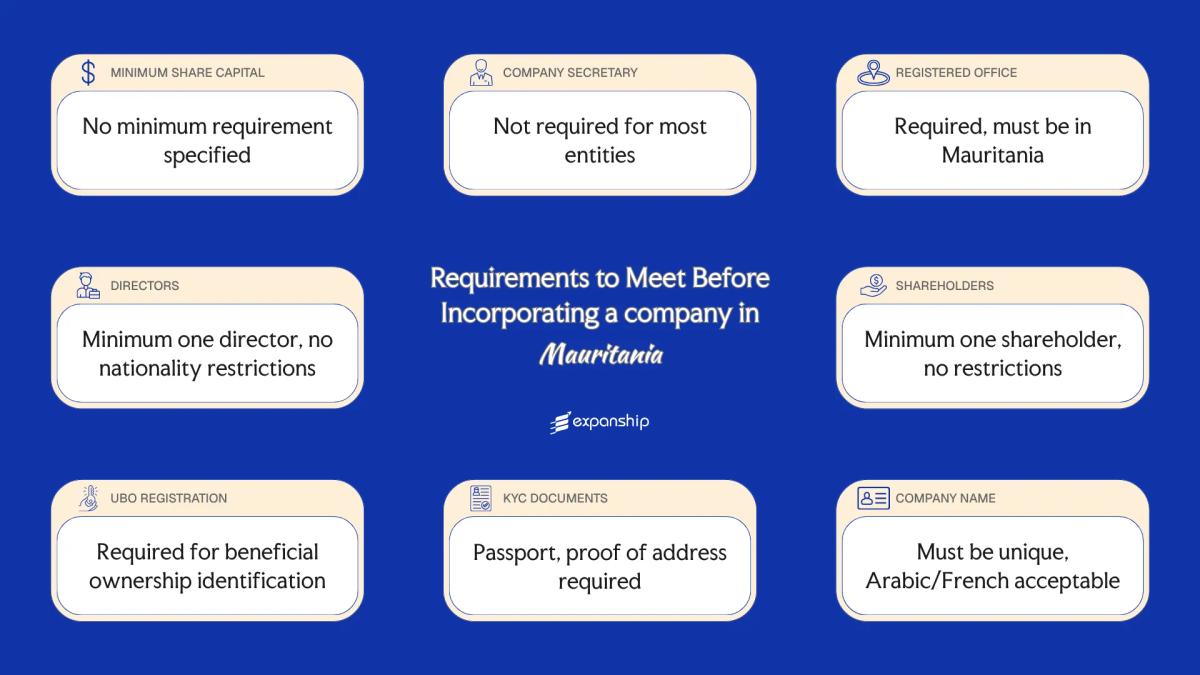
Minimum Share Capital Requirements in Mauritania
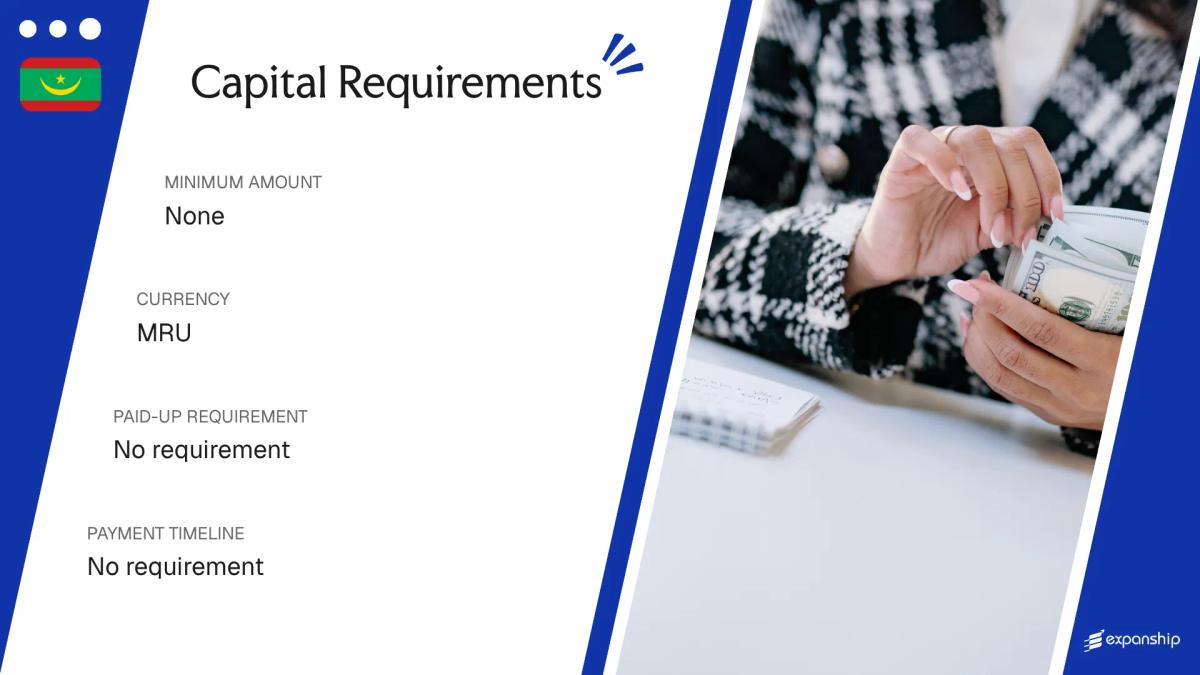
Minimum share capital requirements in Mauritania are governed primarily by the OHADA Uniform Act on Commercial Companies and Economic Interest Groups, which Mauritania adopted as part of its broader commercial law framework. The applicable rules differ based on entity type, with the Société Anonyme and Société à Responsabilité Limitée each carrying distinct capital thresholds.
Capital verification at formation falls under the oversight of the Registre du Commerce et du Crédit Mobilier (RCCM), which requires evidence of capital deposit before the entity is formally registered. Share capital in Mauritania operates on a par value system, and the statutory obligation to meet minimum capital thresholds is a formation condition rather than a recurring annual requirement.
| Parameter | Detail |
|---|---|
| Minimum Authorized Share Capital | MRU 100,000 for SARL; MRU 1,000,000 for SA (per OHADA Uniform Act) |
| Maximum Authorized Share Capital | No statutory maximum |
| Minimum Paid-Up Capital | 20% of subscribed capital at incorporation for SA; full amount for SARL |
| Paid-Up Requirement at Incorporation | Partial payment permitted for SA; full payment required for SARL |
| Accepted Currency | Mauritanian Ouguiya (MRU) |
| Accepted Forms of Contribution | Cash contributions and contributions in kind |
| Timeframe to Deposit Capital | Prior to filing with the RCCM |
Capital must be deposited before the RCCM registration is completed. The deposit certificate from a licensed bank or notary is a required submission document, not a post-registration formality.
Company Secretary Requirements in Mauritania
Under Mauritanian commercial law, the company secretary requirements Mauritania imposes are relatively limited compared to common law jurisdictions. There is no standalone statutory office of "company secretary" as found in Anglo-Saxon frameworks; instead, corporate governance obligations fall on the managing director (gérant) or the board, depending on the entity type.
That said, certain administrative and compliance functions must be assigned within the company structure. A designated officer bears responsibility for maintaining statutory registers, ensuring timely filings with the Registre du Commerce et du Crédit Mobilier (RCCM), and coordinating with public authorities on regulatory matters.
Qualification criteria for whoever fulfills this administrative role include:
- No mandatory residency requirement applies; the function can be discharged by a non-resident officer.
- The role may be held by an individual or delegated to a qualified legal or accounting professional.
- No specific licensing regime governs the position under current Mauritanian corporate rules.
- The person must have legal capacity under Mauritanian civil law.
- Corporate entities may fulfill the role if permitted by the company's statutes.

Incorporate a Company in Mauritania
Set up your business entity in Mauritania with guidance on legal structure, registration, and statutory compliance.
Registered Office Requirements in Mauritania
Registered office requirements in Mauritania follow the general framework established under the OHADA Uniform Act on Commercial Companies, which governs corporate domiciliation across member states including Mauritania. A non-compliant or fictitious address can expose your entity to administrative sanctions, potential deregistration, and challenges to the validity of official correspondence served to that address.
- A physical address within Mauritania is required; P.O. Box addresses alone do not satisfy domiciliation rules.
- Virtual office arrangements are generally not recognised as a compliant registered address under OHADA domiciliation standards.
- The address must be located in Mauritania; a foreign address cannot serve as the legal domicile of a locally incorporated entity.
- Proof of occupancy, such as a lease agreement or title deed, is typically required to establish a valid legal address.
- The registered address is recorded in the Registre du Commerce et du Crédit Mobilier (RCCM) and is publicly accessible.
- Any change to the registered address must be formally notified to the RCCM; failure to update the record can result in correspondence being legally deemed served at the old address.
Director Requirements in Mauritania
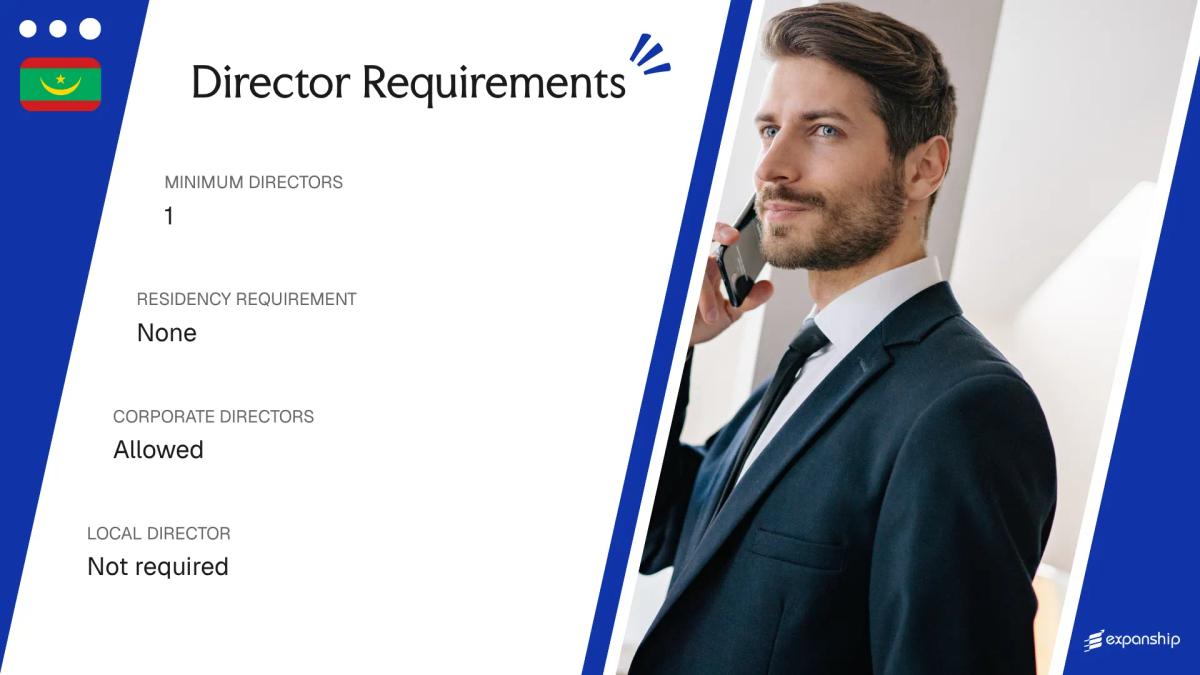
Meeting the director requirements for a Mauritania company is governed primarily by the OHADA Uniform Act on Commercial Companies, which sets out the statutory duties and liabilities that a gérant or board director assumes upon appointment. Directors bear personal liability for mismanagement, violations of applicable law, and breaches of the company's articles of association.
| Parameter | Detail |
|---|---|
| Minimum Number of Directors | One director is required for an SARL (gérant); an SA requires at least three board members. |
| Maximum Number of Directors | An SA may have up to twelve board members under the OHADA Uniform Act. |
| Local/Resident Director Required | No statutory residency requirement exists under current OHADA rules as adopted in Mauritania. |
| Nationality Restrictions | No nationality restrictions are imposed on directors. |
| Minimum Age Requirement | Directors must be of legal majority age, which is 18 years under Mauritanian civil law. |
| Corporate Directors Permitted | Corporate directors are generally permitted, though a permanent representative must be designated. |
| Director Must Be a Shareholder | No statutory requirement for a director to hold shares in the entity. |
| Publicly Listed on Registry | Director information is filed with the Registre du Commerce et du Crédit Mobilier (RCCM). |
| Disqualification Conditions | Persons subject to a judicial ban on commercial activity or convicted of financial crimes are disqualified. |
Despite Mauritania's geographic and cultural ties to the Arab world, its company law framework follows the French-African OHADA treaty system, meaning director obligations mirror those in Senegal or Côte d'Ivoire rather than any Arab League corporate law model.
Shareholder Requirements in Mauritania
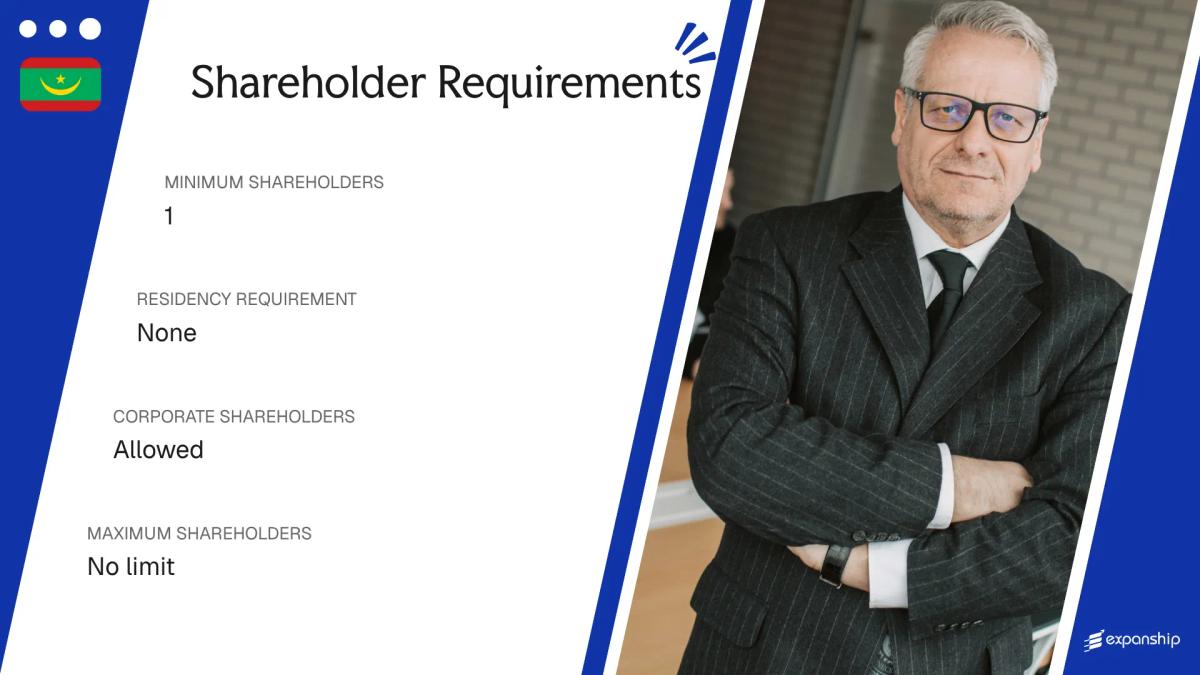
Under Mauritanian corporate law, a Société à Responsabilité Limitée (SARL) requires a minimum of one shareholder, permitting a sole associé structure. No statutory maximum applies to the number of associés in a SARL.
Nationality and Residency Restrictions
Shareholders are not required to be Mauritanian nationals or residents. Foreign ownership is generally permitted, though certain regulated sectors may impose restrictions on foreign shareholding percentages under sector-specific legislation.
Corporate Shareholders
Corporate entities may hold shares in a Mauritanian company as associés. No general prohibition exists against corporate shareholders, provided the entity meets applicable identification and documentation requirements at incorporation.
Shareholder Liability
In a SARL, your liability as a shareholder is limited to the amount of your capital contribution. Extended personal liability does not arise under ordinary circumstances.
Register of Shareholders
A register of associés must be maintained at the company's registered office. Filing obligations and public accessibility are governed by the Centre de Formalités des Entreprises registration framework.
Shareholder Structure Guidance for Your Mauritanian Entity
Get tailored advice on meeting associé requirements and structuring ownership for your company formation in Mauritania.
UBO / Beneficial Ownership Disclosure Requirements in Mauritania
Mauritania has established beneficial ownership requirements under its anti-money laundering framework, aligned with FATF Recommendations, where a beneficial owner is generally defined as any natural person who ultimately owns or controls 25% or more of a legal entity.
- Identify all natural persons holding 25% or more of the company's shares or voting rights, or those who otherwise exercise ultimate effective control.
- Collect supporting identification and documentation for each identified beneficial owner at the time of incorporation.
- Disclose beneficial ownership information to the relevant authority, which under Mauritanian AML legislation falls under the oversight of the Cellule de Traitement du Renseignement Financier (CENTIF).
- Update the beneficial ownership record whenever a change in ownership or control occurs.
| Parameter | Detail |
|---|---|
| Ownership Threshold for UBO Status | 25% or more of shares or voting rights |
| Filing Authority | CENTIF (Cellule de Traitement du Renseignement Financier) |
| Disclosure Deadline at Incorporation | No specific statutory deadline published |
| Publicly Accessible Register | No publicly accessible register confirmed |
| Penalties for Non-Disclosure | Subject to AML sanctions under Mauritanian law; specific penalties not publicly codified |
| Ongoing Update Obligation | Required upon any change in beneficial ownership or control |
KYC / Document Requirements in Mauritania
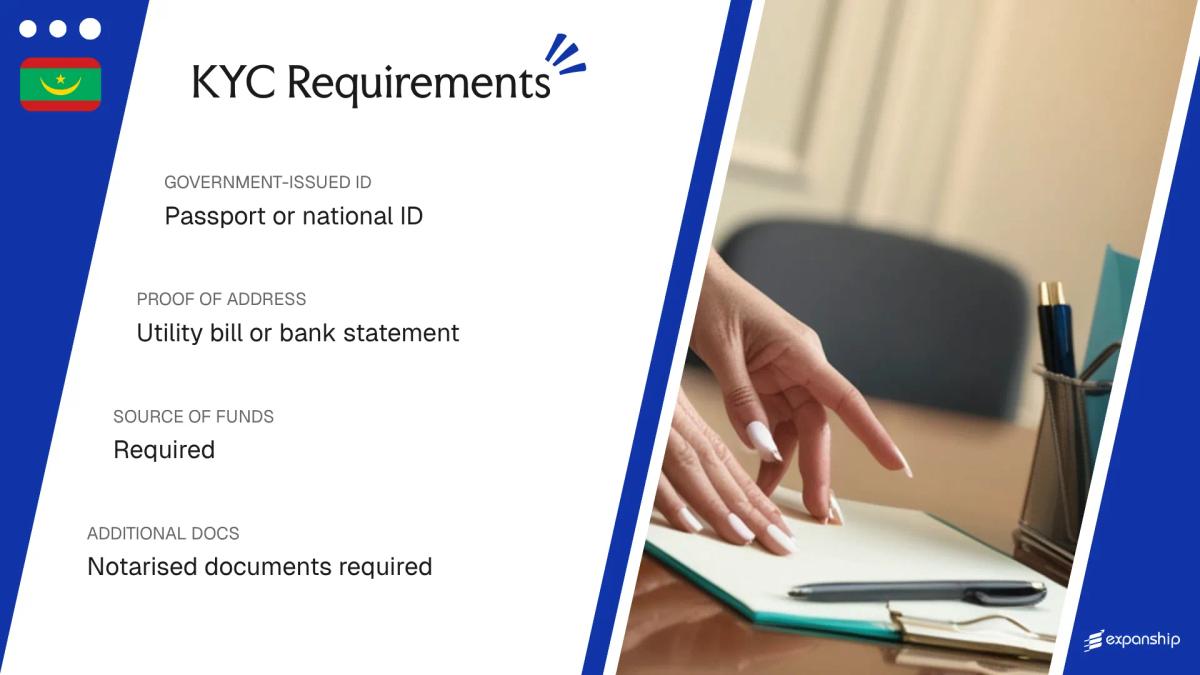
KYC document requirements in Mauritania are governed by the AML/CFT framework administered by the Cellule de Traitement du Renseignement Financier (CTRF), the national financial intelligence unit. Corporate service providers and notaries are obligated to collect and verify identity documentation from all principals before completing registration.
Individual / Personal Documents
- Valid passport or national identity card for each director, shareholder, and beneficial owner
- Proof of residential address dated within three months, such as a utility bill or bank statement
- Completed and signed KYC declaration form as required by the registering authority
- Recent passport-sized photographs may be required depending on the notary or filing agent
Corporate Documents
- Certificate of incorporation or equivalent constitutional document for any corporate shareholder or director
- Articles of association or bylaws of the corporate entity
- Current register of directors issued by the home jurisdiction's company registry
- Proof of the corporate entity's registered address in its home jurisdiction
Source of Funds Documentation
- Bank statements covering a minimum recent period to evidence available capital
- Audited financial accounts where the entity has been operational
- A written declaration of the origin of funds signed by the relevant principal
Notarisation and Apostille Requirements
- Foreign documents generally require notarisation and legalisation or an apostille under the Hague Convention framework
- Official translations into French are required for documents not originally in French
- A certified translator recognised in Mauritania must produce all translations
Untranslated foreign-language documents are among the most common reasons for delays or rejection at the point of registration.
Company Name Requirements in Mauritania
Company name requirements in Mauritania are assessed during the incorporation process through a review conducted at the Centre de Formalités des Entreprises (CFE). Proposed names are checked for uniqueness against the commercial register before registration proceeds.
All entities must append a legal suffix reflecting their corporate form, such as SA or SARL. French is the operative language for official company names, given its status as the language of commercial law in the jurisdiction.
Certain words are restricted or prohibited outright. Terms implying a government connection, banking activity, or regulated financial services require prior authorisation from the relevant supervisory authority before the name can be accepted.
Name reservation is available through the CFE prior to filing incorporation documents. The reservation holds the proposed name for a defined period, preventing another applicant from registering the same or a confusingly similar denomination in the interim.
Compliance Services for Companies in Mauritania
Maintain your legal standing in Mauritania with ongoing compliance support, from annual filings to regulatory reporting obligations.
Conclusion
Mauritania company incorporation requirements span several regulatory obligations governed primarily by the OHADA Uniform Act on Commercial Companies, as adopted within the country's legal framework. Minimum share capital thresholds vary by entity type, and beneficial ownership disclosure obligations reflect the country's commitments under anti-money laundering frameworks. Resident director requirements add a further layer of consideration for foreign investors. Once these obligations are understood, the practical focus shifts to preparing compliant documentation, engaging a local registered office, and coordinating with the Centre de Formalités des Entreprises to complete registration.
Expanship's Corporate Formation Services in Mauritania
Mauritania's incorporation framework places specific obligations on foreign investors, from capital deposit requirements at the Banque Centrale de Mauritanie to documentation that must be authenticated and legalised before submission to the Centre de Formalités des Entreprises. Expanship's Mauritania corporate formation services are structured around these procedural realities, helping your business meet each compliance checkpoint without taking on the administrative burden of coordinating across multiple government bodies directly.
Beyond initial registration, our support covers the full formation cycle and beyond:
- We prepare and file all incorporation documents required by the CFE and relevant Mauritanian authorities.
- Our team provides registered agent and local office solutions to satisfy your statutory address obligations.
- We manage direct liaison with government bodies and regulatory offices on your behalf.
- Post-incorporation compliance, including annual obligations, is handled through ongoing support packages.
- We facilitate introductions to banking institutions operating in Mauritania.
- Tax registration with the Direction Générale des Impôts and coordination with local authorities is included in our scope.
To discuss your requirements, contact Expanship Mauritania.
Frequently Asked Questions (FAQ)
A foreign national can serve as a director in Mauritania, but residency and work authorization requirements may apply depending on the level of operational involvement. Where the director also takes on an executive management role within the country, a valid residence permit and work authorization issued by Mauritanian authorities are generally required. Purely non-executive foreign directors face fewer restrictions, though notarized and apostilled identity documentation is still mandatory.
Failure to disclose beneficial ownership information to the Centre de Formalités des Entreprises or the competent commercial registry exposes the company to administrative sanctions, including fines and potential suspension of commercial activity. Mauritania has strengthened its AML framework in line with FATF recommendations, and non-compliance is treated as a regulatory violation rather than a minor procedural lapse. Directors bear personal liability for maintaining accurate and current UBO records.
A physical, verifiable address in Mauritania is required for company registration; a postal box alone does not satisfy the requirement. The registered office address must appear in the company's constitutive documents and be capable of receiving official correspondence from the Centre de Formalités des Entreprises and other state bodies. Virtual office arrangements are only acceptable where the provider can confirm physical occupancy of the premises.
Foreign shareholders must submit a certified copy of a valid passport, proof of residential address dated within three months, and a bank reference or equivalent source-of-funds document. If the shareholder is a corporate entity rather than an individual, the incorporating authority requires a certificate of incorporation, the entity's constitutive documents, and UBO declarations for the upstream ownership chain. All foreign-language documents must be translated into French by a sworn translator before submission.
Mauritanian commercial law prohibits company names that imply a state affiliation, use protected terms such as "national," "federal," or "bank" without regulatory authorization, or are identical or deceptively similar to an already-registered entity. The Centre de Formalités des Entreprises conducts a name availability check as part of the registration process, and a reservation can be made prior to filing the full incorporation dossier. Names that contravene public order or morality are also rejected outright.
Mauritanian company law does not impose a statutory obligation to appoint a company secretary in the same manner as common law jurisdictions such as the UK or Mauritius. Administrative and compliance responsibilities that a company secretary would typically handle are instead assigned to the gérant in an SARL or to the board and its designated officers in an SA. Despite the absence of a formal requirement, appointing a qualified administrator to manage ongoing compliance obligations is considered sound corporate governance practice.
Legal Disclaimer
The information provided in this article is for general informational purposes only and does not constitute legal, tax, or professional advice. While we strive to ensure the accuracy and timeliness of the content, laws and regulations are subject to change, and the application of laws can vary widely based on specific facts and circumstances.
Readers should not act upon this information without seeking professional counsel tailored to their individual situation. Expanship and its authors disclaim any liability for actions taken or not taken based on the content of this article.
For specific advice regarding your business setup, compliance requirements, or any legal matters, please consult with qualified legal and tax professionals in the relevant jurisdiction.