

Key Takeaways
- Mauritania's corporate tax rate sits below the regional average for West Africa, giving foreign-owned entities a measurable cost advantage over peers incorporated in neighbouring jurisdictions.
- OHADA law governs the corporate framework, providing investors with a standardised, treaty-based legal instrument that reduces the unpredictability often associated with domestic-only company law in the region.
- Foreign nationals can hold full equity in a Mauritanian SARL without mandatory local partner requirements, structuring ownership on purely commercial terms from the outset.
- The country's position at the intersection of Sub-Saharan Africa and the Arab world means a single incorporated entity can operate across both ECOWAS and Arab League trade frameworks, reducing the structural complexity of managing multi-regional supply chains.
Mauritania is an independent sovereign state in northwestern Africa, bordered by the Atlantic Ocean to the west and positioned at the intersection of North Africa and sub-Saharan West Africa. Understanding the benefits of incorporating in Mauritania begins with recognizing where regulatory authority sits: company registration falls under the remit of the Agence de Promotion des Investissements en Mauritanie, which oversees foreign investment entry and business establishment. Foreign nationals can generally hold equity in Mauritanian entities without mandatory local partner requirements, reflecting the government's stated openness to foreign direct investment across most sectors.
The SARL is the legal vehicle most commonly used by foreign businesses entering the market. From a tax posture standpoint, the country operates a conventional territorial-based system with standard corporate levies rather than a zero-tax or offshore framework. This article examines the principal advantages that company formation here offers to international investors and business operators.
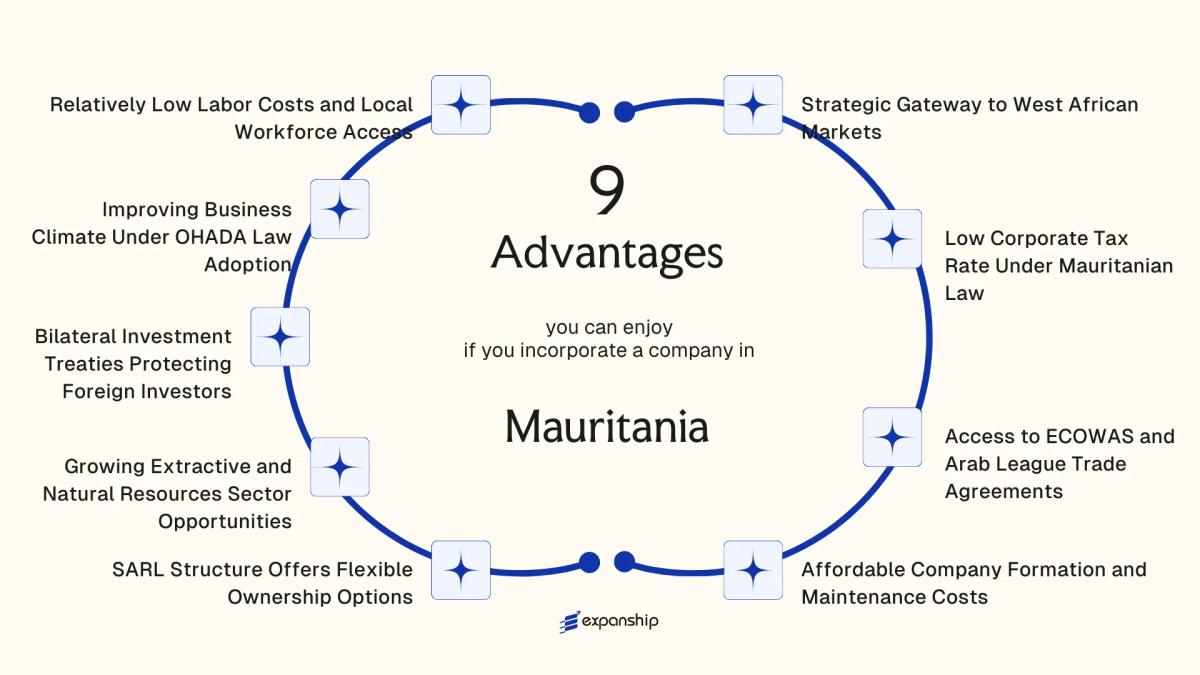
Strategic Gateway to West African Markets
Mauritania sits at a geographic crossroads where sub-Saharan Africa meets the Arab Maghreb, and this positioning gives your business a rare dual-market reach that few West African jurisdictions can replicate.
Proximity to High-Growth Regional Economies
The country shares borders with Senegal, Mali, and Western Sahara, placing a registered entity within practical reach of landlocked markets that depend on Atlantic-facing corridors for trade. Senegal's Dakar port and the Mauritanian port of Nouadhibou together form a logistics spine that businesses incorporated in the country can access without the regulatory friction of routing through third-party jurisdictions.
A Base for Mauritania Gateway to West Africa Business Operations
Firms structured under Mauritanian commercial law, governed by the Code de Commerce, can position operations to serve markets across the Sahel without establishing separate legal presences in each state. This reduces structural overhead significantly, since a single SARL or SA can contract, invoice, and hold assets across multiple commercial relationships from one registered base.
A single Mauritanian entity can serve as your operational hub for West African market access without requiring multiple parallel incorporations.
Low Corporate Tax Rate Under Mauritanian Law
Mauritania's standard corporate income tax rate sits at 25%, established under the General Tax Code (Code Général des Impôts). While that headline rate is not the lowest in the region, the tax framework includes sector-specific regimes and incentive mechanisms that can significantly reduce the effective rate your business actually pays.
Under the Investment Code, qualifying foreign firms operating in targeted sectors may access reduced rates, temporary exemptions, or profit reinvestment deductions. These provisions apply based on the nature of the activity, the volume of capital invested, and the geographic zone of operation, which means the conditions are specific and verifiable rather than discretionary.
Certain sectors, including agribusiness and export-oriented industries, benefit from reduced withholding tax treatment on dividends and repatriated profits. For foreign investors structuring cross-border operations, that distinction carries direct cash-flow implications.
The tax advantages under Mauritanian law are grounded in practical structural features:
- Minimum corporate tax thresholds are set at a level that does not penalize early-stage businesses with limited revenue
- Sector-based incentives are codified, reducing reliance on case-by-case administrative negotiation
- Export-oriented entities can qualify for preferential treatment without establishing a separate holding structure
Value-added tax obligations are also calibrated to business size, with micro and small enterprises assessed under a simplified regime that limits compliance costs during the early phases of operation.

Company Incorporation in Mauritania
Set up a compliant legal entity in Mauritania with support from Expanship's corporate services team.
Access to ECOWAS and Arab League Trade Agreements
Mauritania ECOWAS trade agreement benefits extend to any company incorporated there, since the country holds full membership in the Economic Community of West African States. That membership gives your business preferential access to a regional bloc covering 15 countries and a combined population exceeding 400 million people. Under the ECOWAS Trade Liberalization Scheme (ETLS), goods originating from member states can move across borders with reduced or eliminated tariffs, which directly lowers the cost of selling into markets like Senegal, Nigeria, or Ghana from a Mauritanian base.
| Trade Framework | Member States/Scope | Primary Benefit for Businesses |
|---|---|---|
| ECOWAS (ETLS) | 15 West African states | Tariff reductions on qualifying originating goods |
| Arab League | 22 member states | Commercial and diplomatic ties across North Africa and the Middle East |
| Greater Arab Free Trade Area (GAFTA) | 18 Arab League signatories | Preferential tariff treatment on trade between signatory states |
Alongside its West African ties, the country is a member of the Arab League, and through the Greater Arab Free Trade Area (GAFTA), companies operating there can benefit from preferential tariff arrangements covering trade with signatory Arab states. For a firm targeting both West African and Arab-world markets simultaneously, this dual regional positioning is structurally uncommon among African jurisdictions. Eligibility for ETLS benefits typically requires that goods meet defined rules of origin criteria, so the operational structure of your entity needs to reflect genuine economic activity within the country.
Affordable Company Formation and Maintenance Costs
Affordable company formation costs in Mauritania give foreign investors a meaningful capital advantage from the outset. Registering a Société à Responsabilité Limitée (SARL) requires a minimum share capital of 100,000 Mauritanian Ouguiya (MRU), which at current exchange rates amounts to roughly USD 2,700. This threshold is substantially lower than many comparable civil law jurisdictions in the region, meaning less capital is tied up before operations begin.
Registration is processed through the Centre de Formalités des Entreprises (CFE), the single-window body that consolidates incorporation procedures. Using a centralized registration body reduces the number of separate filings required, which directly cuts professional fees and administrative time for your business.
Annual compliance costs also remain contained. General accounting obligations and corporate filings under the OHADA Uniform Acts, which Mauritania has moved to adopt, follow standardized frameworks, making it easier to budget recurring maintenance expenses without engaging multiple local specialists.
Keep in mind while enjoying this benefit:
- Minimum capital of 100,000 MRU must be deposited before registration is finalized
- CFE handles tax, commercial registry, and social security registration in one process
- Ongoing compliance follows OHADA-aligned standards, reducing legal interpretation costs
- Annual accounts must be prepared according to the OHADA Uniform Act on Accounting
The CFE single-window system means your firm can receive its commercial registration number, tax identification, and social security enrollment simultaneously, rather than sequentially across separate agencies.
SARL Structure Offers Flexible Ownership Options
The Mauritania SARL flexible ownership benefits stem from a company law framework that gives foreign investors direct control over equity structure without the restrictions common to publicly listed entities. Under the OHADA Uniform Act on Commercial Companies, a société à responsabilité limitée can be formed by a single shareholder or by up to 50 shareholders, making it workable for both solo foreign operators and multi-party joint ventures.
Liability Boundaries Protect Personal Assets
Each shareholder's liability is capped at their capital contribution. This separation between personal and business assets means that if your Mauritanian entity incurs debts, your exposure does not extend beyond what you invested in the firm.
Minimum capital requirements under OHADA rules are modest, which allows you to right-size your initial investment rather than commit excess capital to satisfy statutory thresholds.
Ownership and Management Can Be Structured Independently
A SARL separates ownership from day-to-day management. The entity is managed by one or more gérants, who need not be shareholders, giving you the option to appoint a local manager while retaining full equity ownership as a foreign investor.
Shareholder rights, profit distribution rules, and transfer restrictions are governed primarily by the articles of association, which OHADA law permits parties to draft with considerable flexibility. For businesses anticipating ownership changes or phased equity transfers, this allows the company's constitutional documents to reflect specific commercial arrangements rather than default statutory provisions.
Structure Your Mauritanian SARL With Confidence
Speak with Expanship's corporate services team about designing an ownership and management structure that fits your investment objectives in Mauritania.
Growing Extractive and Natural Resources Sector Opportunities
Mauritania natural resources sector business opportunities are among the most concrete reasons foreign investors register entities here. The country holds commercially significant deposits of iron ore, gold, copper, and gypsum, alongside confirmed offshore oil and gas reserves in the Greater Tortue Ahmeyim LNG project, which spans the maritime border with Senegal. For a foreign business owner, this concentration of extractable resources in a single jurisdiction reduces the geographic spread required to participate in multiple commodity markets.
- The Mining Code (Code Minier) governs exploration and exploitation rights, providing a defined legal framework under which foreign firms can apply for research permits and exploitation licenses without mandatory local partnership in many categories.
- The offshore hydrocarbons sector is regulated by the Société Mauritanienne des Hydrocarbures et du Patrimoine Minier (SMHPM), which serves as the state counterpart in production-sharing agreements, giving your company a single institutional point of contact for upstream negotiations.
- Foreign extractive industry investment benefits from specific fiscal stabilization clauses written into mining conventions, which lock in tax conditions for the duration of a project and reduce exposure to future legislative changes.
- The Mauritanian Investment Promotion Agency (MIPA) registers qualifying projects that may access sector-specific incentives under the Investment Code, including customs duty exemptions on imported equipment during the construction phase.
Bilateral Investment Treaties Protecting Foreign Investors
Mauritania bilateral investment treaties foreign investors is not an abstract concern — it is a defined layer of legal protection backed by signed international instruments. The country has concluded BITs with several states, including France, Germany, and a number of Arab League members, each providing foreign investors with enforceable protections against expropriation without compensation and discriminatory treatment.
Under these treaties, your business gains access to international arbitration mechanisms, typically ICSID or UNCITRAL, rather than being confined to domestic courts. This matters because it removes sovereign risk from dispute resolution, giving foreign-owned entities a neutral forum if a host-state measure damages their investment.
Each treaty defines the scope of "investment" broadly, covering equity stakes, reinvested earnings, and contractual rights. That breadth means your firm's protected position extends beyond physical assets to include returns and associated business rights.
A hypothetical scenario: A French-owned extractives entity operating under the France-Mauritania BIT faces an administrative measure restricting repatriation of profits. Under the treaty's fair and equitable treatment standard and access to ICSID arbitration, the investor can pursue international arbitration without exhausting local remedies first, preserving capital and timeline in a way not available to investors from non-treaty states.
Improving Business Climate Under OHADA Law Adoption
Mauritania's formal adoption of the OHADA treaty framework introduces a significant structural shift for foreign investors. OHADA law benefits Mauritania business operations by replacing fragmented national commercial statutes with a unified, predictable legal code — the Acte Uniforme — that governs company formation, contracts, insolvency, and securities across member states.
For a foreign-owned firm, this predictability has direct operational value. Disputes involving commercial contracts can be referred to the OHADA Common Court of Justice and Arbitration (CCJA), rather than being resolved solely through domestic courts, which may have limited commercial jurisprudence.
The harmonized texts also reduce compliance ambiguity across entity types. Under OHADA's Acte Uniforme relatif au droit des sociétés commerciales, the rules governing SARL and SA structures are standardized, so your legal counsel working in any OHADA jurisdiction can apply consistent interpretations.
- The CCJA provides a supranational arbitration forum outside local judicial systems
- OHADA's uniform acts are binding without requiring separate national enactment
- Commercial dispute resolution timelines are governed by defined procedural rules
Mauritania's OHADA membership status and the extent of Acte Uniforme implementation in domestic practice should be independently verified, as transposition timelines vary across member states.
Relatively Low Labor Costs and Local Workforce Access
Mauritania low labor costs business advantages begin with the statutory minimum wage, known locally as the SMIG (Salaire Minimum Interprofessionnel Garanti). Set and periodically revised by the government, the SMIG sits considerably below minimum wage thresholds in comparable Francophone West African economies, which directly reduces your fixed payroll obligations from the first hire.
Labor relations in the country are governed by the Labour Code (Code du Travail), which establishes standard employment contracts, working hours, and termination procedures. Foreign-incorporated entities operating under an SARL or SA structure are subject to the same framework, meaning your firm can engage local staff under well-defined statutory terms without negotiating bespoke arrangements.
The workforce composition also carries practical value for specific industries:
- French and Arabic are both official languages, reducing onboarding friction for firms operating across Francophone Africa or the Arab world.
- The fishing, mining, and construction sectors have produced a pool of workers with extractive-industry experience, reducing training costs for businesses in those fields.
- Nouakchott, as the administrative and commercial center, concentrates clerical, logistics, and mid-level professional talent within a single urban labor market.
Social contribution obligations for employers are administered through the Caisse Nationale de Sécurité Sociale (CNSS). Contribution rates are set as a percentage of gross salary and apply to both local and expatriate employees, giving your business predictable workforce cost calculations from the outset rather than variable exposure.
Why Mauritania Stands Out Among African Incorporation Destinations
Compared against other West African incorporation destinations, Mauritania occupies a distinct position. The combination of OHADA-aligned commercial law, a low flat corporate tax rate, and membership in both ECOWAS and the Arab League gives it a dual-market profile that few neighbouring jurisdictions can replicate. Investors evaluating options across the Sahel-Atlantic corridor would realistically weigh Mauritania against Senegal, Morocco, and Mali, all of which target overlapping investor profiles but differ meaningfully on cost, treaty access, and legal framework.
The comparison below focuses on parameters where Mauritania holds a neutral or favourable position relative to these competitors. Senegal, for instance, operates under a higher general corporate tax rate and imposes more structured minimum capital requirements for equivalent entity types. Morocco offers stronger institutional depth but at significantly higher operational costs and with a more complex regulatory entry process for foreign-owned firms. Mali shares the OHADA framework but presents greater political risk and reduced treaty coverage. Mauritania's SARL structure, governed under the OHADA Uniform Act, carries no mandatory minimum capital threshold, which reduces the upfront commitment required from foreign incorporators.
| Parameter | Mauritania | Senegal | Morocco | Mali |
|---|---|---|---|---|
| Corporate Tax Rate | 25% flat | 30% standard | 31% standard | 30% standard |
| OHADA Framework | Yes | Yes | No | Yes |
| Arab League Membership | Yes | No | Yes | No |
| ECOWAS Membership | Yes | Yes | No | Yes |
| SARL Minimum Capital | None mandated | None mandated | MAD 100,000 (approx. USD 10,000) | None mandated |
| Bilateral Investment Treaties | 20+ | 25+ | 60+ | 15+ |
| Official Language (Legal) | Arabic / French | French | Arabic / French / Tamazight | French |
Compliance Services for Companies in Mauritania
Maintain your Mauritanian entity in good standing with ongoing compliance support, including annual filings, statutory obligations, and regulatory reporting under applicable OHADA and local law requirements.
Conclusion
Incorporating in Mauritania presents a coherent case for foreign investors whose business objectives align with what the jurisdiction structurally offers. The combination of OHADA-governed corporate law, bilateral investment treaty protections, and a corporate tax regime that applies at rates lower than many regional peers gives a foreign-owned entity a degree of legal predictability and cost efficiency that is difficult to find across West Africa.
The SARL structure's permissive ownership rules and the country's geographic position as a bridge between Sub-Saharan Africa and the Arab world are not incidental features. For firms operating across multiple trade blocs or managing supply chains that span both regions, those structural realities have direct consequences for how a business organises itself and where it books activity.
Whether this structure fits your business depends on your sector, the nature of your investor base, and how your operations connect to the markets the country can realistically access. A natural resources firm, a regional trading entity, or a business seeking treaty-backed asset protection will find a different degree of fit than a purely digital or service-led operation. Understanding that distinction is the first step toward a formation decision that holds up over time.
Start Your Mauritania Company Formation With Expanship Today
Mauritania company formation with Expanship begins with understanding the regulatory environment that governs how foreign-owned entities are registered and maintained. Expanship's services are structured around the SARL and SA entity types recognized under Mauritanian commercial law, and address the compliance obligations administered by the Centre de Formalités des Entreprises (CFE). From the initial OHADA-aligned incorporation procedures to ongoing statutory filings, the full scope of what this blog has covered — trade access, tax positioning, investor protections, and labor considerations — informs how each engagement is structured.
For foreign business owners, Expanship handles the operational and procedural elements that require local knowledge and in-country presence:
- Document preparation and notarization for CFE submission
- Registered agent and registered office provision in Mauritania
- Government filing and liaison with the Registre du Commerce et du Crédit Mobilier (RCCM)
- Post-incorporation compliance management, including annual statutory obligations
- Banking introduction assistance to support account opening with local financial institutions
- Legalization of foreign documents required for shareholder or director registration
To discuss your specific requirements, contact Expanship Mauritania directly.
Frequently Asked Questions (FAQ)
The standard corporate income tax rate in Mauritania is 25%, applied to net taxable profits. Businesses operating in specific sectors or free zones may be subject to different rates or exemption periods under applicable investment codes. Confirming the applicable regime for your business activity with a qualified local tax adviser is advisable before entity registration.
Mauritania's adoption of the OHADA Uniform Acts introduces a harmonized commercial legal framework shared across multiple African member states, replacing fragmented national rules for areas such as company formation, commercial contracts, and insolvency proceedings. For foreign investors, this means greater predictability when structuring transactions or enforcing rights, since the Uniform Acts are interpreted consistently across OHADA jurisdictions. The CCJA (Common Court of Justice and Arbitration) serves as the final arbitral and judicial authority under this framework.
Mauritania has signed bilateral investment treaties (BITs) with several countries, providing protections that typically include guarantees against expropriation without compensation, free transfer of capital and returns, and access to international arbitration in the event of a dispute. The specific protections available depend on whether a BIT exists between Mauritania and your home country. You can verify the current treaty network through UNCTAD's Investment Policy Hub or the relevant national investment authority.
Registration timelines vary depending on the completeness of documentation and the business activity involved, but formation through the Centre de Formalités des Entreprises (CFE) is generally intended to be completed within a matter of days for standard structures. Delays can occur when sector-specific approvals, notarized documents, or foreign document authentication are required. In practice, foreign investors should allow additional time for document legalization and any translation requirements under Mauritanian administrative procedure.
Mauritania's status as an associate member of ECOWAS provides partial access to regional trade arrangements, though the scope differs from that available to full members. Full ECOWAS membership grants broader tariff and movement benefits, so the exact preferences accessible to a Mauritanian-incorporated entity depend on the specific agreement and product category involved. Businesses targeting regional trade should conduct a treaty-by-treaty review before relying on assumed preferential access.
Failure to meet ongoing compliance obligations, such as annual filing requirements or tax declarations under Mauritanian law, can result in administrative penalties, suspension of business activities, or in serious cases, involuntary dissolution by the relevant commercial registry. The OHADA Uniform Act on Commercial Companies sets out the legal consequences for non-compliance with governance and reporting obligations applicable to SARLs. Directors and shareholders may also bear personal liability in certain circumstances, particularly where non-compliance results in financial harm to creditors.
Legal Disclaimer
The information provided in this article is for general informational purposes only and does not constitute legal, tax, or professional advice. While we strive to ensure the accuracy and timeliness of the content, laws and regulations are subject to change, and the application of laws can vary widely based on specific facts and circumstances.
Readers should not act upon this information without seeking professional counsel tailored to their individual situation. Expanship and its authors disclaim any liability for actions taken or not taken based on the content of this article.
For specific advice regarding your business setup, compliance requirements, or any legal matters, please consult with qualified legal and tax professionals in the relevant jurisdiction.