

Key Takeaways
- Mauritania's Commercial Code mandates Arabic as the language of legal documentation, creating a structural compliance burden for foreign investors who must engage qualified translators and legal counsel for every binding instrument.
- Foreign investors face restricted ownership rights in key sectors, limiting the viability of full-control structures that multinationals typically rely on when establishing operational subsidiaries.
- Registration through APEM is subject to bureaucratic delays that extend incorporation timelines beyond what comparable regional jurisdictions require, increasing pre-operational costs and uncertainty.
- With a limited double taxation treaty network, cross-border profit repatriation and intercompany transactions are exposed to withholding tax obligations that a broader treaty framework would otherwise reduce or eliminate.
Mauritania operates under an evolving regulatory framework, where formal commercial law coexists with significant procedural gaps and inconsistent enforcement across sectors. The disadvantages of incorporating in Mauritania span structural, financial, legal, and operational categories — each of which this article examines in detail.
Not every drawback will apply equally to your business. The risks of doing business in Mauritania differ considerably depending on whether you are establishing a trading company, a resource-extraction subsidiary, or a services firm.
This article is most relevant to foreign investors and multinational entities considering direct incorporation rather than a representative or branch arrangement. Mauritanian commercial activity is governed primarily by its Commercial Code, which sets the baseline legal obligations your entity will be subject to from registration onward.
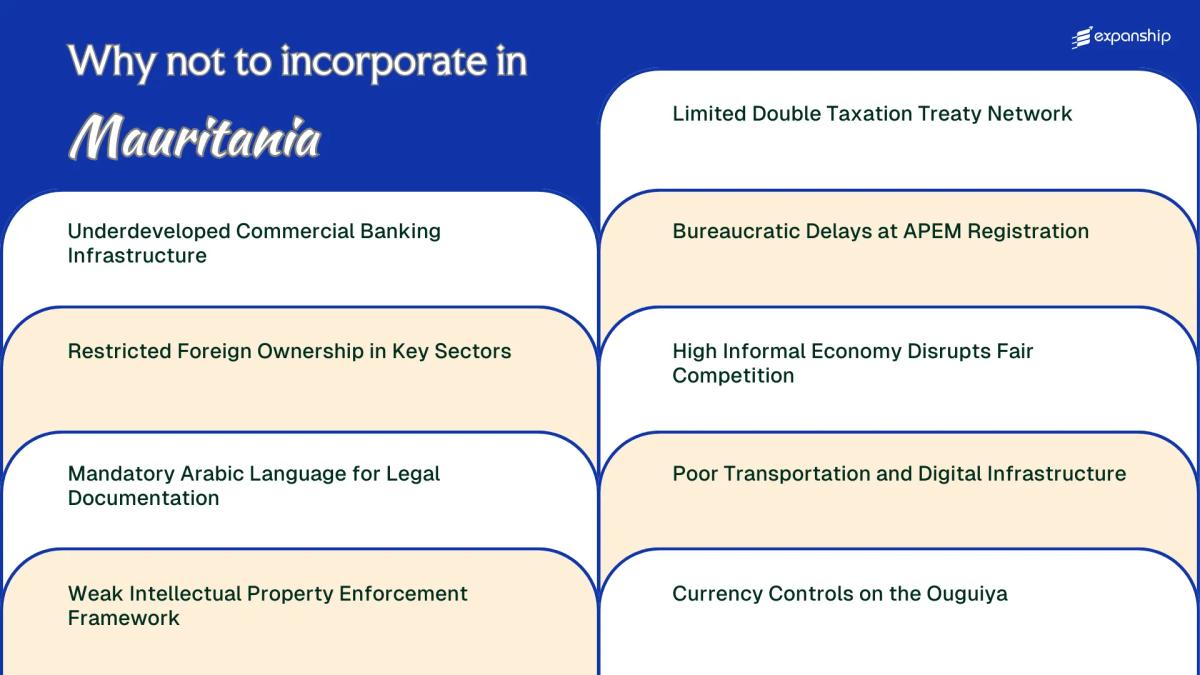
Underdeveloped Commercial Banking Infrastructure
Mauritania banking infrastructure limitations affect foreign businesses from the moment they attempt to open a corporate account. The sector remains shallow, with a small number of licensed commercial banks serving a population spread across a largely cash-dependent economy.
Limited Banking Access for Foreign-Owned Entities
Foreign firms registering through the Agence de Promotion des Investissements en Mauritanie (APEM) frequently encounter delays opening corporate accounts, as most banks require extensive documentation and apply discretionary due diligence standards that are inconsistently applied. Your business may wait weeks or months before accounts become operational, stalling payroll, vendor payments, and initial capital deployment.
Few banks offer trade finance products, correspondent banking relationships, or multi-currency accounts suited to internationally active companies. This structural gap in commercial banking challenges Mauritania-based foreign entities that require routine cross-border transactions.
Restricted Digital and Correspondent Banking Services
Online banking functionality across most Mauritanian institutions remains limited, with minimal integration with international payment systems. This forces your finance team to rely on in-branch processes that add time and cost to routine operations.
Correspondent banking access is available through select institutions, but coverage is narrow compared to West African peers such as Senegal or Côte d'Ivoire.
A foreign business owner may find it effectively impossible to repatriate funds or settle international invoices on schedule without maintaining a parallel banking relationship in a third-country jurisdiction.
Restricted Foreign Ownership in Key Sectors
Foreign ownership restrictions in Mauritania apply most acutely in sectors that are central to the country's economy. The Investment Code and sector-specific legislation reserve certain activities for Mauritanian nationals or require local partnership arrangements, which limits the operational structure your business can adopt from the outset.
The fishing industry illustrates this directly. Foreign firms seeking access to Mauritanian waters must operate through licensing agreements with the state or enter joint venture arrangements, rather than establishing wholly foreign-owned fishing entities. This reduces your profit share and control over day-to-day operations.
Similar constraints affect land ownership and some areas of the extractive sector. Practically, these restrictions force foreign investors into the following burdens:
- Sourcing a qualifying local partner adds due diligence costs before incorporation even begins
- Minority ownership positions reduce your ability to enforce internal governance decisions
- Profit distribution structures in joint ventures may require regulatory approval, creating delays
- Local partner dependency introduces legal exposure if disputes arise under Mauritanian civil law
Wholly foreign-owned structures remain possible in many commercial sectors, but the requirement to identify and legally bind a local partner in restricted industries adds cost, time, and negotiation complexity before a single dirham of revenue is generated.

Company Incorporation in Mauritania
Understand the structural requirements and ownership rules before setting up your business in Mauritania.
Mandatory Arabic Language for Legal Documentation
Arabic legal documentation requirements in Mauritania extend well beyond standard translation work. Under Mauritanian law, all official corporate documents, contracts, and regulatory filings must be drafted or formally translated into Arabic to be legally valid. For foreign executives and investors whose operations run in English, French, or another language, this creates a structural compliance cost before the business even begins operating.
| Compliance Requirement | Implication for Foreign Business |
|---|---|
| Corporate bylaws must be in Arabic | External certified legal translation required at incorporation |
| Commercial contracts enforceable only in Arabic version | Dual-language contracts carry risk if Arabic version conflicts with source text |
| Arabic required for APEM registration filings | Non-Arabic documentation rejected, causing registration delays |
| Legal disputes adjudicated in Arabic | Foreign firms must retain Arabic-speaking legal counsel throughout proceedings |
Certified legal translators qualified in Mauritanian commercial law are scarce, which extends preparation timelines and inflates professional fees. A translation error in corporate bylaws or a shareholder agreement is not a minor administrative issue; it can render a clause unenforceable under local courts.
French retains practical use in business settings, but it holds no statutory standing in formal legal and judicial processes. Your firm carries the full burden of ensuring Arabic-language accuracy across every binding document, with no tolerance for approximation.
Weak Intellectual Property Enforcement Framework
Intellectual property enforcement risks Mauritania presents to foreign businesses are structural, not incidental. The country is a member of the African Intellectual Property Organization (OAPI), which means trademark and patent rights are registered through the Bangui Agreement framework rather than a purely domestic system. While OAPI membership provides a regional filing mechanism, the practical enforcement of those rights within Mauritanian territory depends on local judicial and administrative capacity, which remains limited.
Court proceedings involving IP disputes are slow and outcomes are inconsistent. Judges with specialized IP knowledge are scarce, which means infringement cases often stall or produce unpredictable rulings.
Trademark registration problems in Mauritania compound this further. Even with a valid OAPI registration, stopping counterfeit goods or unauthorized use of your brand requires engaging local enforcement channels that lack dedicated IP units.
- OAPI registration does not guarantee domestic enforcement action by Mauritanian authorities
- No specialized IP court or tribunal exists within the jurisdiction
- Border enforcement against counterfeit imports operates without a dedicated IP customs mechanism
- Civil litigation for infringement requires local legal representation familiar with both OAPI procedures and national courts
- Criminal IP enforcement thresholds under national law are rarely applied in practice
Despite being an OAPI member state, Mauritania has no standalone national IP office, meaning your IP rights exist regionally on paper but have no dedicated domestic authority to enforce them locally.
Limited Double Taxation Treaty Network
Mauritania's double taxation treaty limitations present a concrete structural risk for foreign investors. The country maintains a narrow network of bilateral tax agreements, leaving most cross-border income flows exposed to double taxation without relief.
Scope of the Treaty Gap
Mauritania has concluded tax treaties with a limited number of partners, primarily Arab League and select francophone African states, offering little coverage for businesses with operations tied to European, North American, or Asian markets. Where no treaty exists, dividend, royalty, and interest payments remitted abroad are subject to withholding tax under domestic rules, increasing the effective cost of repatriating profits significantly.
Practical Consequences for Foreign-Owned Entities
Your home jurisdiction may tax the same income again, with no foreign tax credit mechanism available to offset what was already withheld in Mauritania. This withholding tax risk in Mauritania companies structures is particularly acute for intellectual property licensing arrangements and intercompany loan agreements, where royalty and interest withholding rates under domestic law apply in full. The absence of treaty protection cannot be resolved through internal structuring alone, and third-country holding arrangements may introduce additional compliance costs without eliminating the underlying exposure.
Addressing Tax Treaty Exposure in Mauritania
Speak with our corporate advisors about structuring your cross-border operations to account for Mauritania's limited bilateral tax treaty network and associated withholding risks.
Bureaucratic Delays at APEM Registration
APEM registration delays Mauritania represent one of the more concrete operational risks for foreign investors entering the market. The Agence de Promotion des Exportations et des Investissements Mauritaniens (APEM) acts as the primary gateway for business registration, but procedural inefficiencies within the agency add unpredictable lead times to what should be a defined incorporation timeline.
- Document verification at APEM can stall your incorporation for weeks if submitted paperwork fails to meet internal standards that are not always publicly codified.
- Physical attendance requirements for certain filing steps mean that remote or overseas-based founders must either travel or appoint a local representative, adding cost and dependency.
- Inter-agency coordination between APEM and bodies such as the tax authority (Direction Générale des Impôts) introduces sequential bottlenecks that compound overall registration delays.
- No statutory maximum processing period is publicly enforced, leaving your business without a guaranteed timeline for legal existence.
- Firms operating in regulated sectors face additional approval layers beyond standard APEM procedures, extending the incorporation process further.
High Informal Economy Disrupts Fair Competition
Informal economy risks Mauritania business owners face are structural, not incidental. A significant portion of commercial activity operates outside the tax registry and regulatory framework, meaning unregistered vendors and traders absorb no VAT, no corporate tax obligations, and none of the compliance costs your formally incorporated entity must carry.
This cost asymmetry directly undercuts your pricing position. A registered firm subject to Mauritanian tax obligations cannot match the margins of an unregistered competitor that bears none of those fixed costs.
Enforcement capacity remains limited. The Direction Générale des Impôts lacks the field resources to systematically bring informal operators into the tax base, so the gap between formal and informal competitors persists over time rather than narrowing.
The problem is particularly acute in retail, food distribution, and construction supply — sectors where informal operators hold established customer relationships and face no documentation requirements.
According to the International Monetary Fund, the informal economy in Mauritania is estimated to represent approximately 20–30% of GDP, a share large enough to structurally distort competition in sectors where formal compliance costs are highest.
Poor Transportation and Digital Infrastructure
Mauritania infrastructure limitations business operations in ways that directly increase cost and reduce operational predictability. The road network outside Nouakchott and Nouadhibou is largely unpaved, meaning goods movement between interior regions and port facilities involves extended transit times and higher vehicle maintenance costs.
Rail infrastructure is almost exclusively dedicated to iron ore transport by SNIM (Société Nationale Industrielle et Minière), leaving commercial freight with no viable rail option. Your supply chain is therefore dependent on road haulage across terrain that becomes impassable during seasonal rains.
Internet penetration remains low by regional standards, with fixed broadband access concentrated in a small number of urban centers. For firms that depend on real-time data exchange, cloud-based operations, or remote team coordination, this creates functional gaps that require costly workarounds such as satellite connectivity.
- Port capacity at Nouakchott Autonomous Port is limited relative to West African hubs like Dakar, resulting in longer dwell times for cargo clearance.
- Mobile network coverage drops significantly outside major towns, affecting field operations and payment processing.
- Electricity supply is unreliable in secondary cities, adding generator dependency to operational overhead.
If your business model requires consistent digital connectivity or multimodal freight logistics beyond the Nouakchott-Nouadhibou corridor, the absence of redundant infrastructure means these gaps cannot be resolved through standard procurement alone.
Currency Controls on the Ouguiya
Mauritania currency controls risks are a direct operational concern for any foreign-owned entity remitting profits or repatriating capital. The Ouguiya (MRU) is a non-convertible currency managed under the oversight of the Banque Centrale de Mauritanie (BCM), which maintains strict foreign exchange controls that restrict the free movement of funds across borders.
Transfers of foreign currency require prior BCM authorization, and approval timelines are unpredictable. This creates real cash flow exposure for businesses that depend on regular dividend repatriation or inter-company payments.
Foreign exchange restrictions in Mauritania also mean that converting MRU into hard currencies like USD or EUR is not transacted at market rates with consistency. The spread between official and parallel rates creates valuation risk that directly affects reported earnings for parent companies abroad.
Currency repatriation problems are compounded by the shallow local banking sector, which limits the volume and speed of eligible transactions even after regulatory approval is obtained.
Overcoming Incorporation Challenges in Mauritania
Overcoming incorporation challenges in Mauritania requires structural preparation rather than reactive problem-solving. The disadvantages covered in this blog are systemic, and addressing them starts before your entity is even registered.
- Register your business through the APEM portal to reduce procedural delays at the Agence de Promotion des Investissements en Mauritanie.
- Engage a certified Arabic-language legal translator at the outset to ensure all constitutional documents meet the mandatory Arabic documentation requirement.
- Structure equity allocation in accordance with the Code des Investissements to remain compliant with foreign ownership restrictions in regulated sectors.
- Open corporate accounts with a bank holding a Banque Centrale de Mauritanie licence to manage Ouguiya currency control obligations from day one.
- File for intellectual property protection through the Organisation Africaine de la Propriété Intellectuelle, given the absence of a strong domestic enforcement regime.
These steps address discrete regulatory requirements under Mauritanian commercial law, but they do not eliminate the underlying structural conditions. The informal economy, infrastructure gaps, and the limited tax treaty network remain external variables that cannot be resolved through entity-level compliance alone.
Mauritania's Overall Investment Appeal
Mauritania investment appeal despite risks is a calculation that hinges on sector, risk tolerance, and timeline. The disadvantages covered in this blog are real and measurable — from APEM registration delays to currency controls on the Ouguiya — yet the country's hydrocarbon reserves, Atlantic fisheries access, and emerging LNG infrastructure keep it on the radar for resource-focused investors.
| Pros | Cons |
|---|---|
| Significant hydrocarbon and mineral resource base creates commercial opportunity | Currency controls on the Ouguiya restrict profit repatriation |
| Atlantic coastline supports access to fishing and maritime sectors | Restricted foreign ownership applies in several strategic industries |
| Strategic position between North and Sub-Saharan Africa | Poor transportation and digital infrastructure raises operational costs |
| APEM provides a single-window registration point for new entities | Bureaucratic delays at APEM extend incorporation timelines unpredictably |
| Growing international engagement through development finance institutions | A limited double taxation treaty network increases cross-border tax exposure |
The high informal economy creates an uneven competitive environment that formal foreign-registered businesses must factor into pricing and planning. Weak intellectual property enforcement and mandatory Arabic-language documentation add further friction that purely administrative preparation cannot fully offset.
Compliance Services for Companies in Mauritania
Maintain your entity's good standing under Mauritanian corporate law, from annual filing obligations to regulatory reporting requirements.
Conclusion
Mauritania company formation drawbacks summary points to a jurisdiction with genuine structural constraints. Currency restrictions under the Banque Centrale de Mauritanie, persistent delays through the APEM registration process, and a thin double taxation treaty network each impose measurable costs on foreign-owned businesses. These are not temporary administrative gaps — several reflect entrenched legal and economic conditions. For your business, the practical implications depend heavily on sector, ownership structure, and tolerance for procedural friction. Specialist guidance on local regulatory requirements will determine whether incorporation here aligns with your operational objectives.
Expanship's Services for Mauritania Expansion
Mauritania expansion challenges that Expanship services address span the specific friction points covered throughout this blog: APEM's procedural delays, Arabic-language documentation requirements, currency controls on the Ouguiya, and the limited treaty network that shapes your tax exposure from day one. Expanship's role is to reduce the operational weight of these obligations, not to change the regulatory environment itself.
Beyond those jurisdiction-specific hurdles, the firm offers a broader range of support for companies entering Mauritania:
- Expanship prepares and files your company registration documents with the relevant authorities.
- A registered agent and local office address are provided to satisfy legal presence requirements.
- Government filings and liaison with bodies such as APEM are managed on your behalf.
- Post-incorporation compliance obligations are tracked and maintained on an ongoing basis.
- Banking introductions are facilitated to support your account opening process.
- Tax registration and coordination with local authorities are handled as part of the setup.
Reach out to Expanship Mauritania to discuss your incorporation requirements directly.
Frequently Asked Questions (FAQ)
Restrictions are concentrated in specific sectors, including fisheries, mining, and certain agricultural activities, where Mauritanian law requires local participation or caps foreign equity stakes. General commercial and service businesses typically face fewer ownership constraints, but any firm operating in a resource-linked sector must review the applicable sectoral legislation before structuring its shareholding. Assuming unrestricted access without sector-specific legal advice is a common and costly mistake.
Documents not drafted in Arabic risk being rejected by registration authorities at APEM or ruled inadmissible in local court proceedings. Mauritania's legal framework designates Arabic as the official language for formal legal and administrative documentation, so contracts, articles of association, and regulatory filings must comply. Relying solely on French-language versions, even where accepted informally, does not provide legal certainty before judicial or regulatory bodies.
Mauritania's treaty network is among the thinnest in the region, with a limited number of bilateral agreements covering income and capital gains. By comparison, Senegal and Morocco maintain broader treaty coverage that reduces withholding tax exposure on dividends, royalties, and interest payments for foreign investors. A business structuring cross-border flows through a Mauritanian entity will likely face higher effective tax costs than one using a jurisdiction with more developed treaty arrangements.
The direct financial cost of enforcement is difficult to quantify because Mauritania's IP enforcement framework is weak and court-ordered remedies are rarely pursued to conclusion. A foreign firm holding trademarks or patents registered through the African Intellectual Property Organization (OAPI), of which Mauritania is a member, still faces the practical problem that local enforcement capacity does not match OAPI's regional registration system. Businesses with valuable IP should factor in the cost of alternative protective measures, since judicial remedies alone offer limited deterrence.
Failure to meet APEM registration requirements or complete mandatory post-incorporation filings can result in administrative sanctions, fines, or the entity being deemed legally non-operational for the purposes of contract enforcement and tax registration. Specific penalty amounts are set within Mauritania's commercial code and related administrative regulations, and they can compound if violations persist over multiple filing periods. Operating without proper standing also exposes directors to personal liability in certain circumstances.
No foreign entity can fully insulate itself from competitive distortion caused by the informal sector, which represents a substantial share of economic activity in Mauritania. Informal operators avoid tax, licensing fees, and labor costs that registered businesses must bear, creating a structural pricing disadvantage for compliant firms particularly in retail, construction, and logistics. There is no regulatory mechanism that currently equalizes competitive conditions between the formal and informal sectors in any meaningful way.
Legal Disclaimer
The information provided in this article is for general informational purposes only and does not constitute legal, tax, or professional advice. While we strive to ensure the accuracy and timeliness of the content, laws and regulations are subject to change, and the application of laws can vary widely based on specific facts and circumstances.
Readers should not act upon this information without seeking professional counsel tailored to their individual situation. Expanship and its authors disclaim any liability for actions taken or not taken based on the content of this article.
For specific advice regarding your business setup, compliance requirements, or any legal matters, please consult with qualified legal and tax professionals in the relevant jurisdiction.