
Key Takeaways
- Martinique's full integration as a French overseas department means businesses must comply with the entire body of metropolitan French commercial law, including the Code de commerce, placing the same regulatory burden on a Caribbean-based entity as on one operating in Paris.
- Corporate and social contribution taxes in Martinique follow French metropolitan rates, eliminating the low-tax advantages commonly associated with Caribbean jurisdictions and increasing the total fiscal cost relative to neighboring islands.
- All entities must register with the Registre du Commerce et des Sociétés and navigate French administrative processes managed from the metropolitan mainland, which extends timelines and adds procedural complexity for non-French-speaking investors.
- As part of EU customs territory, Martinique-based companies are excluded from the preferential trade agreements that independent Caribbean nations have negotiated independently, narrowing market access for businesses relying on regional trade relationships.
Incorporating in Martinique places your business under one of the more heavily regulated frameworks in the Caribbean region, given the territory's status as a French overseas department subject to metropolitan French law and EU directives.
The disadvantages of incorporating in Martinique span fiscal, administrative, operational, and market-access dimensions — each examined in the sections that follow.
How significantly these drawbacks affect your firm depends on the entity type you choose, your industry sector, and whether you intend to operate locally or use the territory as a base for broader regional activity. A foreign investor entering under a Société à Responsabilité Limitée faces a different compliance profile than one operating through a branch structure.
This article is most relevant to non-EU investors and international business owners who are unfamiliar with French administrative and legal systems. The governing commercial legislation is found in the Code de commerce, published on Légifrance, France's official legal database.
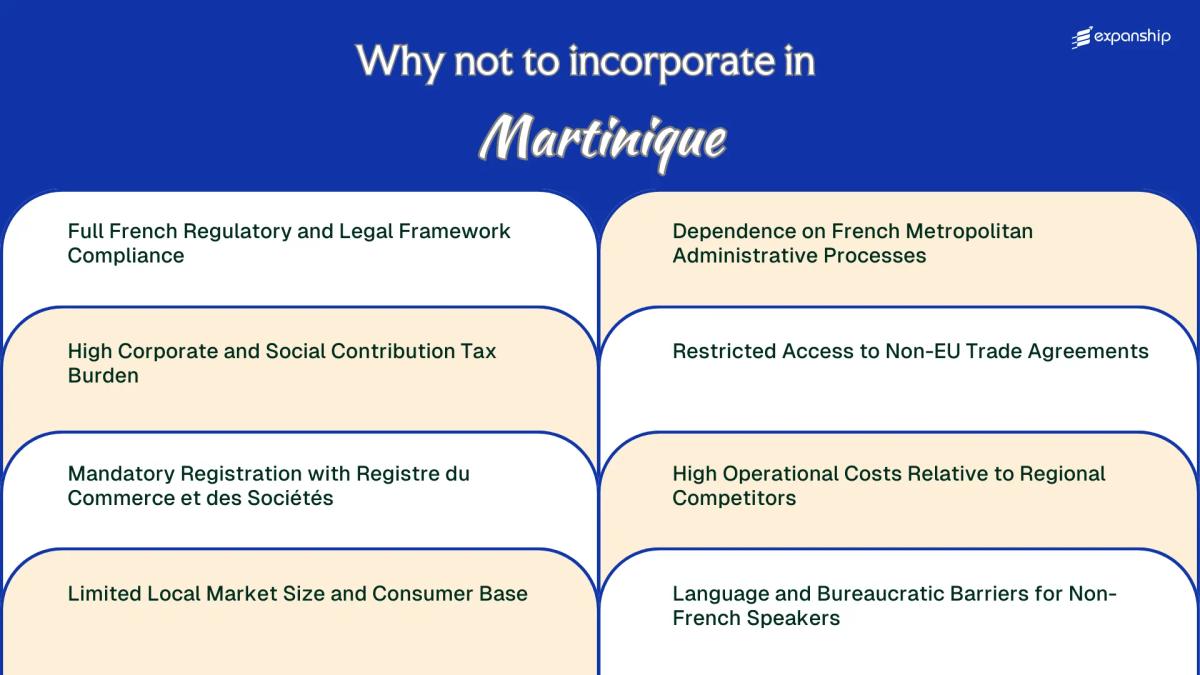
Full French Regulatory and Legal Framework Compliance
The French regulatory compliance burden Martinique businesses face is not a local construct — it is the full weight of French metropolitan law applied without structural simplification. As an overseas region of France under Article 73 of the French Constitution, the jurisdiction operates under the same legal architecture as mainland France, including the Code de commerce, the Code du travail, and EU regulatory instruments.
Scope of Legal Obligations Under French Law
French commercial law requires companies to comply with reporting obligations, governance standards, and consumer protection rules identical to those enforced in Paris or Lyon. For a foreign business owner unfamiliar with French civil law traditions, engaging local legal counsel is not optional — it is a structural necessity that adds fixed operating costs before revenue is generated.
EU regulatory requirements apply in full, including GDPR under Regulation (EU) 2016/679 and sector-specific directives. A firm operating in financial services or food production faces the same compliance architecture as a business incorporated in Frankfurt.
Administrative Burden on Foreign Entities
The Autorité des marchés financiers, the DGCCRF, and sector-specific regulators all extend their jurisdiction here. Each layer of oversight adds reporting cycles, audit exposure, and potential administrative sanctions calibrated to French enforcement standards.
Martinique French legal framework restrictions offer no simplified pathway for foreign-owned SMEs — exemptions available in some offshore jurisdictions do not exist here.
Your compliance obligations are set in Paris and Brussels, not Fort-de-France — meaning regulatory costs, timelines, and penalties mirror those faced by businesses operating in continental France.
High Corporate and Social Contribution Tax Burden
The high corporate tax burden in Martinique stems directly from its status as a French overseas department, where mainland French fiscal law applies in full. Corporate income is taxed at the standard French rate — 25% for most entities — which significantly exceeds what comparable Caribbean and Latin American jurisdictions charge.
Beyond corporate income tax, social contribution charges represent a substantial secondary cost. Employer cotisations sociales in Martinique cover health insurance, pension contributions, unemployment insurance, and family allowances, collectively pushing total employer labor costs well above the base salary figure.
For a foreign business owner, these charges create friction at multiple operational levels:
- Hiring even a small local team triggers mandatory employer contribution obligations that can add roughly 40-45% on top of gross wages, compressing margins from the outset.
- Foreign firms unaccustomed to French payroll declarations face penalty exposure under URSSAF enforcement if filings are late or misclassified.
- Dividend distributions from a French-registered entity remain subject to French withholding tax rules, reducing net repatriation for non-resident shareholders.
- The taxe sur les salaires can apply to entities not subject to VAT, creating an additional payroll-linked levy that many foreign operators do not anticipate.
Some partial exemptions exist under the LODEOM framework for businesses in specific sectors, but these apply narrowly and require formal qualification.

Company Incorporation in Martinique
Understand the full tax and contribution obligations before registering your business in Martinique.
Mandatory Registration with Registre du Commerce et des Sociétés
Registre du Commerce Martinique limitations begin before your business earns its first euro. Every commercial entity operating on the island must register with the Registre du Commerce et des Sociétés (RCS), administered through the Tribunal de Commerce de Martinique. This obligation is non-negotiable under French commercial law, and failure to complete it before commencing activity exposes the firm to trading sanctions and potential personal liability for its directors.
Registration itself requires submitting a dossier through the Centre de Formalités des Entreprises (CFE), which coordinates across multiple French administrative bodies simultaneously. For a foreign director unfamiliar with French procedural norms, assembling certified and apostilled documents from their home country adds both time and cost before the business is legally operational.
| Requirement | Detail | Burden for Foreign Applicants |
|---|---|---|
| Document certification | All foreign documents must be apostilled or legalized | Adds weeks to preparation time |
| Language requirement | All filings must be in French | Translation costs apply to every document |
| Director identity file | Certified ID, proof of address, criminal record extract | Each item requires official certification |
| Legal notice publication | Mandatory in a Journal d'Annonces Légales | Additional administrative fee, non-waivable |
| CFE coordination | Dossier routes through multiple agencies | Delays compound when agencies request corrections |
Publication of a legal notice in a Journal d'Annonces Légales is compulsory under French law, adding a fixed cost that applies regardless of company size or structure. There is no minimum turnover threshold below which this obligation disappears, meaning a small foreign-owned entity bears the same procedural burden as a large corporation.
Limited Local Market Size and Consumer Base
Martinique's small market size drawbacks are felt immediately when you examine the population figures. The island has roughly 350,000 residents, a figure that places a structural ceiling on domestic revenue potential for any incorporated entity.
Consumer purchasing power is concentrated in a narrow segment of the population, and the local economy depends heavily on imports and public sector employment. A foreign firm expecting to scale primarily through local sales will encounter hard volume limits that no commercial strategy can easily offset.
The geography compounds this. Martinique covers approximately 1,128 square kilometres, meaning distribution costs and logistics expenses are spread across a market too small to generate the economies of scale that justify them in larger territories. This makes unit economics difficult for most product-based businesses.
The INSEE economic data for the island confirms that GDP and household consumption figures remain significantly below metropolitan French averages, reflecting the limited consumer base Martinique businesses must operate within.
Key conditions this market size imposes on your business:
- Revenue projections must account for a domestic addressable market capped at approximately 350,000 consumers
- Sectoral saturation occurs faster than in larger economies, restricting entry for late-moving competitors
- B2C models face legally unrestricted but commercially constrained growth due to population density limits
- Export dependency becomes structurally necessary to achieve viable turnover thresholds
- Any firm subject to minimum activity thresholds under French commercial law must factor local demand constraints into its compliance planning
Despite being classified as a French outermost region under EU law, Martinique's local consumer market is smaller than several non-EU Caribbean island economies with which it cannot freely negotiate bilateral trade terms.
Dependence on French Metropolitan Administrative Processes
Martinique French administrative dependency risks stem from the island's status as a French overseas department (DOM), which means your business operates under direct metropolitan governance rather than any autonomous local regulatory authority.
Structural Dependence on Paris-Based Administration
Decisions affecting commercial registration, regulatory approvals, and public procurement often require coordination with or validation from metropolitan French ministries and agencies, not local bodies alone. For a foreign-incorporated entity operating in Martinique, this creates an additional layer of bureaucratic distance that extends processing timelines beyond what comparable Caribbean jurisdictions require.
The Préfecture de la Martinique serves as the primary administrative authority on the ground, but its decisions on numerous commercial and regulatory matters remain subject to metropolitan oversight frameworks. Dependence on Paris-based processes means that administrative delays originating outside Martinique are outside your firm's ability to anticipate or resolve locally.
Practical Consequences for Foreign Business Operations
Regulatory changes, policy updates, and administrative procedures follow the French metropolitan legislative calendar, which your business has no mechanism to influence. This leaves foreign-owned entities exposed to operational disruptions driven by administrative reforms conceived entirely outside the local commercial context.
Businesses that require swift regulatory responses, such as those in logistics or financial services, face structural disadvantages compared to entities incorporated in jurisdictions with autonomous decision-making frameworks.
Managing Administrative Dependency in Martinique
Understand how metropolitan France's administrative processes affect your business operations in Martinique and how to plan accordingly.
Restricted Access to Non-EU Trade Agreements
As an EU outermost region under Article 349 of the Treaty on the Functioning of the European Union, Martinique non-EU trade agreement restrictions directly limit the trading relationships your business can pursue. The territory applies EU customs rules and trade policy, which means preferential agreements that neighbouring Caribbean states have negotiated independently are not available to entities incorporated here.
- CARICOM membership is closed to Martinique-based companies, blocking access to the preferential tariff schedules and reduced trade barriers that apply across most of the Caribbean basin.
- Bilateral free trade agreements concluded directly by independent Caribbean nations, such as those between individual OECS members and third countries, do not extend to firms operating under French territorial jurisdiction.
- EU trade agreements may exclude or apply modified terms to outermost regions, meaning your entity cannot assume full coverage under deals the EU has signed with major trading partners.
- This structural position creates a commercial disadvantage relative to competitors incorporated in nearby jurisdictions with autonomous trade policy.
High Operational Costs Relative to Regional Competitors
High operational costs for Martinique businesses stem directly from the territory's alignment with French metropolitan wage and labor standards. The SMIC (salaire minimum interprofessionnel de croissance), France's statutory minimum wage, applies in full, which as of 2024 stands at approximately €11.65 per hour gross — significantly above minimum wage levels in neighboring islands such as Barbados, Saint Lucia, or the Dominican Republic.
Employer social contributions under the French social security system compound this further. Employer charges can represent 40–45% of gross salary on top of base wages, a burden that companies operating in lower-contribution Caribbean jurisdictions do not face.
Commercial real estate and utilities in Martinique also reflect metropolitan French pricing structures rather than regional Caribbean norms, driven partly by import dependency and freight costs from mainland France.
- Imported materials and equipment carry logistics surcharges that domestic-market peers in continental Europe do not face
- Energy costs remain above the EU average due to the island's reliance on thermal power generation
Hypothetical scenario: A small firm with five full-time employees at minimum wage would incur approximately €95,000–€100,000 annually in total employment costs (gross salary plus employer contributions), compared to an estimated €40,000–€50,000 for an equivalent team in a comparable non-EU Caribbean jurisdiction.
Language and Bureaucratic Barriers for Non-French Speakers
Language barriers incorporating in Martinique begin at registration. All filings with the Registre du Commerce et des Sociétés, the tribunal judiciaire, and the Centre de Formalités des Entreprises must be submitted in French. There are no official provisions for bilingual documentation.
Contracts, corporate bylaws (statuts), and correspondence with public bodies must meet French legal drafting standards. A translation that is technically accurate but does not conform to French legal terminology can result in rejected filings or requests for clarification that delay registration by weeks.
Ongoing compliance compounds this burden. Annual filings, tax declarations submitted to the Direction Générale des Finances Publiques, and any social contribution reporting to URSSAF all require French-language submissions prepared to metropolitan French administrative standards.
For foreign directors without French proficiency, every administrative interaction requires a qualified intermediary. That dependency is not occasional; it is structural, and it introduces both recurring cost and operational delay into routine compliance cycles.
- All official correspondence with public agencies must be in French
- Legal documents not conforming to French drafting standards face rejection
- No official provisions exist for English or multilingual administrative processes
If your appointed legal representative or local agent lacks fluency in formal administrative French, filings submitted to any public body in Martinique carry a material risk of rejection regardless of their substantive accuracy.
Overcoming Incorporation Challenges in Martinique
Overcoming Martinique incorporation challenges begins with understanding that the jurisdiction's French legal architecture is not optional or negotiable — it is the operating baseline for every registered entity.
- Register your company through the Centre de Formalités des Entreprises to consolidate your Registre du Commerce et des Sociétés filing obligations into a single administrative process.
- Elect a corporate structure, such as the SARL or SAS, that aligns with your projected social contribution liability under French labour and social security regulations.
- Apply for applicable fiscal incentives under the Girardin law framework to offset the elevated tax burden associated with overseas department status.
- Engage a certified comptable accredited under French professional standards to manage URSSAF declarations and ensure ongoing tax compliance.
- Assess whether your target markets extend beyond the Caribbean single market, given restrictions on non-EU trade agreement access that affect the firm's export strategy.
Mitigating risks of company formation in Martinique requires working within the Code de Commerce and French administrative law, not around them. The structural solutions above address documented friction points but do not eliminate the underlying regulatory obligations each foreign business assumes upon incorporation.
Martinique's Investment Potential Assessed
Martinique presents a credible incorporation destination for foreign businesses with the right operational profile, particularly those seeking EU market access through an outermost region with French legal certainty. The Martinique investment risks and limitations covered in this blog are structural rather than incidental, rooted in the jurisdiction's constitutional position within France and the European Union.
| Pros | Cons |
|---|---|
| Full access to EU single market and EU legal protections under French law | Corporate and social contribution tax burden is high relative to Caribbean competitors |
| Registre du Commerce et des Sociétés provides a formal, legally recognized registration framework | RCS registration processes depend on metropolitan French administrative timelines |
| French regulatory framework offers legal predictability and investor protection | Compliance with French metropolitan law adds significant regulatory overhead |
| Outermost region status provides access to EU structural funds and specific aid schemes | Non-EU trade agreements do not apply, restricting preferential access to third-country markets |
| Euro-denominated economy reduces currency risk for European investors | Operational costs, including labor and logistics, exceed those of neighboring jurisdictions |
| French-language legal infrastructure is well-established | Non-French-speaking business owners face material language and bureaucratic barriers |
The local consumer base remains small, and domestic demand alone cannot sustain most foreign business models targeting scale. Structural dependencies on Paris-based administrative processes add procedural friction that has no equivalent in independent Caribbean jurisdictions.
Compliance Services for Companies in Martinique
Maintaining good standing under French and EU regulatory requirements demands ongoing attention to filing deadlines, tax obligations, and administrative procedures specific to Martinique.
Conclusion
The drawbacks of incorporating in Martinique are structural rather than incidental. As an outermost region of the EU under French territorial law, the entity you register here operates within one of the more demanding regulatory environments in the Caribbean, shaped by the Code de commerce, French social contribution obligations, and metropolitan administrative processes that add friction at every stage. The limited consumer base and restricted access to non-EU trade frameworks remain the most consequential constraints for firms targeting regional growth. Professional guidance through the applicable French and EU compliance requirements will determine whether your structure functions as intended from day one.
Expanship's Role in Your Martinique Expansion
Martinique company formation challenges support begins with understanding what those challenges actually are before you commit resources. Expanship works with businesses handling the specific obligations covered in this blog, from RCS registration through the CFE to ongoing compliance with French corporate law as it applies in this overseas department. Our role is to reduce the administrative load these requirements place on your team, not to make them disappear.
Expanship offers a defined scope of corporate services for businesses entering Martinique.
- Your entity's registration documents are prepared and filed correctly with the relevant authorities.
- A registered agent and official office address are provided to meet local requirements.
- Government filings and liaison with regulatory bodies, including the CFE and tax authorities, are handled on your behalf.
- Post-incorporation compliance obligations are monitored and managed on an ongoing basis.
- Banking introductions are facilitated to support your firm's operational setup.
- Tax registration and coordination with local authorities are managed from the outset.
Reach out to Expanship Martinique to discuss your incorporation requirements.
Frequently Asked Questions (FAQ)
Yes, all commercial entities operating in Martinique, including the SARL, SAS, and SA structures, must register with the Registre du Commerce et des Sociétés before conducting business. This requirement is rooted in the French Commercial Code, which applies in full in Martinique as an overseas department of France. There are no exemptions for foreign-owned businesses or small-scale operations.
Non-compliance with French law in Martinique can result in administrative sanctions, fines, forced dissolution, or personal liability for company directors under the French Commercial Code. Because Martinique operates under French metropolitan law rather than a distinct local legal code, enforcement mechanisms are the same as those applied in mainland France. Regulatory gaps are not tolerated, and ignorance of French statutory obligations does not constitute a valid defense before French courts.
Access to the broader Caribbean market from Martinique is structurally limited. As an outermost region of the EU, Martinique is subject to EU trade policy, which means your business cannot benefit from the preferential trade agreements that independent Caribbean states have negotiated with non-EU partners, including the CARICOM-Canada framework discussions and bilateral arrangements with the United States. Expanding beyond the island's population of approximately 350,000 requires deliberate regional market entry strategies that come with additional legal and logistical cost.
Certain filings and approvals require processing through administrative bodies in metropolitan France, which extends timelines beyond what local procedures alone would require. A straightforward incorporation that might take two to four weeks in a jurisdiction with fully autonomous administration can take considerably longer when approvals are routed through Paris-based agencies. The added time compounds when documentation requires certified French translations or apostilles for foreign directors and shareholders.
No. All legal documentation, filings with the Registre du Commerce et des Sociétés, and correspondence with the Direction Générale des Finances Publiques must be conducted in French. There is no statutory provision for English-language submissions. Foreign founders who do not engage a qualified French-speaking legal or administrative representative face a high risk of procedural errors, delays, and potential rejection of filings.
Largely yes. Martinique's wage floor is tied to the French SMIC (salaire minimum interprofessionnel de croissance), which is considerably higher than minimum wage levels in neighboring independent Caribbean nations. Combined with French-mandated employer social charges, the total cost of hiring even a small local workforce is substantially higher than in jurisdictions such as the Dominican Republic or Saint Lucia, where labor regulation is set domestically and at lower thresholds.
Your firm would be bound by EU customs regulations and the EU's Common External Tariff, which restricts how freely you can import goods from non-EU countries or re-export to markets outside EU trade agreements. Martinique's status as an outermost region means it does not benefit from the same customs flexibility as EU overseas territories like Saint-Barthélemy. Any business model relying on triangular trade or free-port advantages would face structural incompatibility with Martinique's regulatory position within the EU single market.
Legal Disclaimer
The information provided in this article is for general informational purposes only and does not constitute legal, tax, or professional advice. While we strive to ensure the accuracy and timeliness of the content, laws and regulations are subject to change, and the application of laws can vary widely based on specific facts and circumstances.
Readers should not act upon this information without seeking professional counsel tailored to their individual situation. Expanship and its authors disclaim any liability for actions taken or not taken based on the content of this article.
For specific advice regarding your business setup, compliance requirements, or any legal matters, please consult with qualified legal and tax professionals in the relevant jurisdiction.