
Key Takeaways
- Companies incorporated in Martinique gain full EU single market access as a matter of legal status, not treaty arrangement, because the territory is an integral part of the French Republic and therefore subject to EU law by default.
- Under French CGI provisions governing outermost regions, qualifying businesses can access a reduced corporate tax rate — the Taux Réduit de l'Impôt sur les Sociétés — that directly lowers the tax burden on eligible operations in ways unavailable to standard Caribbean jurisdictions.
- Registration through the Greffe du Tribunal Mixte de Commerce de Fort-de-France places companies within the French commercial law framework, giving foreign investors regulatory clarity and legal enforceability backed by one of Europe's most developed judicial systems.
- Eligibility for European Structural Funds through Martinique's outermost region designation opens capital access mechanisms — unavailable to any independent Caribbean state — that can materially support infrastructure, workforce development, and sectoral investment.
Martinique is an island territory in the eastern Caribbean that functions as an overseas region and department of France, giving it full political and legal integration with the French Republic and, by extension, the European Union. Companies formed here are subject to French commercial law, administered and registered through the Greffe du Tribunal Mixte de Commerce de Fort-de-France. Foreign investors face no general restrictions on ownership, and the territory operates under an open framework for foreign direct investment consistent with EU principles.
The SARL and SAS structures are the vehicles most commonly used by foreign businesses establishing a presence here. From a tax posture, the jurisdiction applies the standard French territorial tax framework, with certain modifications applicable to outermost regions under EU state aid provisions.
The benefits of incorporating in Martinique are shaped by its dual identity — part Caribbean geography, part European legal and regulatory order. This article examines the specific advantages that Martinique company formation offers to businesses considering this jurisdiction for their international structuring needs.
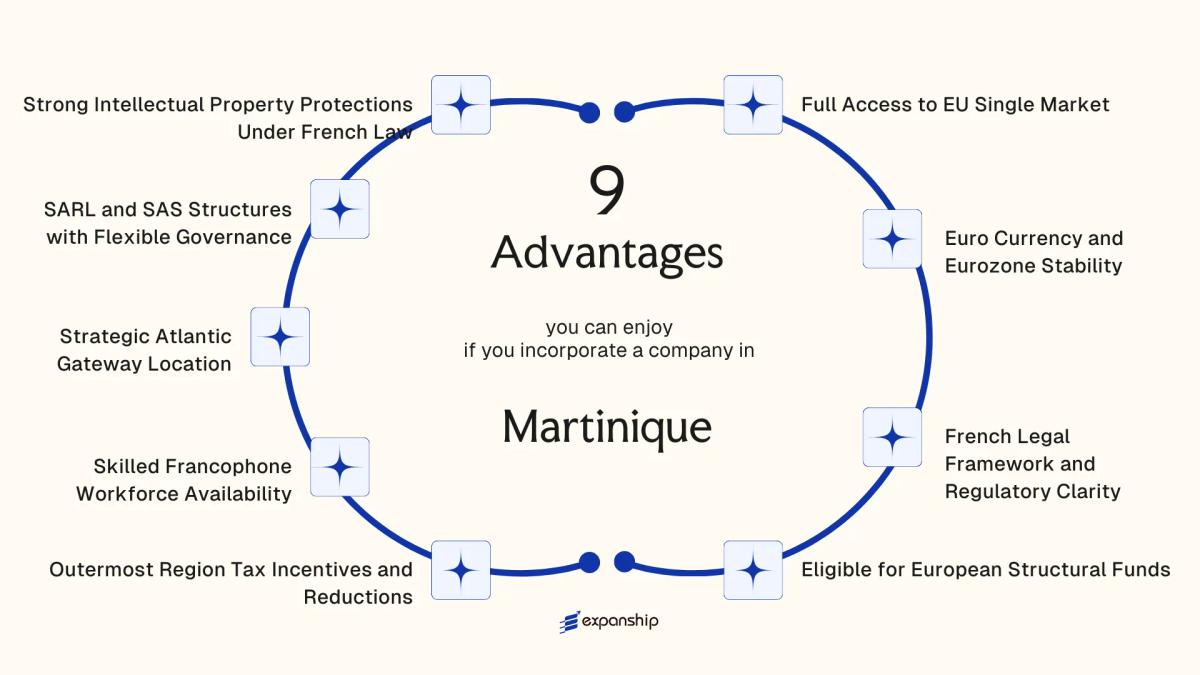
Full Access to EU Single Market
Martinique EU single market access benefits stem from the territory's constitutional status as a French overseas department and, by extension, an outermost region of the European Union under Article 349 of the Treaty on the Functioning of the European Union (TFEU). A company registered here operates within EU territory, not simply in association with it.
What Full Membership Actually Means for Trade
Unlike jurisdictions with preferential trade agreements, your firm in Martinique holds full rights under EU single market rules, meaning goods, services, capital, and persons move freely across all 27 member states without customs barriers. EU regulations, directives, and technical standards apply directly, so your products do not require separate conformity assessments for each national market.
Contractual and Regulatory Standing Across the EU
French commercial law, including the Code de commerce, governs business operations here, and EU directives on financial services, procurement, and digital markets apply without transposition gaps. A contract or license established through your Martinique entity carries the same legal weight as one formed in Paris or Berlin.
Your Martinique entity qualifies as an EU-based company for procurement, contracting, and regulatory purposes across all member states.
Euro Currency and Eurozone Stability
As a French overseas region under Article 349 of the Treaty on the Functioning of the European Union (TFEU), Martinique uses the euro as its official currency. For foreign businesses, this eliminates currency conversion costs and exchange rate exposure when transacting with counterparties across the eurozone's 20 member states.
Operating within a currency union backed by the European Central Bank (ECB) means your firm benefits from monetary policy designed to maintain price stability, targeting inflation at 2% over the medium term. That institutional anchor reduces the kind of currency volatility that can erode profit margins or complicate multi-year financial planning.
Practical advantages this structure offers your business:
- Contracts denominated in euros carry no intra-eurozone conversion risk, simplifying cross-border pricing
- Banking relationships draw on French and EU-regulated institutions subject to ECB oversight
- Financial statements prepared in euros are directly comparable across most EU jurisdictions without restatement
- Access to euro-denominated trade finance aligns with standard EU supplier and buyer expectations
Entities incorporated here transact under the same currency framework as Paris, Frankfurt, or Amsterdam. For investors from dollarized or volatile-currency markets, that consistency in financial infrastructure carries measurable operational value.

Company Incorporation in Martinique
Incorporate your company in Martinique under French law with full eurozone currency access and EU regulatory standing.
French Legal Framework and Regulatory Clarity
Martinique operates under French national law, which means your company is governed by the same legal architecture as a business incorporated in metropolitan France. The French legal framework benefits Martinique business owners by providing a codified, predictable commercial environment rather than a jurisdiction-specific body of rules that may be poorly tested or inconsistently enforced.
The Code de Commerce applies directly, covering company formation, director obligations, shareholder rights, and contractual enforcement. French civil procedure governs dispute resolution, and the Tribunal de Commerce handles commercial litigation. For foreign investors accustomed to common law systems, this means engaging with a highly structured civil law tradition where rights and obligations are explicitly codified rather than derived from case precedent.
| Legal Instrument | Scope of Application |
|---|---|
| Code de Commerce | Company formation, governance, and dissolution |
| Code Civil | Contract law, liability, and property rights |
| Autorité des marchés financiers (AMF) | Financial markets regulation |
| Tribunal de Commerce | Commercial dispute adjudication |
French regulatory oversight extends to Martinique through national agencies, meaning your entity is subject to supervision by institutions with established enforcement records. The Autorité des marchés financiers and the Banque de France operate with the same mandate here as on the mainland. This institutional continuity reduces the compliance uncertainty that can arise in jurisdictions where regulatory bodies are underfunded or have limited enforcement capacity. Compliance obligations are well-documented, and legal counsel familiar with French commercial law anywhere in the EU can advise on your Martinique entity without requiring jurisdiction-specific retraining.
Eligible for European Structural Funds
Martinique European structural funds eligibility gives your business access to a category of EU financing that most Caribbean-based companies cannot touch. As one of the EU's nine Outermost Regions under Article 349 of the Treaty on the Functioning of the European Union (TFEU), the island qualifies for allocations under the European Regional Development Fund (ERDF), known locally as FEDER, and the European Social Fund Plus (ESF+).
These funds are administered through multi-year programming cycles. The current framework runs under the 2021–2027 Cohesion Policy, with the managing authority in Martinique overseeing eligible expenditures. For a foreign investor, this means your locally incorporated entity can apply for co-financing on qualifying infrastructure, innovation, and employment projects, reducing the net capital required to scale operations.
ERDF access in Martinique is specifically designed to offset the structural disadvantages of remote island economies, which means allocation rates and co-financing thresholds tend to be more favorable than those available to mainland French regions.
Keep these points in mind:
- Your entity must be legally registered and operating within the territory
- Projects must align with the thematic objectives defined in the regional operational programme
- Public co-financing from FEDER does not replace private investment; it supplements eligible project costs
- Fund access requires compliance with EU State aid rules under EU regulations
A company incorporated in Martinique can access EU structural funds that are entirely unavailable to businesses registered in neighboring independent Caribbean nations, regardless of their economic ties to Europe.
Outermost Region Tax Incentives and Reductions
Martinique's designation as an Outermost Region (RUP) under Article 349 of the Treaty on the Functioning of the European Union grants it a distinct fiscal standing that mainland EU jurisdictions do not share. This status authorizes derogations from standard EU tax rules, enabling France to apply preferential fiscal measures that directly reduce the tax burden on businesses operating from the territory.
Reduced VAT Rates and Consumption Tax Structure
The standard VAT rate in Martinique is 8.5%, compared to the mainland French rate of 20%. For essential goods and services, a reduced rate of 2.1% applies. This compressed VAT structure lowers operating costs for businesses that sell goods and services locally, since input tax recovery and consumer price sensitivity both improve at lower headline rates.
A separate indirect tax, the Octroi de Mer, applies to goods entering the island, but locally established manufacturers can benefit from exemptions or reductions under Council Decision 2014/940/EU, which was extended under subsequent EU decisions. For eligible producers, this mechanism reduces competitive disadvantage against imported goods.
RECI and Corporate Investment Incentives
Under French tax law, businesses investing in productive assets in Martinique may qualify for the Réduction d'Impôt pour Investissement Outre-Mer (commonly referenced under Article 199 undecies B and related provisions of the Code Général des Impôts). The RECI tax credit for businesses can offset a portion of corporate income tax liability tied to qualifying capital expenditures. Eligibility is conditioned on the nature of the investment, sector classification, and minimum retention periods for the acquired assets.
Maximize Your Tax Position in Martinique
Speak with an Expanship specialist to identify which outermost region fiscal incentives apply to your business structure and investment plans.
Skilled Francophone Workforce Availability
Martinique's skilled Francophone workforce advantages stem directly from its status as a French département, where the education system operates under the same national framework as metropolitan France. The Académie de Martinique oversees primary through secondary education, and graduates enter higher education institutions aligned with French national standards, producing professionals whose qualifications carry full recognition across all EU member states.
- French is the sole official language of business, law, and administration, which eliminates translation layers when coordinating with French or EU-headquartered entities.
- The territory hosts higher education institutions including the Université des Antilles, producing graduates in law, economics, and management trained under French national curricula.
- Professionals hold French-recognized diplomas (diplômes nationaux), meaning their credentials are directly portable and verifiable within the EU without additional certification processes.
- For firms operating in Francophone Africa, the Caribbean Community (CARICOM), or French Overseas Territories, a locally hired team already shares the linguistic and cultural framework those markets require.
- Labor contracts are governed by the French Code du travail as extended to Martinique, so your business operates within a familiar, codified employment law structure rather than an opaque or underdeveloped local regime.
Strategic Atlantic Gateway Location
Martinique's geographic position in the Lesser Antilles places it at a natural crossroads between North America, South America, and Europe. For a firm routing transactions or managing regional operations, this translates into time zone overlap with both the US Eastern seaboard and Western European business hours — a practical operational advantage that purely European entities cannot replicate.
As a French overseas region, the island falls under EU customs territory while sitting physically within the Caribbean basin. A company incorporated here can access Caribbean markets without the regulatory distance that Continental European entities face, while simultaneously maintaining full EU legal standing under French law administered by the Tribunal de Commerce de Fort-de-France.
Atlantic shipping lanes pass through the Eastern Caribbean corridor, and Fort-de-France port connects to major transatlantic freight routes. For businesses in logistics, distribution, or trade facilitation, the physical location reduces transit times between continents compared to routing through Continental European ports.
A European logistics firm routing Caribbean distribution through Fort-de-France rather than Rotterdam could reduce average transatlantic transit time by approximately 3 to 5 days on eastbound Atlantic routes, depending on destination port and carrier schedule — a measurable reduction in lead times for time-sensitive cargo.
SARL and SAS Structures with Flexible Governance
Both the SARL (Société à Responsabilité Limitée) and SAS (Société par Actions Simplifiée) are available in Martinique under French commercial law, specifically the Code de Commerce. The Martinique SARL SAS flexible governance benefits stem from how each structure handles shareholder agreements, management appointments, and profit distribution — all of which can be tailored to suit foreign-controlled entities without requiring a local majority shareholder.
The SAS is particularly relevant for investor-led structures. Its statuts (articles of association) can define custom voting thresholds, restrict share transfers, and establish multi-tier management without requiring board committees mandated by law. This contractual freedom reduces reliance on default statutory rules that might otherwise constrain minority investors or holding structures.
For smaller operations, the SARL offers a familiar limited liability framework with a single gérant (manager) who can be a non-resident. Minimum share capital requirements are nominal, which reduces the upfront structural cost of incorporation.
- SAS allows multiple share categories, useful for venture or joint venture arrangements
- SARL governance defaults are simpler and lower-cost to maintain annually
- Both structures register through the Guadeloupe-based Registre du Commerce et des Sociétés (RCS)
Foreign nationals managing an SAS or SARL may require a titre de séjour autorisant l'exercice d'une activité commerciale if they intend to operate from within French territory.
Strong Intellectual Property Protections Under French Law
French IP protection benefits Martinique business owners in a direct and legally grounded way. As an integral part of France, the territory falls under the full jurisdiction of French intellectual property law, codified in the Code de la Propriété Intellectuelle. This means your trademarks, patents, copyrights, and trade secrets receive the same legal standing as those registered by a firm on the French mainland.
Registration Through INPI
The Institut National de la Propriété Industrielle (INPI) is the French national body responsible for IP registration, and its authority extends fully to entities incorporated in Martinique. A trademark or patent filed through INPI carries national protection across all French territory, including overseas departments. For a foreign business owner, this removes any ambiguity about whether local or reduced-standard rules apply.
EU-Wide IP Coverage
Because France is an EU member state, IP rights registered at the EU level through the European Union Intellectual Property Office (EUIPO) apply automatically to Martinique. A European Union Trade Mark (EUTM) covers all 27 member states under a single filing, which includes protection in this jurisdiction without a separate registration.
Applicable EU regulations include:
- EU Regulation 2017/1001 on the European Union Trade Mark
- EU Directive 2019/790 on copyright and related rights in the Digital Single Market
- The European Patent Convention, through which EPO-granted patents are validated in France
This framework means your IP assets registered through French or EU channels carry enforceable rights across multiple legal systems from a single corporate base.
Why Martinique Stands Out Among Caribbean and EU Jurisdictions
Positioned against other Caribbean incorporation destinations, the Martinique advantages over Caribbean jurisdictions become most apparent when viewed through a regulatory and market-access lens rather than a tax-rate comparison alone. Jurisdictions such as the Cayman Islands or BVI offer low-tax structures with limited operational credibility in EU markets, while Barbados provides a more substantive business environment but without access to the EU Single Market or Eurozone currency stability. Puerto Rico, though a US territory with its own incentive programmes, targets a different investor profile and operates under a distinct legal system.
What distinguishes this territory from its regional peers is the structural combination it offers: French commercial law under the Code de commerce, euro-denominated accounts without currency conversion friction, and EU institutional standing that most Caribbean jurisdictions cannot replicate through treaty arrangements alone. For a business owner evaluating Caribbean EU incorporation benefits across multiple options, the applicable legal certainty and market reach represent structural differences, not just competitive positioning.
| Parameter | Martinique | Cayman Islands | Barbados | Puerto Rico |
|---|---|---|---|---|
| EU Single Market Access | Full (Outermost Region) | No | No | No |
| Currency | Euro (EUR) | Cayman Dollar / USD | Barbadian Dollar (pegged) | USD |
| Legal Framework | French Civil Law (Code de commerce) | English Common Law | English Common Law | US Federal / Civil Law hybrid |
| EU Structural Fund Eligibility | Yes (ERDF, ESF+) | No | No | No |
| IP Protection Standard | French law / EU directives | Domestic only | Domestic only | US federal law |
| Corporate Tax Regime | French system with ORs reductions | 0% (no corporate tax) | 5.5%–25% tiered | 4% (Act 60 qualifying entities) |
| Regulatory Oversight Body | IEDOM, INSEE, CCI Martinique | CIMA | FSC Barbados | OCIF / US federal regulators |
Compliance Services for Companies in Martinique
Maintain good standing with French commercial law obligations, URSSAF filings, and local regulatory requirements for entities incorporated in Martinique.
Conclusion
Martinique's position as an outermost region of the European Union gives foreign businesses something genuinely uncommon: Caribbean geography combined with full EU legal standing, euro-denominated transactions, and access to structural funding mechanisms that most tropical jurisdictions cannot offer. The benefits of incorporating in Martinique rest on this foundational duality, and it is the reason the jurisdiction attracts attention from sectors as different as agro-industry and digital services.
Two advantages carry particular weight. Access to the EU single market removes the barrier of third-country trade status, while the Taux Réduit de l'Impôt sur les Sociétés applicable under French CGI provisions directly reduces the tax burden on qualifying operations. These are not incidental perks; they are structural features embedded in law.
That said, Martinique company formation advantages are most relevant to businesses whose model aligns with the jurisdiction's profile. A firm oriented toward intra-EU commerce, Atlantic trade routes, or Francophone markets will find a stronger fit than one with no operational connection to the region. French regulatory compliance requirements and the administrative language of French also shape day-to-day operations in ways that should inform any incorporation decision.
For businesses where the fit is clear, the next practical step is understanding precisely which entity structure, SAS or SARL, and which incentive regime applies to your specific activity. Getting that determination right from the outset shapes everything that follows.
Start Your Martinique Company Formation With Expanship
Starting your Martinique company formation with Expanship means working with a team that understands the full regulatory picture — from selecting between an SARL and SAS to meeting ongoing compliance obligations set by the Greffe du Tribunal de Commerce de Martinique. The benefits covered in this blog, EU market access, Eurozone monetary stability, French IP protections, and Outermost Region tax incentives, each carry specific filing, structuring, and maintenance requirements that vary by entity type and business activity.
Expanship manages the procedural and administrative side of your incorporation and ongoing compliance:
- Document preparation, notarization, and legalization for French and EU regulatory standards
- Registered agent and registered office provision in Fort-de-France
- Government filings and direct liaison with the Greffe du Tribunal de Commerce
- Post-incorporation compliance management, including annual accounts and statutory reporting
- Banking introduction assistance with locally operating financial institutions
- Coordination of applications for Outermost Region (RUP) incentive programs where eligible
To discuss your structure, timeline, and requirements directly, contact Expanship Martinique.
Frequently Asked Questions (FAQ)
Yes, foreign nationals from outside the European Union can incorporate a company in Martinique, though they must obtain the appropriate administrative authorisation to conduct commercial activity in France. As Martinique is an integral part of the French Republic and classified as an Outermost Region under Article 349 of the Treaty on the Functioning of the European Union, French company law applies in full, meaning the incorporation process follows the same rules as metropolitan France. Depending on your nationality and the nature of the business activity, you may need to secure a titre de séjour with a professional purpose before the entity can be registered with the Registre du Commerce et des Sociétés.
Companies operating in Martinique can access tax reductions available to French Outermost Regions, including provisions under the Girardin scheme, which historically offered investment-based tax relief designed to stimulate economic activity in overseas territories. The general French corporate tax rate applies as the baseline, but specific sectoral investments may qualify for enhanced deductions under the Loi de Finances and related overseas investment legislation. The exact benefit depends on the type of activity, the scale of investment, and whether European State aid thresholds under the EU's Outermost Regions aid framework are met.
Yes, as a recognised Outermost Region, Martinique is eligible for allocations from the European Regional Development Fund and the European Social Fund under cohesion policy. Businesses incorporated and operating locally may qualify for co-financed grant programmes administered through the Conseil Régional de la Martinique and managed in coordination with the European Commission. Eligibility conditions typically include minimum investment thresholds, job creation commitments, and alignment with the regional operational programme priorities for the applicable multiannual financial framework period.
Registration of an SAS or SARL in Martinique typically follows the same administrative timeline as metropolitan France, with incorporation at the Registre du Commerce et des Sociétés generally completed within one to two weeks once all required documents are filed. The actual duration depends on document completeness, notarisation requirements where applicable, and publication of the avis de constitution in a journal d'annonces légales. Delays can occur if capital deposit certificates, identity documents, or the statuts are not in the prescribed form required by the Centre de Formalités des Entreprises.
French law governs all civil and commercial matters in Martinique, and disputes are adjudicated through the French court system, including the Tribunal de Commerce for commercial matters. Intellectual property rights are registered and enforced under the framework administered by the Institut National de la Propriété Industrielle, which applies uniformly across French territory including overseas departments. This means rights holders benefit from the same enforcement mechanisms, appeal structures, and international treaty protections, including those under the TRIPS Agreement and the EU IP Enforcement Directive, as businesses incorporated in mainland France.
For both the SAS and the SARL, French law sets the minimum share capital at one euro, giving founders significant flexibility in structuring their initial capitalisation. That said, practical banking requirements, creditor expectations, and sector-specific licensing conditions may necessitate a higher paid-in capital, particularly in regulated industries such as finance or healthcare. The capital must be deposited with a French bank or notary and held in a blocked account until the Registre du Commerce et des Sociétés issues the Kbis extract confirming the entity's registration.
Martinique's VAT regime differs from that of metropolitan France. The standard French VAT does not apply; instead, a local consumption tax known as the taxe sur le chiffre d'affaires applies at different rates. This means transactions between a Martinique-registered entity and EU member state businesses are generally treated as imports and exports for VAT purposes, rather than intra-community transactions. Businesses planning to trade goods or services with EU counterparts should account for this distinction when modelling their supply chain and invoicing structures, and should verify current applicable rates with the Direction Générale des Finances Publiques.
Legal Disclaimer
The information provided in this article is for general informational purposes only and does not constitute legal, tax, or professional advice. While we strive to ensure the accuracy and timeliness of the content, laws and regulations are subject to change, and the application of laws can vary widely based on specific facts and circumstances.
Readers should not act upon this information without seeking professional counsel tailored to their individual situation. Expanship and its authors disclaim any liability for actions taken or not taken based on the content of this article.
For specific advice regarding your business setup, compliance requirements, or any legal matters, please consult with qualified legal and tax professionals in the relevant jurisdiction.