
Key Takeaways
- Under the CNMI Business Corporation Act, investor protections remain comparatively underdeveloped relative to U.S. mainland incorporation jurisdictions, exposing shareholders to greater structural risk when disputes arise.
- Foreign investors face a constitutionally embedded prohibition on acquiring freehold land in the CNMI, a restriction that materially limits asset-backed business models and long-term capital deployment in the territory.
- Businesses incorporated in the CNMI must satisfy both territorial-level regulatory requirements and the full weight of applicable federal U.S. law, creating a dual compliance burden that increases operational complexity and legal overhead.
- The territory's small resident population, geographic remoteness from major Asia-Pacific trade hubs, and dependence on imported goods compound the logistical costs and market constraints facing any locally operating enterprise.
The Commonwealth of the Northern Mariana Islands operates under a dual regulatory structure, subject to both its own territorial statutes and direct federal U.S. law — a combination that creates layered compliance obligations for any business incorporated there. The CNMI Business Corporation Act governs the formation and conduct of business entities at the territorial level, while federal agencies retain authority over a significant range of commercial activities.
The disadvantages of incorporating in Northern Mariana Islands span regulatory, financial, geographic, and labor-related categories. How severely these affect your business depends on factors such as your industry, intended ownership structure, and whether your operations are locally focused or internationally oriented.
This article is most relevant to foreign investors, offshore holding company operators, and internationally mobile entrepreneurs evaluating CNMI business incorporation drawbacks before committing capital or structure to the territory.
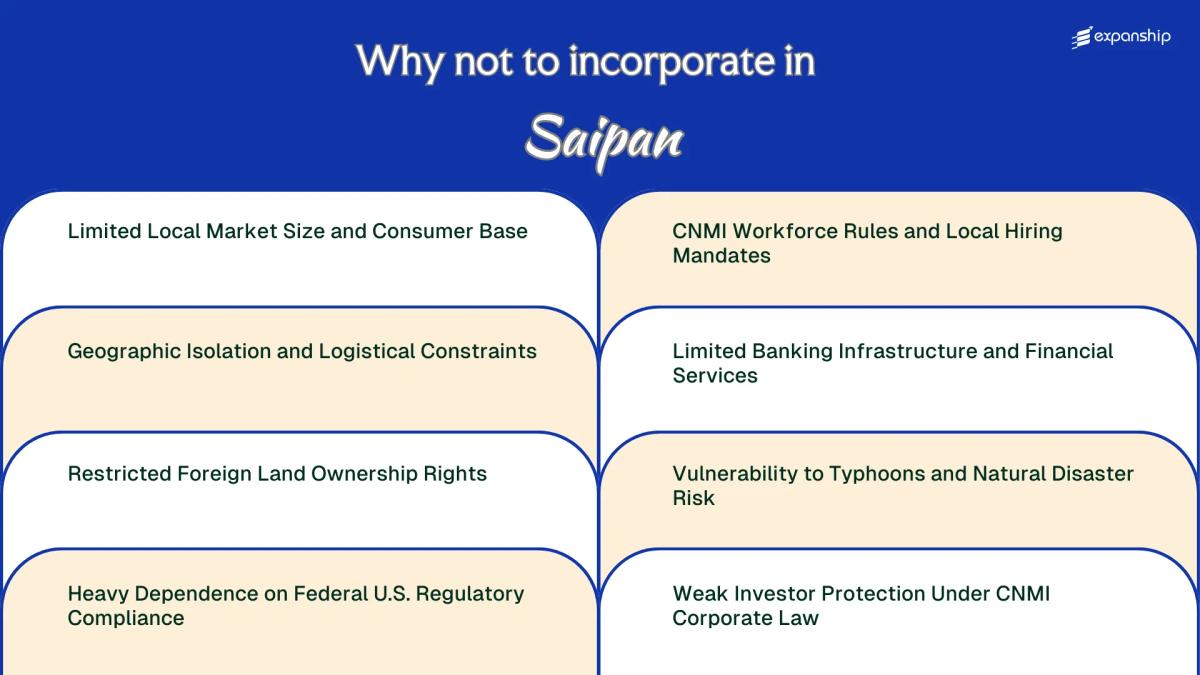
Limited Local Market Size and Consumer Base
Northern Mariana Islands small market limitations present a structural ceiling for any foreign business targeting domestic revenue. With a total population of approximately 47,000 people, the addressable consumer base is among the smallest of any U.S. jurisdiction.
A Consumer Pool Too Thin to Sustain Scale
Most of that population is concentrated on Saipan, with Tinian and Rota holding only a few thousand residents each. For a foreign entity dependent on local sales volume to justify incorporation costs, this geographic fragmentation compounds an already insufficient demand base.
Tourism Dependency Creates Revenue Volatility
CNMI limited consumer base challenges are intensified by the territory's reliance on inbound tourism, primarily from East Asia, which collapsed after 2020 and has not fully recovered. A business model built around visitor spending rather than resident consumption exposes your firm to external demand shocks it cannot control domestically.
Retail, hospitality, and service sectors all face hard unit-economics constraints when the resident market cannot independently sustain operations year-round.
If your business model requires a self-sustaining local customer base, the CNMI's population size makes domestic-only revenue generation structurally unviable for most foreign firms.
Geographic Isolation and Logistical Constraints
CNMI geographic isolation business challenges begin before your company ships its first product. The islands sit roughly 5,750 miles from the U.S. mainland and approximately 1,500 miles from major Asian freight hubs, meaning nearly every material input must travel long distances before reaching Saipan.
Transpacific freight costs are substantially higher per unit than shipping to continental U.S. destinations. For a business that depends on imported goods, equipment, or raw materials, that cost differential compounds across every procurement cycle.
Operating under these remote Pacific island incorporation conditions creates specific operational burdens:
- Procurement lead times stretch significantly, forcing you to hold larger safety stock and tie up working capital in inventory.
- Freight insurance premiums increase with longer transoceanic transit routes, adding a recurring cost that competitors based on the U.S. mainland do not face.
- Equipment repairs requiring specialized parts can stall operations for weeks while shipments clear customs and complete the final leg to Saipan.
- Limited direct air cargo routes reduce your options for expedited delivery, making time-sensitive supply chains difficult to maintain.
Saipan's port infrastructure, managed through the Commonwealth Ports Authority, handles relatively low cargo volumes compared to major Pacific gateways. That limited throughput capacity can cause congestion during peak periods, extending clearance times.

Company Incorporation in the Northern Mariana Islands
Understand the structural requirements and logistical realities before registering a business entity in the CNMI.
Restricted Foreign Land Ownership Rights
Northern Mariana Islands foreign land ownership restrictions are embedded directly in the CNMI Constitution. Article XII limits land ownership to persons of Northern Mariana Islands descent, a classification that excludes virtually all foreign nationals and most U.S. citizens from holding fee simple title to real property.
For a foreign business owner, this means your company cannot own the land on which its office, warehouse, or facility sits. Long-term leases are the only practical alternative, and while lease terms can extend up to 55 years, that arrangement still exposes your business to renegotiation risk, lessor default, and the inability to use land as loan collateral.
| Restriction | Detail | Business Impact |
|---|---|---|
| Ownership eligibility | NMI descent required for fee simple title | Foreign entities categorically excluded from land ownership |
| Maximum lease term | Up to 55 years under CNMI law | Cannot secure perpetual interest; subject to lease expiration |
| Collateral limitation | Leasehold interest not equivalent to freehold | Restricts access to secured real estate financing |
| Constitutional basis | Article XII, CNMI Constitution | Cannot be overridden by corporate structuring or federal law |
Financing a physical operation becomes structurally harder without land title. Lenders typically accept leasehold security at a discount, which limits borrowing capacity relative to what the same asset would support in a freehold jurisdiction.
Article XII applies regardless of how your entity is structured. A CNMI corporation with foreign shareholders carries the same restriction as a directly foreign-owned firm.
Heavy Dependence on Federal U.S. Regulatory Compliance
Because the CNMI is a U.S. commonwealth, CNMI federal regulatory compliance burdens apply in full force to any entity incorporated there. Unlike sovereign offshore jurisdictions, your business is subject to federal statutes administered by agencies such as the IRS, the Department of Labor, OSHA, and the EPA, with no carve-outs based on the territory's size or remote location.
Federal tax law applies to CNMI-incorporated entities on U.S.-source income, and the IRS's mirror code system governs how local and federal tax obligations interact. The practical result is a dual-layer filing obligation that demands familiarity with both CNMI Division of Revenue and Taxation rules and the federal Internal Revenue Code simultaneously.
Environmental, employment, and consumer protection regulations all track federal standards. A small firm operating on Saipan faces the same OSHA record-keeping requirements as a manufacturer in Ohio.
- Federal employment law, including the Fair Labor Standards Act, applies without modification to covered employees.
- OSHA reporting timelines and workplace safety standards are federally mandated.
- The IRS mirror code requires separate analysis of which federal provisions apply directly versus through the CNMI mirror system.
- Federal anti-money laundering obligations under FinCEN apply to qualifying financial activities.
- Northern Mariana Islands federal law obligations do not diminish based on entity size or annual revenue below certain thresholds.
The CNMI's mirror tax code means that CNMI residents and businesses technically pay taxes to the CNMI government rather than directly to the IRS, yet the tax liability is calculated as if the Internal Revenue Code applied word for word.
CNMI Workforce Rules and Local Hiring Mandates
CNMI local hiring mandates create measurable friction for foreign-owned businesses that need to staff up quickly or bring in specialized talent.
The Structure of Local Hiring Requirements
Under CNMI labor law, employers are generally required to demonstrate that no qualified U.S. workers, including CNMI residents, are available before hiring foreign nationals through the federally administered CW-1 guest worker visa program. This requirement forces your business through a mandatory recruitment attestation process, adding time and administrative cost to every foreign hire. The CW-1 program itself operates under annual cap reductions mandated by federal law, meaning the pool of available foreign worker permits shrinks each year.
What This Means for Your Staffing Capacity
Cap reductions place hard ceilings on how many guest workers a firm can employ, regardless of operational need. For businesses in sectors where local labor supply is thin, such as hospitality or construction, this Northern Mariana Islands guest worker program limitation can stall expansion or force reliance on undertrained local hires. CNMI labor law challenges for businesses compound when positions require technical expertise that the resident workforce does not currently hold.
Addressing Workforce Compliance Challenges in the CNMI
Get guidance on understanding local hiring obligations, CW-1 program requirements, and labor law compliance before establishing your entity in the Northern Mariana Islands.
Limited Banking Infrastructure and Financial Services
Northern Mariana Islands banking infrastructure limitations affect foreign businesses from the moment they attempt to open a corporate account. Only a small number of commercial banks operate across the CNMI, with most financial activity concentrated on Saipan.
- The limited number of licensed commercial banks in the CNMI means your business has minimal choice in selecting institutions that offer trade finance, multi-currency accounts, or credit facilities suited to international operations.
- Correspondent banking relationships between CNMI-based banks and major global financial hubs are restricted, which slows cross-border transactions and raises transfer costs for firms with overseas clients or suppliers.
- CNMI financial services drawbacks extend to credit availability, as smaller local banks carry constrained lending capacity that rarely meets the capital requirements of mid-size foreign enterprises.
- Because the islands fall under U.S. federal banking regulation through the Federal Deposit Insurance Corporation and the Office of the Comptroller of the Currency, compliance requirements mirror mainland U.S. standards without the compensating access to mainland banking depth.
- Businesses requiring specialized financial products such as letters of credit or export financing must typically engage institutions based on the U.S. mainland, adding operational friction and cost.
Vulnerability to Typhoons and Natural Disaster Risk
CNMI typhoon risk for businesses is not a peripheral concern — it is a recurring operational reality. The islands sit within the Western Pacific typhoon belt, placing them directly in the path of some of the most destructive storm systems on Earth. Super Typhoon Yutu struck Saipan and Tinian in October 2018 as a Category 5 storm, causing an estimated $3.3 billion in damages and forcing widespread business closures for months.
Physical destruction is only part of the exposure. Infrastructure damage — to ports, roads, and power grids — can suspend your supply chain and cut access to the islands entirely, compounding losses well beyond the storm itself.
Recovery timelines in the CNMI have historically extended over years, not weeks. For a foreign-owned entity without deep local reserves, that gap between disruption and restoration can be structurally fatal.
Insurance costs reflect this risk. Property and business interruption coverage in high-typhoon-exposure zones carries significantly higher premiums than comparable policies in mainland U.S. markets, directly increasing your operating cost baseline.
A foreign-owned retail business on Saipan with $500,000 in assets could realistically face annual property insurance premiums 40–60% higher than equivalent coverage in a low-risk U.S. mainland jurisdiction, with no guarantee of full replacement cost recovery given the limited local contractor pool post-disaster.
Weak Investor Protection Under CNMI Corporate Law
CNMI corporate law investor protection weaknesses stem largely from the territory's thin statutory framework. The Commonwealth Code governs corporate formation and conduct, but it lacks the depth of shareholder protection mechanisms found in major U.S. state statutes like Delaware's General Corporation Law. For foreign investors, this gap translates directly into reduced legal recourse when disputes arise.
Minority shareholders in a CNMI-incorporated entity have limited statutory tools to challenge director decisions or demand transparency. There is no dedicated securities regulator operating at the territorial level with enforcement authority comparable to the SEC's reach in stateside jurisdictions. Your ability to compel disclosure or seek derivative action depends heavily on what your articles of incorporation and bylaws explicitly establish.
Corporate governance defaults under the Commonwealth Code place significant discretion in the hands of directors and majority shareholders. This structure disadvantages minority foreign investors, who may hold equity without meaningful voting leverage or information rights unless those are negotiated contractually at formation.
- No territorial securities enforcement body with independent investigative authority
- Statutory minority shareholder remedies are limited compared to U.S. mainland corporate statutes
- Fiduciary duty litigation must be pursued through the CNMI Superior Court, a venue with a small bench and limited corporate case precedent
If your investment structure relies on minority shareholder protections not explicitly written into the entity's governing documents, the Commonwealth Code's default provisions will likely leave those rights unenforceable.
Overcoming These Incorporation Challenges
Overcoming these incorporation challenges in CNMI requires structural preparation rather than reactive adjustments once problems surface. The disadvantages covered in this blog are not incidental; they are embedded in the jurisdiction's legal architecture and federal overlay.
- Register your entity under the CNMI Corporations Act and confirm your business type is eligible for non-resident foreign national ownership before committing capital.
- Secure a federally chartered or FDIC-insured banking relationship outside CNMI to compensate for the limited local banking infrastructure.
- Obtain a Foreign Investment Certificate through the CNMI Department of Commerce to establish your legal standing on land-use and operational rights.
- Structure your workforce plan in accordance with the federally administered H-2 visa program, which now governs transitional worker admissions in the islands.
- Obtain adequate property and business interruption insurance rated for typhoon exposure given the territory's documented natural disaster frequency.
Mitigation steps operate within a dual-layered system where both CNMI statutory law and applicable federal law set binding constraints. Compliance gaps at either level carry independent legal consequences for your business.
Northern Mariana Islands Still Worth Considering
Asking whether the Northern Mariana Islands is worth incorporating in has no single answer — the jurisdiction carries real structural constraints, but it also offers a set of conditions that remain uncommon among U.S.-affiliated Pacific territories. For a business whose profile aligns with what CNMI can realistically support, those conditions carry weight.
| Pros | Cons |
|---|---|
| CNMI-incorporated entities operate under U.S. federal law, giving them access to federal courts and dollar-denominated banking. | Foreign nationals cannot own land in the CNMI, limiting real estate-dependent business models. |
| The territory's U.S. Commonwealth status allows goods to be labeled "Made in USA" under specific conditions. | The local consumer base is under 50,000 residents, making domestic market revenue negligible for most businesses. |
| No federal income tax is paid to the IRS; taxes are filed with the CNMI Division of Revenue and Taxation instead. | Banking infrastructure is thin, with limited correspondent banking relationships and restricted access to trade finance. |
| Geographic position provides proximity to major Asia-Pacific markets, particularly Japan, South Korea, and China. | Typhoon exposure and seismic activity create recurring operational and insurance cost pressures. |
| Businesses benefit from a U.S.-flag jurisdiction without the full regulatory overhead of incorporation in a U.S. state. | Local hiring mandates and federal workforce compliance rules add administrative complexity for foreign-staffed operations. |
Investor protection under CNMI corporate law remains underdeveloped relative to U.S. state frameworks, and that gap is a genuine consideration for any entity planning to raise capital or structure complex equity arrangements.
Compliance Services for Companies in the Northern Mariana Islands
Stay current with CNMI Division of Revenue and Taxation requirements, annual reporting obligations, and federal compliance mandates applicable to Commonwealth-incorporated entities.
Conclusion
A Northern Mariana Islands incorporation drawbacks summary points to a jurisdiction that carries real structural constraints alongside its U.S. territorial status. Land ownership restrictions under Article XII of the CNMI Constitution, limited banking infrastructure, and federal compliance obligations under U.S. law collectively shape a formation environment that demands careful pre-entry analysis. Your firm's operational model, capital requirements, and staffing approach all factor into whether these constraints are manageable. Specialist guidance on CNMI regulatory requirements remains a practical necessity for any entity planning a serious presence here.
Expanship's Services for Your CNMI Expansion
Incorporating in the CNMI involves a specific combination of federal oversight, territorial corporate law, and local workforce requirements that most businesses underestimate before they begin. Expanship CNMI company formation services are designed to reduce the operational burden of working across those layers — from preparing documents that satisfy both CNMI DCCA requirements and applicable federal standards, to handling the ongoing compliance obligations that follow registration.
Our Northern Mariana Islands business setup assistance covers the full formation-to-compliance cycle:
- We prepare and file your company registration documents with the relevant CNMI authorities.
- A registered agent and local office address are provided to meet territorial requirements.
- We liaise directly with government bodies, including the DCCA, on your behalf.
- Post-incorporation compliance obligations are managed on an ongoing basis.
- Banking introduction support is available to help your entity establish a functional account.
- We handle tax registration and coordinate with local authorities as required.
Reach out to Expanship Northern Mariana Islands to discuss how we can support your formation process.
Frequently Asked Questions (FAQ)
Federal law applies broadly across all incorporated entities in the CNMI, not just specific sectors. Because the CNMI is a U.S. territory, your business is subject to federal agencies including the IRS, the U.S. Department of Labor, and OSHA, regardless of the industry you operate in. The Covenant to Establish a Commonwealth, which governs the CNMI's relationship with the United States, brought most federal statutes into effect there over time.
Violations of local workforce requirements can result in fines, permit revocations, and restrictions on your ability to renew nonresident worker permits under CNMI and federal guest worker rules. The U.S. Citizenship and Immigration Services administers the CW-1 nonimmigrant visa program, which replaced the CNMI's former local permit system, and non-compliance can affect your firm's standing under that program. Repeated violations may jeopardize your entity's operating licenses issued through the CNMI Department of Commerce.
Yes, meaningfully so. The CNMI Business Corporation Act provides a thinner statutory framework compared to Delaware's General Corporation Law, which offers decades of case law, well-defined fiduciary standards, and predictable judicial outcomes for shareholders and directors. Foreign investors accustomed to Delaware or Wyoming protections will find less legal precedent and fewer shareholder remedy mechanisms available under CNMI law.
The cost can be substantial. Typhoon Yutu in 2018 caused an estimated $3.3 billion in damage across Saipan and Tinian, which effectively shut down commercial operations for extended periods and disrupted supply chains for months. Beyond physical damage, your business faces recurring insurance premiums for typhoon coverage, potential gaps in business interruption policies, and rebuilding timelines that can run well past a year depending on construction material supply constraints.
Your business will need to rely on a limited pool of financial institutions, which currently includes a small number of commercial banks operating on Saipan. Restricted access to trade finance, foreign currency accounts, and credit facilities can constrain working capital and delay payments to international suppliers or partners. This is a recognized structural gap that disproportionately affects companies with high transaction volumes or cross-border payment needs.
For a business with no genuine operational footprint in the CNMI, the risks shift rather than decrease. Federal tax rules, including IRS reporting obligations, still apply, and a lack of local substance can raise questions about whether your entity meets the requirements for any territory-specific tax positions. The CNMI Department of Revenue and Taxation may also scrutinize registrations where economic activity occurs entirely outside the islands.
Not entirely. If your entity employs any workers physically present in the CNMI, local hiring preference rules and the federal CW-1 program requirements apply to those positions. A fully remote operation with no CNMI-based staff reduces exposure to these rules, but your registration still subjects the firm to CNMI business licensing conditions, which the Department of Commerce enforces and which may carry their own local compliance conditions depending on your business activity classification.
Legal Disclaimer
The information provided in this article is for general informational purposes only and does not constitute legal, tax, or professional advice. While we strive to ensure the accuracy and timeliness of the content, laws and regulations are subject to change, and the application of laws can vary widely based on specific facts and circumstances.
Readers should not act upon this information without seeking professional counsel tailored to their individual situation. Expanship and its authors disclaim any liability for actions taken or not taken based on the content of this article.
For specific advice regarding your business setup, compliance requirements, or any legal matters, please consult with qualified legal and tax professionals in the relevant jurisdiction.