

Key Takeaways
- Entities incorporated in the CNMI benefit from a reduced income tax framework administered under Title 4 of the Commonwealth Code, keeping local tax obligations structurally below standard U.S. onshore rates while retaining access to federal legal protections.
- Because the CNMI operates within U.S. banking and court systems, foreign-owned companies gain institutional credibility that purely offshore jurisdictions in the Caribbean or Pacific cannot replicate.
- Oversight of business licensing and entity formation by the CNMI Department of Commerce means investors work within a federally anchored regulatory environment that supports foreign ownership across most sectors.
- Geographic positioning in the western Pacific places CNMI-registered businesses within practical operational reach of Japan, South Korea, and China — a time zone and logistics advantage that Atlantic and Caribbean incorporation destinations are structurally unable to offer.
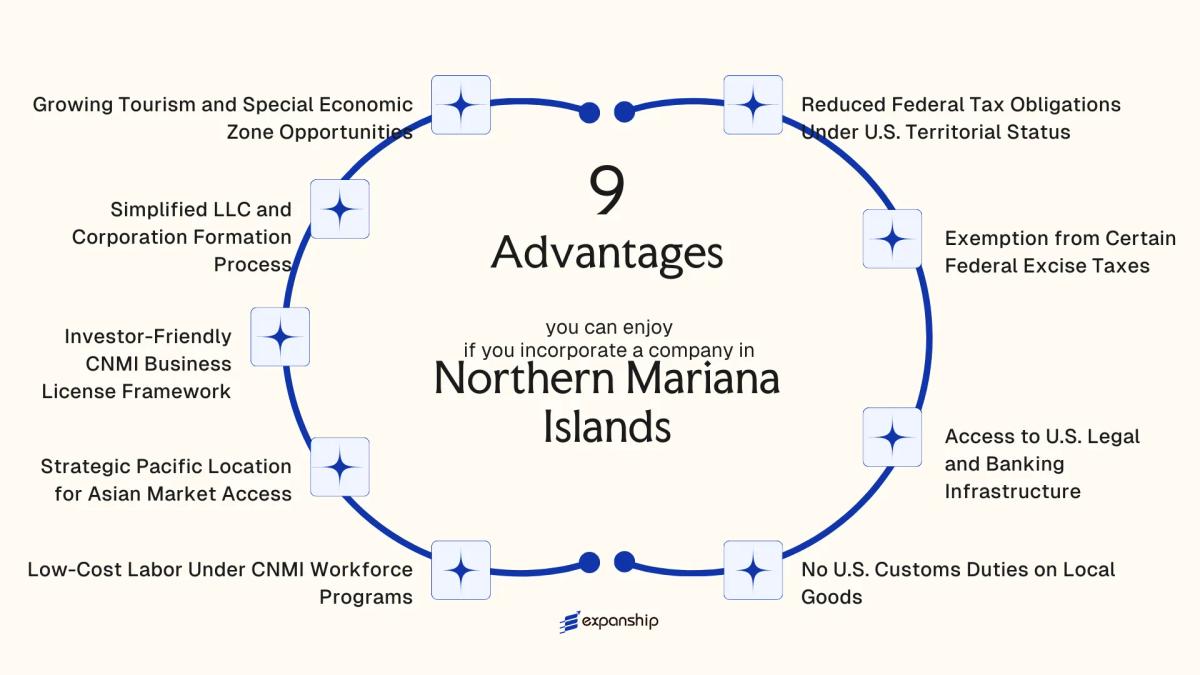
The Commonwealth of the Northern Mariana Islands (CNMI) is a U.S. territory located in the western Pacific Ocean, operating under a unique political arrangement that grants it a degree of legislative autonomy while keeping it under the U.S. constitutional framework. For businesses evaluating the benefits of incorporating in Northern Mariana Islands, this status shapes almost every aspect of the regulatory and fiscal environment.
Company registration falls under the oversight of the CNMI Department of Commerce, which administers business licensing and entity formation on the islands. Foreign investors most commonly establish operations through a Limited Liability Company. The territory applies a low-tax posture, with its own local tax code operating separately from the U.S. Internal Revenue Code in several respects.
Foreign ownership is broadly permitted across most sectors, and the CNMI government has historically maintained an open stance toward foreign direct investment. This article examines the key advantages that make CNMI company formation a structurally distinct option for international businesses.
Reduced Federal Tax Obligations Under U.S. Territorial Status
The Northern Mariana Islands operates under a unique tax arrangement that separates it from both U.S. states and conventional offshore jurisdictions. Under the Covenant to Establish a Commonwealth (Public Law 94-241), CNMI residents and qualifying businesses pay taxes to the local government rather than directly to the U.S. federal government.
The Mirror Tax System and What It Means for Your Entity
CNMI administers its own income tax regime modeled on the U.S. Internal Revenue Code, but collected locally by the CNMI Division of Revenue and Taxation. This means a qualifying business incorporated in the territory is generally not subject to direct federal income tax filing obligations to the IRS in the way a U.S. domestic corporation would be.
For foreign investors, this distinction has real financial weight. Tax liability flows to CNMI authorities rather than the U.S. Treasury, and local rates have historically been set at levels more favorable than standard U.S. federal corporate tax rates.
Qualification Conditions That Govern This Benefit
The tax separation benefit applies specifically to income derived from CNMI sources. Income generated outside the territory may trigger different treatment under U.S. tax rules, so the source of revenue matters when assessing overall exposure.
Corporate income tied to CNMI operations is taxed locally under territorial rules, not at the standard U.S. federal corporate rate of 21%.
Exemption from Certain Federal Excise Taxes
Under U.S. federal law, territories are generally subject to Internal Revenue Code provisions, but certain excise taxes that apply to the 50 states do not extend to the CNMI. This structural carve-out is one of the more concrete CNMI federal excise tax exemption advantages available to businesses operating from the islands.
Specifically, goods produced in and consumed within the territory can fall outside the scope of federal excise tax obligations that would otherwise apply to equivalent activity conducted on the U.S. mainland. For businesses in manufacturing, distribution, or product-based industries, this translates to a measurable reduction in tax cost at the point of production or sale.
The basis for this treatment lies in the Covenant to Establish a Commonwealth, which governs the tax relationship between the CNMI and the federal government. Under the Covenant, certain federal tax provisions apply to the territory selectively rather than automatically.
Why this matters in practical terms:
- Federal excise categories that apply automatically in the 50 states require explicit extension to apply in the CNMI, meaning your firm is not presumed liable by default
- Locally consumed goods may avoid excise layers that would otherwise stack costs in a mainland-equivalent operation
- The territorial tax relationship creates a defined statutory boundary, giving your business a predictable compliance baseline rather than an ambiguous one
Eligibility for these exclusions generally depends on where goods are produced and consumed, so businesses with cross-territory distribution should assess the scope carefully.

Company Incorporation in the Northern Mariana Islands
Set up your CNMI-registered company with full compliance support, from entity selection through to license filing.
Access to U.S. Legal and Banking Infrastructure
Businesses incorporated in the CNMI benefit from Northern Mariana Islands US banking infrastructure access in a way that no purely offshore jurisdiction can replicate. Because the Commonwealth operates under U.S. sovereignty, companies formed here can open accounts with U.S.-chartered banks, access the Federal Reserve payment system, and transact in U.S. dollars without the correspondent banking friction that typically affects foreign entities trying to reach American financial networks.
| Infrastructure Element | Applicable to CNMI Entities | Governing Framework |
|---|---|---|
| U.S.-chartered bank accounts | Yes | U.S. federal banking law |
| Federal court jurisdiction | Yes | 48 U.S.C. § 1801 et seq. (Covenant) |
| UCC commercial law applicability | Yes | CNMI Title 5 Commercial Code |
| U.S. dollar as official currency | Yes | U.S. monetary law |
The 1976 Covenant to Establish a Commonwealth, codified in part under 48 U.S.C. § 1801, extended U.S. federal court jurisdiction to the territory. For a foreign investor, this means commercial disputes involving your entity can be adjudicated under a U.S. federal legal framework, which carries substantially more international enforceability than judgments issued by courts in most small-island jurisdictions.
The CNMI also adopted a version of the Uniform Commercial Code, giving your contracts and secured transactions a legal structure that counterparties in the United States and internationally recognize. That familiarity reduces due diligence burden for U.S. partners and lenders when evaluating your firm.
No U.S. Customs Duties on Local Goods
CNMI no customs duties on local goods is one of the more operationally significant advantages the territory offers. Under the Covenant to Establish a Commonwealth of the Northern Mariana Islands (Public Law 94-241), goods produced in the CNMI and shipped to the U.S. mainland enter duty-free, provided they meet applicable origin requirements. For a manufacturing or export-oriented business, that removes a cost layer that competitors operating from foreign jurisdictions must absorb.
The duty-free treatment applies specifically to goods of CNMI origin, meaning the product must meet the substantial transformation or value-added threshold under U.S. customs rules. Finished goods that simply pass through without sufficient local processing do not qualify.
Keep these points in mind:
- Goods must originate in the CNMI, not merely transit through
- Applicable rules of origin are administered by U.S. Customs and Border Protection
- The duty exemption applies to shipments into U.S. customs territory, not to imports into the CNMI from foreign countries
- Products with components sourced from outside the U.S. or CNMI may face additional scrutiny under origin determination rules
For businesses in light manufacturing, food processing, or apparel production targeting the U.S. market, the Northern Mariana Islands duty-free trade advantage reduces landed cost and pricing pressure relative to offshore manufacturing hubs subject to standard U.S. tariff schedules.
The CNMI's duty-free access to the U.S. market coexists with its own separate customs zone, meaning goods imported into the CNMI from foreign countries are not automatically subject to U.S. tariff rates.
Low-Cost Labor Under CNMI Workforce Programs
CNMI workforce program labor cost advantages give foreign businesses access to a labor pool that operates outside the standard U.S. federal minimum wage floor. Under the Consolidated Natural Resources Act of 2008 (CNRA), Congress assumed control over CNMI immigration but maintained a separate wage schedule, allowing minimum wage rates to be phased up incrementally rather than immediately matching the federal rate. That gap, while narrowing, still translates into measurable payroll savings for labor-intensive operations.
Guest Worker Provisions and What They Mean for Payroll
The CNMI-Only Transitional Worker (CW-1) visa program, administered by U.S. Citizenship and Immigration Services, permits employers to hire foreign nationals for positions that cannot be filled by the local U.S. workforce. This is a federally authorized pathway, not a informal arrangement, which means your business can plan headcount around it with legal certainty. For sectors such as hospitality, construction, and light manufacturing, the ability to source workers through a structured federal program directly reduces the cost and uncertainty of recruitment.
Workforce Availability in a Small Market
The total labor market in the CNMI is small by any measure, and the CW-1 program compensates for that constraint by expanding the available talent pool beyond the resident population. Employers filing CW-1 petitions must comply with USCIS prevailing wage requirements and annual numerical caps, so the program carries conditions that require forward planning. Within those parameters, however, a foreign-owned company can staff operations at wage levels that remain below comparable costs in Hawaii or Guam.
Plan Your CNMI Workforce Strategy
Get guidance on CW-1 compliance, wage requirements, and how to structure your CNMI entity to take full advantage of available workforce programs.
Strategic Pacific Location for Asian Market Access
Situated roughly 3,800 kilometers from Tokyo, 2,800 kilometers from Manila, and within a five-hour flight radius of major Northeast Asian financial centers, the Northern Mariana Islands Pacific location Asian market access combination is a structural advantage, not a marketing claim. Your firm is physically closer to Osaka, Seoul, and Taipei than to Los Angeles, which directly reduces freight transit times, travel costs for executive meetings, and logistical complexity for Asia-facing operations.
- The CNMI sits within the same time zones used by major Asian trading partners, meaning your business can conduct real-time transactions and communications during standard Asian business hours without the overnight gap that affects U.S. mainland entities.
- Operating under U.S. legal jurisdiction gives your firm contractual credibility with Japanese, Korean, and Chinese counterparties who treat U.S.-incorporated entities differently from pure offshore vehicles registered in smaller Pacific jurisdictions.
- Saipan's Francisco C. Ada/Saipan International Airport maintains direct air connections to Asian cities, reducing the operational friction of relocating personnel or meeting clients in-region.
- Proximity to the Asia-Pacific region means goods manufactured or processed in the CNMI can reach Asian markets faster than goods shipped from U.S. mainland ports, which carries direct cost implications for businesses with physical inventory.
Investor-Friendly CNMI Business License Framework
The CNMI investor-friendly business license advantages begin at the regulatory entry point. The Division of Revenue and Taxation, operating under the CNMI Department of Finance, administers business licensing through a centralized process. Foreign nationals can obtain a business license without requiring a local partner or resident shareholder, which removes a structural barrier common in other Pacific jurisdictions.
Licensing categories are activity-based, meaning your firm pays only for the license tier that corresponds to its actual operations. This prevents the blanket fee structures that inflate compliance costs in jurisdictions with undifferentiated licensing schedules.
The CNMI Business License Act governs the issuance, renewal, and classification of commercial permits. Licenses are renewed annually, and renewal fees are calculated on a fixed schedule rather than as a percentage of revenue, so your compliance costs remain predictable regardless of business growth.
A foreign-owned trading company licensed in the CNMI at a flat annual business license fee of approximately $300 to $500 retains full cost certainty on its licensing obligations year over year, compared to jurisdictions where percentage-based licensing fees can scale into thousands of dollars as revenue grows.
The Northern Mariana Islands business licensing benefits for investors also extend to processing timelines, with standard applications typically resolved within a defined administrative window under CNMI regulatory procedure, allowing your entity to commence operations without extended pre-launch delays.
Simplified LLC and Corporation Formation Process
Northern Mariana Islands LLC formation advantages begin with the administrative structure itself. The CNMI Department of Commerce, through its Business License Division, handles entity registration under the CNMI Business Corporation Act and related LLC statutes. Formation timelines are relatively short compared to many U.S. mainland states, and filings can be completed without a resident agent who must be a locally licensed attorney.
For foreign business owners, this matters because it reduces the cost and complexity of establishing a legal presence. You are not required to physically appear in the CNMI to register an entity, which lowers the barrier for remote founders or international investors managing multiple jurisdictions.
- LLCs and corporations are both recognized entity types under CNMI law
- Minimum capital requirements are not prohibitively high for either structure
- Annual reporting obligations are defined and predictable, allowing for consistent compliance planning
The CNMI corporation formation benefits for businesses also extend to structural flexibility. An LLC provides pass-through taxation options, while a corporation may suit businesses anticipating external investment or phased equity distribution.
Foreign nationals must confirm current foreign ownership restrictions applicable to specific industries under CNMI law before assuming unrestricted entity formation rights.
Growing Tourism and Special Economic Zone Opportunities
CNMI special economic zone business opportunities have expanded significantly following the establishment of the Saipan-based casino and resort development frameworks under the CNMI Casino Gaming Control Commission, created through Public Law 18-56. This regulatory structure opened formal investment channels in gaming, hospitality, and integrated resort development that did not previously exist in the territory.
Tourism is one of the CNMI's largest economic sectors, drawing visitors primarily from South Korea, Japan, and China. For a foreign-owned entity registered in the territory, this concentration of Asian visitor traffic creates direct commercial access to high-volume consumer markets without requiring a separate regional subsidiary.
Free Trade Zone Framework
Tinian, one of the CNMI's three main islands, has historically operated under free trade zone designations that permit qualifying businesses to benefit from reduced customs processing requirements and favorable conditions for import-export activity. For a trading or distribution firm, this can reduce landed costs on goods moving through the Pacific corridor.
Tourism Investment Structure
Foreign investors entering the hospitality sector can structure their entity to align with CNMI Department of Commerce licensing categories specific to tourism-related businesses. These categories govern everything from tour operations to accommodation services.
- Casino resort development falls under the Gaming Control Commission's licensing jurisdiction
- Tourism-oriented businesses may qualify for targeted investment incentives administered at the territorial government level
- Tinian's free trade zone status applies distinct rules from those governing Saipan-based commerce
The practical outcome is that sector-specific structuring options exist that are unavailable in most comparable Pacific jurisdictions.
Why Northern Mariana Islands Stands Apart from Rival Offshore Destinations
Rival destinations for Pacific-incorporated businesses tend to cluster around three profiles: established offshore hubs like Hong Kong and Singapore, and U.S.-adjacent territories like Guam. Investors evaluating CNMI unique benefits compared to offshore alternatives are typically weighing American legal credibility against lower-cost Asian-registered structures. What the comparison reveals is that CNMI occupies an uncommon middle position, carrying U.S. federal court jurisdiction and dollar-denominated banking while maintaining a local tax regime that diverges from the federal standard.
Guam operates under a similar U.S. territorial framework, but lacks CNMI's Qualifying Certificate program under the Foreign Investment Act, which has historically offered negotiated tax incentives unavailable in Guam. Hong Kong and Singapore offer established financial infrastructure and zero capital gains tax, but neither provides access to U.S. federal courts or FDIC-insured banking. For businesses where counterparty trust in American legal enforceability is a commercial requirement, that distinction carries material weight. The Northern Mariana Islands advantages over offshore destinations are less about headline tax rates and more about the structural credibility of operating within U.S. jurisdiction while retaining territorial tax flexibility.
| Parameter | CNMI | Hong Kong | Singapore | Guam |
|---|---|---|---|---|
| U.S. Federal Court Jurisdiction | Yes | No | No | Yes |
| FDIC-Insured Banking Access | Yes | No | No | Yes |
| Negotiated Local Tax Incentives | Yes (QC Program) | Limited | Limited | No |
| U.S. Dollar as Official Currency | Yes | No (HKD) | No (SGD) | Yes |
| Proximity to East Asian Markets | High | High | High | Moderate |
Compliance Services for CNMI-Registered Companies
Maintain good standing with CNMI regulatory requirements, including annual reporting, business license renewals, and local filing obligations.
Conclusion
The benefits of incorporating in Northern Mariana Islands rest on a structural foundation that few Pacific jurisdictions can replicate: territorial status under the United States that carries federal legal protections without the full weight of federal taxation. That combination, reinforced by the CNMI's position within U.S. banking and court systems, gives foreign-owned entities a level of institutional credibility that purely offshore destinations do not offer.
Two features stand out across any serious evaluation of CNMI company formation advantages. The reduced income tax framework administered under Title 4 of the Commonwealth Code keeps local tax obligations below typical onshore U.S. rates. At the same time, geographic proximity to major Asian economies, particularly Japan, South Korea, and China, gives Pacific-facing businesses a time zone and logistics position that Atlantic or Caribbean jurisdictions simply cannot match.
None of these advantages operate identically for every business. A professional services firm, a manufacturing operation, and a tourism-oriented entity each engage with CNMI's regulatory and tax framework differently, and the net benefit depends on how your specific structure aligns with local licensing requirements and applicable federal exemptions. Understanding that fit with precision, before formation rather than after, is what determines whether the jurisdiction delivers its full potential value to your business.
Let Expanship Handle Your CNMI Company Formation End to End
Expanship CNMI company formation services cover the full arc of what this blog has outlined: from selecting between an LLC and a corporation under CNMI Title 4 statutes, to satisfying the licensing requirements administered by the CNMI Department of Commerce, to meeting ongoing annual compliance obligations. Foreign investors do not need a prior foothold in U.S. territorial law to engage these processes correctly.
Expanship's service scope for CNMI entity formation includes:
- Preparation and legalization of all incorporation documents required under CNMI corporate statute
- Registered agent and registered office provision within the Commonwealth
- Filing coordination and liaison with the CNMI Department of Commerce, Corporations Division
- Business license application support under the CNMI business license framework
- Post-incorporation compliance management, covering annual reports and fee schedules
- Banking introduction assistance for firms requiring a U.S.-affiliated account
Northern Mariana Islands business incorporation services for investors involve specific procedural steps that carry real legal consequences if handled incorrectly. CNMI company setup assistance for foreign businesses is most effective when the service provider understands both the federal overlay and the Commonwealth's own regulatory layer. Expanship operates with that dual awareness.
To discuss your specific entity structure or timeline, contact Expanship CNMI directly.
Frequently Asked Questions (FAQ)
Incorporation timelines vary depending on the entity type and document completeness, but standard processing through the CNMI Department of Commerce's Corporations Division typically takes between five and fifteen business days. Expedited processing options may be available for an additional fee. Delays generally occur when submitted articles of incorporation or organization contain errors or when required local consents are outstanding.
The CNMI operates a mirror tax code, meaning its income tax rules parallel the U.S. Internal Revenue Code but taxes are paid to the CNMI government rather than to the U.S. federal government. The effective corporate tax rates mirror federal rates, though the CNMI retains local authority to offer certain modifications or incentives. Businesses operating exclusively within the CNMI generally satisfy their income tax obligations through the local mirror system without a separate federal filing liability.
The CNMI Investment Incentives Act is available to qualifying businesses regardless of the nationality of the investors, provided the entity meets the criteria set out under the Act. Eligible firms may receive tax holidays, reduced gross revenue tax rates, and import duty waivers for a defined term. The specific incentives granted depend on the investment amount, industry sector, and the number of local jobs the business creates.
A registered agent with a physical address in the CNMI is required to maintain a valid business registration, as service of legal process must be directed to a locally accessible point of contact. This does not necessarily mean your firm must lease commercial office space, as a registered agent service can satisfy this requirement. Failure to maintain a valid registered agent can result in administrative dissolution of the entity by the CNMI Department of Commerce.
Income sourced outside the CNMI by a locally registered entity may be subject to U.S. federal tax obligations depending on the ownership structure and the residency status of the shareholders. The mirror tax system's insulation from federal taxation applies primarily to income generated within CNMI-source activities. A company with significant off-island income should assess its filing obligations under both the CNMI mirror code and the U.S. Internal Revenue Code, as the two may interact depending on corporate structure.
CNMI employers are generally subject to Federal Insurance Contributions Act (FICA) obligations for eligible employees, as the CNMI's territorial status brings it within certain federal payroll tax frameworks. However, the CNMI has historically had specific transitional arrangements governing the application of federal labor and employment statutes following the 2009 federalization of its immigration system under Public Law 110-229. Employers should verify current federal agency guidance, as the applicability of specific federal employment tax provisions has evolved since federalization.
Legal Disclaimer
The information provided in this article is for general informational purposes only and does not constitute legal, tax, or professional advice. While we strive to ensure the accuracy and timeliness of the content, laws and regulations are subject to change, and the application of laws can vary widely based on specific facts and circumstances.
Readers should not act upon this information without seeking professional counsel tailored to their individual situation. Expanship and its authors disclaim any liability for actions taken or not taken based on the content of this article.
For specific advice regarding your business setup, compliance requirements, or any legal matters, please consult with qualified legal and tax professionals in the relevant jurisdiction.