
Key Takeaways
- Mongolia's Company Law, administered through the Business Registration Information System (BRIS) and the Mongolian Registration and Enforcement Authority (MREA), imposes a multi-step registration process that increases both the time and administrative cost of establishing a foreign-owned entity.
- Foreign investors face restricted access to international capital markets due to Mongolia's underdeveloped banking infrastructure and limited correspondent banking relationships, making routine cross-border transactions more operationally complex than in more established jurisdictions.
- The Mongolian economy's heavy concentration in extractive industries creates cyclical volatility that disproportionately affects corporate operating conditions, tax revenues, and regulatory priorities across all sectors — not just mining.
- Enforcement of intellectual property rights in Mongolia remains inconsistent in practice, leaving foreign businesses with registered trademarks or proprietary technology exposed to infringement risks that are difficult to remedy through the domestic legal system.
Mongolia operates under an evolving regulatory framework, with corporate governance largely governed by the Company Law enacted and periodically amended through the Legal Information Institute of Mongolia. The disadvantages of incorporating in Mongolia span operational, financial, legal, and geographic categories, each presenting distinct friction points for foreign-owned entities.
Not every drawback will apply equally across all business types. A firm in extractive industries faces different exposure than a service-based entity or a trading company, and your corporate structure will shape which constraints carry the most practical weight.
This article is most directly relevant to foreign investors and international business owners considering establishing a presence in Mongolia for the first time, particularly those without prior experience in frontier or resource-dependent markets.
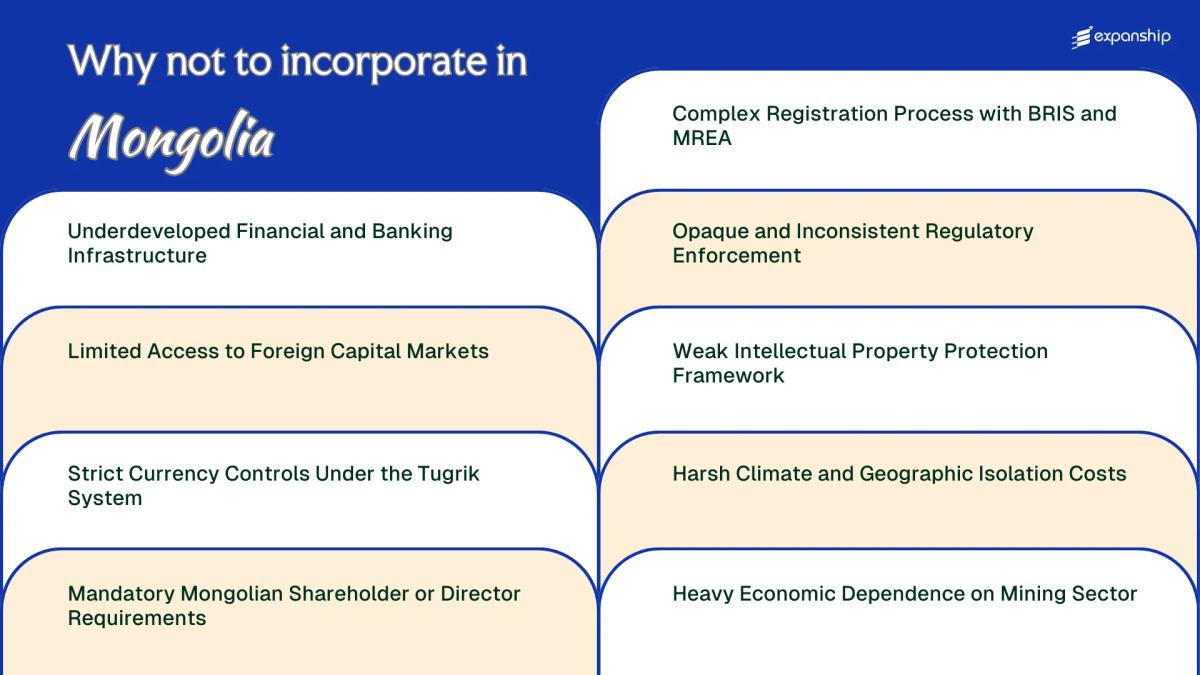
Underdeveloped Financial and Banking Infrastructure
Mongolia banking infrastructure limitations affect foreign firms from the moment of incorporation. Banking access for a foreign-registered entity operates through a small cluster of domestic institutions with limited international connectivity.
Restricted Correspondent Banking Relationships
The Mongolian banking sector is concentrated among a handful of state-influenced commercial banks, including Khan Bank, Golomt Bank, and Trade and Development Bank. None of these institutions maintain the breadth of correspondent banking relationships that foreign businesses typically depend on for cross-border payments, meaning routine transactions can face delays or outright rejection by intermediary banks.
Opening a corporate account as a foreign-owned entity requires submission of notarized, apostilled documentation, and approval timelines are unpredictable. For businesses that need to pay overseas suppliers or receive foreign client payments quickly, this structural gap creates measurable operational friction.
Limited Access to Business Financial Products
Credit facilities, trade finance instruments, and multi-currency accounts remain underdeveloped within the domestic market. Foreign firms cannot easily access the working capital products that would be standard in more developed financial systems, which compounds the cost of operating in a capital-intensive or trade-dependent sector.
Your business may be unable to open a functional corporate bank account for several months after incorporation, directly delaying commercial operations and contract execution.
Limited Access to Foreign Capital Markets
Mongolia foreign capital market restrictions present a direct structural barrier for foreign-incorporated entities seeking to raise capital beyond domestic sources. The Mongolian Stock Exchange (MSE), established under the Securities Law of Mongolia, handles a relatively thin volume of listed securities, limiting your firm's ability to access meaningful equity financing through public markets.
Foreign companies face particular difficulty because MSE listing requirements and investor appetite are oriented toward domestic mining and commodity-linked businesses. An entity operating outside those sectors will find the pool of qualified local investors narrow.
Raising capital abroad while operating through a Mongolian-registered structure introduces additional friction:
- Cross-border equity offerings require alignment with both the Financial Regulatory Commission's (FRC) securities rules and the foreign market's disclosure standards, creating dual compliance costs.
- The MSE's limited market capitalization restricts the valuation benchmarks available to foreign firms, making it harder to attract institutional investors.
- Repatriating capital raised externally involves currency conversion constraints that reduce the effective yield of any foreign fundraising effort.
The FRC oversees securities issuance and foreign participation, but its regulatory framework has not evolved to accommodate hybrid capital structures common in developed markets.

Company Incorporation in Mongolia
Understand the full regulatory and structural requirements before establishing a business presence in Mongolia.
Strict Currency Controls Under the Tugrik System
Mongolia Tugrik currency control restrictions impose a direct operational cost on foreign businesses that few other mid-tier jurisdictions replicate at the same degree. The Mongolian tugrik (MNT) is not freely convertible, and the Bank of Mongolia, as the primary regulatory authority over foreign exchange, enforces rules that constrain how, when, and in what volume your business can move money across borders.
Under the Foreign Investment Law and related Bank of Mongolia directives, foreign currency transactions above certain thresholds require prior approval and supporting documentation. This approval process introduces delays that disrupt payroll cycles, supplier payments, and dividend distributions to overseas shareholders.
| Restriction | Regulatory Basis | Practical Burden |
|---|---|---|
| MNT is non-convertible on capital account | Bank of Mongolia directives | Limits ability to hold or transfer profits in stable foreign currency |
| Repatriation requires documented approval | Foreign Investment Law | Delays profit transfers by days to weeks per transaction |
| Foreign currency accounts face monitoring requirements | Bank of Mongolia regulations | Increases administrative overhead for routine treasury operations |
| Exchange rate set by managed float | Bank of Mongolia policy | Exposes your firm to depreciation risk with limited hedging instruments available domestically |
MNT currency repatriation problems are most acute for businesses with recurring cross-border cash flows, such as those paying royalties, intercompany loans, or management fees to a foreign parent. Each transfer can require fresh documentation, making treasury management disproportionately resource-intensive.
Mongolia currency conversion restrictions also reflect a thin domestic foreign exchange market. The limited volume of forex trading means bid-ask spreads can be wide, quietly eroding the value of each conversion your business completes.
Mandatory Mongolian Shareholder or Director Requirements
Mongolia mandatory local shareholder requirements do not apply universally, but sector-specific restrictions under the Investment Law of Mongolia (2013, as amended) impose meaningful ownership limits in industries deemed strategically sensitive. Foreign investors operating in mining, media, banking, and certain infrastructure sectors face caps on equity ownership, which directly restricts how much control your business can retain.
For entities where a local director is not legally mandated, practical compliance still often pushes foreign firms toward appointing a resident representative. This person must be reachable by Mongolian authorities, creating a dependency that is difficult to manage from abroad.
Nominee director arrangements carry their own risks. Without careful legal structuring, a nominee holds formal authority under Mongolian law, and disputes over fiduciary duties or unauthorized decisions can be both costly and slow to resolve through local courts.
- Foreign ownership caps apply in strategic sectors and are enforced at registration
- State-owned enterprises may require government approval for foreign equity above defined thresholds
- A resident contact point is expected for regulatory correspondence even where no local director law exists
- Nominee director liability under Mongolian corporate law falls on the appointed individual, not the foreign principal by default
Mongolia does not impose a blanket local shareholder requirement on most standard LLCs, yet foreign-owned firms in media are effectively barred from majority ownership under sector-specific legislation.
Complex Registration Process with BRIS and MREA
Registering a business through Mongolia's Business Registration Information System (BRIS) and the Mongolian Registration Entity Authority (MREA) presents structural obstacles that foreign investors frequently underestimate. The process involves multiple agency touchpoints, document authentication requirements, and Mongolian-language submissions that create friction from the outset.
Procedural Complexity at the MREA
Foreign-owned entities must submit notarized and apostilled incorporation documents translated into Mongolian before the MREA will process an application, adding both cost and time to what might appear to be a straightforward registration. Sole foreign-owned companies face additional scrutiny under the Law on Investment and related foreign entity regulations, which require pre-registration verification steps not applicable to domestic firms.
Operational Consequences for Foreign Investors
BRIS, while digitized in principle, does not fully accommodate foreign-issued identification or foreign address formats, forcing your firm to rely on a local representative or agent to complete submissions accurately. This dependency on local intermediaries is not optional in practice; errors or incomplete filings result in rejection without substantive guidance on remediation, extending timelines well beyond the statutory processing window.
Support for Overcoming Registration Challenges in Mongolia
Get guidance on navigating MREA requirements, BRIS submissions, and foreign entity compliance obligations before you begin the registration process.
Opaque and Inconsistent Regulatory Enforcement
Mongolia regulatory enforcement inconsistency creates measurable unpredictability for foreign firms, as the same regulatory provision can be interpreted and applied differently depending on the agency, the official, or even the timing of the inspection.
- The General Authority for State Registration (GASR) and sector-specific regulators such as the Financial Regulatory Commission operate under overlapping mandates, meaning your entity may receive conflicting compliance directives from different bodies simultaneously.
- Discretionary enforcement powers held by tax and licensing authorities allow officials to impose penalties or suspend operations without a standardized procedural threshold, exposing your business to arbitrary intervention.
- Mongolia's opaque business regulations create gaps between published rules and actual enforcement practice, so legal counsel's advice based on the written law may not reflect what inspectors demand on the ground.
- Mongolia regulatory compliance unpredictability is compounded by frequent amendments to the General Law on Business Entities, which can alter obligations with limited transition periods for foreign-registered firms.
- Judicial remedies against regulatory decisions remain slow and uncertain, limiting your practical ability to contest enforcement actions through the courts.
Weak Intellectual Property Protection Framework
Mongolia intellectual property protection risks are a material concern for any foreign firm operating in knowledge-intensive sectors. The primary domestic authority governing IP matters is the Intellectual Property Office of Mongolia (IPOM), which administers trademark and patent registration under the Law on Patents and the Law on Trademarks and Geographical Indications.
Registration alone offers limited protection in practice. Enforcement against infringement depends on civil litigation or criminal prosecution through Mongolian courts, both of which are slow, expensive, and produce inconsistent outcomes for foreign rights holders.
Patent examination capacity at IPOM remains limited relative to international standards. This creates delays in grant timelines, leaving your technology or brand exposed during the interim period between application filing and formal protection.
- Trademark monitoring against third-party filings is not automated or proactively managed by IPOM
- Border enforcement mechanisms for counterfeit goods remain underdeveloped
- No specialized IP tribunal exists; cases are handled by general civil courts with limited technical expertise
A foreign software firm that files a patent application in Mongolia may wait considerably longer for examination than it would in a jurisdiction with a substantive examination track, during which time a local competitor could independently commercialize a similar solution without immediate legal remedy available to the foreign applicant.
Harsh Climate and Geographic Isolation Costs
Mongolia geographic isolation business costs are not abstract concerns — they translate directly into elevated freight expenses, longer lead times, and logistical complexity that most businesses operating in coastal or well-connected economies simply do not encounter.
As a double-landlocked country, all imports and exports must transit through either China or Russia. This dependence on two neighboring transit states means your supply chain is exposed to bilateral political friction, customs delays at multiple borders, and transit fees that compound shipping costs significantly.
Road infrastructure outside Ulaanbaatar is largely unpaved, and rail connectivity is limited to the Trans-Mongolian corridor. Goods movement to and from secondary cities or mining regions frequently requires overland transport across terrain that becomes impassable during severe winters, when temperatures routinely fall below -30°C.
Extreme seasonal conditions also raise operational costs for physical premises. Heating infrastructure, winterized equipment, and weather-resilient logistics planning are not optional considerations — they represent fixed cost burdens that apply year-round in their planning, even if only seasonally in their operation.
- Freight costs to European markets can run multiples higher than comparable shipments from Southeast Asian hubs
- Cold-weather downtime affects construction, outdoor operations, and ground transport
- No domestic deep-water port access exists; all sea freight requires third-country transshipment
If your business model depends on time-sensitive imports or exports, the absence of direct sea access means every shipment passes through at least one foreign customs jurisdiction, and any diplomatic or regulatory disruption along that transit route falls entirely outside your control.
Heavy Economic Dependence on Mining Sector
Mongolia's mining sector economic dependency risks are structural, not cyclical. Copper and coal alone account for roughly 80–90% of export revenue, meaning the broader economy moves in direct correlation with commodity price cycles over which no domestic policy has control.
When copper prices fall, as they did sharply in 2015–2016, government revenues contract, the tugrik depreciates, and fiscal deficits widen. For a foreign-owned entity, this translates into compressed consumer demand, reduced contract reliability, and heightened currency exposure within the same budget cycle.
Resource dependence also distorts sectoral investment. Capital, regulatory attention, and infrastructure spending concentrate around the Ömnögovi and Khövsgöl mining corridors, leaving service, manufacturing, and technology firms operating in comparatively underfunded environments.
The Mongolian economy's reliance on Oyu Tolgoi and Tavan Tolgoi mega-projects means that delays or renegotiations on those agreements, as occurred with the Oyu Tolgoi cost dispute in 2022, produce macroeconomic ripple effects that reach businesses with no direct connection to the extractive industry.
Overcoming Incorporation Challenges in Mongolia
Overcoming Mongolia incorporation challenges requires structural preparation before registration, not reactive adjustments afterward. The obstacles covered in this blog range from currency controls and banking access to IP enforcement gaps and mining sector concentration.
- Register your entity through the Business Registration Information System (BRIS) and confirm concurrent filings with the MREA to avoid procedural delays at the outset.
- Appoint a Mongolian national as a director or shareholder where required under the Company Law of Mongolia to satisfy local participation thresholds.
- Establish a Mongolian-currency tugrik account with a licensed domestic bank to address Bank of Mongolia foreign exchange regulations from the start.
- File trademark registrations with the Intellectual Property Office of Mongolia (IPOM) immediately upon incorporation, given the weak enforcement environment.
- Structure capital contributions and repatriation plans in compliance with the Foreign Investment Law to account for currency control restrictions.
Mongolia's regulatory framework operates across multiple overlapping authorities, and compliance obligations shift depending on sector. Businesses with mining-adjacent activities face additional licensing layers under the Minerals Law of Mongolia.
Mongolia's Overall Investment Potential
Mongolia presents real Mongolia investment risks and potential in roughly equal measure. The structural disadvantages covered in this blog are not minor friction points — they reflect systemic issues in infrastructure, regulation, and capital access. That said, the country's resource wealth, strategic position between China and Russia, and ongoing efforts to diversify its economy mean it remains a credible destination for foreign businesses with the right exposure and tolerance for frontier-market conditions.
| Pro | Con |
|---|---|
| Significant mineral resource base creates supply chain and trade opportunities | Heavy economic dependence on mining exposes the business environment to commodity price cycles |
| Geographic position between China and Russia offers regional trade access | Physical isolation and extreme climate increase logistics and operational costs |
| Government has established formal foreign investment registration pathways | The BRIS and MREA registration process involves multiple agencies and unpredictable timelines |
| A legal framework for foreign ownership exists under Mongolian company law | Mandatory local shareholder or director requirements apply in certain regulated sectors |
| Intellectual property protections are formally codified | Enforcement of IP rights remains inconsistent in practice |
| Banking services for corporate accounts are available domestically | Access to international capital markets and foreign financing is structurally limited |
Corporate Compliance Services in Mongolia
Maintain your company's standing with Mongolian regulatory authorities, including annual filing obligations, directorship requirements, and ongoing statutory compliance under local law.
Conclusion
Mongolia's position as an incorporation destination reflects a clear set of structural constraints. The Mongolia company incorporation drawbacks summary presented across this blog points to friction points that are material, not incidental. Currency controls under the Bank of Mongolia's tugrik framework restrict how your business moves money across borders. Enforcement inconsistency from bodies such as the MREA creates unpredictable compliance exposure. Geographic remoteness compounds operational costs in ways that balance sheet projections rarely capture fully. For firms weighing the cons of registering a company in Mongolia, understanding how these factors interact determines whether the jurisdiction fits your actual business model.
Expanship's Mongolia Expansion Services
From BRIS registration requirements to currency restrictions under the Mongolian Tugrik system, incorporating in Mongolia carries genuine operational weight. Expanship Mongolia company formation services are structured around the specific compliance obligations your business will face here, from liaising with the Business Registration Information System to managing post-incorporation filings with the MREA. The role is to reduce the administrative burden these processes create, not to make them disappear.
Expanship's service scope covers the full incorporation and compliance cycle for foreign entities entering Mongolia.
- Your company registration documents are prepared and submitted accurately against Mongolian legal requirements.
- A registered agent and local office address are provided to satisfy statutory presence obligations.
- Government filings and direct liaison with Mongolian regulatory authorities are handled on your behalf.
- Ongoing post-incorporation compliance is managed to keep your entity in good standing.
- Banking introduction support helps connect your business with local financial institutions.
- Tax registration and liaison with the Mongolian Tax Authority are coordinated from the outset.
Reach out to Expanship Mongolia to discuss your incorporation requirements directly.
Frequently Asked Questions (FAQ)
The local participation requirement applies specifically to certain sectors and entity types under Mongolian law, so the answer depends on how your business is structured and what industry it operates in. Foreign-invested companies in restricted sectors must meet minimum local ownership thresholds, which can limit your control over the entity. Even outside restricted sectors, regulatory approvals often move faster when a local director is present.
Non-compliance with the Business Registration Information System or the Mongolian regulatory framework can result in your entity being struck off the register or facing operating restrictions. Registration errors are not simply corrected through an online amendment; they often require additional notarized documentation and in-person filings. Delays in rectifying these issues can halt your business activity entirely while the process is resolved.
Logistics costs in Mongolia are significantly higher than regional averages due to its landlocked position between Russia and China and extreme seasonal temperatures. Importing equipment or raw materials requires routing through third-country transit agreements, which adds both cost and time. For businesses requiring reliable cold-chain logistics or just-in-time supply chains, these constraints can make unit economics difficult to sustain.
Mongolia's tugrik has historically experienced sharp depreciation cycles tied to commodity price swings, making it more volatile than currencies in many comparable frontier markets. The Bank of Mongolia imposes restrictions on foreign currency transactions, which limits your ability to freely repatriate profits or hedge exposure through standard instruments. Companies earning revenue in tugrik while holding foreign-currency liabilities face compounding exchange risk.
Not easily, and certainly not through domestic mechanisms alone. Mongolian entities face structural barriers to listing on international exchanges or accessing foreign institutional credit, and the local Stock Exchange offers limited liquidity for most foreign investors. Firms that require access to international capital for growth typically need to establish a holding structure in a jurisdiction with stronger capital market connectivity, with the Mongolian entity functioning as an operating subsidiary.
A business incorporated in Mongolia that has no direct connection to mining still carries indirect exposure to the sector's cycles. When commodity prices fall, government revenues contract, consumer spending drops, and regulatory priorities shift toward resource extraction policy, which can deprive other sectors of policy attention and infrastructure investment. Currency depreciation triggered by mining downturns affects all businesses operating in tugrik, regardless of their industry.
Inconsistent enforcement means that the same regulatory requirement may be applied differently across regions, agency officers, or time periods, creating unpredictability in your compliance obligations. Foreign entities are sometimes subject to more scrutiny than domestic firms, and informal expectations during inspections are not always aligned with what is written in statute. This unpredictability increases both legal costs and the time your management team must allocate to regulatory affairs.
Legal Disclaimer
The information provided in this article is for general informational purposes only and does not constitute legal, tax, or professional advice. While we strive to ensure the accuracy and timeliness of the content, laws and regulations are subject to change, and the application of laws can vary widely based on specific facts and circumstances.
Readers should not act upon this information without seeking professional counsel tailored to their individual situation. Expanship and its authors disclaim any liability for actions taken or not taken based on the content of this article.
For specific advice regarding your business setup, compliance requirements, or any legal matters, please consult with qualified legal and tax professionals in the relevant jurisdiction.