
Key Takeaways
- Mongolia's flat 10% corporate income tax rate under the Corporate Income Tax Law places it among the most competitively taxed jurisdictions in the region for foreign-incorporated entities.
- Foreign businesses can establish a limited liability company with broad ownership rights across most sectors, subject only to specific restrictions in industries designated as strategic under national legislation.
- The Investment Law of Mongolia and the administrative framework of the General Authority for State Registration provide a legally structured entry path that reduces procedural uncertainty for incoming foreign investors.
- Situated between China and Russia, Mongolia offers cross-border commercial access to two of the world's largest economies from a cost base that few comparable emerging market jurisdictions can match.
Mongolia is an independent, landlocked nation in East Asia, bordered by China to the south and Russia to the north. The benefits of incorporating in Mongolia draw attention from foreign investors across extractive industries, trade, and services, partly due to the country's general openness to foreign direct investment under the Investment Law of Mongolia. Company registration is administered by the General Authority for State Registration, the central body responsible for business entity filings nationwide. The most common vehicle through which foreign businesses establish a presence is the limited liability company.
From a fiscal standpoint, Mongolia operates a low-tax regime, with corporate income tax structured at rates that remain competitive relative to regional peers. Foreign ownership is broadly permitted across most sectors, subject to specific restrictions in strategic industries as defined under national legislation.
This article examines the key advantages that Mongolia company formation presents for businesses considering entry into this market.
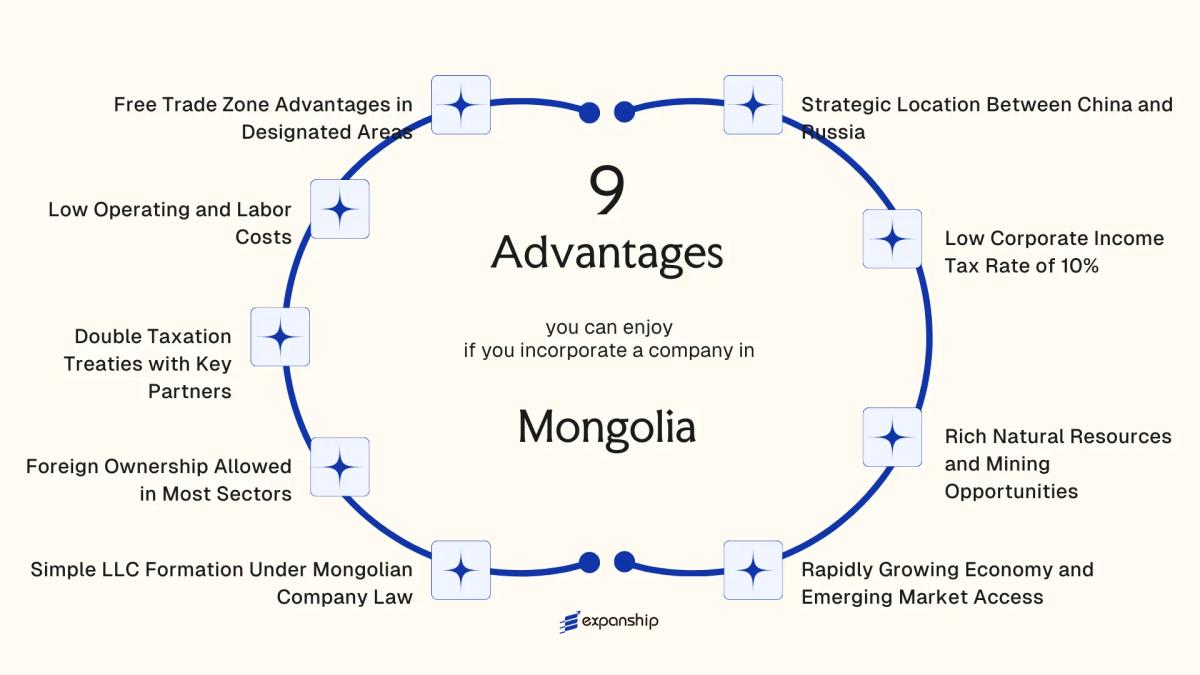
Strategic Location Between China and Russia
Mongolia's strategic location between China and Russia positions it at the intersection of two of the world's largest economies, creating a geography that translates directly into commercial access rather than mere proximity.
A Transit Corridor with Real Trade Volume
China and Russia together account for the overwhelming majority of Mongolia's foreign trade. The Economic Corridor framework under the China-Mongolia-Russia trilateral cooperation agreement formalizes this relationship, meaning your business can operate within a structure that has governmental backing from all three states.
Cross-border rail and road networks connect Mongolian territory to both markets. For a firm engaged in freight, logistics, or wholesale distribution, this infrastructure reduces the cost and complexity of reaching either neighbor.
What Border Access Means for Market Entry
Establishing a local entity gives your business a physical and legal base from which to engage suppliers in China and buyers in Russia without routing operations through a third country. This matters particularly for trading companies and intermediaries where counterparty relationships are geographically sensitive.
A Mongolia-registered entity can serve as a functional trade corridor base between the Chinese and Russian markets under an established trilateral cooperation framework.
Low Corporate Income Tax Rate of 10%
Mongolia's corporate income tax rate is set at a flat 10%, established under the Corporate Income Tax Law of Mongolia. For context, the global average corporate tax rate sits above 23%, making the Mongolia 10% corporate income tax advantage a structurally significant one rather than a marginal difference. That gap directly reduces the tax burden on profits generated by your business, without requiring special status or negotiated arrangements.
Unlike many low-tax jurisdictions that apply reduced rates only to specific sectors or qualifying income types, Mongolia applies this flat rate broadly to resident legal entities, including limited liability companies (XXK) established by foreign investors. Your company pays the same rate as any domestic firm.
The practical implications for foreign investors are straightforward:
- Retained earnings are higher relative to equivalent operations taxed at regional or OECD averages, giving your entity more capital to reinvest without restructuring
- Tax liability is calculable from the outset, since the flat structure removes bracket uncertainty that affects planning in tiered systems
- No minimum profit threshold triggers a different rate, so early-stage entities benefit from the same rate applied to established firms
The tax is administered by the General Department of Taxation under the Ministry of Finance. Standard corporate taxable income rules apply, meaning ordinary business deductions reduce the taxable base before the 10% rate is applied.

Company Incorporation in Mongolia
Set up your Mongolian LLC (XXK) with the correct structure from the start, including tax registration with the General Department of Taxation.
Rich Natural Resources and Mining Opportunities
Mongolia natural resources mining investment benefits position the country as one of the most mineral-rich destinations in Asia for foreign investors seeking exposure to extractive industries. The country holds significant deposits of copper, coal, gold, molybdenum, fluorspar, and uranium, with the South Gobi region alone hosting world-scale projects. Your business enters a sector where the resource base is already established and internationally documented.
The primary legal framework governing mining activity is the Minerals Law of Mongolia, which outlines licensing procedures, royalty structures, and operational rights. The Mineral Resources and Petroleum Authority of Mongolia (MRPAM) administers exploration and mining licenses, providing a single regulatory entry point for foreign firms. Licenses are issued for defined periods and are transferable, which means your equity stake in a licensed entity carries tangible asset value.
| Mineral | Primary Region | Common Use |
|---|---|---|
| Copper | South Gobi (Oyu Tolgoi) | Electronics, construction |
| Coking Coal | South Gobi (Tavan Tolgoi) | Steel production |
| Gold | Selenge, Khentii | Jewelry, finance |
| Fluorspar | Dornogovi | Chemical manufacturing |
| Molybdenum | Central Mongolia | Steel alloys |
Foreign participation in the mining sector is permitted, though strategic deposits classified under the State Special Needs category require government involvement, which affects equity structure in certain high-value licenses. For projects outside that classification, a foreign-owned entity incorporated under Mongolian company law can hold a mining license directly. Proximity to Chinese industrial demand means off-take relationships are geographically and logistically straightforward to establish.
Rapidly Growing Economy and Emerging Market Access
Mongolia's GDP growth has consistently outpaced regional averages during commodity and infrastructure expansion cycles, making the Mongolia emerging market economy benefits concrete rather than speculative. The economy is formally classified as a lower-middle-income emerging market by the World Bank, and the government's framework for attracting foreign capital is codified under the Investment Law, enacted in 2013 and amended in 2021.
Nominal GDP crossed USD 17 billion by 2023, driven substantially by coal and copper exports through the Oyu Tolgoi and Tavan Tolgoi projects. For a foreign firm, this signals an economy with verifiable productive capacity, not just projected potential.
Domestic consumption is also expanding. A young, urbanizing population concentrated in Ulaanbaatar supports demand growth in retail, financial services, and technology sectors, all areas where foreign-owned entities can operate with relatively few restrictions under current law.
Keep the following in mind when positioning your business to access this market:
- GDP growth rates are heavily correlated with commodity export volumes, so sector timing matters
- The Investment Law grants foreign investors the same legal protections as domestic ones in most sectors
- The Financial Regulatory Commission oversees non-banking financial activity, relevant to fintech and investment firms
- Stability of returns can vary sharply with global mineral commodity prices
Mongolia's stock exchange, the Mongolian Stock Exchange, listed its first ETF in 2021, signaling a capital markets infrastructure that most readers would not associate with a landlocked frontier economy of under 4 million people.
Simple LLC Formation Under Mongolian Company Law
Mongolia LLC formation advantages begin at the registration stage itself. Under the Company Law of Mongolia (2011, as amended), a limited liability company — locally designated as ХХК (Хязгаарлагдмал Хариуцлагатай Компани) — can be established by a single founder, whether an individual or a legal entity. That flexibility removes the requirement for a co-founder, which matters when a foreign investor wants full structural control from day one.
Minimal Capital Requirements and Fast Registration
No statutory minimum share capital applies to a standard ХХК. This means your business can be legally constituted without committing a fixed capital sum upfront, preserving liquidity during the early operational phase.
Registration is handled through the Legal Entities Registration Office (LERO) under the Ministry of Justice and Home Affairs. The process is largely document-driven, and registration timelines are generally measured in days rather than weeks, reducing the administrative lag between planning and operational readiness.
Straightforward Governance Structure
A ХХК requires only a General Director as its executive officer; a supervisory board is not mandatory for smaller entities. This lean governance requirement reduces ongoing compliance obligations, which directly lowers your administrative overhead year-on-year.
Liability of each shareholder is confined to their contribution to the charter capital. That structural separation between personal assets and company liabilities gives foreign investors a defined risk boundary that is legally enforceable under Mongolian company law.
Set Up Your Mongolia ХХК With Full Legal Clarity
Get guidance on structuring your Mongolian limited liability company correctly from registration through ongoing compliance.
Foreign Ownership Allowed in Most Sectors
Under the Foreign Investment Law of Mongolia (most recently revised in 2013 and amended since), foreign nationals may own 100% of a locally registered company in the majority of commercial sectors. There is no general requirement to take on a local partner or co-shareholder. That structural openness has a direct practical consequence: your business retains full decision-making authority over operations, profit distribution, and corporate governance without dilution imposed by law.
- Full equity control means retained profits are distributed entirely according to your ownership structure, without mandatory local profit-sharing.
- Mongolia foreign ownership business advantages are most evident in sectors such as trade, manufacturing, logistics, technology, and services, where no prior government approval is required solely on the basis of foreign nationality.
- Under the Foreign Investment Law, investors from abroad are granted legal protections equivalent to those afforded to domestic entities, meaning your firm cannot be subjected to discriminatory operational conditions relative to a Mongolian-owned competitor.
- Sectors involving strategic assets, such as mining above certain thresholds or media, do require approval from the relevant authority, but the general commercial registry process through the General Authority for State Registration does not impose nationality-based equity restrictions.
- Mongolia foreign investor rights advantages extend to the right to repatriate profits and capital, reinforcing the value of full ownership by ensuring returns are accessible internationally.
Double Taxation Treaties with Key Partners
Mongolia double taxation treaty benefits matter most when your profits cross borders. Mongolia has concluded tax treaties with over 25 countries, including China, Russia, Germany, France, South Korea, Japan, the United States, and the United Arab Emirates. Each agreement allocates taxing rights between Mongolia and the partner state, reducing or eliminating withholding taxes on dividends, interest, and royalties paid to foreign entities.
For a foreign investor repatriating profits, this network directly affects your effective tax cost. Without treaty protection, withholding taxes on dividends can reach 20% under Mongolian domestic law. Many bilateral agreements reduce this rate significantly, sometimes to 5% or 10% depending on the ownership threshold met by the recipient company.
Treaty eligibility typically requires the receiving entity to qualify as a tax resident of the partner jurisdiction under that agreement's residency article.
A foreign parent company holding a qualifying stake in a Mongolian subsidiary and resident in a treaty country with a 5% dividend withholding rate would pay MNT 50,000 in tax on MNT 1,000,000 of distributed profit, compared to MNT 200,000 under the domestic 20% rate, a saving of MNT 150,000 per distribution cycle.
Treaty provisions are administered under Mongolia's General Taxation Law and applied through the Mongolian Tax Authority's residency certificate verification process.
Low Operating and Labor Costs
Mongolia low operating costs business advantage is most visible in the country's wage structure. Monthly salaries across mid-level professional roles generally fall well below those in neighboring China or Russia, giving foreign-owned firms a meaningful reduction in recurring payroll expenditure without sacrificing access to a young, urbanizing workforce concentrated in Ulaanbaatar.
The national minimum wage is set by government resolution and reviewed periodically under Mongolian labor law. At current levels, it remains low by regional standards, which directly reduces the baseline cost of hiring locally compliant staff. For labor-intensive operations, this gap between input cost and output value can be substantial.
Beyond wages, general overhead costs benefit from:
- Office rental rates in Ulaanbaatar that sit below comparable space in Beijing or Moscow
- Utility costs that, for industrial users, are subsidized through state-linked energy providers
- Lower mandatory employer social insurance contributions compared to OECD-standard jurisdictions, governed under the Social Insurance Law of Mongolia
For a foreign entity establishing regional operations, these combined factors mean that fixed monthly costs can be structured conservatively from the outset, preserving capital for growth-stage activities.
Minimum wage rates and employer social insurance contribution percentages are subject to annual government revision, so confirm current figures with a locally registered labor law advisor before finalizing your employment cost projections.
Free Trade Zone Advantages in Designated Areas
Mongolia free trade zone business advantages are concentrated in three government-designated Special Economic Zones (SEZs): Zamyn-Uud on the Chinese border, Altanbulag on the Russian border, and Tsagaannuur in the northwest. These zones are governed by the Law on Special Economic Zones, which grants operating entities a distinct set of fiscal and regulatory concessions unavailable to firms incorporated under the standard regime.
Reduced Tax Obligations Within SEZ Boundaries
Businesses registered and operating within an SEZ are subject to preferential tax treatment under Mongolian law. Corporate income tax rates in these zones can be reduced to as low as 0% for qualifying activities, compared to the standard 10% national rate. This applies to approved industries including trade, logistics, and processing, making the zones relevant to firms that move goods across the China-Russia corridor.
Customs and Trade Facilitation
Goods entering and exiting SEZs benefit from customs duty exemptions on imports of raw materials, equipment, and goods intended for re-export. For a foreign investor using Mongolia as a transit or processing hub, this removes a cost layer that would otherwise apply at the standard border rate. The exemption is tied to the nature of the activity within the zone, not simply to the entity's registration address.
Infrastructure Access and Operational Positioning
- Rail connectivity through Zamyn-Uud links directly to the Chinese rail network
- Altanbulag provides road and rail access to the Trans-Siberian corridor
- Zone administrations handle licensing and permits locally, reducing the need to process approvals through Ulaanbaatar
Why Mongolia Stands Out Among Emerging Asian Jurisdictions
Compared to other emerging Asian markets targeting foreign investment, Mongolia's structural profile is distinct enough to warrant direct evaluation. Investors who consider Vietnam, Kazakhstan, or Kyrgyzstan when assessing frontier market entry will find that Mongolia's combination of a flat 10% corporate tax rate, unrestricted foreign ownership in most non-strategic sectors, and a geographically anchored position between two of the world's largest economies produces a different risk-return calculus than most regional peers. Mongolia's advantages among Asian emerging jurisdictions become clearest when measured against markets with comparable GDP trajectories but heavier regulatory structures.
The comparison below focuses on parameters directly relevant to a foreign investor making a formation decision: tax exposure, ownership rights, and treaty access. Kazakhstan and Kyrgyzstan are included as Central-East Asian incorporation alternatives that attract similar investor profiles, while Vietnam represents a comparable frontier-to-emerging transition economy in the broader Asian corridor. These are the jurisdictions a reader evaluating Mongolia would realistically place side by side.
| Parameter | Mongolia | Kazakhstan | Kyrgyzstan | Vietnam |
|---|---|---|---|---|
| Standard Corporate Tax Rate | 10% (flat) | 20% | 10% | 20% |
| Foreign Ownership (General Sectors) | Up to 100% | Up to 100% | Up to 100% | Sector-restricted |
| Double Taxation Treaties | 30+ | 50+ | 40+ | 80+ |
| Free Trade Zone Availability | Yes (designated zones) | Yes (AIFC and SEZs) | Yes (FEZs) | Yes (EPZs and IZs) |
| Minimum Share Capital (LLC equivalent) | No statutory minimum | No statutory minimum | No statutory minimum | No statutory minimum |
Compliance Services for Companies in Mongolia
Maintain your Mongolian entity in good standing with annual filing, tax reporting, and regulatory obligations managed by specialists.
Conclusion
Mongolia presents a structurally grounded case for foreign incorporation, anchored in a flat 10% corporate income tax rate under the Corporate Income Tax Law and genuine openness to foreign ownership across most sectors of the economy.
For resource-focused businesses, the access to one of the world's most significant underdeveloped mineral reserves remains a defining factor. For firms oriented toward trade and regional distribution, the geographic position between China and Russia creates cross-border commercial access that few other jurisdictions can replicate at this cost base.
Whether a given entity benefits most from Mongolia's tax position, its network of double taxation treaties, or its low operating costs depends on the nature of your business and the sectors you intend to enter. The advantages of Mongolia business registration are real, but they are not uniform across all industries or ownership structures. Certain strategic sectors require additional regulatory clearance, and the fit between your business model and what this jurisdiction offers should be assessed against your specific structure and objectives.
The case for incorporating here rests not on any single feature but on the combination of a low-cost operating environment, a legally accessible foreign ownership framework, and an emerging market position that remains underutilized by international firms. Formal guidance through the registration process under the General Authority for State Registration significantly reduces exposure to procedural delays.
Let Expanship Handle Your Mongolia Company Formation
Expanship provides Mongolia company formation services that cover the full incorporation lifecycle, from structuring your LLC under the Mongolian Company Law of 2011 to ongoing compliance with the Financial Regulatory Commission and the General Department of Taxation. The benefits outlined in this blog — from the 10% corporate income tax rate to foreign ownership permissions — each carry corresponding administrative requirements that demand accurate, timely execution with the relevant Mongolian authorities.
Expanship's service scope includes the following:
- Preparation and legalization of incorporation documents, including the company charter and founding agreement
- Registered agent and registered office provision in Ulaanbaatar
- Filing with the State Registration Office (Улсын Бүртгэлийн Ерөнхий Газар) and liaison with relevant government departments
- Post-incorporation compliance management, including annual reporting and tax registration obligations
- Assistance with corporate bank account introductions through local and international financial institutions
- Support with Foreign Investment Law notifications where applicable to your sector
Professional Mongolia business incorporation services reduce the administrative friction that comes with operating across a regulatory system conducted primarily in Mongolian, with its own distinct procedural requirements.
Reach out to Expanship Mongolia to discuss your incorporation requirements directly.
Frequently Asked Questions (FAQ)
Mongolia applies a tiered corporate income tax rate under the Corporate Income Tax Law, with small businesses taxed at 1% or 10% on income up to a threshold, while income above that level is taxed at 25%. The base rate most commonly referenced for standard businesses is 10%, though your applicable rate depends on annual taxable income. Confirming your firm's classification with a local tax adviser before registration will determine which bracket applies.
Registration of a limited liability company (LLC) with the General Authority for State Registration (GASR) typically takes between three and seven business days once all required documents are submitted. The process involves submitting the company charter, founder details, and proof of a registered address. Delays generally occur when documentation is incomplete or requires notarization and apostille from the founder's home country.
Mongolia has concluded double taxation agreements with a number of countries, including China, Russia, Germany, and Luxembourg, among others. The specific withholding tax reductions available on dividends, interest, and royalties depend on the treaty with your home jurisdiction, and rates vary by agreement. Reviewing the applicable treaty text against the domestic withholding rates set out in the Corporate Income Tax Law will identify what relief your entity can claim.
Entities established within designated free trade zones, such as the Altanbulag, Tsagaannuur, and Zamiin-Uud zones, benefit from preferential tax treatment and simplified customs procedures that differ from the standard national regime. The specific incentives are governed by the Law on Free Zones and administered by the relevant zone authority rather than the GASR. Not all business activities are eligible for free zone status, so confirming that your intended operations qualify under the applicable zone regulations is necessary before structuring around those benefits.
The Law on Companies does not impose a fixed minimum share capital for a standard LLC formation in Mongolia. Founders are required to define the charter capital in the company's founding documents, but there is no statutory floor amount prescribed for general commercial entities. Certain regulated industries, such as banking and insurance, are subject to separate sector-specific capital requirements set by their respective regulatory authorities.
The Law on Investment (2013) includes stabilization provisions that aim to protect existing investors from adverse legislative changes for a defined period, particularly for entities that have concluded an investment agreement with the government. Outside of a formal investment agreement, however, changes in law can affect operational requirements going forward, even for already-registered entities. The scope of protection depends on whether your business entered into a stabilization agreement and the terms negotiated within it.
Legal Disclaimer
The information provided in this article is for general informational purposes only and does not constitute legal, tax, or professional advice. While we strive to ensure the accuracy and timeliness of the content, laws and regulations are subject to change, and the application of laws can vary widely based on specific facts and circumstances.
Readers should not act upon this information without seeking professional counsel tailored to their individual situation. Expanship and its authors disclaim any liability for actions taken or not taken based on the content of this article.
For specific advice regarding your business setup, compliance requirements, or any legal matters, please consult with qualified legal and tax professionals in the relevant jurisdiction.