
Key Takeaways
- The Law on Trade Companies governs all business structures in North Macedonia, with the Central Registry of North Macedonia (Централен регистар на Република Северна Македонија) responsible for registering and maintaining records of every legal entity.
- North Macedonia's corporate tax regime operates on a distribution basis, meaning profits are taxed only when distributed rather than at the point of earning.
- The Limited Liability Company (Друштво со Ограничена Одговорност – DOO) is the most commonly registered entity in North Macedonia, favored by small and medium enterprises for its low capital threshold and governance flexibility.
- Foreign entities can establish a presence in North Macedonia without full incorporation by registering a Branch Office or Representative Office, deferring the commitment to a locally incorporated structure.
Introduction to Entity Types in North Macedonia
North Macedonia is a landlocked country in the southeastern Balkans, bordered by Serbia, Kosovo, Bulgaria, Greece, and Albania. It has been an independent republic since 1991 and a NATO member since 2020, with EU candidate status that continues to shape its regulatory alignment with European standards.
Company registration is administered by the Central Registry of North Macedonia (Централен регистар на Република Северна Македонија), the body responsible for registering all legal entities, maintaining the commercial register, and processing statutory filings. The tax regime operates on a low-rate, territorial basis, with corporate profits taxed only upon distribution rather than at the point of earning.
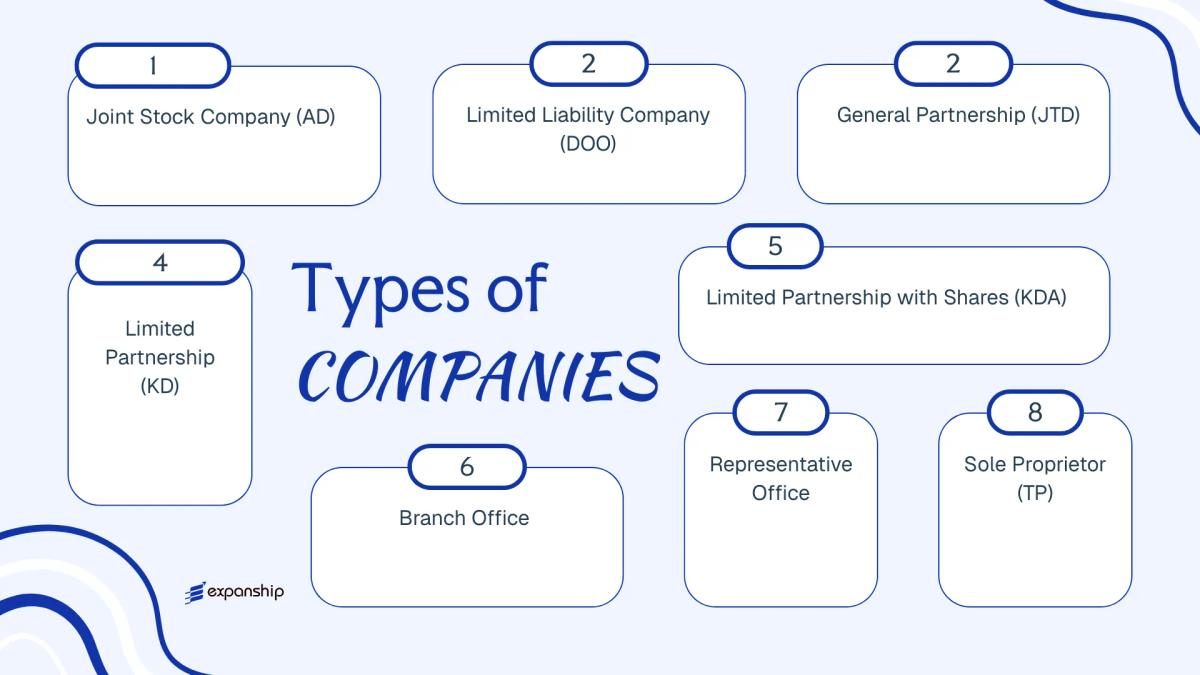
Business entity types available under Macedonian company law include:
- Joint Stock Company (Акционерско Друштво – AD)
- Limited Liability Company (Друштво со Ограничена Одговорност – DOO)
- General Partnership (Јавно Трговско Друштво – JTD)
- Limited Partnership (Командитно Друштво – KD)
- Limited Partnership with Shares (Командитно Друштво на Акции – KDA)
- Branch Office
- Representative Office
- Sole Proprietor (Трговец Поединец – TP)
Each structure carries distinct requirements around capital, liability, governance, and reporting obligations — all of which the sections below examine in detail.
An Overview of Business Structures in North Macedonia
North Macedonia's company law framework recognises several distinct legal forms of business, each governed primarily by the Law on Trade Companies (Zakon za Trgovski Друштва). This legislation, administered through the Central Registry of the Republic of North Macedonia (Centralen Registar), establishes the formation requirements, liability rules, and operational parameters for each structure. Every entity type serves a different commercial purpose, from simple one-person trading to large-scale capital market participation.
Business Structures at a Glance
| Entity Type | Legal Form | Liability | Tax Status | Local Trading | Minimum Members | Regulatory Authority | Governing Act |
|---|---|---|---|---|---|---|---|
| Joint Stock Company (AD) | Corporate entity | Limited to shares | Taxable | Permitted | 1 shareholder | Central Registry | Law on Trade Companies |
| Limited Liability Company (DOO) | Corporate entity | Limited to capital contribution | Taxable | Permitted | 1 member | Central Registry | Law on Trade Companies |
| General Partnership (JTD) | Partnership | Unlimited, joint and several | Taxable | Permitted | 2 partners | Central Registry | Law on Trade Companies |
| Limited Partnership (KD) | Partnership | Mixed (general/limited) | Taxable | Permitted | 2 partners | Central Registry | Law on Trade Companies |
| Limited Partnership with Shares (KDA) | Hybrid partnership | Mixed (general/limited) | Taxable | Permitted | 2 partners | Central Registry | Law on Trade Companies |
| Branch Office | Non-legal entity | Parent bears liability | Taxable on local income | Permitted | N/A (parent company) | Central Registry | Law on Trade Companies |
| Representative Office | Non-legal entity | Parent bears liability | Generally exempt | Not permitted | N/A (parent company) | Central Registry | Law on Trade Companies |
| Sole Proprietor (TP) | Individual trader | Unlimited personal liability | Taxable | Permitted | 1 individual | Central Registry | Law on Trade Companies |
Each of these structures is examined in full in the sections below.
Joint Stock Company (Акционерско Друштво – AD)
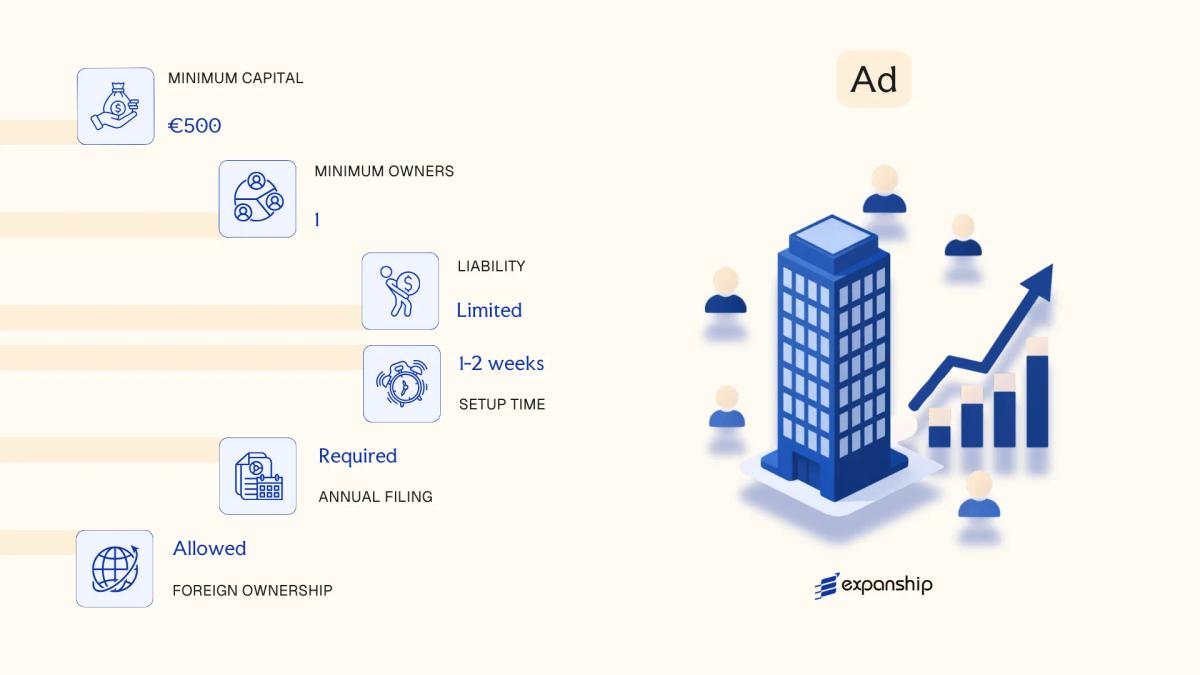
Governed by the Company Law of North Macedonia (Закон за трговски друштва), the Joint Stock Company AD North Macedonia is the most structurally complex corporate form available under domestic law. It carries separate legal personality, meaning the entity itself — not its shareholders — holds rights and obligations.
Liability is strictly limited to subscribed share capital. This structure suits businesses that intend to raise capital from a broader investor base or eventually list on a regulated exchange.
Key Characteristics
| Requirement | Detail | Notes |
|---|---|---|
| Legal Form | Joint Stock Company (Акционерско Друштво – AD) | Separate legal personality; distinct from its shareholders |
| Members | Shareholders (акционери); Board of Directors or Supervisory/Management Board | Minimum 1 shareholder (no maximum); at least 3 board members for public AD |
| Local Presence | Registered seat in North Macedonia required | Physical registered address; no mandatory resident director, but local registered address is obligatory |
| Share Capital | MKD 25,000 minimum (private AD); MKD 1,000,000 for public AD | Capital divided into shares; shares may be ordinary or preference |
| Share Transferability | Freely transferable unless articles of association restrict transfer | Public AD shares may be listed on the Macedonian Stock Exchange |
| Privacy | Shareholder register is not fully public; board members appear in Central Registry | Beneficial ownership disclosure required under AML regulations |
Focus Points
- Taxation: Subject to a 10% corporate income tax on distributed profits; VAT applies at 18% standard rate; dividend withholding tax of 10% applies, reducible under applicable double tax treaties; no stamp duty on share issuance. Refer to the Public Revenue Office for current rates.
- Annual Compliance: Mandatory financial statement filing with the Central Registry (Централен регистар); statutory audit required for large and medium-sized entities and for all public ADs.
- Treaty Access: North Macedonia maintains a network of double tax agreements; AD entities qualify as residents for treaty purposes when centrally managed and incorporated domestically.
- Conversion: An AD may be converted into a DOO or another permitted form through a formal restructuring procedure under the Company Law.
- Restrictions: Regulated sectors (banking, insurance, investment funds) require an AD structure but also sector-specific licensing from the National Bank or Securities and Exchange Commission.
Sub-Types
Private Joint Stock Company (Затворено Акционерско Друштво)
Shares are not offered to the public and are subject to transfer restrictions set out in the articles of association. This form is used for closely held businesses that require the AD structure without public capital-raising.
Public Joint Stock Company (Отворено Акционерско Друштво)
Shares may be offered publicly and listed on the Macedonian Stock Exchange. Additional disclosure, prospectus, and ongoing reporting obligations apply under securities legislation.
When to Use This Structure
The AD is suited to large-scale operations, investment holding structures, and businesses intending to attract institutional investors or access public capital markets. Its primary advantage is unrestricted share transferability and capacity for multi-class share issuance. The main drawback is the administrative burden: statutory audits, board governance requirements, and capital thresholds make it disproportionate for most small or mid-sized ventures.
Best suited for businesses planning public listings, institutional investment rounds, or operating in sectors where the AD form is a regulatory requirement.

Company Incorporation in North Macedonia
Expanship assists with AD registration, document preparation, and Central Registry filing in North Macedonia.
Limited Liability Company (Друштво со Ограничена Одговорност – DOO)
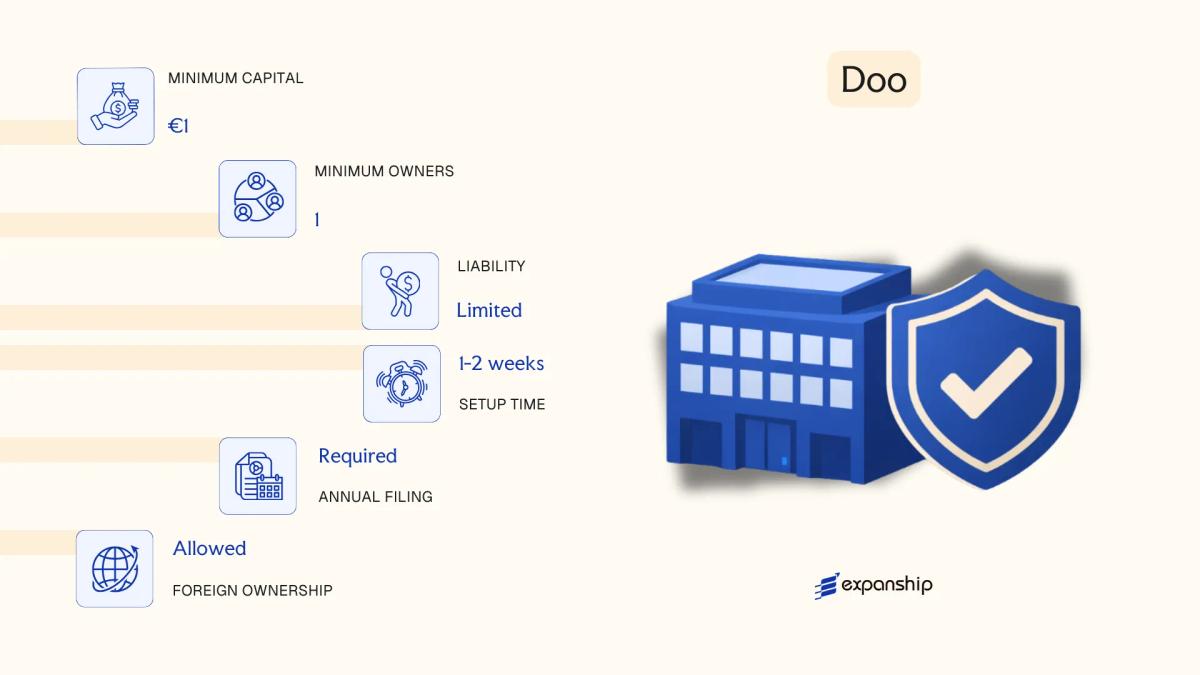
The Limited Liability Company DOO North Macedonia is governed by the Company Law (Закон за трговски друштва), originally enacted in 2004 and subsequently amended. As a separate legal entity, the DOO shields its members from personal liability beyond their contributed capital, making it a hybrid structure that combines corporate liability protection with relatively straightforward governance.
Registration of a DOO is administered through the Central Registry of North Macedonia (Централен регистар на Република Македонија), which processes incorporation filings and maintains the official company register.
Key Characteristics
| Requirement | Detail | Notes |
|---|---|---|
| Legal Form | Limited Liability Company (DOO) | Separate legal personality; members not liable for company debts |
| Members | 1–50 members | Members hold ownership stakes (udeли); single-member DOO is permitted |
| Management | One or more managers (управители) | Managers need not be members; no nationality restriction |
| Registered Office | Local registered address required | Must be a physical address in North Macedonia |
| Minimum Capital | MKD 5,000 (~EUR 80) | Must be fully paid upon registration |
| Privacy | Member details filed in the Central Registry | Ownership information is publicly accessible |
Focus Points
- Taxation: Subject to 10% corporate income tax; standard VAT rate of 18% applies once the registration threshold is met; withholding tax on dividends is generally 10%.
- Annual compliance: Annual financial statements must be submitted to the Central Registry; financial reporting follows local accounting standards aligned with IFRS.
- Economic substance: No formal substance test is prescribed specifically for DOOs, though genuine operational activity is expected for tax residency purposes.
- Treaty access: As a tax resident entity, a DOO can access North Macedonia's network of double taxation treaties.
- Conversion: A DOO may be converted into a Joint Stock Company (AD) through a formal transformation procedure under the Company Law.
Closing
The DOO suits small-to-medium trading operations, holding structures, and service-based businesses where management simplicity and capped liability are priorities. The low minimum capital requirement reduces the barrier to entry, though the 50-member ceiling restricts its use for larger investor pools.
The DOO is most appropriate for foreign investors and entrepreneurs seeking a straightforward, single-jurisdiction operating entity with limited liability and minimal capital commitment.
Partnerships in North Macedonia [General Partnership (JTD), Limited Partnership (KD), Limited Partnership with Shares (KDA)]
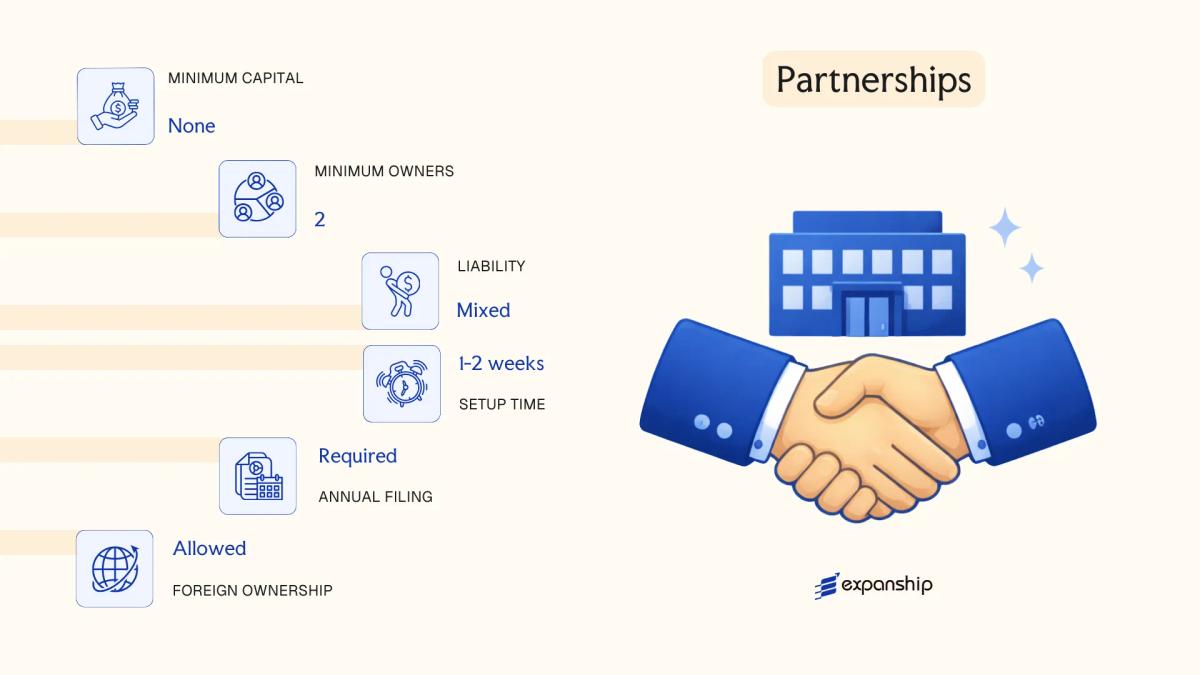
Partnerships in North Macedonia are governed by the Law on Trade Companies (Zakon za Trgovski Drushtva), most recently consolidated in 2004 with subsequent amendments. Three partnership forms exist under this legislation: the General Partnership (Јавно Трговско Друштво – JTD), the Limited Partnership (Командитно Друштво – KD), and the Limited Partnership with Shares (Командитно Друштво на Акции – KDA). These structures are less commonly used than the DOO but remain available options under Macedonian commercial law.
Partnerships in North Macedonia JTD KD structures carry distinct liability profiles. In a JTD, all partners bear unlimited joint and several liability for the firm's obligations. The KD separates partners into two classes: general partners with unlimited liability and limited partners whose exposure is capped at their contributed capital. The KDA follows the same two-tier model but divides the limited partners' capital into transferable shares, making it structurally closer to a joint stock company.
Key Characteristics
| Requirement | JTD | KD | KDA |
|---|---|---|---|
| Legal Form | General Partnership | Limited Partnership | Limited Partnership with Shares |
| Partners | General partners (unlimited liability) | General partners + limited partners | General partners + shareholders (limited partners with shares) |
| Minimum Members | 2 general partners | 1 general + 1 limited partner | 1 general partner + 3 shareholders |
| Minimum Capital | None prescribed | None prescribed | MKD 500,000 (approx.) |
| Local Presence | Registered address in North Macedonia required | Registered address required | Registered address required |
| Privacy | Partner names filed in the Central Registry | All partner names publicly registered | General partners and shareholder register filed publicly |
Focus Points
- Taxation: Corporate profits taxed at 10%; VAT applies at the standard 18% rate once turnover thresholds are met; withholding tax of 10% applies to profit distributions to non-residents; no stamp duty on capital contributions.
- Annual Compliance: Financial statements must be submitted to the Central Registry annually; bookkeeping obligations apply regardless of activity level.
- Treaty Access: North Macedonia has an active double taxation treaty network; partnership income attribution rules determine treaty eligibility at the partner level.
- Conversion: A JTD or KD may be converted into a DOO or AD through a formal transformation procedure under the Law on Trade Companies.
- Restrictions: Foreign nationals may be general partners but unlimited personal liability exposure makes this form commercially uncommon for non-resident investors.
Sub-Types
General Partnership (JTD)
All partners hold management rights by default and carry unlimited personal liability. This form is typically used by small professional practices or family-run businesses where partners have full mutual trust and no separation of liability is required.
Limited Partnership (KD)
Limited partners may not participate in management without assuming general partner status. The KD suits structures where one active managing partner operates the business while passive investors contribute capital with capped exposure.
Limited Partnership with Shares (KDA)
The KDA introduces transferable share certificates for limited partners, enabling broader capital participation without modifying management control held by general partners. It is occasionally used as a transitional structure before conversion to an AD.
Closing
Partnerships suit closely held businesses or professional arrangements where the partners are known to each other and operational simplicity is prioritised over liability protection. The absence of a minimum capital requirement in JTD and KD structures is a practical advantage, though unlimited personal liability for general partners remains a significant commercial constraint.
Partnerships in North Macedonia are most appropriate for small professional firms or family businesses where all active participants accept personal liability and formal corporate governance is not required.
Foreign Business Presence in North Macedonia [Branch Office, Representative Office]
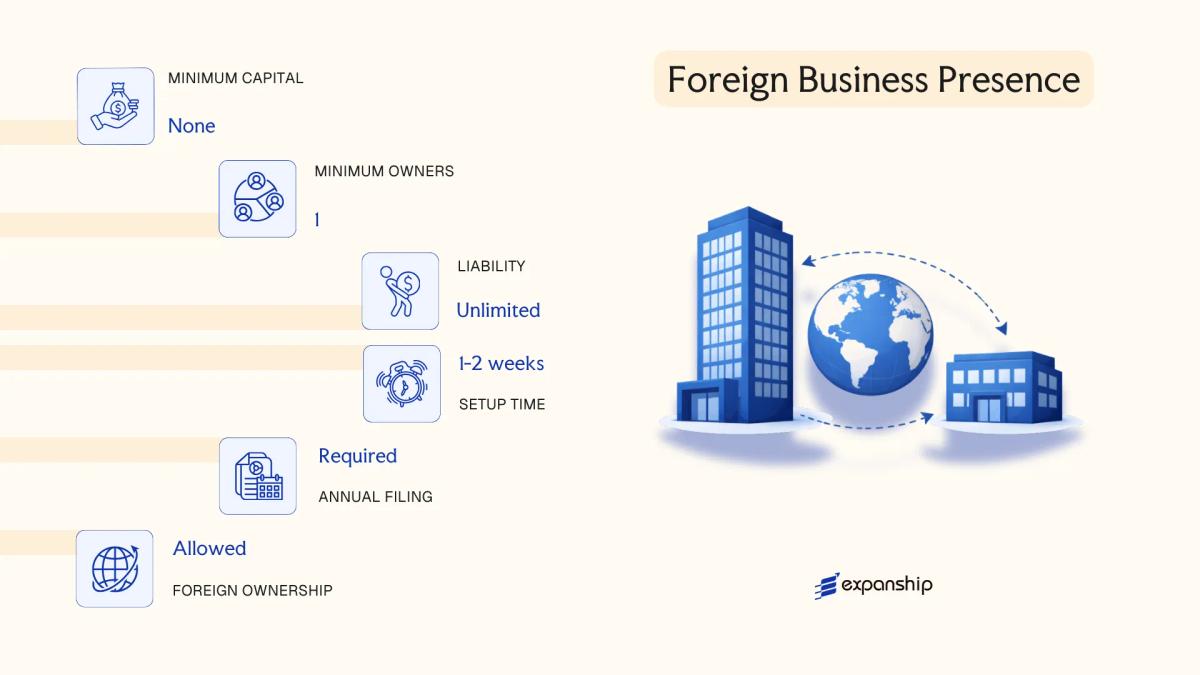
Foreign companies seeking to operate in North Macedonia without incorporating a new local entity have two recognised options under the Law on Trade Companies (Official Gazette of the Republic of Macedonia, No. 28/2004, with subsequent amendments): a Branch Office and a Representative Office. A foreign company branch office in North Macedonia is registered with the Central Registry of the Republic of North Macedonia and is treated as an organisational unit of the parent company, not a separate legal entity.
Neither structure carries independent legal personality. All liabilities of both forms extend to the parent company abroad.
Key Characteristics
| Requirement | Branch Office | Representative Office |
|---|---|---|
| Legal Form | Organisational unit of foreign parent | Organisational unit of foreign parent |
| Managed by | Authorised representative (proxy holder) | Authorised representative |
| Legal Personality | None — parent company bears liability | None — parent company bears liability |
| Permitted Activities | Commercial and operational activity | Non-commercial only (market research, liaison, promotion) |
| Local Presence | Registered address in North Macedonia required | Registered address required |
| Capital Requirement | None prescribed | None prescribed |
| Registration Body | Central Registry of the Republic of North Macedonia | Central Registry of the Republic of North Macedonia |
Focus Points
- Taxation: Branch offices are subject to 10% corporate income tax on locally sourced profits; VAT registration is required if annual turnover exceeds MKD 1,000,000. Representative offices are generally not subject to corporate tax as they do not generate revenue.
- Economic Substance: Branch offices engaged in active trade must maintain genuine operational presence; the authorised representative must be identifiable in the registry.
- Annual Compliance: Both structures must submit annual financial reports to the Central Registry; branch offices additionally file tax returns with the Public Revenue Office.
- Treaty Access: Access to North Macedonia's double tax treaties depends on the parent company's jurisdiction; treaty benefits flow to the parent, not the branch or representative office directly.
- Restrictions: Representative offices are strictly prohibited from conducting revenue-generating commercial activity; any breach risks reclassification or deregistration.
Sub-Types
Branch Office
A branch office may conduct full commercial operations, enter contracts, and generate income in its own operational name, with all legal obligations binding on the parent company.
Representative Office
A representative office is limited to promotional, liaison, and market research functions. It cannot sign commercial contracts or invoice clients, making it suited only to market-entry research or pre-sales activity.
Closing Paragraph and Recommendations
Both structures serve foreign firms testing or supporting operations without committing to full local incorporation. The branch office offers operational flexibility, while the representative office carries a hard restriction on revenue generation that limits its practical scope considerably.
A branch office suits foreign firms with confirmed commercial activity in the market; a representative office is appropriate only for preliminary market research or liaison functions with no intention of local revenue generation.
Sole Proprietor (Трговец Поединец – TP)
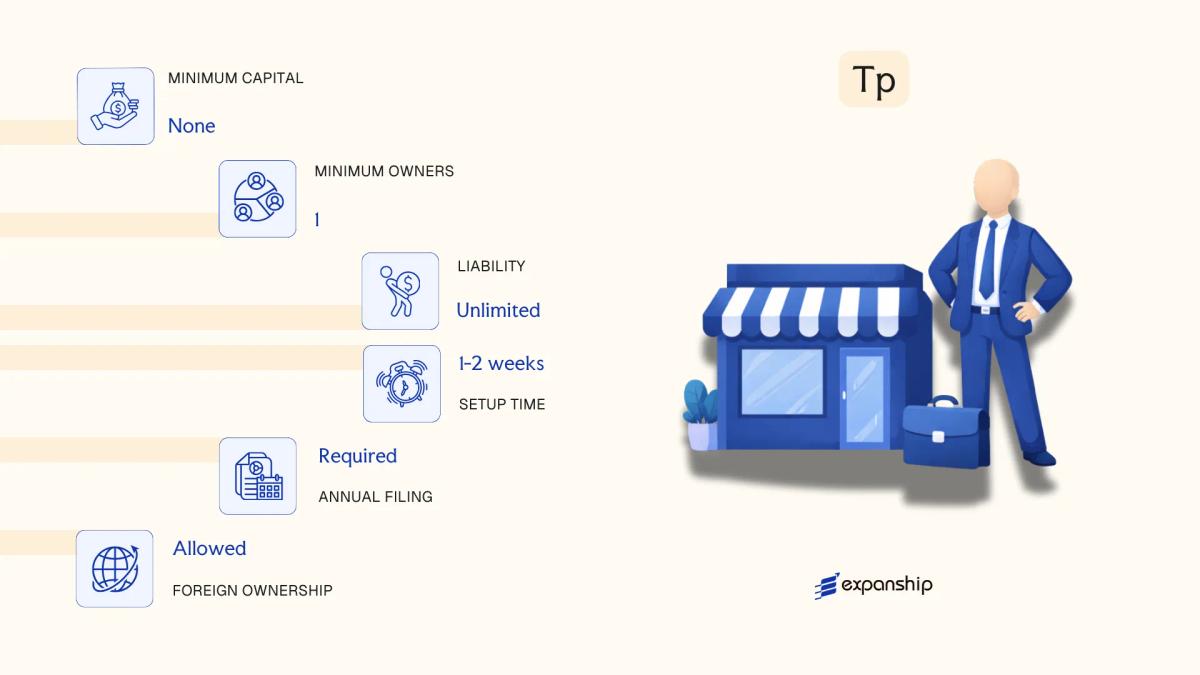
Registering as a sole proprietor TP North Macedonia is governed by the Trade Companies Law (Закон за трговски друштва), which defines the Трговец Поединец as a natural person conducting business activity in their own name. Unlike a company, this form carries no separate legal personality — the proprietor and the business are legally the same entity, meaning personal assets are fully exposed to business liabilities.
Трговец Поединец registration Macedonia is handled through the Central Registry of the Republic of North Macedonia (Централен регистар на Република Северна Македонија), which processes applications and issues the registration certificate. The structure suits individuals operating small-scale, low-risk commercial activity without the administrative burden of a corporate form.
Key Characteristics
| Requirement | Detail | Notes |
|---|---|---|
| Legal Form | Sole Proprietorship | No separate legal personality; proprietor bears full personal liability |
| Members | Single natural person (Proprietor) | Must be a resident individual; no minimum age beyond general legal capacity |
| Local Presence | Registered business address in North Macedonia | A physical address is required for registration purposes |
| Capital | No statutory minimum | No capital deposit required at formation |
| Privacy | Proprietor's name appears in public registry | Full public disclosure via the Central Registry |
Focus Points
- Taxation: Subject to personal income tax on business income; VAT registration is mandatory once annual turnover exceeds the statutory threshold; no separate corporate tax applies.
- Annual Compliance: Must maintain basic bookkeeping records and submit an annual financial report to the Central Registry.
- Conversion: Can be converted into a DOO or other corporate form under the Trade Companies Law if business activity expands.
- Restrictions: Foreign nationals face residency-based limitations on registering as a sole trader; self-employed business registration North Macedonia is generally reserved for resident individuals.
- Treaty Access: As a non-corporate entity, access to double tax treaty benefits may be limited depending on treaty-specific provisions.
Closing
The TP structure suits resident individuals running sole-trade services, freelance activity, or micro-scale commerce where simplicity outweighs the need for liability protection. Its key advantage is minimal formation and compliance cost; its principal drawback is unlimited personal liability for all business obligations.
Resident individuals conducting low-risk, single-person business activity who prioritise administrative simplicity over liability protection.
How to Choose the Right Entity Type in North Macedonia
Knowing how to choose a company type in North Macedonia before registration prevents structural problems that are costly or legally complex to reverse later.
Why Your Entity Choice Matters
The Law on Trade Companies governs which structures are available and what obligations each carries. Selecting the wrong one has concrete consequences:
- Forming a DOO when your intended activity requires a licensed entity — such as banking or insurance — results in regulatory non-compliance and possible de-registration by the Central Registry of North Macedonia.
- Choosing a structure that lacks access to the treaty network prevents you from claiming withholding tax reductions under applicable double taxation agreements.
- Registering a branch office when you require a separate legal entity means the parent company bears unlimited liability for local obligations.
- Establishing an AD when a single-person consultancy is all you operate adds mandatory audit and supervisory board costs that a DOO does not require.
Key Factors to Consider
- Business Activity: Regulated sectors such as banking, insurance, and investment funds require specific licensed entity forms beyond the standard DOO or AD.
- Ownership Structure: A single founder suits a DOO, while multiple investors requiring transferable shareholdings point toward an AD.
- Tax Objectives: Your eligibility for North Macedonia's flat 10% corporate tax or specific incentive regimes depends on your chosen structure and residency status.
- Liability Exposure: Partnerships carry unlimited personal liability, which directly affects your risk profile relative to capital-separated structures.
- Exit Strategy: Conversion between entity types is possible but requires formal court and registry procedures under the Law on Trade Companies, making the initial choice consequential.
Compliance Services for Companies in North Macedonia
Maintain your legal standing with ongoing compliance support tailored to your entity type and regulatory obligations.
Conclusion
Incorporating a company in North Macedonia involves selecting from a defined set of structures governed primarily by the Law on Trade Companies. The DOO accounts for the majority of registrations, favored by small and medium enterprises for its manageable capital threshold and flexible governance. The AD suits larger ventures requiring access to capital markets or institutional investment. General and limited partnerships fit closely held businesses where personal liability is an acceptable trade-off for operational simplicity. Branch and representative offices serve foreign entities testing the market before committing to a locally incorporated structure. The sole proprietor form remains straightforward but carries unlimited personal liability.
North Macedonia has steadily expanded its network of double taxation treaties and continues aligning its regulatory framework with EU standards, a process that shapes ongoing adjustments to company law and reporting obligations through the Central Registry.
How Expanship Can Assist You
Expanship's company formation services North Macedonia cover the full registration process, from selecting the appropriate entity type — a DOO, AD, branch, or representative office — through to formal registration with the Central Registry of North Macedonia (Централен Регистар). Your obligations do not end at incorporation; ongoing compliance with the Law on Trade Companies governs how your business operates year-round.
From initial paperwork through to post-incorporation management, Expanship handles each stage directly:
- Document preparation and notarization
- Registered agent and registered office provision
- Filing with the Central Registry on your behalf
- Post-incorporation compliance management
- Banking introduction assistance
Our North Macedonia incorporation assistance is available across all entity types discussed in this guide, including partnership structures that are often overlooked by international investors.
Reach out through Expanship North Macedonia to discuss your requirements with a specialist.
Frequently Asked Questions (FAQ)
The DOO (Друштво со Ограничена Одговорност) is the most frequently incorporated entity. Its relatively low minimum capital threshold and single-member permissibility under the Companies Law make it the default choice for small to mid-sized businesses.
A branch is not a separate legal entity; it carries the full liability of its foreign parent and cannot independently hold assets or enter contracts in its own name. A DOO is a distinct legal person, subject to corporate profit tax at 10% under domestic tax law, with full local trading rights. Compliance obligations are higher for the DOO but so is operational independence.
North Macedonia does not offer nominee shareholder arrangements as a recognized formal mechanism under its Companies Law. Beneficial ownership information is submitted to the Central Registry (Централен Регистар), making full anonymity unavailable across all entity types. The DOO and AD both require shareholder disclosure in the registry.
A DOO and an AD can each be formed by one individual. General Partnerships (JTD) and Limited Partnerships (KD) require a minimum of two partners by statutory definition. A Sole Proprietor (TP) is, by nature, a one-person structure.
Foreign nationals face no nationality restrictions when registering a DOO, AD, or acting as a sole proprietor under the Companies Law. Non-residents must obtain a tax identification number and may need to appoint a local authorized representative for correspondence with the Central Registry. A branch or representative office requires the foreign parent entity to already be legally constituted abroad.
The Companies Law permits structural transformations, including conversion of a DOO into an AD and vice versa, subject to procedural requirements filed with the Central Registry. Partnerships converting to capital companies must meet the minimum share capital requirements applicable to the target entity type. Not all conversion paths are equally straightforward, and each requires a formal resolution and updated registration.
The DOO, AD, and KDA each possess separate legal personality distinct from their members. General Partnerships (JTD) and Limited Partnerships (KD) do not have fully separate legal personality in the same sense, meaning partners retain direct exposure to business liabilities. Sole Proprietors operate without any separation between personal and business assets.
Legal Disclaimer
The information provided in this article is for general informational purposes only and does not constitute legal, tax, or professional advice. While we strive to ensure the accuracy and timeliness of the content, laws and regulations are subject to change, and the application of laws can vary widely based on specific facts and circumstances.
Readers should not act upon this information without seeking professional counsel tailored to their individual situation. Expanship and its authors disclaim any liability for actions taken or not taken based on the content of this article.
For specific advice regarding your business setup, compliance requirements, or any legal matters, please consult with qualified legal and tax professionals in the relevant jurisdiction.