

Key Takeaways
- North Macedonia's flat 10% corporate income tax rate is among the lowest in the Western Balkans, allowing businesses to retain a structurally larger share of profits compared to most comparable regional jurisdictions.
- Foreign investors establishing a DOOEL benefit from a minimal share capital threshold that allows a legal entity to be registered without committing substantial capital upfront, lowering the financial barrier to market entry.
- Preferential trade access under the EU Stabilisation and Association Agreement extends the commercial reach of a North Macedonia-registered entity beyond the domestic market, creating measurable advantages for businesses with European export or supply chain exposure.
- The Central Registry's streamlined incorporation framework means that compliant registration of a DOOEL can be completed without the procedural complexity that characterises entity formation in many other emerging market jurisdictions.
Situated in the heart of the Western Balkans, North Macedonia is a landlocked independent republic that shares borders with Greece, Bulgaria, Serbia, Kosovo, and Albania. Company registration falls under the jurisdiction of the Central Registry, the statutory authority responsible for incorporating and maintaining records of all legal entities operating in the country. Foreign investors most commonly establish a DOOEL when entering the market.
The country operates a low-tax regime anchored by a flat corporate income tax rate, making it one of the more cost-competitive environments for business formation in the region. On the question of foreign ownership, the legal framework permits 100% foreign ownership of locally registered entities without sector restrictions in most industries, and the government has signaled consistent openness to foreign direct investment through successive legislative reforms.
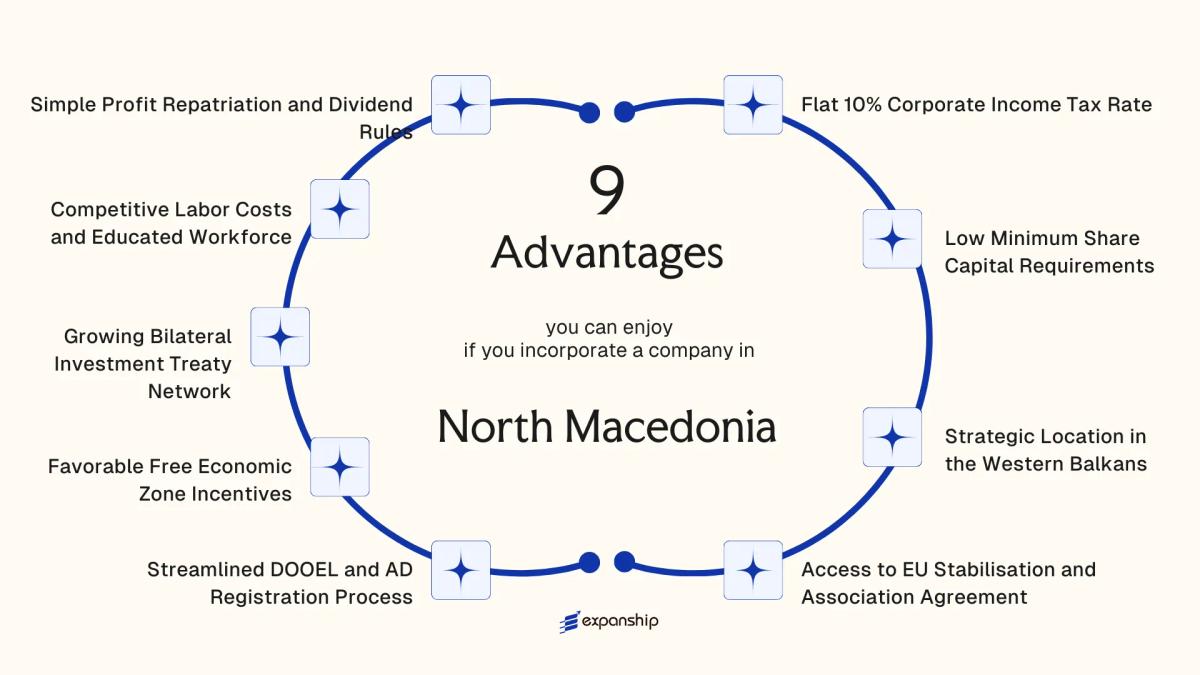
The benefits of incorporating in North Macedonia span tax efficiency, structural flexibility, geographic advantage, and bilateral treaty protections. This article examines each of those advantages in detail.
Flat 10% Corporate Income Tax Rate
North Macedonia applies a flat 10% corporate income tax rate under the Income Tax Law, one of the lowest statutory rates among European jurisdictions. For foreign investors benchmarking tax exposure before committing to a structure, that figure carries immediate weight.
How the Rate Applies to Taxable Profits
Corporate income tax in North Macedonia is assessed on net taxable profit, with the 10% rate applying uniformly regardless of company size or sector. This flat structure eliminates the bracket uncertainty that exists in progressive tax systems, so your projected post-tax returns remain calculable from the outset.
Retained Earnings and the Reinvestment Incentive
Profit that remains within the entity and is reinvested into the business is effectively deferred from dividend taxation, which reduces the immediate tax burden on growth-oriented firms. The Public Revenue Office administers tax assessment and filing, and annual corporate tax returns are submitted following the close of the financial year.
At 10%, your company's statutory tax liability in North Macedonia sits well below the EU average corporate rate of approximately 21%, directly improving net margin on profits booked through a Macedonian entity.
Low Minimum Share Capital Requirements
North Macedonia's low minimum share capital benefit is most visible in the formation rules for the DOOEL, the single-member limited liability structure most commonly used by foreign investors. Under the Companies Law, the minimum share capital for a DOOEL is just 5,000 Macedonian denars, roughly equivalent to EUR 80. That threshold requires no external financing, no bank guarantee, and no phased payment schedule before registration is approved.
This matters because capital tied up in statutory requirements is capital unavailable for operations. With such a low entry point, your business can allocate working capital toward actual activity from day one rather than satisfying a regulatory deposit.
- No third-party audit is required to verify the initial capital contribution
- The contribution can be made in cash, which avoids complex in-kind valuation procedures
- No minimum paid-in requirement before incorporation is complete
- The threshold applies regardless of the shareholder's nationality or country of residence
For comparison, several EU member states set minimum share capital thresholds for equivalent limited liability structures at EUR 2,500 or higher, with some requiring partial payment upfront. The DOOEL structure sidesteps these constraints entirely, making initial setup financially accessible even for early-stage ventures or solo operators testing a new market.

Company Incorporation in North Macedonia
Set up a DOOEL or AD in North Macedonia with full compliance support across registration, capital structuring, and post-incorporation requirements.
Strategic Location in the Western Balkans
North Macedonia's strategic Western Balkans location advantage stems from geography that connects Central Europe, Southeast Europe, and the Adriatic coast within a single transit corridor. The country shares borders with Serbia, Kosovo, Bulgaria, Greece, and Albania, placing any registered entity within short overland reach of multiple distinct markets simultaneously.
Corridor VIII and Corridor X, two of the Pan-European transport corridors, pass through or adjacent to the territory. These routes link the Adriatic port of Durrës in Albania eastward to Bulgaria and Turkey, while also connecting Central Europe southward to Greece and the Aegean. A firm operating from Skopje can realistically reach Thessaloniki, Sofia, or Belgrade within two to three hours by road.
| Destination | Approximate Distance | Estimated Drive Time |
|---|---|---|
| Thessaloniki, Greece | ~70 km | ~1 hour |
| Sofia, Bulgaria | ~220 km | ~2.5 hours |
| Belgrade, Serbia | ~430 km | ~4 hours |
| Tirana, Albania | ~240 km | ~3 hours |
For businesses involved in manufacturing, distribution, or logistics, this connectivity reduces transit costs and delivery times across a region of roughly 20 million consumers in the immediate neighborhood. Your company is not positioned at the periphery of a single market but at a functional crossroads where multi-directional supply chains become operationally straightforward to manage.
Access to EU Stabilisation and Association Agreement
The Stabilisation and Association Agreement between North Macedonia and the EU, which entered into force in 2004, creates a preferential trade framework that eliminates or substantially reduces customs duties on a wide range of goods traded between the country and EU member states. For a company incorporated here, this means products manufactured or processed domestically can enter EU markets at reduced or zero tariff rates, cutting costs that competitors based outside the SAA framework must absorb.
The SAA also establishes provisions on services, capital movement, and intellectual property protection aligned with EU standards. Your business entity benefits from a degree of regulatory predictability that mirrors EU commercial norms, without yet carrying full membership obligations.
Rules of origin requirements under the SAA govern which goods qualify for preferential treatment, so your production or processing operations must meet defined local content thresholds to access the tariff benefits.
Keep these points in mind:
- Goods must satisfy Pan-Euro-Mediterranean cumulation rules to qualify for preferential tariff treatment
- Services trade benefits are subject to sector-specific commitments defined within the SAA text
- The SAA framework is separate from EU membership; full single market access does not apply
- Misclassifying origin can result in duty recovery and penalties at EU customs
North Macedonia is one of only a few non-EU countries that has maintained an active SAA alongside official EU candidate status simultaneously since 2005, giving incorporated firms a dual-track trade positioning uncommon among regional peers.
Streamlined DOOEL and AD Registration Process
North Macedonia DOOEL and AD registration advantages stem largely from how the country has structured its company formation process to reduce administrative friction for foreign principals. The Central Registry of the Republic of North Macedonia (CRRM) serves as the single-point authority for company registration, meaning you deal with one body rather than several parallel agencies.
Single-Window Registration via the CRRM
Registering a DOOEL (Drushtvo so Ogranichena Odgovornost na Edinstven Osnivach) or an AD (Akcionersko Drushtvo) is handled electronically through the CRRM's online portal. Registration of a DOOEL can typically be completed within a few business days of submitting the required documentation. For a foreign investor, that compressed timeline means your entity can begin operating, opening bank accounts, and signing contracts well before comparable filings would clear in many Western European jurisdictions.
Minimal Documentation Burden for Foreign Incorporators
A DOOEL requires a single founder, who may be a foreign national or a foreign legal entity, without any requirement for a local resident director. This structural flexibility reduces the dependency on local nominees that registration in many regional jurisdictions would otherwise demand. The AD, designed for larger capital structures, carries more formal governance requirements, but the CRRM still processes its incorporation through the same centralized system, keeping procedural consistency across both entity types. That consistency lowers the coordination cost when you are managing multiple filings or transitioning from one entity type to the other.
Plan Your North Macedonia Incorporation with Expanship
Get structured guidance on registering a DOOEL or AD in North Macedonia, from documentation preparation to CRRM submission and post-registration compliance.
Favorable Free Economic Zone Incentives
North Macedonia free economic zone incentives for businesses are codified primarily through the Law on Technological Industrial Development Zones, which established a framework of tax and customs privileges unavailable under the standard corporate regime.
- Companies operating within a TIDZ pay 0% corporate income tax for the first ten years of activity, a direct cost advantage over the flat 10% rate that applies outside the zones.
- A 0% rate on dividends distributed from TIDZ-registered entities reduces the total tax burden on profit extraction, which matters to foreign shareholders repatriating returns.
- Customs duties are waived on imported raw materials, equipment, and machinery used in production within the zone, lowering capital expenditure for manufacturing and assembly operations.
- VAT exemptions apply to goods and services supplied within the zones, which reduces cash-flow friction for businesses operating on high transaction volumes.
- The zones are administered by the Directorate for Technological Industrial Development Zones, which coordinates infrastructure provision alongside the incentive framework.
- Eligibility is tied to minimum investment thresholds and the nature of business activity, meaning services or production operations that meet the qualifying criteria gain access to the full incentive package.
For foreign firms structuring export-oriented or manufacturing operations, the TIDZ regime separates the effective tax burden substantially from what applies to domestically focused entities.
Growing Bilateral Investment Treaty Network
North Macedonia bilateral investment treaty advantages stem from a treaty network covering over 30 countries, including Germany, the Netherlands, Switzerland, and Turkey. Each agreement establishes enforceable investor protections that sit outside domestic courts, giving foreign shareholders a defined legal recourse in the event of expropriation, unfair treatment, or breach of state commitments.
Under most of these BITs, disputes can be submitted to international arbitration, typically through ICSID or UNCITRAL rules. That mechanism matters because it removes your firm from reliance on local judicial processes for the resolution of investment disputes with the state.
The treaties generally guarantee:
- Fair and equitable treatment
- Protection against unlawful expropriation without compensation
- Free transfer of investment-related funds across borders
- Most-favored-nation treatment in comparable circumstances
Eligibility typically depends on the investor qualifying as a national or legal entity of the treaty partner state, so the nationality of your holding structure affects which BIT protections apply to your investment.
A hypothetical scenario: A German-owned company incorporated in North Macedonia facing expropriation by a state authority could initiate ICSID arbitration under the Germany-North Macedonia BIT, bypassing local courts entirely and seeking compensation under international law standards rather than domestic administrative procedures.
Competitive Labor Costs and Educated Workforce
North Macedonia competitive labor costs for businesses represent one of the more measurable structural advantages available in the region. Average gross wages sit well below Western European levels, and total employer labor costs, including mandatory social contributions, remain comparatively low. This directly reduces operating expenditure for foreign-owned entities staffing locally.
The workforce composition adds practical value beyond the wage differential. The country has a developed tertiary education system, with universities producing graduates in engineering, IT, economics, and law. English proficiency is widespread among younger professionals, which matters for firms running cross-border operations from a local base.
Under the Law on Labor Relations, employment contracts are standardized, and the regulatory framework governing working hours, termination, and benefits follows clear statutory rules. Predictable labor law reduces the legal uncertainty that foreign employers often face when entering unfamiliar markets.
- Employer social contribution rates are set by statute and apply uniformly
- IT and technical talent availability has expanded alongside growth in the technology sector
- Multilingual capability among graduates supports client-facing and administrative functions
Salary benchmarks and social contribution rates are subject to periodic legislative revision, so confirm current figures with a local legal or HR advisor before finalizing your staffing cost projections.
Simple Profit Repatriation and Dividend Rules
North Macedonia profit repatriation benefits for investors stem largely from a legal framework that imposes no restrictions on transferring dividends or profits out of the country. Foreign shareholders in a DOOEL or AD can remit earnings abroad without requiring prior government approval, which removes a layer of administrative friction that exists in several regional peers.
Under the Law on Profit Tax, dividends distributed to non-resident shareholders are subject to a withholding tax rate of 10%. This rate applies uniformly, regardless of the recipient's jurisdiction of residence, unless a double taxation agreement provides for a reduced rate. The network of tax treaties the country has concluded with numerous partners directly lowers this cost for qualifying foreign investors.
There is no minimum holding period before profits can be distributed. Once a company has fulfilled its annual tax obligations and the relevant financial statements are approved, retained earnings are available for distribution. This absence of lock-in periods gives foreign owners practical flexibility over the timing of their returns.
Currency transfers are governed under the Law on Foreign Exchange Operations. Repatriation transactions are processed through licensed commercial banks operating under oversight from the National Bank of the Republic of North Macedonia, providing a regulated and documented channel for outbound transfers.
Key structural features of this regime include:
- No capital controls restricting dividend outflows to foreign accounts
- Withholding tax capped at 10%, reducible under applicable tax treaties
- No mandatory reinvestment requirement imposed on foreign-owned entities
- Distributions processed through the standard banking system without special licensing
Why North Macedonia Stands Out Among Balkan Jurisdictions
Compared against its immediate neighbors, North Macedonia holds a distinct position for foreign investors evaluating the Western Balkans. The three jurisdictions in the table below — Serbia, Albania, and Bulgaria — were selected because they target a similar investor profile, compete for the same FDI flows, and are frequently evaluated alongside North Macedonia by businesses seeking a regional base. The comparison focuses on structural parameters where the country holds a neutral or favourable standing.
What the table reflects, but cannot fully convey, is the combined effect of these parameters. A flat tax rate paired with no withholding tax on reinvested profits and low minimum capital creates a cost structure that is difficult to replicate across the region without trade-offs. Serbia offers a larger domestic market but applies a higher effective tax burden in some configurations. Bulgaria sits within the EU and matches the 10% corporate rate, yet carries higher compliance costs and a different regulatory framework. Albania has reduced its headline rate but lacks the treaty depth and free zone incentives available here.
| Parameter | North Macedonia | Serbia | Albania | Bulgaria |
|---|---|---|---|---|
| Corporate Income Tax Rate | 10% (flat) | 15% | 15% | 10% (flat) |
| EU Member State | No (SAA in force) | No (candidate) | No (candidate) | Yes |
| Minimum Share Capital (LLC equivalent) | MKD 1 (approx.) | RSD 100 | ALL 100 | BGN 2 |
| Free Economic Zones | Yes (TIDZ framework) | Yes | Limited | Yes |
| Bilateral Investment Treaties (approx.) | 30+ | 60+ | 40+ | 60+ |
| Withholding Tax on Dividends | 15% (standard) | 20% | 8% | 5% |
| WB6 Regional Trade Integration | Yes | Yes | Yes | No |
Compliance Services for Companies in North Macedonia
Stay aligned with local reporting obligations, tax filings, and statutory requirements under Macedonian law.
Conclusion
North Macedonia presents a coherent case for foreign incorporation, built on structurally low tax costs, accessible capital thresholds, and treaty-backed trade access that most comparable jurisdictions cannot replicate in combination. The flat 10% corporate income tax rate keeps retained earnings working for your business rather than disappearing into the tax base, while the minimal share capital requirement for a DOOEL means you can establish a legal presence without committing significant capital upfront.
Trade access under the Stabilisation and Association Agreement with the EU adds a layer of commercial utility that extends well beyond the domestic market. For businesses with export operations or supply chain exposure to European buyers, that preferential access translates into tangible cost and compliance advantages over time.
Fitting these benefits to your specific situation requires honest assessment. A firm in manufacturing may find the Free Economic Zone incentives more compelling than the standard tax rate; a service-based business may weight labor costs and repatriation rules differently. The benefit profile is real, but its relevance depends on how your entity is structured and what markets you intend to serve. For businesses where those factors align, the foundation is already in place to move from registration to operation with relatively few structural barriers.
Start Your North Macedonia Company with Expanship Today
Expanship assists foreign investors with North Macedonia company formation, covering both the DOOEL (single-member limited liability company) and the AD (joint-stock company) structures registered through the Central Registry of North Macedonia. From preparing your founding act and articles of association to filing with the Trade Registry and meeting post-incorporation obligations under the Company Law, the firm handles the procedural requirements that typically slow down foreign applicants unfamiliar with local practice.
Services available through Expanship North Macedonia include:
- Document preparation, notarization, and legalization for foreign-sourced materials
- Registered agent and registered office provision within North Macedonia
- Filing and liaison with the Central Registry of North Macedonia
- Post-incorporation compliance management, including annual reporting and tax registration with the Public Revenue Office
- Banking introduction assistance to support corporate account opening with local financial institutions
Reach out to Expanship North Macedonia to discuss your incorporation requirements directly.
Frequently Asked Questions (FAQ)
The standard corporate income tax rate is 10%, applied on distributed profits rather than total annual profit under the country's tax base model. There is no municipal surcharge or additional levy that raises the effective rate above this flat figure. Retained earnings that are not distributed as dividends are generally not subject to the tax until distribution occurs.
Registration through the Central Registry can be completed within one to three business days when all documentation is in order. The process is handled electronically via the Central Registry's online platform, and a company receives its tax identification number and registration certificate upon completion. Delays typically arise from incomplete notarized documents or apostille requirements on foreign-issued identity records.
Zone-specific incentives apply only to companies physically operating within one of the designated Technological Industrial Development Zones, not to all registered entities. Benefits such as reduced or zero corporate income tax for qualifying periods, VAT exemptions, and customs relief are conditional on meeting investment thresholds and operational criteria set by the TIDZ management authority. A standard DOOEL registered outside a zone is subject to ordinary tax rules.
Bilateral Investment Treaties grant protections to foreign investors, not obligations that trigger penalties for non-compliance. If an investor does not meet the treaty's definition of a qualifying investment, they simply fall outside the treaty's protections, such as access to international arbitration under ICSID or UNCITRAL rules, and would be subject to domestic legal remedies instead. The treaties do not impose performance requirements on investors as a condition of operating in the country.
The minimum share capital for a DOOEL is 1 Macedonian Denar, which is effectively nominal. Under the Companies Law, this amount must be stated in the founding act, but the practical deposit requirement at this level imposes no meaningful capital barrier to incorporation. For a joint-stock company (AD), the minimum share capital requirement is substantially higher, making the DOOEL structure the standard choice for most foreign investors entering the market.
The Stabilisation and Association Agreement grants preferential trade terms, including reduced or eliminated tariffs on qualifying goods exported to EU member states, subject to rules of origin requirements. A company registered in the country can benefit from these terms provided its products meet the origin criteria specified in the agreement's protocols. Goods that do not satisfy origin requirements may not qualify for preferential rates regardless of where the exporting entity is incorporated.
Legal Disclaimer
The information provided in this article is for general informational purposes only and does not constitute legal, tax, or professional advice. While we strive to ensure the accuracy and timeliness of the content, laws and regulations are subject to change, and the application of laws can vary widely based on specific facts and circumstances.
Readers should not act upon this information without seeking professional counsel tailored to their individual situation. Expanship and its authors disclaim any liability for actions taken or not taken based on the content of this article.
For specific advice regarding your business setup, compliance requirements, or any legal matters, please consult with qualified legal and tax professionals in the relevant jurisdiction.