

Key Takeaways
- North Macedonia's relatively small double taxation treaty network limits foreign investors' ability to structure cross-border operations tax-efficiently, increasing withholding tax exposure compared to more treaty-connected EU jurisdictions.
- Companies incorporated under the Law on Trade Companies may encounter procedural delays at the Court Registration Centre, extending the timeline before a legal entity can lawfully commence commercial activity.
- The shallow depth of the Macedonian Stock Exchange and underdeveloped private credit markets constrain debt and equity financing options for growth-stage businesses operating from the jurisdiction.
- A limited domestic pool of workers with specialized technical or professional qualifications forces many foreign-owned entities to rely on costly expatriate hiring or remote staffing arrangements to fill senior roles.
North Macedonia operates under an evolving regulatory framework, shaped significantly by its EU accession commitments and ongoing alignment with European commercial standards. Its primary company law is codified in the Law on Trade Companies, which governs entity formation, director obligations, and corporate governance requirements.
The disadvantages of incorporating in North Macedonia span several distinct categories, from financing constraints to enforcement gaps and structural market limitations.
Not every foreign investor will encounter these challenges equally. A manufacturing firm has a different risk exposure than a fintech startup, and a sole-owner consultancy faces different compliance pressures than a multi-shareholder holding structure.
This article is most relevant to foreign entrepreneurs, EU-based SMEs, and investors considering the country as a primary operating base rather than a holding or pass-through vehicle.
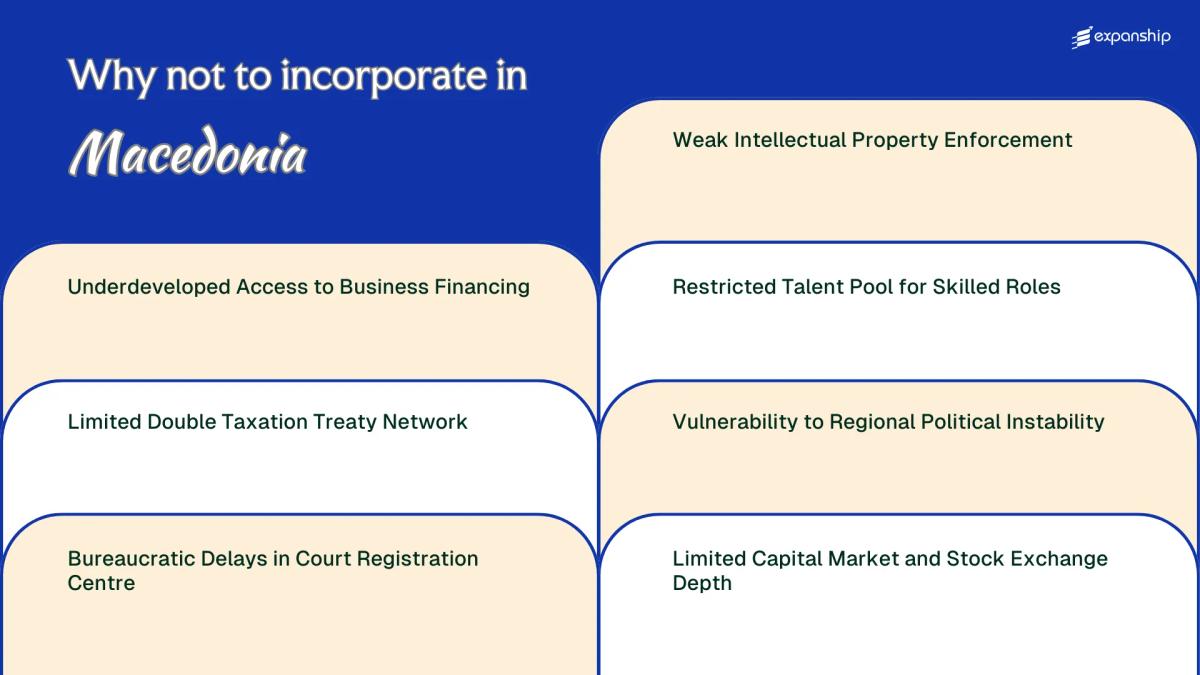
Underdeveloped Access to Business Financing
North Macedonia business financing limitations affect foreign-incorporated entities from the earliest stages of operation. Domestic credit markets remain shallow, and the structural gaps in business lending create tangible costs for firms dependent on external capital.
Shallow Credit Access for Commercial Borrowers
Banks operating under the supervision of the National Bank of the Republic of North Macedonia apply conservative collateral requirements and short loan tenors, which disadvantage businesses without established local assets. Lending to the private sector as a percentage of GDP has historically lagged behind EU member state averages, reflecting a banking sector oriented toward retail rather than commercial borrowing.
SME lending challenges are compounded by the absence of well-capitalised development finance alternatives at scale. Restricted access to capital means foreign-owned entities frequently cannot match the credit terms available to them in their home markets.
Limited Institutional Financing Instruments
Non-bank financing options, including private equity and venture capital markets, remain underdeveloped relative to the scale of commercial demand. A business requiring growth capital beyond what domestic banks offer has few institutional channels within the jurisdiction to bridge that gap.
This structural limitation forces reliance on foreign parent company funding or international lenders, adding transfer pricing compliance obligations under domestic tax rules and increasing operational complexity.
Foreign businesses incorporated here should account for the realistic probability of funding growth through capital injected from abroad, as local institutional financing will not substitute for credit facilities available in more developed markets.
Limited Double Taxation Treaty Network
North Macedonia double taxation treaty limitations present a concrete structural problem for foreign-owned entities operating across borders. The country has signed treaties with roughly 50 jurisdictions, a network that leaves significant gaps when your clients, suppliers, or shareholders are based in countries outside that list.
Without treaty coverage, withholding taxes on dividends, royalties, and interest payments between your North Macedonian entity and an uncovered jurisdiction apply at domestic statutory rates rather than reduced treaty rates. That directly increases the tax cost of cross-border profit repatriation.
This creates measurable friction in several practical scenarios:
- Payments to service providers in non-treaty countries trigger higher withholding, reducing net cash received by the counterparty and complicating contract pricing
- Shareholders resident outside covered jurisdictions face full domestic withholding on dividend distributions, eroding actual returns
- Cross-border royalty arrangements with entities in uncovered markets carry elevated tax costs that reduce the commercial viability of IP-based structures
- Double taxation risk on the same income stream forces your firm to seek unilateral relief mechanisms, which are less certain and more administratively demanding
The limited DTT coverage in North Macedonia companies predominantly affects businesses with operations spanning emerging markets or regions where bilateral negotiations have not progressed.

Company Incorporation in North Macedonia
Set up your business entity in North Macedonia with guidance on structure, registration, and cross-border tax considerations.
Bureaucratic Delays in Court Registration Centre
North Macedonia court registration delays represent one of the more operationally disruptive aspects of setting up a business there. Company registration is handled by the Central Registry of North Macedonia (Centralen Registar), and processing times — while officially brief on paper — frequently extend beyond stated deadlines in practice due to administrative backlogs and manual verification requirements.
The gap between the official timeline and the actual experience matters directly to your business. If your legal entity is not registered, you cannot open a corporate bank account, execute contracts under a local legal identity, or begin VAT registration — all of which are sequential dependencies.
| Registration Stage | Official Timeframe | Practical Delay Risk |
|---|---|---|
| Company name reservation | 1 day | Low, but rejected names restart the clock |
| Document submission review | 1-3 days | Frequently extended for foreign-notarised documents |
| Entry in trade register | Up to 4 hours post-approval | Dependent on prior stages clearing without error |
| Full registration certificate issuance | Same day as entry | Delayed if supporting documentation is queried |
Foreign-notarised documents must typically be apostilled and, in some cases, translated by a certified translator into Macedonian before the Central Registry will accept them. Each rejected or incomplete submission resets the review cycle, compounding the delay further.
Procedural errors carry disproportionate cost for foreign incorporators, since correcting them often requires coordinating across multiple countries to re-notarise or re-apostille source documents. There is no fast-track submission channel specifically designated for foreign-owned entities.
Weak Intellectual Property Enforcement
Weak intellectual property enforcement in North Macedonia remains a documented concern for foreign businesses that rely on brand identity, proprietary technology, or licensed content. The State Office of Industrial Property (SOIP) handles trademark and patent registration, but registration alone does not guarantee protection in practice.
Enforcement gaps appear at the implementation level. Civil courts handling IP disputes lack the specialization seen in dedicated IP tribunals found in larger EU member states, which extends litigation timelines and increases legal costs for rights holders pursuing infringement claims.
Trademark enforcement challenges are particularly acute in sectors involving counterfeit goods and software piracy. The EU IP enforcement report has historically flagged the Western Balkans region, including North Macedonia, for elevated piracy and counterfeiting rates compared to EU member state averages.
- SOIP registration is legally required before you can assert trademark rights in local courts
- IP infringement claims must be filed through general civil courts, not specialized IP tribunals
- Criminal enforcement of IP violations depends on the state prosecution service, which prioritizes cases selectively
- Border enforcement against counterfeit imports operates under customs authority, requiring separate recordation with customs officials
North Macedonia's IP laws are largely aligned with EU directives as part of its EU accession commitments, yet domestic enforcement capacity has not kept pace with the legislative framework.
Restricted Talent Pool for Skilled Roles
North Macedonia skilled workforce shortages present a measurable challenge for foreign firms seeking to staff technical, legal, or managerial roles locally.
Structural Gaps in the Available Labor Market
Emigration has persistently reduced the domestic supply of qualified professionals, particularly in engineering, IT, and finance. According to World Bank assessments, North Macedonia has experienced sustained outward migration of working-age adults, which directly reduces the pool your business can draw from when hiring locally.
Firms operating under sectors regulated by the Agency for Foreign Investments and Export Promotion, or those requiring licensed professionals under domestic law, face particular difficulty filling specialist positions. Talent pool restrictions compound this further when roles require bilingual proficiency or EU-standard certifications that local candidates may not hold.
Operational Consequences for Foreign Businesses
Recruiting internationally to fill gaps is possible but introduces additional cost and administrative burden, including work permit procedures under the Law on Employment of Foreigners. Reliance on expatriate staff raises payroll costs and adds compliance obligations that domestic competitors do not face at the same scale.
Brain drain challenges are not distributed evenly across sectors; technology and legal services report the most acute shortfalls. This concentration means a foreign firm in those sectors carries a disproportionate recruitment burden compared to one operating in less specialized industries.
Addressing Workforce and Operational Challenges in North Macedonia
Speak with our corporate services team about structuring your North Macedonia entity to manage local compliance obligations, staffing constraints, and registration requirements effectively.
Vulnerability to Regional Political Instability
North Macedonia regional political instability risks create measurable exposure for foreign-owned entities, particularly those dependent on cross-border supply chains, EU market access, or predictable regulatory continuity. The Western Balkans political risk environment affects the country disproportionately given its unresolved bilateral disputes and contested domestic political history.
- The Prespa Agreement with Greece, while resolving the naming dispute that blocked NATO and EU accession, remains politically contested domestically, creating periodic governance instability that can delay legislative reform affecting foreign businesses.
- Unresolved border and recognition issues with Bulgaria have stalled EU accession negotiations since 2020, leaving your firm without the regulatory harmonization protections that EU membership would provide.
- Recurring coalition government fragility means that business-critical legislation, including tax and investment law amendments, can be postponed or reversed between parliamentary terms.
- Proximity to Serbia, Kosovo, and Bosnia means that regional escalations can trigger currency pressure on the Macedonian denar and disrupt trade corridor reliability.
- The country's candidate status does not bind it to EU dispute resolution mechanisms, so your business cannot rely on those frameworks for cross-border enforcement.
Limited Capital Market and Stock Exchange Depth
North Macedonia capital market limitations directly constrain how foreign-owned companies can raise equity, exit investments, or attract institutional capital locally.
The Macedonian Stock Exchange (MSE) operates under the Securities Law and is supervised by the Securities and Exchange Commission of North Macedonia (SEC). Trading volumes remain thin, with a narrow pool of listed companies relative to regional peers in Southeast Europe.
For a foreign firm seeking a local IPO or secondary listing as a capital-raising mechanism, the MSE offers an insufficient investor base to support meaningful price discovery or liquidity. This forces growth-stage businesses to seek financing through private placements or foreign capital markets, adding cost and structural complexity.
Equity financing restrictions are also compounded by limited domestic institutional investment. Local pension funds and insurance companies — the typical anchor investors in developed exchanges — manage relatively modest assets, reducing demand for new equity issuances.
A foreign technology firm seeking to raise EUR 5 million through a local equity offering on the MSE would likely find insufficient institutional demand to complete the round at a competitive valuation, effectively requiring the company to pursue financing from Vienna, Frankfurt, or private regional funds — each adding legal, advisory, and cross-border compliance costs that a more liquid domestic market would eliminate.
Strategies to Overcome These Challenges
Overcoming North Macedonia incorporation challenges requires a structural approach rather than reactive adjustments after problems surface. The disadvantages covered in this blog span financing access, treaty gaps, registration delays, IP enforcement, talent constraints, political risk, and capital market depth.
- Register your entity through the Central Registry (Централен регистар) to confirm all documentation requirements upfront, reducing processing delays at the Court Registration Centre.
- Structure intercompany agreements under jurisdictions with bilateral investment treaties that extend protections to North Macedonia-based entities, compensating for gaps in the local double taxation treaty network.
- File intellectual property rights with the State Office of Industrial Property (SOIP) immediately upon incorporation, before commencing commercial operations.
- Incorporate talent acquisition plans that account for cross-border hiring within the Western Balkans region, given the domestic skilled labour constraints.
- Maintain capital reserves in foreign accounts to reduce dependence on local bank financing and the shallow domestic capital market.
- Monitor political developments through the Secretariat for European Affairs, particularly regarding EU accession progress, which directly affects regulatory stability.
These steps operate within a legal framework governed by the Trade Companies Law and sector-specific regulations administered by bodies including the Securities and Exchange Commission. Structural decisions made at the point of incorporation carry the most durable compliance implications under this framework.
North Macedonia's Overall Business Viability
Compliance Services for Companies in North Macedonia
Maintain your company's good standing with ongoing compliance support, from annual filings and statutory reporting to regulatory updates under Macedonian law.
North Macedonia business viability despite drawbacks is a question best answered by examining what the jurisdiction actually offers against what it costs you to manage its shortcomings. The flat 10% corporate tax rate, EU candidate status, and relatively low incorporation costs through the Central Registry (Centralen Registar) give the country a credible foundation. These advantages are real, but they operate alongside the financing gaps, enforcement weaknesses, and political exposure this blog has detailed.
| Pros | Cons |
|---|---|
| A flat 10% corporate income tax rate keeps the statutory tax burden low. | The treaty network is limited, creating withholding tax exposure on cross-border payments. |
| EU candidate status provides a degree of long-term regulatory alignment. | Court Registration Centre delays can extend the incorporation and change-of-registration timeline. |
| Operating costs, including salaries, remain comparatively low in the region. | Skilled talent in technical and specialist roles is in short supply domestically. |
| The investment climate is supported by the Foreign Investment Law. | Intellectual property enforcement through local courts is inconsistent in practice. |
| Geographic position supports access to Balkan and EU markets. | Regional political dynamics introduce periodic uncertainty into the operating environment. |
Conclusion
The cons of North Macedonia company registration are real and structurally grounded. The country occupies a mid-tier position among Balkan business destinations, offering a low flat tax rate but offset by measurable operational constraints. Thin access to business financing limits growth capital for early-stage firms. The treaty network remains narrower than competing EU member states, creating cross-border tax exposure. Intellectual property enforcement gaps present ongoing risk for IP-dependent businesses. Structural limitations like these do not disappear through planning alone, and professional guidance on local regulatory processes under the Central Registry remains a practical requirement for foreign incorporators.
Expanship's North Macedonia Incorporation Services
From managing Court Registration Centre filings to addressing the gaps in North Macedonia's IP enforcement framework, the operational demands of incorporating here require local knowledge and precise execution. Expanship North Macedonia incorporation services are designed to reduce that burden by handling the procedural and compliance requirements that slow down foreign businesses. Our role is to manage complexity at the formation and post-incorporation stage, not to change the realities of the market.
Beyond formation, your business benefits from a structured range of support across every critical stage:
- We prepare and submit all company registration documentation on your behalf.
- We provide a registered agent and local office address to satisfy statutory requirements.
- Our team liaises directly with government bodies and handles all regulatory filings.
- We manage ongoing compliance obligations to keep your entity in good standing.
- We facilitate introductions to banking institutions suited to your business profile.
- We handle tax registration and coordinate with local authorities on your behalf.
Reach out to Expanship North Macedonia to discuss how we can support your incorporation process.
Frequently Asked Questions (FAQ)
The impact depends on where your parent company or investors are based. North Macedonia has signed treaties with roughly 50 countries, so businesses structured through jurisdictions not covered by those agreements face full withholding tax exposure on dividends, royalties, and interest payments. Companies with holding structures in non-treaty jurisdictions carry a measurably higher tax burden than those based in covered countries.
Straightforward registrations are legally required to be processed within four hours of submission under the one-stop-shop system, but document rejections, notarisation requirements, and incomplete filings routinely extend that timeline to several days or weeks. Each resubmission resets the process, and there is no administrative penalty imposed on the Registry for delays caused by its own review process.
The Macedonian Stock Exchange has significantly lower trading volumes and market capitalisation than the Belgrade or Zagreb exchanges, making equity-based fundraising practically unavailable for most foreign-owned entities. Bank lending remains the primary external financing channel, and commercial banks apply conservative collateral requirements that disadvantage newly incorporated foreign firms without local asset bases.
You would need to recruit from abroad, which triggers North Macedonia's work permit process under the Law on Foreigners. Obtaining a work and residence permit for a non-EU national typically takes several weeks and requires demonstrated proof that no suitable local candidate was available. This adds both cost and delay to staffing plans that depend on imported expertise.
Political instability does not directly alter the legal standing of a registered entity, but it can affect regulatory enforcement priorities, the pace of EU accession-linked reforms, and foreign investor protections that depend on treaty implementation. North Macedonia's EU candidate status means some reforms are externally anchored, but domestic political disputes have historically stalled legislation affecting business registration, tax administration, and judicial reform.
The Macedonian Stock Exchange does not provide a realistic exit or expansion mechanism for most businesses, since secondary market liquidity is low and listing requirements are not matched by sufficient investor demand. This effectively restricts growth financing to retained earnings, bank debt, or foreign parent company funding, which concentrates financial risk and limits the structural options available to scaling businesses.
Legal Disclaimer
The information provided in this article is for general informational purposes only and does not constitute legal, tax, or professional advice. While we strive to ensure the accuracy and timeliness of the content, laws and regulations are subject to change, and the application of laws can vary widely based on specific facts and circumstances.
Readers should not act upon this information without seeking professional counsel tailored to their individual situation. Expanship and its authors disclaim any liability for actions taken or not taken based on the content of this article.
For specific advice regarding your business setup, compliance requirements, or any legal matters, please consult with qualified legal and tax professionals in the relevant jurisdiction.