
Key Takeaways
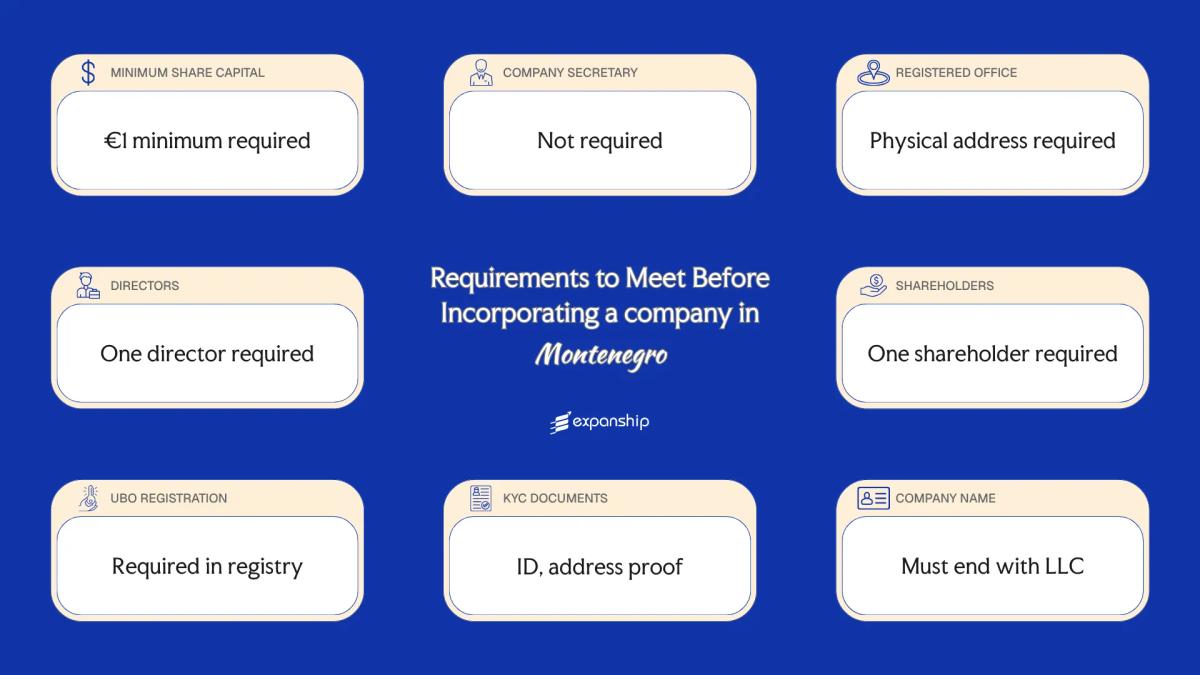
- Entities incorporating in Montenegro as a d.o.o. must meet a minimum registered share capital threshold of one euro, as established under the Law on Business Organisations.
- Beneficial ownership information must be registered with the Central Registry of Commercial Entities (CRCE) from the point of incorporation, pursuant to Montenegro's AML Law.
- The Central Registry of the Commercial Court serves as the mandatory registration authority for all business entities in Montenegro, and failure to satisfy its documentary requirements results in rejection of the registration application.
- Incorporation requirements in Montenegro vary depending on the legal form of the entity, the sector of operation, and whether the owners are domestic or foreign nationals, making jurisdiction-specific due diligence a formal prerequisite to filing.
Company formation in Montenegro is governed by the Law on Business Organisations, with the Central Registry of the Commercial Court serving as the primary body responsible for registering business entities.
This article covers the formal incorporation requirements that apply under that framework, from capital thresholds to documentation and compliance obligations.
Failure to meet these requirements results in rejection of the registration application or, where violations are identified post-registration, potential deregistration and legal liability under applicable Montenegrin law.
Requirements can differ depending on the legal form of the entity, the sector in which it will operate, and whether the owners are domestic or foreign nationals.
This article is most relevant to foreign investors and business owners in the process of assessing Montenegro company formation compliance before initiating a registration application.
Minimum Share Capital Requirements in Montenegro

Montenegro minimum share capital requirements are governed by the Law on Business Organizations, which sets a statutory minimum for the most commonly used private entity structure. The Central Registry of Commercial Entities (CRCE) administers the incorporation process and verifies that capital obligations are met at the point of registration.
Under Montenegrin law, share capital in a društvo sa ograničenom odgovornošću (DOO) operates on a par value system, where each share carries a nominal value. Capital deposit is an incorporation requirement rather than an ongoing statutory obligation, though the subscribed capital must remain intact as a matter of company solvency law.
| Parameter | Detail |
|---|---|
| Minimum Authorized Share Capital | EUR 1.00 for a DOO |
| Maximum Authorized Share Capital | No statutory maximum |
| Minimum Paid-Up Capital | EUR 1.00 |
| Paid-Up Requirement at Incorporation | Capital must be deposited before registration with the CRCE |
| Accepted Currency | Euro (EUR) |
| Accepted Forms of Contribution | Cash and non-cash contributions (in-kind assets subject to valuation) |
| Timeframe to Deposit Capital | Prior to submission of incorporation documents to the CRCE |
A statutory minimum of EUR 1.00 does not eliminate the need for a defined capital structure. Your DOO must still specify share denominations and ownership proportions in its founding act, which the CRCE reviews at registration.
Company Secretary Requirements in Montenegro
Under Montenegro's corporate framework, there is no statutory requirement for companies to appoint a company secretary. The Law on Business Organizations governs the internal structure of a montenegrin drustvo sa ogranicenom odgovornoscu (d.o.o.), and it does not mandate this role as a condition for incorporation or ongoing compliance.
That said, some firms voluntarily designate an individual or service provider to handle Montenegro company secretary requirements on a practical basis, covering tasks such as maintaining the company's statutory books, coordinating filings with the Central Registry of Business Entities (CRPS), and ensuring timely submission of annual financial statements.
Where such a role is adopted, the following general eligibility considerations apply:
- No formal licensing regime currently governs who may act in a secretarial capacity.
- Both natural persons and legal entities may perform these functions contractually.
- There is no statutory residency requirement tied to this role.
- Corporate service providers operating under Montenegrin law may fulfill these duties.
- The function is typically defined by the company's founding act or internal regulations.

Incorporate a Company in Montenegro
Set up your business entity in Montenegro with guidance on registration, legal structure, and compliance requirements.
Registered Office Requirements in Montenegro
Registered office requirements in Montenegro are governed by the Law on Business Organisations, which mandates that every company registered with the Central Registry of the Commercial Court maintain a designated legal seat within the country's territory. Using a non-compliant or fictitious address can result in the company being struck from the register or subjected to enforcement proceedings by the Commercial Court.
- A physical address is required; a P.O. box alone does not satisfy the legal seat requirement.
- Virtual office addresses are generally permitted provided they correspond to a real, identifiable premises with a verifiable street address.
- The registered address must be located within Montenegro; a foreign address does not fulfil the legal seat obligation.
- Supporting documentation, such as a lease agreement or proof of ownership, is typically required to evidence the right to use the address.
- The registered address is publicly listed in the Central Registry of the Commercial Court and is accessible through official registry searches.
- Any change to the registered address must be formally notified to the Central Registry, and the updated information must be reflected in the company's registration data without undue delay.
Director Requirements in Montenegro
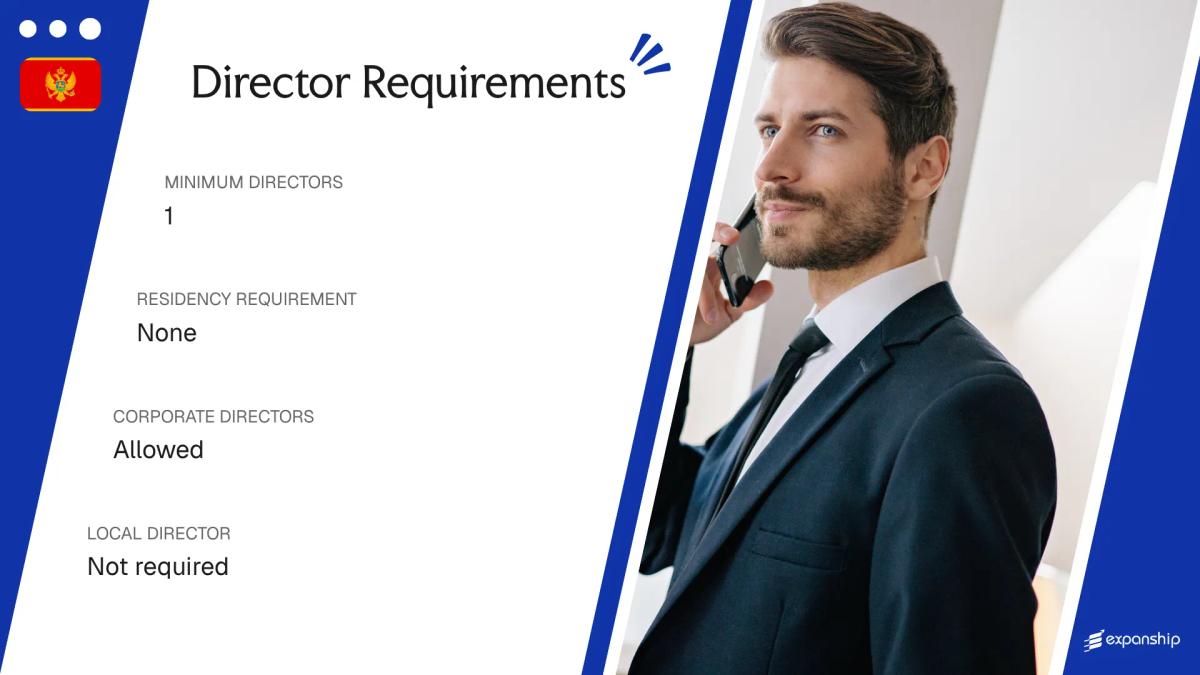
Under Montenegro director requirements, a director of a društvo sa ograničenom odgovornošću (DOO) assumes statutory duties governed by the Law on Business Organizations, including fiduciary obligations to act in the company's best interests and personal liability for damages caused through negligent or unlawful conduct.
| Parameter | Detail |
|---|---|
| Minimum Number of Directors | One director is required. |
| Maximum Number of Directors | No statutory maximum is prescribed. |
| Local/Resident Director Required | No local or resident director is required. |
| Nationality Restrictions | No nationality restrictions apply. |
| Minimum Age Requirement | Directors must be at least 18 years of age. |
| Corporate Directors Permitted | Corporate directors are not permitted; the director must be a natural person. |
| Director Must Be a Shareholder | No, a director is not required to hold shares in the company. |
| Publicly Listed on Registry | Yes, director details are recorded in the Central Registry of the Commercial Court and are publicly accessible. |
| Disqualification Conditions | A person may be disqualified from serving as director if subject to a court prohibition on performing business activities under Montenegrin law. |
Foreign nationals can serve as the sole director of a Montenegrin DOO without any local co-director, residency requirement, or prior approval from a regulatory authority.
Shareholder Requirements in Montenegro
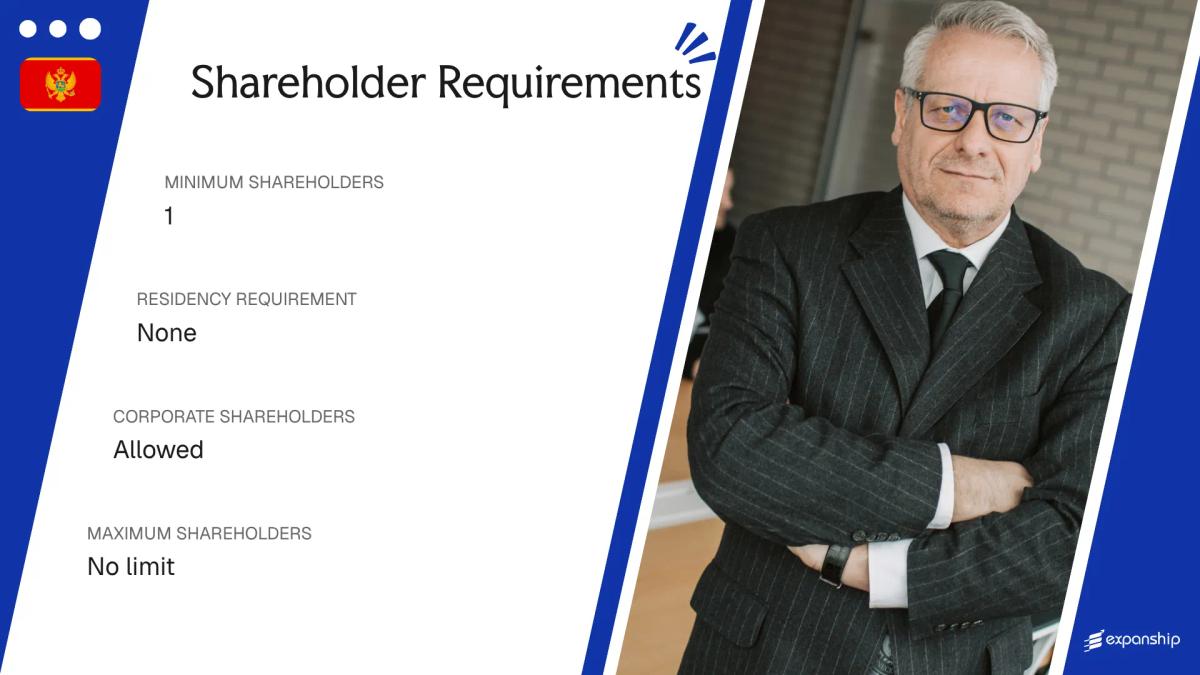
A Montenegro DOO (društvo sa ograničenom odgovornošću) requires at least one shareholder, meaning a sole shareholder structure is fully permitted under the Law on Business Organizations. No statutory maximum applies, allowing the company to accommodate multiple shareholders as the business scales.
Nationality and Residency Restrictions
Montenegro shareholder requirements impose no nationality or residency conditions on shareholders. Foreign individuals and entities may hold 100% of the share capital without restriction.
Corporate Shareholders
Corporate entities are permitted to act as shareholders in a DOO. No additional licensing or local presence is required solely by virtue of a legal entity holding shares.
Shareholder Liability
Shareholder liability is limited to each shareholder's capital contribution. Under the Law on Business Organizations, this protection may be disregarded if a court finds that a shareholder misused the corporate structure to defraud creditors.
Register of Shareholders
A register of shareholders must be maintained internally by the company. Filing obligations with the Central Registry of Commercial Entities apply when ownership changes occur.
Shareholder Structuring Support for Your Montenegro Incorporation
Get guidance on structuring your shareholding arrangement in compliance with Montenegro's Law on Business Organizations before and during the incorporation process.
UBO / Beneficial Ownership Registration Requirements in Montenegro
Montenegro beneficial ownership registration requirements are governed by the Law on Prevention of Money Laundering and Terrorist Financing, which defines a beneficial owner as any natural person who ultimately owns or controls more than 25% of shares or voting rights in a legal entity.
- Identify all natural persons meeting the 25% ownership or control threshold before or at the point of registration.
- Submit beneficial ownership data to the Central Registry of the Commercial Court (CRPS) during the company registration process.
- Provide each UBO's full name, date of birth, nationality, and residence details.
- File any changes to UBO information with the CRPS within 15 days of the change occurring.
| Parameter | Detail |
|---|---|
| Ownership Threshold for UBO Status | 25% of shares or voting rights |
| Filing Authority | Central Registry of the Commercial Court (CRPS) |
| Disclosure Deadline at Incorporation | At the time of company registration |
| Publicly Accessible Register | Yes |
| Penalties for Non-Disclosure | Fines applicable under the Law on Prevention of Money Laundering and Terrorist Financing |
| Ongoing Update Obligation | Changes must be filed within 15 days |
KYC / Document Requirements in Montenegro
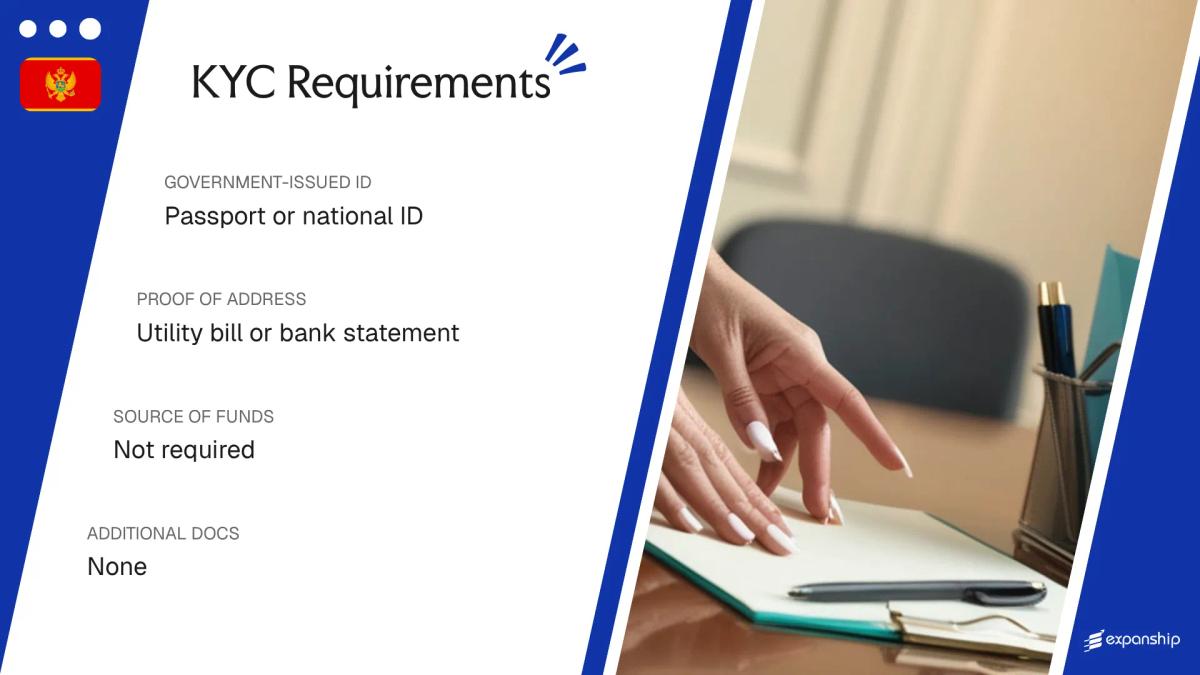
Montenegro KYC document requirements apply at the point of incorporation and are governed by the Law on Prevention of Money Laundering and Terrorist Financing, administered by the Administration for Prevention of Money Laundering.
Individual / Personal Documents
- Valid government-issued photo ID (passport or national identity card) for each director, shareholder, and beneficial owner
- Proof of residential address dated within three months, such as a utility bill or bank statement
- Completed and signed KYC/AML questionnaire as required by the incorporating agent or notary
- Tax identification number or equivalent from the individual's country of residence
Corporate Documents
- Certificate of incorporation or equivalent constitutional document for the corporate shareholder or director
- Register of directors and register of shareholders issued by the relevant home-jurisdiction authority
- Proof of the corporate entity's registered office address
Source of Funds Documentation
- Recent bank statements (typically covering the previous three to six months) evidencing the origin of capital
- Audited financial statements where the investing entity is a corporate body
- A written declaration of source of funds may be required where bank documentation is insufficient
Notarisation and Apostille Requirements
- Foreign-issued documents generally require apostille certification under the Hague Convention
- Official translations into Montenegrin must be certified by a court-approved translator
- Notarisation requirements depend on the document type and the issuing country's legal system
The most common reason for incorporation rejection is submission of address proof documents that exceed the three-month validity threshold accepted by the notary.
Company Name Requirements in Montenegro
Proposed company names in Montenegro are assessed at the point of incorporation to confirm they are distinguishable from existing registered entities. A name that is identical or confusingly similar to one already on the Central Registry will be rejected.
Your chosen name must be in the Montenegrin language using the Latin or Cyrillic script, and must include a legal form suffix such as "d.o.o." for a limited liability company. No minimum or maximum word length is formally prescribed, though the name must be sufficiently distinct.
Certain words are either restricted or prohibited outright. Terms implying a connection to state institutions, international organisations, or regulated sectors such as banking and insurance require prior authorisation from the relevant supervisory authority before the name can be registered.
Name reservation is available through the Central Registry of the Commercial Court. A reserved name is held for a defined period prior to formal incorporation, preventing other applicants from registering an identical or similar designation in the interim.
Compliance Services for Companies in Montenegro
Ongoing compliance obligations for Montenegrin companies include annual financial reporting, tax filings, and maintaining accurate corporate records. Expanship supports your entity through each requirement.
Conclusion
Montenegro company incorporation requirements are governed primarily by the Law on Business Organizations, with oversight from the Central Registry of Commercial Entities (CRCE). The requirements covered across this guide reflect a structured framework that foreign investors must satisfy before an entity becomes operational.
Two requirements warrant particular attention. Registered share capital for a d.o.o. is set at a minimum of one euro, though the UBO registration obligation under the AML Law introduces an additional compliance layer that applies from the point of incorporation. Once these requirements are understood, the practical work of engaging local service providers and preparing formation documents begins.
Expanship's Corporate Services for Montenegro Expansion
Satisfying Montenegro's UBO registration requirements, registered office obligations, and director documentation standards involves coordinating with multiple local authorities, including the Central Registry of Business Entities. Expanship's Montenegro corporate services expansion support is structured around those specific administrative layers, reducing the coordination burden on your team without removing your responsibility for compliance.
From initial formation through ongoing maintenance, your business has access to a defined range of services:
- We prepare and file all company registration documents with the Montenegrin Central Registry.
- A registered agent and compliant local office address are provided to satisfy residency requirements.
- Our team liaises directly with government bodies and regulatory authorities on your behalf.
- Post-incorporation obligations, including annual filings and UBO updates, are managed on a continuing basis.
- Banking introduction support is available to assist with account establishment in Montenegro.
- Tax registration and coordination with local fiscal authorities are handled as part of your setup.
To discuss your requirements, contact Expanship Montenegro.
Frequently Asked Questions (FAQ)
A foreign national can be appointed as sole director of a Montenegro d.o.o. without holding a Montenegrin residence permit. The Companies Act does not impose a residency or nationality requirement on directors. However, the appointed director will need a Montenegrin tax identification number (PIB), which must be obtained through the Tax Administration before or during the registration process.
Failure to register beneficial ownership information with the Central Registry of Commercial Entities constitutes a violation under Montenegro's Law on Prevention of Money Laundering and Terrorist Financing. Companies found non-compliant can face financial penalties, and in cases of prolonged or deliberate non-disclosure, responsible individuals may face additional personal liability. The CRCE cross-references UBO data with other regulatory bodies, so gaps in registration are identifiable during routine compliance checks.
Montenegro's Companies Act does not mandate the appointment of a company secretary as a distinct corporate officer, so the question of residency for that role does not arise in the same way it does in common law jurisdictions. Administrative and compliance functions are typically handled by the director or an authorised representative. If you appoint a legal representative to act on behalf of the company before the CRCE, that person must hold a valid power of attorney but is not required to be a Montenegrin resident.
The CRCE requires that the company name be in the Montenegrin language and written in the Latin script, though foreign words or brand names can be included as part of the full registered name if the core designation complies with local naming rules. Names that are identical or confusingly similar to an already-registered entity will be rejected outright. A name availability check through the CRCE's online registry is advisable before submitting registration documents.
A functional, staffed office is not required to satisfy Montenegro's registered office obligation. Under the Companies Act, the registered address serves as the official address for legal correspondence and regulatory notices, and a registered address service provided by a licensed local provider is acceptable. The address must be a genuine, verifiable location within Montenegro — a post office box alone will not satisfy the requirement.
Legal Disclaimer
The information provided in this article is for general informational purposes only and does not constitute legal, tax, or professional advice. While we strive to ensure the accuracy and timeliness of the content, laws and regulations are subject to change, and the application of laws can vary widely based on specific facts and circumstances.
Readers should not act upon this information without seeking professional counsel tailored to their individual situation. Expanship and its authors disclaim any liability for actions taken or not taken based on the content of this article.
For specific advice regarding your business setup, compliance requirements, or any legal matters, please consult with qualified legal and tax professionals in the relevant jurisdiction.