
Key Takeaways
- Montenegro's 9% flat corporate income tax rate is one of the lowest in Europe, and the absence of withholding tax on reinvested profits means growth-phase businesses can accumulate capital at the entity level without triggering an additional tax event.
- Foreign investors benefit from 100% ownership rights in a D.O.O. without sectoral restrictions, with registration processed through the Central Registry (CRPS) under a formation framework that does not impose prohibitive share capital thresholds.
- Montenegro's Companies Act provides the D.O.O. structure with a stable, codified legal foundation that reduces regulatory uncertainty for foreign-owned entities maintaining long-term operations in the jurisdiction.
- An expanding bilateral double tax treaty network reduces cross-border tax friction for shareholders and clients in treaty partner countries, making the jurisdiction particularly efficient for holding structures and internationally oriented service businesses.
Montenegro is an independent sovereign state in southeastern Europe, situated on the Adriatic coast and bordering several Western Balkan nations. The benefits of incorporating in Montenegro draw increasing attention from foreign entrepreneurs, partly because the country maintains a low-tax fiscal posture grounded in a flat corporate income tax structure. Company registration falls under the oversight of the Central Registry, the authority responsible for commercial entity registration and related compliance filings. Foreign nationals face no general restrictions on ownership of a locally registered entity, and the legal framework explicitly permits 100% foreign ownership across most sectors.
The D.O.O. (Društvo sa ograničenom odgovornošću) is the legal vehicle most commonly used by international businesses establishing a presence in the country.
Openness to foreign direct investment is reflected both in national legislation and in bilateral agreements the government has pursued with trading partners. This article examines the principal advantages that Montenegro company formation offers to businesses considering this jurisdiction for their operational or holding structure.
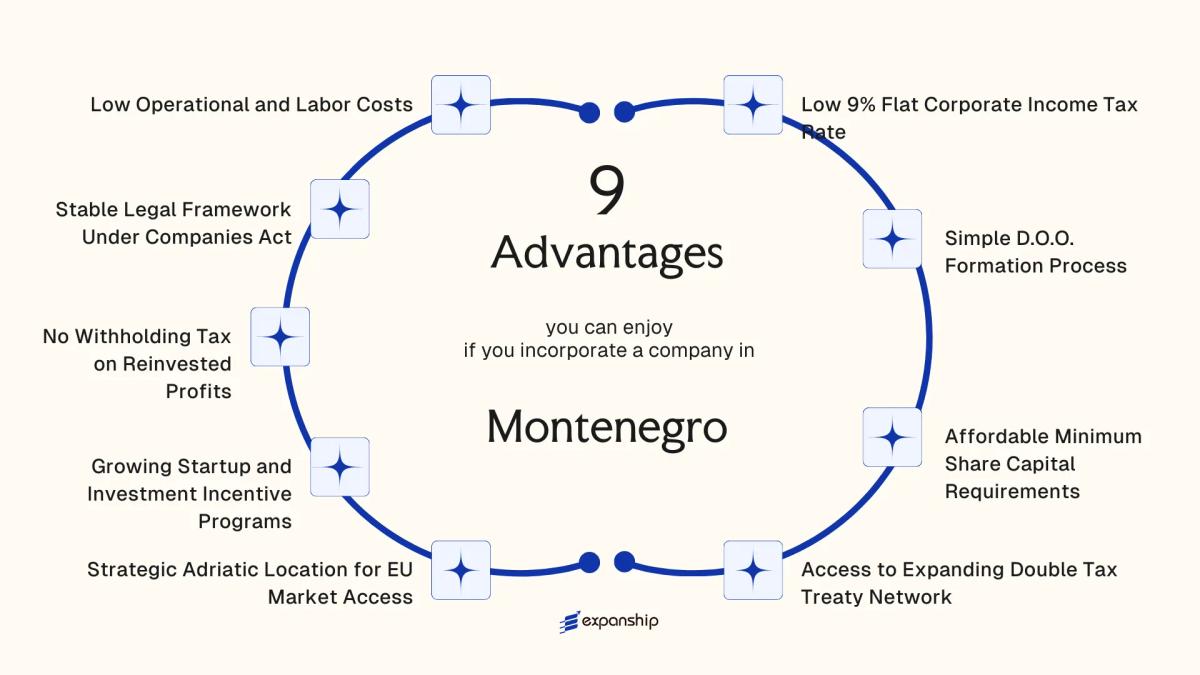
Low 9% Flat Corporate Income Tax Rate
Montenegro applies a flat 9% corporate income tax rate under the Corporate Income Tax Law, one of the lowest statutory rates among European jurisdictions. For a foreign business owner, this rate applies uniformly regardless of profit size, removing the tiered complexity common in larger economies.
What the Rate Covers
Resident companies are taxed on worldwide income, while non-resident entities are taxed only on Montenegro-sourced income. This distinction matters if your firm holds assets or generates revenue across multiple countries, as it directly affects how much of your global income falls within Montenegrin tax jurisdiction.
Why the Rate Matters to Foreign Investors
The EU average corporate tax rate sits above 21%, making the Montenegro 9% flat corporate tax rate structurally significant for businesses prioritizing tax efficiency. A foreign investor can retain a substantially higher share of after-tax profit compared to operating through a subsidiary in most Western European countries.
Taxable profit is calculated as the difference between revenues and deductible expenses recognized under Montenegrin accounting standards, so understanding what qualifies as deductible has direct bearing on your effective rate.
Your effective tax burden stays predictable year over year, since a flat rate eliminates bracket-related uncertainty as your profits grow.
Simple D.O.O. Formation Process
Registering a D.O.O. (Društvo sa ograničenom odgovornošću) in Montenegro is governed by the Companies Act, which sets out a formation procedure that foreign nationals can complete without an in-country legal presence at every stage. The process is administered through the Central Registry of Commercial Entities (CRCE), and registration can typically be completed within a few business days of submitting the required documentation. For foreign entrepreneurs accustomed to multi-week timelines in other European jurisdictions, this speed has direct cost implications — less waiting means earlier operational capacity.
The CRCE operates as a single-window registry, meaning that trade registration, tax identification, and statistical registration are handled within the same administrative process rather than across separate agencies. This consolidation reduces coordination overhead for foreign founders who are managing formation remotely.
The documentation threshold for a D.O.O. is structured to avoid unnecessary barriers:
- A single founder is sufficient, so there is no requirement to assemble a shareholder group before filing
- No local director is mandated under the Companies Act, giving foreign owners full control of the management structure
- The founding act can be executed before a Montenegrin notary in a single appointment, avoiding extended legal drafting timelines
- Corporate shareholders can act as founders, which allows holding structures to incorporate a subsidiary without individual nominee arrangements

Incorporate a D.O.O. in Montenegro
Register your Montenegrin limited liability company through the Central Registry of Commercial Entities with Expanship handling documentation, notarization coordination, and compliance setup.
Affordable Minimum Share Capital Requirements
Montenegro's minimum share capital requirement for a D.O.O. (Društvo sa Ograničenom Odgovornošću) is set at €1. Established under the Companies Act (Zakon o privrednim društvima), this threshold means you can legally register a limited liability entity without committing significant capital at the formation stage.
For a foreign founder, this has a direct practical consequence: startup capital that would otherwise be tied to a statutory deposit can be directed toward operations, staffing, or market entry costs from day one.
| Feature | Detail |
|---|---|
| Minimum Share Capital | €1 |
| Governing Law | Companies Act (Zakon o privrednim društvima) |
| Entity Type | D.O.O. (Limited Liability Company) |
| Capital Deposit Requirement | Required at registration |
| Liability Exposure | Limited to contributed capital |
The €1 floor does not impose any minimum paid-up ratio beyond the stated amount, which removes a common administrative barrier found in higher-threshold regimes across the region. A business can be structured with minimal initial equity while still benefiting from the full liability protection that the D.O.O. form provides.
This low capital requirement is particularly relevant for consultancies, digital service firms, and holding structures, where operational capital needs are modest and the primary value lies in intellectual or contractual assets rather than physical investment.
Access to Expanding Double Tax Treaty Network
Montenegro's double tax treaty network benefits foreign businesses by reducing or eliminating the risk of the same income being taxed twice across different jurisdictions. The country has concluded DTTs with over 40 countries, covering major trading partners across Europe, the Middle East, and Asia. For a foreign-owned entity, this directly affects how dividends, royalties, interest, and capital gains are taxed at source.
Under most of these agreements, reduced withholding rates apply to cross-border income flows. A business structured through a Montenegrin entity can use treaty provisions to minimize tax friction on payments to and from partner jurisdictions, which has measurable impact on net returns for international investors.
Treaty eligibility generally requires that the entity has genuine tax residency in Montenegro, meaning it must be managed and controlled from within the country under domestic tax law.
Keep these points in mind:
- Confirm the specific treaty with your target jurisdiction before structuring payments
- Treaty benefits apply to tax residents, not just registered entities
- Royalty and dividend provisions vary by individual treaty
- Beneficial ownership rules may affect whether reduced rates apply to your structure
Montenegro's DTT with several EU member states was inherited and renegotiated from agreements originally signed under the Federal Republic of Yugoslavia, giving the network a longer operational history than the country's own independence in 2006 would suggest.
Strategic Adriatic Location for EU Market Access
Montenegro's Adriatic location gives your business direct geographic proximity to the EU's southern flank, with land borders shared with EU member states Croatia and Slovenia accessible within hours, and sea routes connecting to Italian ports across the Adriatic. For a company registered here, that physical positioning translates into shorter logistics chains and easier cross-border commercial relationships with EU-based partners and customers.
EU Accession Status as a Structural Business Advantage
Montenegro has held EU candidate status since 2010 and opened accession negotiations in 2012, making it one of the most advanced candidates in the Western Balkans process. Its domestic legal and regulatory alignment with the EU acquis communautaire is already substantial, which means the operating environment for your firm is progressively converging with EU standards without your entity being subject to full EU tax and compliance burdens yet.
That transitional position is operationally significant. A business incorporated under Montenegrin law can engage EU counterparties under a regulatory framework that EU partners recognize as broadly compatible, while benefiting from a domestic tax structure that diverges favorably from the EU average.
Trade Access Through CEFTA and Bilateral Arrangements
Membership in the Central European Free Trade Agreement (CEFTA) gives registered entities preferential market access across multiple Western Balkan markets simultaneously. Combined with a Stabilisation and Association Agreement with the EU, goods and services originating from a Montenegrin firm can move into EU markets under defined preferential conditions.
This dual access, regional through CEFTA and directional toward the EU through SAA obligations, is a structural feature of the jurisdiction that a firm incorporated elsewhere in the region may not replicate.
Maximize Montenegro's Market Access Advantages for Your Business
Speak with our corporate services team about how your entity structure can be positioned to benefit from Montenegro's trade agreements and EU accession alignment.
Growing Startup and Investment Incentive Programs
Montenegro startup investment incentive benefits have expanded notably in recent years, with the government deploying a set of targeted programs to attract foreign capital and entrepreneurial activity beyond traditional tourism and real estate sectors.
- The Investment and Development Fund of Montenegro (IRF) provides credit support and co-financing instruments for small and medium enterprises, including foreign-owned entities registered as a D.O.O. This reduces the initial capital burden that typically accompanies market entry.
- Under the Law on Foreign Investments, foreign investors receive national treatment, meaning your firm operates under the same conditions as domestically owned businesses, without sector-specific restrictions in most industries.
- The government has designated free economic zones, where qualifying companies can access customs duty exemptions and reduced administrative obligations on imports of raw materials and equipment.
- Certain municipalities offer local tax relief and subsidized land use to businesses committing to job creation thresholds, a direct cost offset for firms establishing operational presence rather than a purely holding structure.
- The country's EU accession process, currently ongoing under formal negotiation chapters, is gradually aligning the regulatory environment with EU standards, which reduces future compliance adjustment costs for businesses already operating within that framework.
No Withholding Tax on Reinvested Profits
Montenegro no withholding tax on reinvested profits is one of the more structurally significant features of its corporate tax regime. Under the Law on Corporate Income Tax, profits that are reinvested back into the business are not subject to withholding tax, allowing retained earnings to compound within the entity rather than being reduced at the point of distribution or reinvestment.
For a foreign business owner, this translates directly into capital efficiency. Profits directed toward equipment, expansion, or operational capacity stay whole, rather than being partially absorbed by a tax event before they can be deployed.
This treatment applies specifically to qualifying reinvestment activity within the company. The practical effect is that your firm can scale using its own generated income without triggering an additional tax layer at the reinvestment stage.
Hypothetical scenario: A D.O.O. generating €200,000 in annual profit reinvests €150,000 into new infrastructure. Under a standard 10% withholding regime, that reinvestment would cost €15,000 in withholding tax before deployment. With no withholding tax applied, the full €150,000 remains available for capital use, compounding the firm's growth capacity year over year.
Stable Legal Framework Under Companies Act
Montenegro's primary corporate legislation, the Law on Business Organizations, establishes a defined legal structure for company formation, governance, and dissolution. For foreign investors, this codified framework means the rules governing your entity are written into statute, not subject to ad hoc administrative interpretation.
Enacted and amended through the national parliament, the Law on Business Organizations aligns with European Union commercial law principles as part of Montenegro's EU accession process. This alignment is a practical advantage: legal concepts governing shareholder rights, director liability, and capital structures follow patterns that European and internationally experienced investors will recognize.
Predictability in corporate law directly affects how you structure ownership, draft shareholder agreements, and plan exit strategies. When the legal environment for businesses follows consistent statutory rules, contractual and governance arrangements hold firmer ground than in jurisdictions where regulatory discretion is wide.
- Company registration is administered through the Central Registry of Commercial Entities (CRCE), a centralized authority with defined processing procedures.
- Dispute resolution falls under Montenegrin courts, with provisions for arbitration clauses in commercial contracts.
- The CRCE maintains a public register, giving third parties verified access to corporate data.
The Law on Business Organizations applies uniformly, but certain regulated sectors require additional licensing from sector-specific authorities before commencing operations.
Low Operational and Labor Costs
Montenegro's low operational costs for businesses stem from a combination of below-regional-average wages, affordable commercial real estate, and utility rates that remain considerably lower than those in neighboring EU member states.
Labor Cost Structure
The national minimum wage in Montenegro is set by government decree and reviewed periodically, with gross figures remaining well beneath comparable rates in Slovenia, Croatia, or Austria. For a foreign firm hiring locally, this translates directly into a lower monthly payroll burden per employee without sacrificing access to a workforce that holds recognized European educational credentials. Contributions to the mandatory social insurance system, administered under Montenegrin labor law, are defined as a percentage of gross salary, so your total employment cost scales predictably with the wage level.
Office and Infrastructure Costs
Commercial rental rates in Podgorica and secondary cities such as Nikšić sit at a fraction of what equivalent office space commands in Lisbon or Warsaw. Beyond rent, corporate utility costs, including electricity supplied through the state-linked grid operator EPCG, are structured at rates that do not carry the premium typical of Western European markets.
Implications for Operating Margin
- A local entry-level professional role can often be filled at a monthly gross cost that would represent roughly one-third or less of the equivalent position in Germany
- Leasing a modest office in Podgorica requires materially less capital commitment than in most Balkan EU capitals
- Combined, these factors allow a foreign entity to reach operational break-even at a lower revenue threshold
Why Montenegro Stands Out Among Regional Incorporation Hubs
Compared against its Balkan neighbours, Montenegro's Montenegro regional incorporation hub advantages become clearest when measured across the factors that directly affect cost, control, and compliance burden for a foreign owner. The jurisdictions a prospective investor most likely also evaluates are Serbia, North Macedonia, and Bosnia and Herzegovina — each targeting similar foreign business profiles, each within the same regional economic corridor, and each operating under distinct tax and company law regimes.
What the comparison reveals is less about headline tax rates, which across the region are broadly competitive, and more about the combination of treaty access, capital requirements, and structural simplicity. Montenegro's Companies Act underpins a legal framework that has been progressively aligned toward EU standards ahead of formal accession, which affects how counterparties and financial institutions outside the region assess entities incorporated here.
| Parameter | Montenegro | Serbia | North Macedonia | Bosnia & Herzegovina |
|---|---|---|---|---|
| Corporate Income Tax Rate | 9% flat | 15% | 10% | 10% (varies by entity) |
| Minimum Share Capital (D.O.O.) | €1 | RSD 100 (approx. €0.85) | MKD 5,000 (approx. €80) | BAM 2,000 (approx. €1,000+) |
| EU Candidate Status | Yes (active negotiations) | Yes | Yes | Yes (candidate since 2022) |
| Double Tax Treaties (approx.) | 40+ | 60+ | 50+ | 40+ |
| Official Currency | Euro (EUR) | Serbian Dinar (RSD) | Macedonian Denar (MKD) | Convertible Mark (BAM) |
Compliance Services for Companies in Montenegro
Maintain good standing with Montenegro's regulatory requirements, from annual filings to tax reporting obligations under the Central Registry of Commercial Entities.
Conclusion
Montenegro's 9% flat corporate income tax rate, combined with the absence of withholding tax on reinvested profits, creates a fiscal environment that directly reduces the cost of operating and scaling a foreign-owned business. These two features work together: profits retained within the company and reinvested are not subject to additional taxation, which supports capital accumulation at the entity level. For businesses in growth phases, this distinction between distributed and reinvested earnings carries measurable financial consequence.
The D.O.O. structure, governed by Montenegro's Companies Act, can be incorporated with a minimum share capital threshold that remains accessible to small and mid-sized foreign investors. Access to an expanding double tax treaty network further reduces cross-border tax friction for businesses with shareholders or clients in treaty partner countries. Together, these structural features make the benefits of incorporating in Montenegro particularly relevant for holding structures, regional trading entities, and service-based businesses with international revenue.
Determining whether these advantages align with your specific business model depends on factors such as your industry, the residency of your shareholders, and where your clients or suppliers are located. Montenegro company formation advantages are most pronounced when the business structure is designed with those variables in mind from the outset. The next step in that process is understanding what formation, compliance, and operational support looks like in practice, and what obligations a registered entity carries under Montenegrin law on an ongoing basis.
Start Your Montenegro Company Formation With Expanship Today
Expanship supports the full formation and compliance lifecycle for businesses registering a D.O.O. under the Companies Act and meeting the requirements set by the Central Registry (CRPS). From initial document preparation through to post-incorporation filings, the scope of support covers the regulatory obligations discussed throughout this blog — the 9% flat tax rate, the double tax treaty network, and the low share capital threshold included.
Engaging Montenegro company formation with Expanship means each stage of the process is handled with direct reference to CRPS procedures and local legal requirements. Services provided include:
- Preparation and legalization of formation documents in accordance with the Companies Act
- Registered agent and registered office provision within Montenegro
- Direct liaison with the Central Registry of Commercial Entities (CRPS) for filing and registration
- Post-incorporation compliance management, including annual reporting obligations
- Corporate document maintenance and statutory record-keeping
- Banking introduction assistance to support operational account setup
Expanship Montenegro is available to discuss your incorporation requirements directly.
Frequently Asked Questions (FAQ)
Montenegro applies a flat 9% corporate income tax rate, which is among the lowest statutory rates in Europe. The tax is levied on worldwide income for resident entities, meaning profits generated outside the country are generally included in the taxable base. Your tax advisor should assess how applicable double tax treaties interact with this to avoid double taxation on foreign income.
Registration with the Central Registry of Business Entities can be completed within a few business days once all required documentation is submitted in proper form. The timeline assumes documents are correctly notarized and translated where applicable. Delays typically arise from incomplete submissions or apostille requirements on foreign-issued identity documents.
The Companies Act of Montenegro does not impose a residency requirement for directors of a D.O.O. A foreign national can serve as the sole director and sole shareholder simultaneously. Certain regulated activities, such as banking or financial services, may carry additional requirements set by sector-specific regulators.
Failure to file annual financial statements or meet statutory obligations under the Companies Act can result in fines imposed by the CRBS or relevant tax authority, and persistent non-compliance may lead to compulsory deregistration. The Tax Administration of Montenegro oversees corporate tax filings, and late submissions attract penalty interest. Maintaining a registered agent or local accountant familiar with local deadlines significantly reduces this exposure.
Montenegro imposes a 15% withholding tax on dividends distributed to non-resident shareholders, though this rate may be reduced under an applicable double tax treaty. The country's treaty network has been expanding, and the rate applicable to your jurisdiction of residence will depend on whether a treaty is in force and its specific provisions. You should verify the current treaty status between Montenegro and your country of residence before structuring profit distributions.
The minimum share capital for a D.O.O. is EUR 1, which is nominal and poses no meaningful barrier to incorporation. Several neighboring jurisdictions require higher minimums; for example, certain entity types in Serbia and North Macedonia carry higher statutory thresholds depending on the business activity. This low requirement makes the D.O.O. structure accessible to early-stage businesses without requiring significant upfront capitalization.
Montenegro has established free economic zones and offers certain concessions under investment promotion legislation, particularly for companies operating in designated development areas or engaging in capital-intensive projects. The Investment and Development Fund of Montenegro (IDF) administers some of these programs, which may include loan financing and co-investment arrangements. Eligibility criteria, qualifying sectors, and benefit thresholds are defined by the applicable legislation and should be confirmed directly with the IDF or through legal counsel operating in the jurisdiction.
Legal Disclaimer
The information provided in this article is for general informational purposes only and does not constitute legal, tax, or professional advice. While we strive to ensure the accuracy and timeliness of the content, laws and regulations are subject to change, and the application of laws can vary widely based on specific facts and circumstances.
Readers should not act upon this information without seeking professional counsel tailored to their individual situation. Expanship and its authors disclaim any liability for actions taken or not taken based on the content of this article.
For specific advice regarding your business setup, compliance requirements, or any legal matters, please consult with qualified legal and tax professionals in the relevant jurisdiction.