
Key Takeaways
- Montenegro's Companies Law imposes compliance obligations that are progressively aligning with EU acquis communautaire, creating a moving regulatory target for foreign entities that must continuously adapt their structures ahead of formal accession.
- Despite unilaterally adopting the euro, Montenegro's lack of monetary sovereignty means businesses absorb currency risk indirectly through trade relationships and cross-border contracts denominated in other currencies, without any central bank mechanism to hedge against external shocks.
- Foreign investors operating IP-dependent business models face material exposure in Montenegro due to enforcement gaps that make protecting registered rights in practice considerably harder than in established EU member states.
- With a limited network of double tax treaties and no access to EU single market passporting rights, Montenegro-incorporated entities bear a structurally higher cross-border tax and trade friction burden compared with entities based in full EU member states.
Montenegro operates under an evolving regulatory framework, with its corporate environment shaped by ongoing alignment with EU acquis communautaire ahead of accession. The primary legislation governing business entities is the Companies Law, which sets out the structural and compliance obligations for registered firms.
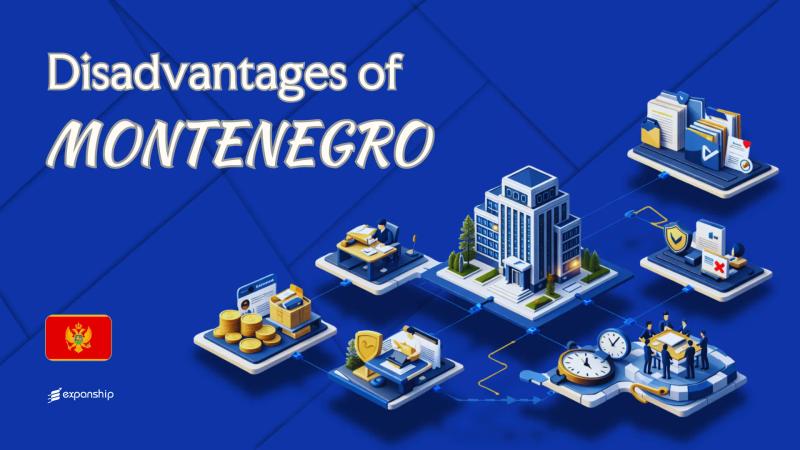
The disadvantages of incorporating in Montenegro span several operational, financial, and institutional categories that foreign investors will encounter at different stages of setup and ongoing management. Not all of these apply equally — the business type, industry sector, and intended use of the entity significantly determine which drawbacks carry the most practical weight for your specific situation.
This article is most relevant to foreign entrepreneurs and mid-sized firms evaluating Montenegro as a base for EU-oriented operations, regional holding structures, or active commercial business.
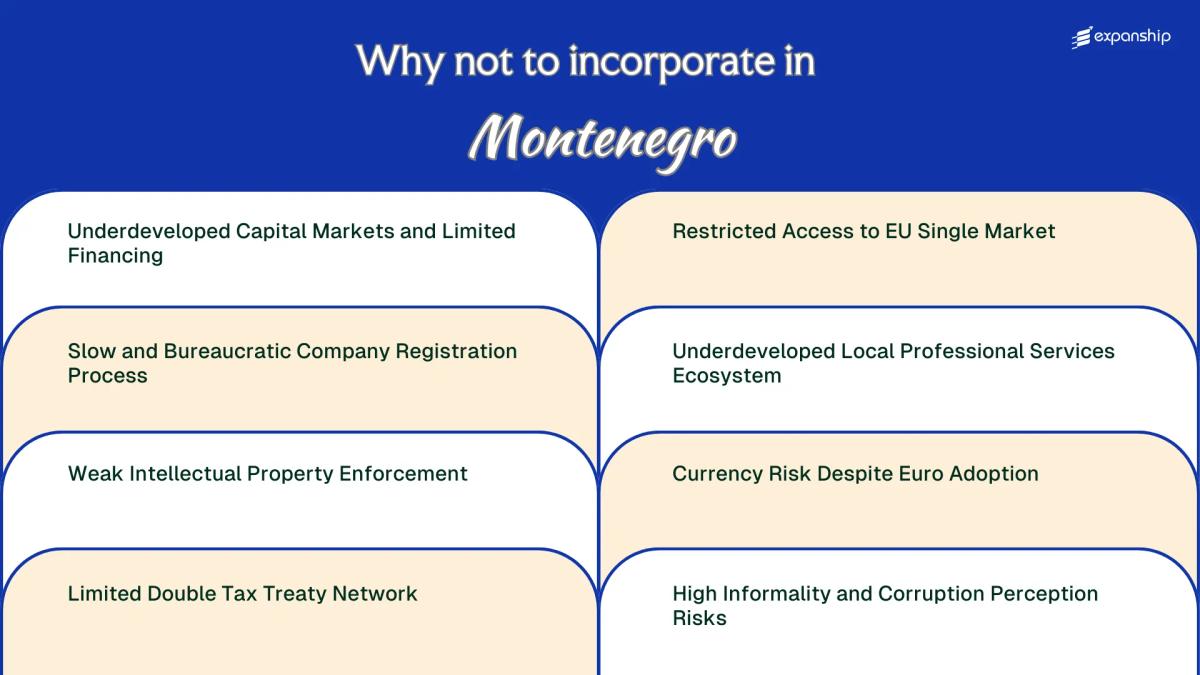
Underdeveloped Capital Markets and Limited Financing
Montenegro limited business financing options represent a structural constraint that foreign founders encounter early, particularly when seeking growth capital beyond initial equity contributions.
Shallow Banking Sector with Restricted Credit Access
The banking sector is dominated by a small number of commercial lenders operating under Central Bank of Montenegro (CBCG) oversight, with credit conditions heavily weighted toward collateral-backed lending. For a newly incorporated foreign-owned entity without established local assets, securing working capital or expansion financing is materially difficult. SME funding challenges are compounded by relatively high lending rates compared to the eurozone average, reducing the viability of debt financing for early-stage businesses.
Absence of Functioning Capital Markets
The Montenegro Stock Exchange (MNSE) operates with low liquidity and limited listed instruments, meaning equity capital markets are not a realistic fundraising channel for most private firms. Venture capital activity is negligible, with no established domestic VC ecosystem to support technology or growth-stage companies. Foreign businesses requiring institutional investment must look entirely outside the country, adding cost and complexity to capital-raising.
Your business will have no meaningful access to local institutional capital, making all significant financing dependent on foreign sources or personal equity.
Slow and Bureaucratic Company Registration Process
Montenegro company registration bureaucracy problems are a recurring concern for foreign founders, particularly those accustomed to digitally streamlined jurisdictions. Company formation is handled through the Central Registry of Commercial Entities (CRPS), and while a one-stop-shop model exists in theory, the practical experience frequently diverges from that standard.
Delays arise at multiple stages, not just the initial filing. Document authentication requirements, mandatory notarization, and the need for certified translations add time and cost before your application even reaches the CRPS.
These procedural layers create specific friction for foreign business owners:
- Apostille requirements on foreign-issued documents mean your formation timeline depends on processing speeds in your home country, not just Montenegro
- Notarization of founding acts before a Montenegrin notary requires either physical presence or a power of attorney, adding legal fees and scheduling delays
- Bank account opening for a d.o.o. typically requires a physical visit, which compounds travel costs for non-resident founders
- Any document discrepancy triggers a formal rejection cycle, restarting parts of the process
Digital submission options remain limited for foreign nationals without a local digital certificate. That gap alone can add weeks to an otherwise straightforward incorporation.

Company Incorporation in Montenegro
Expanship manages the full d.o.o. formation process through the CRPS, handling notarization, document preparation, and registration on your behalf.
Weak Intellectual Property Enforcement
Montenegro intellectual property enforcement risks are a genuine operational concern for any foreign business that relies on brand identity, proprietary technology, or creative output. The country's IP framework is governed by the Law on Industrial Property and the Law on Copyright and Related Rights, administered through the Intellectual Property Office. While the legislative foundation broadly aligns with international standards, the practical capacity to enforce those rights falls short.
Court proceedings involving IP disputes move slowly, and specialized judicial expertise in IP matters remains limited. For a foreign firm, this means that even a valid trademark registration offers weaker protection in practice than the law suggests on paper.
| Indicator | Detail |
|---|---|
| Trademark opposition window | 3 months from publication, short for foreign owners monitoring remotely |
| Enforcement body | Intellectual Property Office (no independent enforcement arm) |
| Civil litigation duration | IP disputes can take several years to resolve in domestic courts |
| Border control capacity | Customs IP seizure mechanisms exist but are inconsistently applied |
| Criminal IP prosecution | Rarely pursued; private enforcement actions carry the full burden |
Counterfeit goods and unauthorized use of protected marks persist in local markets, with limited proactive intervention from authorities. Your firm bears the cost and effort of detection and legal action. EU membership candidate status has prompted legislative updates, but institutional enforcement capacity has not kept pace with those reforms.
Limited Double Tax Treaty Network
Montenegro's double tax treaty limitations present a concrete structural problem for foreign businesses routing income, dividends, royalties, or interest through a Montenegrin entity. As of the most recent publicly available data from the Montenegrin MoF, the country has concluded fewer than 50 double taxation agreements, a noticeably thinner network compared to jurisdictions such as the Netherlands or Luxembourg, which maintain 90+ treaties.
For your business, this gap means that payments flowing between Montenegro and non-treaty countries are subject to domestic withholding tax rates, which can reach up to 15% on dividends, interest, and royalties paid to foreign recipients under the Corporate Income Tax Law.
If a key trading partner or parent company is domiciled in a jurisdiction without a treaty, the cost of cross-border profit repatriation rises immediately. That additional withholding burden can erode the tax efficiency that initially made the structure attractive.
- Verify whether a treaty exists between Montenegro and each jurisdiction receiving dividends, royalties, or interest from your entity.
- Domestic withholding tax rates apply in full where no treaty override exists.
- Treaty provisions vary in rates and covered income types; each agreement must be reviewed individually.
- Treaty shopping through intermediate jurisdictions may be restricted under applicable anti-avoidance provisions.
Montenegro unilaterally adopted the euro as its currency but is not an EU member, meaning its tax treaties carry none of the automatic withholding tax exemptions provided under the EU Parent-Subsidiary or Interest and Royalties Directives.
Restricted Access to EU Single Market
Montenegro EU single market access restrictions apply directly to any company incorporated there, since the country remains a candidate state under the Stabilisation and Association Agreement (SAA) rather than a full EU member.
What the Non-Member Status Actually Restricts
Goods exported from a Montenegrin entity to EU member states are subject to standard third-country customs procedures, meaning your business cannot benefit from the free movement of goods that an EU-incorporated firm receives automatically. For service-based businesses, EU passporting rights, particularly relevant in financial services under frameworks such as MiFID II or Solvency II, are unavailable, forcing separate licensing in each target EU market.
How This Affects Operational and Commercial Decisions
Foreign companies that structured their operations expecting imminent EU membership may face prolonged exposure to these non-EU business limitations, as accession negotiations have advanced slowly across several chapters. Procurement opportunities under EU public tenders are also restricted, since EU member states frequently apply preferences that exclude third-country bidders at the contract threshold level, narrowing your firm's addressable market considerably.
Assessing Market Access Implications Before Incorporating in Montenegro
Speak with our corporate advisors about how Montenegro's non-EU status affects your specific business model, target markets, and cross-border structuring requirements.
Underdeveloped Local Professional Services Ecosystem
The Montenegro professional services ecosystem limitations create real operational friction for foreign-owned entities that require dependable local support.
- The pool of lawyers, accountants, and corporate advisors with fluency in international structuring, cross-border tax, or foreign investment law is narrow, meaning your firm may struggle to find qualified professionals who understand obligations beyond the domestic framework.
- English-language professional services remain inconsistent in quality and availability, forcing many foreign business owners to rely on translation intermediaries or import advisors from abroad at added cost.
- Local accounting firms familiar with IFRS or consolidation requirements for multinational groups are scarce, creating reporting gaps that expose your entity to compliance risk under the Montenegrin Accounting Law.
- The absence of Big Four or comparable mid-tier international audit presence limits assurance options for businesses that require audited financials acceptable to foreign parent companies or institutional lenders.
- Specialised advisory capacity in areas such as transfer pricing documentation or substance requirements is underdeveloped, shifting the compliance burden onto foreign headquarters or external consultants.
Currency Risk Despite Euro Adoption
Montenegro currency risk euro adoption is a frequently misunderstood subject. The country uses the euro as its official currency without being an EU member or a party to the Eurozone agreements, meaning it has no seat at the European Central Bank and exercises no influence over monetary policy decisions that directly affect the cost of credit, inflation, and capital flows within its borders.
This arrangement, sometimes called unilateral euroization, removes the option of exchange rate adjustment as an economic stabilization tool. If external shocks compress your firm's margins or raise input costs, the government cannot devalue the currency to restore competitiveness, a mechanism available to most non-Eurozone neighbors in the Western Balkans.
For foreign businesses with revenues in non-euro currencies, such as USD or GBP, the exposure is compounded. Your entity absorbs the full volatility of EUR/USD or EUR/GBP movements without any domestic hedging infrastructure or central bank backstop to cushion the impact.
Hypothetical scenario: A U.S.-based founder billing clients in USD and operating a Montenegrin entity with euro-denominated payroll and overhead faces a 10% EUR/USD appreciation scenario that increases effective operating costs by roughly the same proportion, with no local monetary mechanism to offset that drag.
High Informality and Corruption Perception Risks
Montenegro corruption perception business risks are quantified in Transparency International's Corruption Perceptions Index, where the country consistently scores in the range that places it among the more problematic performers in the Western Balkans region. For a foreign business owner, this signals elevated exposure to unpredictable decision-making in public procurement, licensing, and regulatory enforcement.
The informal economy remains a structural feature of commercial life. Transactions conducted outside formal channels distort competitive conditions, meaning a compliant foreign-registered entity may face pricing pressure from local competitors carrying lower effective costs due to unreported activity.
Judicial independence concerns compound this further. The European Commission's annual Montenegro Progress Reports have repeatedly cited the slow pace of judicial reform and limited track records in prosecuting high-level corruption, which translates directly into reduced confidence that contractual disputes or regulatory violations will be resolved impartially.
- Permit and licensing approvals can involve informal intermediaries, adding unquantifiable cost and delay.
- State-adjacent industries, including construction, real estate, and public contracts, carry the highest documented exposure.
- Anti-corruption oversight is distributed across multiple bodies, including the Agency for Prevention of Corruption (ASK), but enforcement consistency remains limited.
Foreign entities operating in regulated or state-adjacent sectors must account for the fact that ASK oversight does not insulate your business from informal pressure at the municipal or cantonal administrative level, where enforcement capacity is weakest.
Mitigating the Challenges of Incorporating in Montenegro
Mitigating the challenges of incorporating in Montenegro requires structural planning rather than reactive fixes. The disadvantages covered in this blog, from bureaucratic registration delays to limited treaty coverage, share underlying causes rooted in institutional capacity and regulatory maturity.
- Register your entity through the Central Registry (CRPS) and confirm all documentation requirements in advance to reduce processing delays at submission.
- Structure ownership through a jurisdiction with an existing double tax treaty to reduce withholding tax exposure on cross-border income flows.
- File intellectual property rights with the Intellectual Property Office of Montenegro before commencing commercial operations to establish priority dates.
- Use euro-denominated contracts where counterparties operate in non-euro currencies to manage transactional currency mismatches.
- Appoint a locally registered compliance officer familiar with the Law on Prevention of Money Laundering to address informality and AML-related scrutiny.
These steps operate within a regulatory environment still undergoing reform as part of Montenegro's EU accession process under Chapter 17 and related chapters. Alignment with EU regulatory standards remains incremental, and structural gaps will persist throughout that transition period.
Montenegro's Overall Appeal for Foreign Investors
Despite the disadvantages covered across this blog, Montenegro remains a credible incorporation destination for foreign businesses that are well-matched to its structure. The country's low corporate tax rate, euro-denominated economy, and EU candidate status give it a defined place among emerging European jurisdictions.
| Pros | Cons |
|---|---|
| A flat 9% corporate income tax rate is among the lowest in Europe | Capital markets are underdeveloped, limiting access to local equity and debt financing |
| The euro is the official currency, eliminating direct exchange rate exposure on domestic transactions | Unilateral euro adoption means the European Central Bank sets monetary policy without input from Montenegrin authorities |
| No minimum share capital requirement for a D.O.O. (limited liability company) | Company registration can be slow due to bureaucratic procedures at the Central Registry (CRPS) |
| EU accession negotiations provide a long-term framework for regulatory alignment | Current non-membership means your business has no automatic access to the EU Single Market |
| Corporate tax residency rules are straightforward under the Law on Corporate Income Tax | The double tax treaty network is limited, increasing withholding tax exposure on cross-border payments |
Corruption perception scores and informal business practices add measurable compliance risk, particularly for companies with international reporting obligations. Intellectual property protections exist on paper but are inconsistently enforced in practice.
Compliance Services for Companies in Montenegro
Maintain your Montenegrin company's good standing with ongoing compliance support, including annual reporting, tax filings, and regulatory obligations under Montenegrin law.
Conclusion
Montenegro's overall position as an incorporation destination is mixed. The Montenegro company incorporation drawbacks summary covered in this blog reflects real structural constraints: limited treaty coverage under the country's existing double tax agreements, the absence of EU single market access, and measurable gaps in intellectual property enforcement. These are not minor friction points. They affect how your business operates day to day and how it is perceived by foreign counterparties. Firms with cross-border operations or IP-dependent models will feel these limitations most acutely. Professional guidance specific to Montenegrin regulatory requirements reduces exposure to the most avoidable risks.
Expanship's Montenegro Incorporation Services
Expanship's Montenegro incorporation services are designed to help you manage the operational weight of registering and maintaining a company in a jurisdiction where bureaucratic friction, limited treaty coverage, and IP enforcement gaps create ongoing compliance demands. Working with the Central Registry of Commercial Entities (CRPS) and navigating Montenegro's tax authority requirements takes time your business may not have to spare. Expanship reduces that burden by handling the procedural and regulatory dimensions directly.
Beyond initial registration, the support covers the full formation and compliance cycle.
- Preparing and filing all incorporation documents with the CRPS on your behalf.
- Providing a registered agent and local office address to satisfy statutory requirements.
- Liaising with government bodies and regulatory authorities throughout the filing process.
- Managing post-incorporation compliance obligations, including annual filings and statutory updates.
- Introducing your entity to banking relationships suited to Montenegro-based operations.
- Handling tax registration and coordination with the Tax Administration of Montenegro (Poreska uprava).
To discuss your Montenegro setup, contact Expanship Montenegro.
Frequently Asked Questions (FAQ)
The limitation applies regardless of entity type, whether you register a d.o.o. (limited liability company) or a d.d. (joint stock company). Montenegro has concluded a relatively small number of double tax treaties compared to EU member states, which means dividend distributions, royalties, and service fees paid to foreign shareholders can attract higher withholding tax rates without treaty relief. The practical impact is greatest for businesses with cross-border intra-group transactions.
A Montenegrin-registered company cannot passport financial services, benefit from CE marking mutual recognition in all contexts, or access EU procurement frameworks reserved for member state entities. Goods exported to the EU are subject to customs procedures and conformity checks that an entity incorporated within the single market would avoid. Montenegro's EU accession negotiations are ongoing, but no confirmed membership timeline exists.
Registration of IP rights through the Intellectual Property Office of Montenegro is straightforward, but enforcement through the courts is not. Civil proceedings are slow, injunctive relief is difficult to obtain quickly, and damages awards have historically been modest. For businesses whose core asset is a brand or proprietary technology, this creates a genuine exposure that contractual protections alone cannot fully address.
Montenegro consistently scores in the lower half of Transparency International's Corruption Perceptions Index, typically ranking below EU candidate peers such as Serbia and similar to or slightly above some Western Balkans comparators depending on the year. The practical risk for foreign businesses is concentrated in licensing, public procurement, and interactions with municipal authorities rather than in routine company administration. This does not mean bribery is unavoidable, but it does mean due diligence on local partners and officials is necessary.
You would need to engage regional or international firms with a Montenegro practice, which increases advisory costs considerably compared to jurisdictions with a mature professional services market. The local bar and accountancy profession is small, and practitioners with fluency in international tax structuring, transfer pricing, or cross-border M&A are limited in number. This gap is most acute for companies that require ongoing sophisticated compliance work rather than basic bookkeeping and annual filings.
Yes, because Montenegro adopted the euro unilaterally and is not part of the Eurozone. It has no access to European Central Bank liquidity facilities and cannot influence monetary policy. If your business transacts in non-euro currencies, such as the US dollar or British pound, you carry standard foreign exchange risk, and there is no domestic hedging infrastructure comparable to what is available in larger financial centres. This is a structural limitation rather than an operational one, but it constrains your risk management options.
Legal Disclaimer
The information provided in this article is for general informational purposes only and does not constitute legal, tax, or professional advice. While we strive to ensure the accuracy and timeliness of the content, laws and regulations are subject to change, and the application of laws can vary widely based on specific facts and circumstances.
Readers should not act upon this information without seeking professional counsel tailored to their individual situation. Expanship and its authors disclaim any liability for actions taken or not taken based on the content of this article.
For specific advice regarding your business setup, compliance requirements, or any legal matters, please consult with qualified legal and tax professionals in the relevant jurisdiction.