
Key Takeaways
- Moldova's Law on LLC imposes notarization requirements and multi-step registration procedures that add time and cost burdens not present in more streamlined EU jurisdictions.
- Persistent institutional corruption and limited judicial independence reduce the reliability of contract enforcement, creating measurable legal risk for foreign investors operating under Moldovan jurisdiction.
- The underdeveloped local banking sector and restricted access to EU capital markets limit financing options for incorporated entities, particularly those requiring cross-border transactions or institutional credit facilities.
- Chronic shortages of skilled labor in specialized sectors such as financial services and technology constrain the practical scalability of operations for foreign businesses that incorporate locally rather than using Moldova as a holding structure.
Moldova operates under an evolving regulatory framework, shaped in part by its Association Agreement with the EU and ongoing alignment with European commercial standards. The primary legislation governing company formation is the Law on LLC, which sets out the structural and compliance obligations applicable to most foreign-registered entities.
The disadvantages of incorporating in Moldova span several distinct areas, from institutional reliability to financial infrastructure and human capital constraints. How significantly these factors affect your business depends on the entity type, the industry sector, and whether your firm operates locally or uses Moldova primarily as a regional holding structure.
Foreign investors entering manufacturing, financial services, or technology are most likely to encounter the drawbacks of Moldova company formation in practical terms. Those relying on EU-standard legal enforceability or cross-border banking access will face the steepest friction.
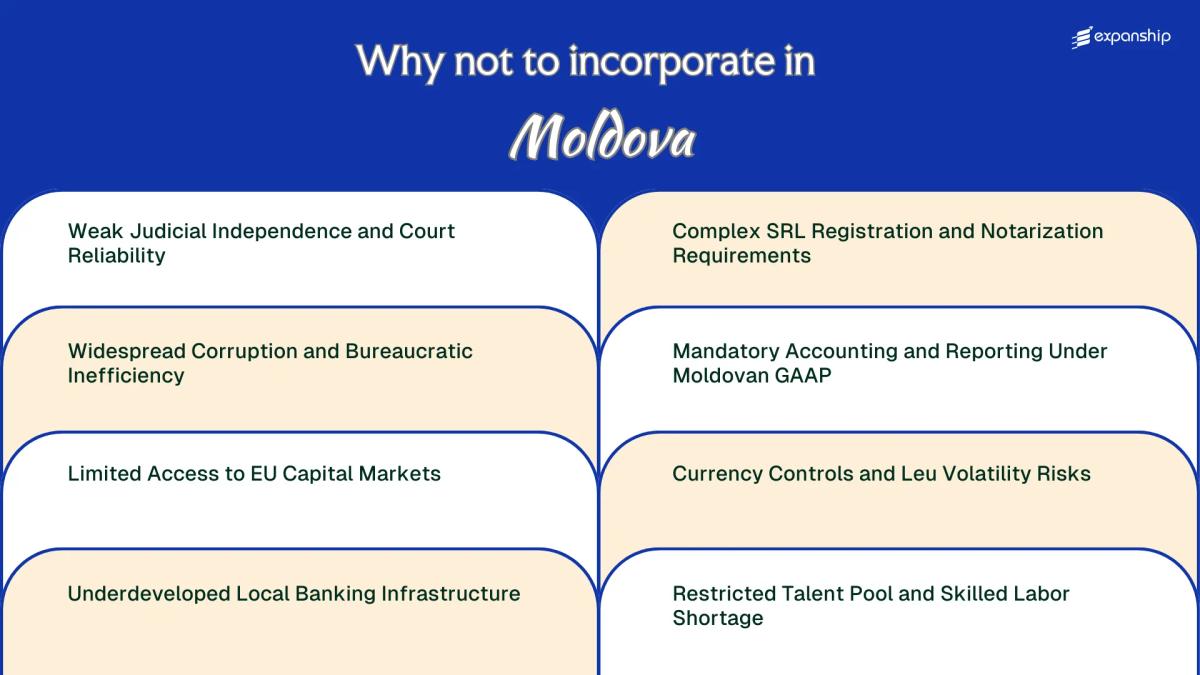
Weak Judicial Independence and Court Reliability
Moldova judicial independence problems are well-documented and present concrete risks for any foreign business with legal exposure in the country. Enforcement of contracts and protection of property rights cannot be reliably assumed.
Structural Weaknesses in the Court System
The judiciary operates under the Superior Council of Magistracy, yet this body has faced sustained criticism from the European Commission and Transparency International for failing to insulate judges from political and economic pressure. For a foreign-owned SRL, this means that commercial disputes, even those with clear contractual backing, may produce inconsistent or unexplained rulings.
Court proceedings under the Civil Procedure Code can extend for years without resolution. Your ability to recover debts, enforce shareholder agreements, or challenge administrative decisions depends on a system where outcomes are difficult to predict.
Arbitration Gaps and Enforcement Risks
Moldova is a signatory to the New York Convention on the Recognition and Enforcement of Foreign Arbitral Awards, which provides some protection for international commercial arbitration. However, domestic enforcement of those awards still runs through local courts, reintroducing the same reliability concerns.
Weak rule of law in Moldova directly affects investor confidence because even a favorable arbitral award offers limited certainty without a functional enforcement mechanism.
Foreign business owners should not assume that contractual rights or court-ordered remedies will be enforced predictably, as judicial inconsistency remains a structural feature of the Moldovan legal system rather than an isolated risk.
Widespread Corruption and Bureaucratic Inefficiency
Corruption risks incorporating in Moldova remain a documented concern, not merely a reputational one. Transparency International's Corruption Perceptions Index consistently ranks the country among the lower-performing European states, reflecting systemic issues that extend into business registration, licensing, and contract enforcement.
Foreign companies often encounter informal payment expectations when dealing with mid-level civil servants at the State Registration Chamber or during inspections by the State Tax Service. These are not marginal encounters — they can delay operational timelines by weeks and create compliance exposure under your home jurisdiction's anti-bribery laws.
Bureaucratic inefficiency compounds this problem in practical terms:
- Obtaining sector-specific licenses requires multiple agency sign-offs, each carrying its own processing delays that are rarely published transparently
- Document authentication requirements create repeated notarization costs that are difficult to anticipate at the outset
- Interactions with the National Food Safety Agency or environmental inspectorates often involve overlapping jurisdiction, forcing your firm to re-submit identical documentation to separate bodies
- Inconsistent application of procedures means decisions that are straightforward for locally connected businesses can stall indefinitely for foreign-owned entities
Small and medium foreign firms without a local intermediary are disproportionately affected. Larger multinationals with dedicated legal representation on the ground tend to absorb these frictions more easily, but that option carries its own cost burden.

Company Incorporation in Moldova
Establish your business entity in Moldova with structured guidance on registration, compliance, and local requirements.
Limited Access to EU Capital Markets
Moldova's limited EU capital market access is a structural constraint, not a temporary gap. The country is not an EU member state, which means Moldovan-incorporated entities cannot benefit from EU passporting rights, the single capital market framework, or the European prospectus regulation that allows firms registered in member states to raise funds across the bloc with a single filing.
| Access Point | Requirement / Barrier | Impact on Foreign Business |
|---|---|---|
| EU Prospectus Passporting | Available only to EEA-registered entities | Moldovan SRLs and SAs are ineligible |
| EU Structural Funds | Restricted to EU member state entities | Moldovan companies cannot apply directly |
| EBRD Direct Equity Financing | Project-based; requires extensive due diligence for non-EU firms | Approval timelines significantly longer |
| Eurobond Issuance | Requires listing on an EU/EEA-regulated exchange | Moldovan firms face dual regulatory compliance costs |
Your firm cannot list on EU-regulated exchanges without restructuring through an EU-domiciled holding entity, which adds both legal cost and operational complexity. Institutional investors in the EU are also subject to internal risk frameworks that frequently exclude or heavily discount exposure to non-EU jurisdictions outside established equivalence regimes.
The National Commission for Financial Markets (NCFM) regulates capital market activity domestically, but the local exchange has limited depth and liquidity. This makes domestic capital raising a poor substitute for EU market access, particularly for growth-stage businesses with international ambitions.
Underdeveloped Local Banking Infrastructure
Moldova banking infrastructure drawbacks are most visible the moment a foreign-owned SRL attempts to open a corporate account. The National Bank of Moldova supervises a sector dominated by a small number of commercial banks, and correspondent banking relationships with Western institutions remain limited, which directly constrains cross-border payment capacity.
Foreign-incorporated entities or non-resident directors face heightened compliance scrutiny under anti-money laundering regulations administered by the NBM. Account opening can take several weeks, and banks routinely request extensive documentation packages that go beyond standard Know Your Customer requirements seen elsewhere in the region.
Wire transfers involving non-Moldovan counterparties may require additional approval steps, adding friction to ordinary treasury operations. For a business that depends on fast supplier payments or regular dividend repatriation, this delay carries a direct operational cost.
- Banks may require physical presence of directors or shareholders during account opening procedures
- Correspondent banking gaps restrict access to SWIFT transfers with certain jurisdictions
- NBM AML regulations impose document burdens on entities with non-resident beneficial owners
- Processing times for international transfers can extend transaction cycles significantly
- Corporate account refusals are not uncommon for structures deemed high-risk by local compliance officers
Several Moldovan commercial banks have had their licenses revoked by the NBM following major fraud scandals, reducing the total number of operating banks and further concentrating corporate banking access in the sector.
Complex SRL Registration and Notarization Requirements
Registering an SRL in Moldova presents procedural hurdles that go beyond routine paperwork. Moldova SRL registration challenges stem largely from mandatory notarial involvement at multiple stages of the incorporation process.
Notarization as a Structural Bottleneck
Under Moldovan law, the founding documents of an SRL, including the articles of association, must be authenticated by a licensed Moldovan notary before the entity can be registered with the State Registration Chamber (now operating under the Agency of Public Services). For a foreign founder without local presence, this requirement forces either a costly trip to Moldova or the execution of a power of attorney through a foreign notary, which must then be apostilled and, in some cases, translated into Romanian by an authorized translator.
Registration Delays and Their Business Cost
The process does not conclude at notarization. Submission to the State Register, review periods, and potential requests for corrected documentation can extend the timeline well beyond the statutory registration window, delaying your ability to open a bank account or execute contracts. Each correction cycle adds costs in notary fees and professional time, creating a disproportionate administrative burden for foreign-owned entities compared to domestically managed firms.
Guidance on SRL Incorporation Challenges in Moldova
Get practical guidance on notarization requirements, document authentication, and registration procedures for SRL formation in Moldova.
Mandatory Accounting and Reporting Under Moldovan GAAP
The Moldova GAAP accounting compliance burden falls heaviest on foreign-owned SRLs unprepared for a dual-standard environment, where firms must apply either National Accounting Standards or IFRS depending on their classification. Under Law No. 113 of 2007 on Accounting and Financial Reporting, all entities must submit annual financial statements to the State Tax Service, with larger companies also subject to mandatory audit requirements.
- Annual financial statements must be filed in Romanian, requiring foreign owners to hire local accountants fluent in both the language and Moldovan-specific chart-of-accounts rules.
- Companies exceeding statutory thresholds are obligated to engage a licensed Moldovan auditor, adding a recurring cost that smaller foreign entities rarely budget for.
- Monthly tax declarations must be submitted electronically via the SIA "Declaratii Electronice" system, creating an ongoing administrative dependency on locally qualified personnel.
- Accounting records must be maintained in Moldovan Lei, exposing foreign-currency transactions to constant restatement obligations.
Currency Controls and Leu Volatility Risks
Moldova leu currency volatility risks are a structural concern for any foreign business operating through a locally incorporated entity. The Moldovan leu (MDL) is a relatively illiquid currency with limited international market depth, making it susceptible to sharp depreciation during periods of economic stress.
The National Bank of Moldova (NBM) governs foreign exchange operations under Law No. 62/2008 on Foreign Exchange Regulation. Certain capital account transactions, including some cross-border transfers and foreign loan arrangements, require prior authorization or are subject to reporting obligations, adding friction to routine treasury operations.
For a foreign-owned SRL repatriating profits, exchange rate swings directly erode the MDL value of distributions before conversion to EUR or USD. The leu lost significant value against the euro during the 2022 energy crisis, a period when many businesses with MDL-denominated revenues faced real losses on foreign-currency obligations.
Businesses with foreign-currency cost bases but local MDL revenues carry a structural mismatch that hedging instruments in Moldova's underdeveloped financial market cannot easily address.
A hypothetical scenario: a firm invoicing Moldovan clients at MDL 1,800,000 annually converts approximately EUR 90,000 at a stable rate. A 10% leu depreciation reduces that conversion to roughly EUR 81,000, a EUR 9,000 loss with no operational change, simply from exchange rate movement.
Restricted Talent Pool and Skilled Labor Shortage
Moldova skilled labor shortage risks are a direct operational constraint for any foreign business expecting to hire locally across technical, managerial, or specialized functions. The country has experienced sustained emigration since the 1990s, with a significant share of its working-age population relocating to EU member states, particularly Romania, Italy, and Germany.
The National Bureau of Statistics has recorded a declining active labor force over successive census periods. For a foreign entity establishing operations locally, this shrinks the realistic candidate pool for roles requiring specific qualifications.
Sectors including IT, finance, engineering, and healthcare face particularly acute scarcity. Recruiting externally introduces visa processing timelines and relocation costs that offset the lower nominal salary base.
Work permit procedures for non-Moldovan nationals are administered under the Law on Foreigners (No. 200/2010), and quota-based admission limits can restrict how many foreign specialists your firm is legally permitted to bring in within a given year.
- Technical and engineering roles are consistently underserved locally
- Senior management candidates with international corporate experience are scarce
- Bilingual professionals fluent in Romanian and English remain a limited segment of the workforce
Foreign businesses must verify annual admission quotas under Law No. 200/2010 before committing to a hiring plan that depends on relocating non-Moldovan specialists, as exceeding quota limits can stall operations indefinitely.
Overcoming Incorporation Challenges in Moldova
Overcoming Moldova incorporation challenges requires structural preparation before registration begins, not reactive adjustments after problems surface. The disadvantages covered in this blog, from SRL notarization requirements to Leu volatility, share a common thread: each one is more manageable when anticipated through proper entity structuring and pre-entry compliance planning.
- Register your SRL through the State Registration Chamber to ensure filings meet official procedural requirements under Law No. 220 on State Registration.
- Open accounts with banks that maintain correspondent relationships with EU institutions to reduce exposure to local banking infrastructure limitations.
- Engage a locally licensed accountant familiar with Moldovan GAAP and National Accounting Standards from the outset to satisfy mandatory reporting obligations.
- Structure foreign currency transactions in advance to account for National Bank of Moldova currency control regulations and Leu exchange rate exposure.
- Source talent regionally or through remote arrangements to offset the constraints of Moldova's limited skilled labor pool.
These steps operate within a regulatory framework set by the State Tax Service and the National Bank of Moldova. Structural decisions made at formation stage have binding downstream effects on tax treatment, reporting obligations, and capital repatriation rights.
Moldova's Overall Business Viability
Moldova's overall business viability concerns are real, but the jurisdiction is not without merit for foreign investors who understand its structural limitations. An SRL remains a functional vehicle for regional operations, particularly for firms targeting CIS markets or operating under the EU-Moldova Association Agreement's trade preferences.
| Pros | Cons |
|---|---|
| EU-Moldova Association Agreement creates preferential trade access to EU markets | Judicial independence remains weak, reducing enforceability of commercial contracts |
| Corporate income tax rate is comparatively low within the Eastern European region | Pervasive corruption increases the practical cost and unpredictability of doing business |
| SRL formation is possible with a single shareholder and minimal capital requirements | Notarization and registration procedures add time and administrative cost to incorporation |
| Geographic position offers access to both EU and CIS trade corridors | The local banking sector is underdeveloped, limiting financing options and transaction reliability |
| Moldovan GAAP reporting is manageable for small entities with local accounting support | Leu volatility and National Bank currency controls introduce foreign exchange risk |
Attracting qualified staff presents a consistent challenge, as skilled professionals often emigrate to EU member states.
Compliance Services for Companies in Moldova
Meet your ongoing statutory obligations under Moldovan law, including annual reporting, accounting filings with the State Tax Service, and corporate record maintenance.
Conclusion
A Moldova company formation disadvantages summary must account for a jurisdiction in active transition, carrying structural constraints that affect day-to-day operations. Judicial unreliability and endemic corruption remain the most consequential risks for foreign-owned entities, directly exposing your business to unpredictable dispute outcomes and administrative friction. Underdeveloped banking infrastructure compounds these risks, limiting access to trade finance and creating correspondent banking gaps that delay cross-border transactions. Structural constraints of this kind require informed pre-entry planning, supported by advisors with direct knowledge of local regulatory processes and Agency for Public Services procedures.
Expanship's Moldova Expansion Services
Expanship's Moldova company formation services are designed to reduce the operational burden of incorporating and maintaining compliance in a jurisdiction where the State Registration Chamber, notarization requirements, and Moldovan GAAP reporting create sustained administrative overhead. From structuring your SRL documents correctly through to ongoing engagement with the State Tax Service, Expanship handles the procedural layers that consume time and resources.
Beyond initial registration, the firm supports your business across the full compliance lifecycle.
- Your company documents are prepared and filed with the relevant Moldovan authorities from the outset.
- A registered agent and local office address are provided to satisfy legal presence requirements.
- Government filings and regulatory body liaison are managed on your behalf throughout the process.
- Post-incorporation compliance obligations, including annual reporting, are tracked and fulfilled.
- Banking introduction assistance connects your entity with suitable local and regional financial institutions.
- Tax registration and coordination with the State Tax Service are handled as part of the setup process.
To discuss your Moldova incorporation requirements, contact Expanship Moldova.
Frequently Asked Questions (FAQ)
Yes, and the exposure is direct. Moldova's National Bank imposes currency control requirements on cross-border transfers, and the Moldovan leu has historically been sensitive to regional economic shocks, including those tied to energy prices and remittance flows. If your SRL invoices internationally but holds leu-denominated accounts locally, exchange rate swings can materially affect reported earnings and repatriated profits.
Non-compliance with Moldovan GAAP, which is governed under the Accounting Law No. 287 of 2017, exposes your company to administrative fines issued by the State Tax Service. Repeated or significant violations can trigger audits and, in serious cases, suspension of the company's tax registration. The obligations apply to all registered entities regardless of size or ownership structure.
Moldova ranks poorly even within the Eastern European region on judicial independence indicators. Unlike EU member states such as Romania or Bulgaria, where court decisions are subject to EU oversight mechanisms, Moldovan courts operate without that external accountability layer. Enforcement of foreign judgments and arbitral awards also remains inconsistent, which increases the legal risk for foreign investors with contractual disputes.
Notarization fees for SRL formation in Moldova vary depending on the complexity of the founding documents and the notary engaged, but they represent an additional procedural cost that does not exist in jurisdictions with fully digitized company registration systems. Beyond the direct fee, the requirement introduces delays because documents must be physically authenticated before submission to the State Registration Chamber. This process can extend the overall incorporation timeline by several business days.
The restriction applies broadly to any entity incorporated under Moldovan law, including SRLs and joint-stock companies. Because Moldova is not an EU member state, Moldovan-registered firms cannot passport financial products or access EU-regulated exchanges under standard EU frameworks. An SRL incorporated in Moldova cannot rely on EU market access rights that a comparable entity registered in, say, Estonia or the Czech Republic would have by default.
Profit repatriation is legally permitted but subject to the currency control framework administered by the National Bank of Moldova. Transfers above certain thresholds require supporting documentation, and delays in processing are common. The practical friction is meaningful for businesses that depend on predictable dividend distributions to parent entities abroad.
Legal Disclaimer
The information provided in this article is for general informational purposes only and does not constitute legal, tax, or professional advice. While we strive to ensure the accuracy and timeliness of the content, laws and regulations are subject to change, and the application of laws can vary widely based on specific facts and circumstances.
Readers should not act upon this information without seeking professional counsel tailored to their individual situation. Expanship and its authors disclaim any liability for actions taken or not taken based on the content of this article.
For specific advice regarding your business setup, compliance requirements, or any legal matters, please consult with qualified legal and tax professionals in the relevant jurisdiction.