

Key Takeaways
- Moldova's 12% corporate income tax rate, combined with the IT Park regime's near-zero effective tax burden, gives qualifying businesses two distinct structural options for reducing their overall tax exposure within a single jurisdiction.
- Foreign investors incorporating an SRL face no nationality requirements for directors or shareholders, and the entity's low minimum share capital threshold means capital can be deployed operationally rather than locked into registration requirements.
- The DCFTA provides Moldovan-registered companies with binding preferential access to EU markets, a legally enforceable trade framework that distinguishes Moldova from jurisdictions relying on informal or unilateral arrangements.
- Through its double taxation treaty network, Moldova allows businesses to manage cross-border tax liabilities across multiple jurisdictions, a material advantage for companies whose revenue originates from both EU and CIS markets given Moldova's geographic position between the two blocs.
Situated in Eastern Europe and bordered by Romania and Ukraine, Moldova is an independent republic and one of the smaller sovereign nations on the continent. Foreign businesses looking at Moldova company formation advantages typically register through the Societatea cu Răspundere Limitată, a limited liability entity governed under Moldovan civil and commercial law. Company registration falls under the jurisdiction of the State Registration Chamber, which administers the incorporation process for both domestic and foreign-owned entities.
Moldova maintains a low-tax posture, combining a modest corporate income rate with targeted exemption regimes that apply to qualifying sectors. Foreign ownership is broadly permitted across most industries, and no general restrictions apply to non-resident shareholders holding equity in locally registered companies. This openness to foreign direct investment is reflected in the country's legal framework, which does not impose nationality requirements for directors or shareholders of standard commercial entities.
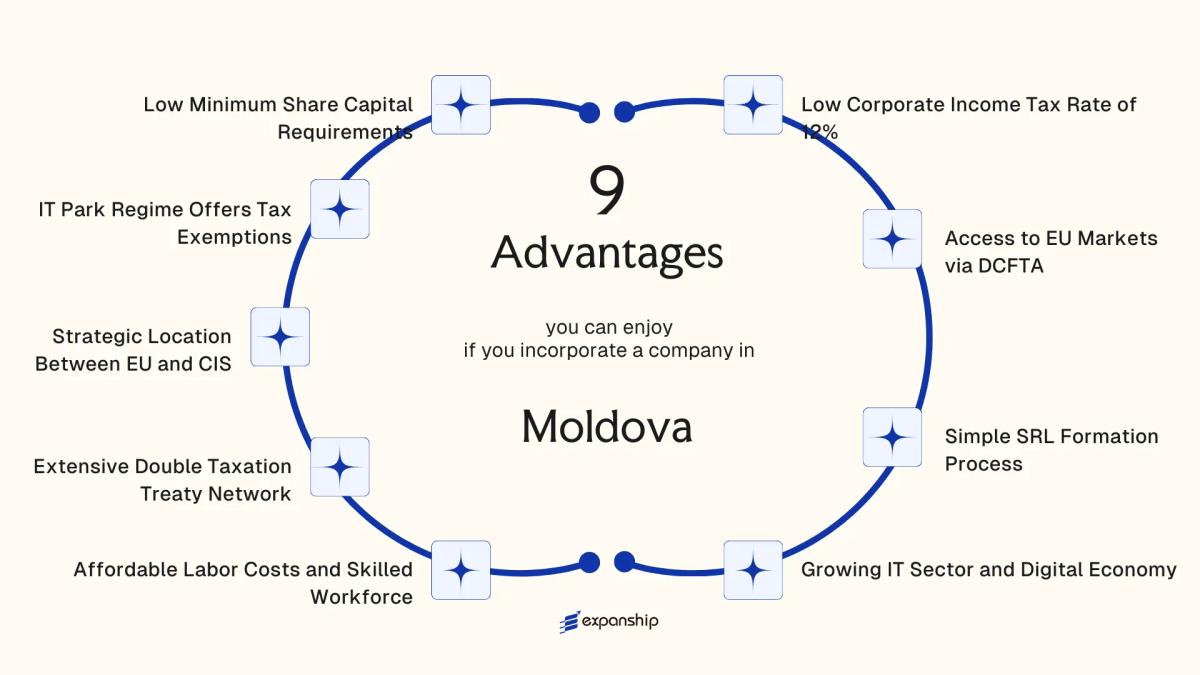
The benefits of incorporating in Moldova span tax efficiency, market access, and labor economics. This article examines each of those advantages in detail.
Low Corporate Income Tax Rate of 12%
Moldova's standard corporate income tax rate sits at 12%, a figure that places it among the lower corporate tax environments in the European region. For a foreign investor establishing an SRL (Societatea cu Răspundere Limitată), this rate applies to taxable profit as defined under the Moldovan Tax Code.
What the 12% Rate Means in Practice
The EU average corporate tax rate hovers around 21%, making Moldova's 12% corporate income tax advantage a measurable difference in annual retained earnings. A business generating $500,000 in taxable profit retains significantly more capital under this rate than it would under typical Western European regimes.
How the Tax Base Is Structured
Corporate tax in Moldova is assessed on net profit after allowable deductions, calculated in accordance with Title II of the Tax Code. This means your deductible expenses reduce the base before the 12% applies, so the effective rate for most operating businesses is lower than the nominal figure. The State Tax Service (Serviciul Fiscal de Stat) administers assessment and filing obligations, and the standard fiscal year follows the calendar year.
A 12% rate on net profit, applied after deductions, gives your SRL a structurally lower tax burden than most European counterparts from the first fiscal year of operation.
Access to EU Markets via DCFTA
Moldova's Association Agreement with the European Union, which entered into force in July 2016, includes a Deep and Comprehensive Free Trade Area that gives businesses incorporated there preferential access to the EU single market. For a foreign-owned company registered in the country, this means exporting qualifying goods to EU member states under reduced or eliminated tariffs, without the company itself being established within the EU.
The practical effect is significant. Products that meet the applicable rules of origin under the DCFTA can enter EU markets on terms that would otherwise require incorporation in an EU member state. This applies across a broad range of goods, including agricultural products, processed foods, textiles, and industrial goods, subject to sector-specific quotas and conformity with EU technical standards.
For businesses targeting European buyers, the Moldova DCFTA EU market access benefits extend beyond tariff reductions:
- Regulatory alignment with EU standards reduces the need for duplicate compliance processes when selling into Europe.
- Customs procedures between Moldova and the EU are simplified relative to standard third-country arrangements.
- Gradual harmonization with EU sanitary, phytosanitary, and technical regulations gives exporters a clearer compliance pathway over time.
The DCFTA does not grant automatic EU membership rights or freedom of movement for labor, so its advantages apply primarily to trade in goods and, to a more limited extent, services.

Company Incorporation in Moldova
Register your Moldovan SRL and access EU markets under the DCFTA framework with end-to-end support from Expanship.
Simple SRL Formation Process
Registering a Societate cu Raspundere Limitata (SRL) in Moldova carries a procedural simplicity that directly reduces the cost and time required to begin operating. The formation process is handled through the State Registration Chamber (now consolidated under the Public Services Agency, known by its Romanian acronym ASP), which functions as the single-point authority for business registration. A standard SRL can be registered within one business day once the required documentation is submitted, a timeframe that allows foreign founders to move from decision to legal entity status without extended administrative delays.
| Parameter | Detail |
|---|---|
| Registration Authority | Public Services Agency (ASP) |
| Standard Registration Timeline | 1 business day |
| Minimum Number of Founders | 1 (individual or legal entity) |
| Maximum Number of Shareholders | 50 |
| Founding Document | Articles of Association (Statut) |
A single founder, whether an individual or a corporate entity, is sufficient to establish an SRL. This removes the structural requirement found in several other jurisdictions that mandate multiple shareholders from the outset, giving solo entrepreneurs and holding structures equal access to the entity type. Your business can be registered entirely in the name of a foreign national, with no local shareholder required under Moldovan company law. The Articles of Association (Statut) serve as the governing document, and their content can be tailored to reflect the specific operational and governance requirements of your firm.
Growing IT Sector and Digital Economy
Moldova IT sector benefits for businesses are increasingly tied to the country's deliberate push toward a digital economy, anchored by formal policy frameworks and institutional backing. The E-Moldova national digital transformation program, along with the Digital Agenda overseen by the Ministry of Economic Development and Digitalization, has directed consistent investment into broadband infrastructure and e-government services. For a foreign-owned entity, this means operating in an environment where digital processes, including electronic signatures, online registration, and digital tax filings, are legally recognized and actively maintained.
The tech talent pipeline is a structural feature of the economy, not an accident. Technical University of Moldova and Moldova State University both produce graduates in software engineering, cybersecurity, and data science annually, contributing to a workforce that international firms can access at below-EU salary rates.
Chisinau has become a recognized node for software development outsourcing across European and North American markets. Several global firms already operate development centers there, which signals that the technical and legal infrastructure can support foreign-owned operations.
Keep these points in mind:
- Digital filings are legally recognized under Moldovan e-governance law
- IT Park regime is separate from general digital economy incentives
- Infrastructure quality varies outside Chisinau
Moldova ranks among the top countries globally for internet speed relative to its GDP per capita, making it a practical base for bandwidth-intensive digital operations.
Affordable Labor Costs and Skilled Workforce
Moldova's affordable skilled workforce advantages are well-documented in regional labor market data. Average gross monthly wages in the country remain significantly below those in neighboring EU member states like Romania or Hungary, giving foreign-owned firms a measurable reduction in fixed operating costs without relocating to lower-productivity markets.
What the Labor Market Offers
University enrollment in technical, engineering, and language disciplines has grown steadily, partly supported by institutions such as the Technical University of Moldova and the State University of Moldova. Many graduates enter the workforce bilingual or trilingual in Romanian, Russian, and English, which directly reduces the overhead that comes with hiring translators or regional intermediaries.
Labor relations are governed by the Labor Code of Moldova (Law No. 154/2003), which sets out employment contracts, working hours, and termination procedures in a structured framework. Statutory social contributions are defined and predictable, allowing accurate payroll modeling before your entity is even registered.
Why This Translates Into a Structural Advantage
For a foreign business owner, the combination of low labor cost benefits and a degree-educated workforce addresses a gap that higher-wage markets cannot close through productivity alone. Hiring a full software development or customer operations team locally costs a fraction of equivalent headcount in Western Europe.
The Moldova IT Park regime, which applies to qualifying tech companies, also influences workforce conditions by attracting skilled professionals to the registered sector. This concentration of technical talent in one regulatory environment makes targeted hiring more efficient for newly incorporated firms.
Start Maximizing Moldova's Workforce Advantages
Speak with an Expanship specialist about structuring your Moldova entity to make the most of local labor conditions and regulatory benefits.
Extensive Double Taxation Treaty Network
Moldova has concluded over 50 bilateral double taxation treaties, giving foreign businesses a structured way to avoid being taxed twice on the same income across multiple jurisdictions. These agreements cover dividends, interest, royalties, and capital gains, and are governed by Moldova's Tax Code alongside each individual treaty instrument.
- Reduced withholding tax rates on dividends paid to non-resident shareholders are available under specific treaties, often falling below the standard domestic rate. This directly lowers the cost of repatriating profits to a parent company or foreign investor.
- Treaty provisions on royalties benefit firms that license intellectual property into or out of the country, since without a treaty the full domestic withholding rate would apply to every payment.
- Access to treaties with both EU member states and CIS countries means a single Moldovan entity can serve as an efficient holding or operating structure for businesses with activity across both blocs.
- Permanent establishment definitions within these treaties give foreign firms clearer thresholds for when a taxable presence is triggered, reducing unintended tax exposure during market-entry phases.
- Treaty benefits are accessed through standard tax residency certification procedures, meaning the compliance burden to claim reduced rates remains manageable for small and mid-sized businesses.
Strategic Location Between EU and CIS
Moldova's strategic location between EU and CIS markets positions a registered company at the intersection of two major trading blocs without requiring physical operations in either. Chisinau sits roughly 150 kilometers from the Romanian border and within close proximity to Ukrainian ports, giving businesses geographic access to both directions.
This dual proximity has a direct operational implication. A firm incorporated here can ship goods westward under the Deep and Comprehensive Free Trade Area (DCFTA) with the EU while maintaining commercial relationships with CIS counterparts under separate bilateral trade arrangements. Few European jurisdictions offer both channels from a single legal entity.
- Goods originating from Moldova can qualify for preferential tariff treatment entering the EU single market under DCFTA rules of origin requirements.
- CIS trade relationships, though evolving, remain relevant for sectors including agriculture, manufacturing, and distribution.
- Chisinau's Internationa Airport and the country's road connections to Romania provide physical logistics access for goods and personnel.
A manufacturer exporting $500,000 in qualifying goods annually to the EU under DCFTA preferential rates, versus standard MFN tariffs averaging 4-5% on industrial goods, could retain $20,000-$25,000 in avoided duties each year, applied directly to operating margins without structural changes to the business.
IT Park Regime Offers Tax Exemptions
Moldova IT Park tax exemption benefits are grounded in a single-tax mechanism that replaces the standard suite of corporate obligations with one consolidated payment. Resident companies pay a single tax of 7% applied to monthly revenue, which substitutes corporate income tax, VAT, income tax on dividends, and several employer-side payroll contributions simultaneously.
For a foreign investor, this consolidation has a direct operational consequence: tax reporting is reduced to one monthly calculation rather than multiple filings across different fiscal obligations. That reduction in administrative overhead translates into lower compliance costs, particularly for early-stage or lean operations.
Eligible activities are defined under Moldovan law and cover software development, IT services, and related technology-focused operations. Resident status is granted by the Moldova IT Park administration, which is the body responsible for onboarding and monitoring compliance.
Key structural advantages of the regime include:
- A 7% single tax rate applied to gross revenue, not profit
- Replacement of multiple taxes with a single monthly payment
- No separate VAT obligation for qualifying resident companies
- Employer payroll contributions subsumed within the single tax
The 7% single tax applies only to revenue generated from activities explicitly listed in the approved activity catalogue; income outside that scope remains subject to standard Moldovan tax rules.
Low Minimum Share Capital Requirements
Moldova's primary advantage in this area is straightforward: the minimum share capital for an SRL (Societate cu Răspundere Limitată) is set at 5,400 Moldovan lei, which amounts to roughly 300 USD. This threshold is governed by the Law on Limited Liability Companies No. 135/2007, and it means your business can be legally incorporated without committing significant capital upfront.
For a foreign investor, this has a direct financial implication. Capital that would otherwise be locked into a statutory deposit remains available for operational expenses, staffing, or market entry costs. Many European jurisdictions require several thousand euros in paid-up capital before a company can be registered, making Moldova's SRL low capital requirement a structurally distinct starting position.
The low paid-up capital requirement also reduces the financial risk of testing a new market. If an investor wants to establish a presence to assess commercial viability before scaling, the minimal statutory obligation does not create a disproportionate sunk cost.
There are conditions worth understanding:
- The full share capital must be contributed within six months of company registration
- Capital can be contributed in cash or in kind, with non-cash contributions subject to independent valuation
- The SRL structure accommodates between one and fifty shareholders, giving flexibility in ownership configuration
Under Law No. 135/2007, the State Registration Chamber (now integrated into the Public Services Agency) oversees the registration process, and the capital requirement is verified at that stage rather than through a pre-registration bank deposit mechanism.
Why Moldova Stands Out Among Emerging European Business Destinations
Positioned between EU member states and CIS markets, Moldova draws comparisons with several Eastern European jurisdictions that offer similar incorporation profiles. The most relevant competitors for foreign investors evaluating this market are Romania, Bulgaria, and Ukraine, each of which targets a broadly similar investor base with low-cost, accessible company formation frameworks. What the comparison reveals is not that Moldova undercuts every metric, but that its combination of the IT Park regime, DCFTA market access, and a flat 12% corporate rate places it in a distinct structural position relative to these alternatives.
Romania and Bulgaria hold EU membership, which carries regulatory familiarity for European investors. Ukraine, despite a larger economy, carries elevated operational risk and ongoing legal instability. For businesses where tax efficiency and EU market access matter more than full EU membership, the Moldovan framework presents a structurally coherent alternative worth direct comparison.
| Parameter | Moldova | Romania | Bulgaria | Ukraine |
|---|---|---|---|---|
| Standard Corporate Tax Rate | 12% | 16% | 10% | 18% |
| IT Sector Tax Regime | IT Park: 7% flat tax (replaces most taxes) | Standard rate applies | Standard rate applies | Diia City: 5% or 9% PIT |
| DCFTA / EU Market Access | Yes (since 2016) | Full EU member | Full EU member | Yes (since 2016) |
| Minimum Share Capital (LLC) | MDL 5,400 (approx. €280) | RON 200 (approx. €40) | BGN 2 (approx. €1) | None |
| Double Tax Treaties | 49+ treaties | 90+ treaties | 70+ treaties | 70+ treaties |
| Official Company Register | State Registration Chamber | ONRC | Commercial Register | USR |
Compliance Services for Companies in Moldova
Stay aligned with Moldovan regulatory requirements, from annual filings and accounting obligations to directorship and registered office maintenance.
Conclusion
Moldova presents a coherent case for foreign incorporation, not because of any single factor, but because several structural advantages align. The 12% corporate income tax rate combined with the IT Park regime's near-zero effective tax burden gives businesses genuine options for structuring their operations efficiently. Access to EU markets through the DCFTA, backed by binding trade commitments rather than informal arrangements, adds a dimension that goes beyond regional appeal.
Your actual benefit depends on the nature of your business. A technology firm will extract different value from this jurisdiction than a trading company or a manufacturing operation. The double taxation treaty network, the affordable skilled workforce, and the SRL's low minimum capital requirement each matter differently depending on your sector, ownership structure, and where your revenue originates.
The framework is established. What determines the outcome is how your specific business is positioned within it. Getting that structure right from the outset, under the correct legal and tax provisions, determines whether these advantages translate into real operational and financial gains.
Let Expanship Handle Your Moldova Company Formation
Expanship Moldova company formation services cover the full registration lifecycle for foreign investors establishing an SRL under Moldovan law. From preparing founding documents that meet the requirements of the State Registration Chamber to coordinating notarized translations and apostilled supporting materials, the process is handled with direct reference to the regulatory steps outlined across this blog. Every engagement accounts for the specific compliance obligations that apply once your entity is active.
Expanship's service scope for Moldova includes:
- Preparation and legalization of incorporation documents, including the articles of association and founder resolutions
- Registered agent and registered office provision at a compliant Moldova address
- Filing coordination with the State Registration Chamber (Camera Înregistrării de Stat)
- Post-incorporation compliance management, including annual reporting and tax registration with the State Tax Service
- Liaison with relevant authorities for IT Park regime applications where applicable
- Banking introduction assistance to support corporate account opening with local financial institutions
Each service is delivered with reference to the applicable procedural requirements rather than a generalized approach, since Moldova's registration framework, tax registration process, and sector-specific regimes carry distinct documentation and timeline expectations that affect how foreign-owned entities are set up and maintained.
To discuss your incorporation requirements, contact Expanship Moldova.
Frequently Asked Questions (FAQ)
The minimum share capital for an SRL is 5,400 Moldovan lei, which at current exchange rates amounts to roughly 300 USD. This amount does not need to be deposited in a bank account before registration; it can be contributed in cash or in kind after the entity is established. This low threshold makes entry accessible for small and early-stage businesses.
Companies admitted to the Moldova IT Park benefit from a single 7% tax on revenue, which replaces corporate income tax, VAT, income tax on dividends, and several social contributions. Eligibility requires that the company conducts activities from an approved list of IT and technology-related services. The regime is governed by Law No. 77 of 2016 on Information Technology Parks.
The Deep and Comprehensive Free Trade Area agreement, part of the EU-Moldova Association Agreement in force since 2016, grants Moldovan-registered companies preferential tariff access to EU markets for a wide range of goods. The firm must meet applicable rules of origin and comply with relevant EU technical standards or sanitary requirements to benefit from reduced or zero duties. This framework does not grant EU single market membership but significantly reduces trade barriers.
Yes, Moldova has an extensive network of double taxation agreements covering over 50 countries, including Germany, the Netherlands, Austria, and several CIS states. These treaties typically reduce or eliminate withholding taxes on dividends, interest, and royalties paid between treaty partners. The specific rates and conditions vary by individual treaty and the residency of the beneficial owner.
Registration of an SRL through the Agency of Public Services typically takes one to three business days once all required documents are submitted in proper form. The process involves submitting the articles of association, shareholder details, and proof of the registered address to the relevant registration office or through the e-government portal. Delays generally occur when documents require additional notarization or when submitted information is incomplete.
Failure to submit annual financial statements to the relevant state authorities or to maintain a registered local address can result in administrative fines and, in cases of prolonged non-compliance, forced liquidation initiated by the state. The State Tax Service and the Agency of Public Services both hold authority to flag non-compliant entities. Directors and shareholders may bear subsidiary liability in certain circumstances under the Civil Code of Moldova.
Legal Disclaimer
The information provided in this article is for general informational purposes only and does not constitute legal, tax, or professional advice. While we strive to ensure the accuracy and timeliness of the content, laws and regulations are subject to change, and the application of laws can vary widely based on specific facts and circumstances.
Readers should not act upon this information without seeking professional counsel tailored to their individual situation. Expanship and its authors disclaim any liability for actions taken or not taken based on the content of this article.
For specific advice regarding your business setup, compliance requirements, or any legal matters, please consult with qualified legal and tax professionals in the relevant jurisdiction.