
Key Takeaways
- Under Latvia's Commercial Law, foreign founders establishing an SIA must meet mandatory minimum share capital requirements before registration can proceed, adding an upfront financial commitment that preconditioned entity formation.
- Non-resident directors and shareholders face heightened scrutiny from the Financial Intelligence Unit under Latvia's strict anti-money laundering framework, creating a more demanding compliance burden than in many comparable EU jurisdictions.
- Access to Latvian corporate banking accounts remains a documented obstacle for foreign-owned entities, with local banks frequently declining to onboard non-resident-controlled companies regardless of legitimate business purpose.
- Latvia's mandatory Latvian-language documentation requirements and the procedural complexity of the Enterprise Register of the Republic of Latvia extend formation timelines and increase administrative costs for internationally based founders.
Latvia operates under a heavily regulated corporate framework, shaped by EU directives and domestic legislation enforced through bodies such as the Enterprise Register of the Republic of Latvia and the Financial Intelligence Unit. The disadvantages of incorporating in Latvia span several distinct categories, from capital requirements and banking access to compliance burdens and documentation standards.
These drawbacks do not apply uniformly. The degree of difficulty a foreign investor encounters depends significantly on the industry, the chosen legal structure, and whether the business intends to operate locally or use the entity for cross-border activity.
The governing legislation for company formation is the Commercial Law. This article is most relevant to non-resident founders, particularly those outside the EU, registering a private limited company (SIA) with limited local operational infrastructure.
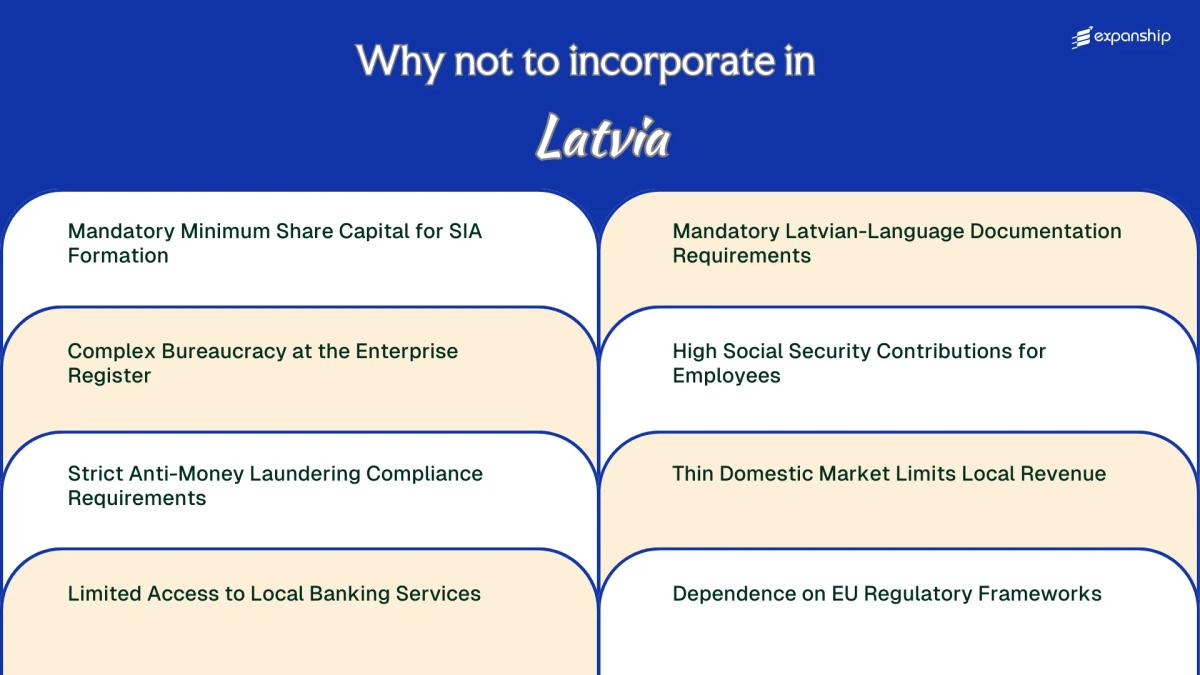
Mandatory Minimum Share Capital for SIA Formation
Latvia SIA minimum share capital requirements present a concrete financial threshold that foreign founders often underestimate before initiating registration.
The EUR 2,800 Minimum and What It Costs You Upfront
Under the Commercial Law of Latvia, an SIA must have a minimum share capital of EUR 2,800, which must be fully paid up before the entity can be registered with the Enterprise Register (Uzņēmumu reģistrs). For a founder incorporating remotely, this means capital must be transferred and verified before the business generates a single euro of revenue.
A reduced formation option exists, permitting registration with as little as EUR 1 in capital, but this triggers a mandatory profit retention requirement of 25% annually until the full EUR 2,800 threshold is reached. That retention obligation directly reduces distributable earnings for years, creating a prolonged capital constraint that affects cash flow planning.
Why This Restricts Foreign Investors Specifically
SIA formation capital restrictions in Latvia become particularly burdensome when combined with the limited banking access that non-resident founders face when opening a local account to deposit that capital.
The requirement itself is not unusually high by EU standards, but the combination of upfront payment, restricted profit distribution under the low-capital route, and account-opening friction creates compounding delays that push back the operational start date.
If you incorporate under the reduced capital route, the mandatory 25% annual profit retention applies until full statutory capital is reached, directly limiting your ability to repatriate earnings in the early years of operation.
Complex Bureaucracy at the Enterprise Register
Latvia Enterprise Register bureaucracy problems are a practical concern for foreign founders, not merely an administrative formality. The Latvijas Uzņēmumu reģistrs (Enterprise Register of the Republic of Latvia) processes all company registrations, amendments, and filings, and its procedural requirements generate friction at multiple stages.
Submissions must conform to precise formatting standards, and incomplete or non-conforming documents are rejected rather than queried, meaning the process restarts. For a foreign director managing filings remotely, each rejection adds weeks to the timeline.
The administrative challenges this creates include:
- Re-authentication of foreign identity documents for each resubmission delays incorporation beyond initial estimates
- Notarised signatures on founding documents must meet Latvian legal standards, which differ from common-law notarisation practices familiar to UK or US-based founders
- Amendments to the articles of association require separate filings, each subject to the same procedural scrutiny as the original registration
Digital submission tools are available but do not eliminate errors caused by language and format requirements. Processing times vary depending on case complexity, and expedited registration carries additional fees that raise incorporation costs without guaranteeing a fixed outcome date.

Company Incorporation in Latvia
Incorporate your Latvian SIA with accurate documentation, correctly formatted filings, and full compliance with Enterprise Register requirements.
Strict Anti-Money Laundering Compliance Requirements
Latvia AML compliance restrictions for companies are among the most demanding in the EU, shaped by the country's history of financial sector sanctions and subsequent regulatory overhaul. Following pressure from the Financial Action Task Force and the European Banking Authority, Latvian authorities introduced a sweeping tightening of the Anti-Money Laundering and Counter Terrorism Financing Law (NILLTPFN likums). Foreign-owned entities bear a disproportionate share of this burden.
The Financial Intelligence Unit (FIU), known locally as Finanšu izlūkošanas dienests, actively supervises non-resident company structures for suspicious transaction patterns. Your firm may be subject to enhanced due diligence requirements simply because its beneficial owners are based outside the European Economic Area, regardless of the business activity involved.
| Requirement | Detail | Burden for Foreign Owners |
|---|---|---|
| Beneficial Ownership Disclosure | Full UBO registration in the Enterprise Register | Non-EEA owners face enhanced scrutiny |
| Enhanced Due Diligence (EDD) | Mandatory for high-risk client and owner profiles | Triggers additional documentation layers |
| FIU Reporting Threshold | Transactions at or above EUR 10,000 require reporting | Routine cross-border transfers may qualify |
| AML Officer Requirement | Obligated entities must appoint a dedicated AML officer | Adds staffing cost for small foreign firms |
Ongoing compliance is not a one-time obligation. Periodic internal AML audits, staff training records, and documented risk assessments are required under the law, and gaps can result in supervisory fines issued by the FIU or sector-specific regulators. For a small foreign-owned SIA with no local compliance infrastructure, meeting these requirements typically demands either hiring specialist staff or engaging external compliance counsel, both at recurring cost.
Limited Access to Local Banking Services
Latvia banking access problems for foreign companies are among the most practically disruptive obstacles you will encounter after incorporation. Following the 2018 collapse of ABLV Bank and the subsequent downgrading of Latvia by Moneyval, the country's banking sector underwent severe restructuring that disproportionately affected non-resident and foreign-owned entities.
Latvian banks now apply heightened due diligence to foreign-controlled companies under the Anti-Money Laundering Law. Correspondent banking relationships were severed for several institutions, reducing the number of banks willing to serve internationally structured businesses.
Account approval timelines can extend to several months. Some banks outright decline applications from firms with non-resident shareholders, regardless of business activity or turnover.
This creates a structural problem: your entity may be legally registered but operationally paralysed without a functional bank account.
- Expect enhanced due diligence requirements, including source-of-funds documentation for all shareholders above 25% ownership
- Non-resident beneficial owners must submit certified identity documents, often apostilled and translated
- Certain business activities, including payment services and crypto-related operations, face categorical restrictions or outright refusal
- Account opening is not guaranteed upon incorporation; delays directly affect your ability to conduct transactions
Latvia has one of the lowest ratios of active banks per registered foreign-owned company in the EU, a direct consequence of post-ABLV regulatory contraction rather than market size.
Mandatory Latvian-Language Documentation Requirements
Latvia mandatory Latvian language documentation requirements apply to all official filings submitted to the Uzņēmumu reģistrs (Enterprise Register), meaning foreign founders must produce articles of association, shareholder resolutions, and other corporate documents exclusively in Latvian.
The Statutory Scope of the Language Requirement
Under the Official Language Law, Latvian holds sole official status, and the Enterprise Register will reject submissions that are not in Latvian. For a foreign business owner without language proficiency, every document requires certified translation before any registration step can proceed.
Operational Costs and Delays for Foreign Entities
Translation and notarisation of corporate documentation is a recurring cost, not a one-time expense. Any subsequent amendments to the articles, changes in share structure, or board resolutions must go through the same process, creating delays and professional fees each time your firm needs to update its corporate record. Companies operating across multiple EU jurisdictions often find this requirement more restrictive than in member states that accept both a national language and English for official filings.
Support for Foreign Founders Managing Latvian Compliance Requirements
Expanship assists foreign-owned entities in preparing and translating mandatory Latvian-language documentation for the Enterprise Register, reducing procedural delays during incorporation and post-registration amendments.
High Social Security Contributions for Employees
Latvia high social security contributions drawbacks represent one of the more significant payroll costs foreign employers face when hiring locally. The combined VSAOI (valsts sociālās apdrošināšanas obligātās iemaksas) rate stands at 34.09%, split between employer (23.59%) and employee (10.50%) contributions.
- Employers must contribute 23.59% of gross salary directly to the State Social Insurance Agency (VSAA), raising the true cost of each hire well above the agreed salary figure.
- The combined 34.09% VSAOI rate exceeds several EU member state averages, making your payroll budget materially less efficient than in comparable jurisdictions.
- These contributions apply from the first employee, giving early-stage foreign businesses no threshold relief during the period when cash flow is most constrained.
- VSAOI obligations extend to foreign nationals employed under Latvian contracts, so hiring expatriate staff does not reduce your exposure.
- Micro-enterprise tax status offers an alternative calculation basis, but eligibility restrictions mean most structured foreign-owned businesses cannot qualify.
Thin Domestic Market Limits Local Revenue
Latvia's small domestic market limitations for business are a structural constraint that no choice of legal entity or registration strategy can resolve. With a population of approximately 1.8 million and a GDP of roughly €43 billion, the addressable consumer base is among the smallest in the EU, making local revenue generation a weak foundation for a company's financial model.
Sectors that depend on volume, such as retail, food and beverage, or consumer services, face a ceiling that is simply a function of population density. Your fixed operating costs, including social contributions and administrative overhead, remain constant regardless of whether local demand materialises.
Export-oriented firms partly sidestep this constraint, but they introduce their own dependencies on cross-border logistics, foreign market access, and currency competitiveness.
A foreign-owned SIA selling B2C software tools to the Latvian market targets a potential digital consumer pool of under one million adults. If average revenue per user runs at €15/month, achieving €500,000 in annual local revenue requires retaining over 2,700 active paying subscribers, a threshold difficult to sustain without significant market share in a country of this size.
Dependence on EU Regulatory Frameworks
Latvia EU regulatory compliance burdens companies in a way that is structurally unavoidable. As an EU member state, the country must transpose and enforce directives across corporate governance, data protection, financial services, and environmental standards, leaving your firm subject to a layered compliance architecture rather than a single national ruleset.
GDPR enforcement through the Data State Inspectorate (Datu valsts inspekcija) adds data handling obligations that require dedicated internal processes or external legal support. For a small foreign-owned entity, this overhead is disproportionate relative to the operational scale.
The Capital Requirements Directive and Anti-Money Laundering directives have been transposed into Latvian law with additional national-level requirements, creating a compliance floor that exceeds what you might encounter in non-EU jurisdictions. Each new EU directive cycle triggers fresh domestic legislation your firm must track and absorb.
EU state aid rules also restrict how local or national authorities can support businesses, limiting the fiscal incentives a foreign-owned firm might otherwise negotiate. This structural constraint is not unique to Latvia, but it compounds the existing cost pressures of operating a small entity here.
Even a dormant or low-activity Latvian company remains fully subject to EU-derived reporting and data protection obligations, meaning registration alone triggers ongoing compliance costs regardless of whether the entity is actively trading.
How to Overcome These Incorporation Challenges
Overcoming Latvia incorporation challenges requires structural preparation before registration, not reactive adjustments after problems arise.
- Register your SIA with the minimum EUR 1 share capital threshold met, using the Enterprise Register online portal to reduce processing delays.
- Appoint a Latvian-resident representative or board member to satisfy residency-linked requirements under the Commercial Law.
- Establish your AML compliance framework in advance, aligned with the requirements set by the Financial Intelligence Unit (FIU) and the Law on the Prevention of Money Laundering.
- Open a business bank account with an EU-based fintech or non-resident-friendly institution if local credit institutions deny access.
- Prepare all incorporation documents in Latvian, using a certified translator where source materials originate in another language.
- Structure payroll to account for mandatory State Social Insurance contributions, currently among the highest statutory rates in the Baltic region.
These steps address the most substantive procedural and compliance barriers the Latvian regulatory system presents. None eliminates underlying structural constraints, which remain fixed by statute and EU-level directives.
Latvia's Overall Business Appeal Assessed
Latvia presents a credible incorporation destination within the EU, particularly for businesses targeting Baltic or broader European markets. The Latvia business environment risks and limitations assessed across this blog reveal friction points that are real but not disqualifying, provided your operational model is suited to them.
| Pros | Cons |
|---|---|
| EU membership provides access to the single market and EU legal frameworks | Dependence on EU regulatory frameworks adds compliance complexity beyond domestic law |
| Corporate income tax is deferred until profit distribution, improving cash flow | Minimum share capital of €2,800 is required upfront for SIA formation |
| Digital residency and e-government tools support remote administration | Enterprise Register processes can involve delays and procedural friction |
| Latvia's geographic position offers access to Baltic and Nordic trade routes | The domestic consumer market is small, limiting locally generated revenue |
| EU passporting rights benefit financial and regulated service firms | Banking access for foreign-owned entities remains materially restricted |
| Latvian law aligns with EU directives, providing a familiar legal foundation for EU-based investors | AML compliance obligations place a significant ongoing administrative burden on company directors |
Social security costs and mandatory Latvian-language documentation add further operational overhead, particularly for businesses without local staff or translation resources.
Compliance Services for Companies in Latvia
Meet your ongoing statutory, AML, and reporting obligations under Latvian law, including Enterprise Register filings and regulatory submissions.
Conclusion
A drawbacks of Latvia company registration summary reveals a jurisdiction that offers genuine EU-market access and a functional digital infrastructure, yet carries structural friction that affects day-to-day operations. Banking access remains a persistent obstacle, with de-risking practices at Latvian credit institutions leaving many foreign-owned SIA formations without a functional account for months. Social security contributions, calculated against mandatory minimums set by the Cabinet of Ministers, add fixed payroll costs that can strain early-stage businesses. AML compliance obligations, overseen by the Financial Intelligence Unit, demand continuous attention rather than one-time setup.
Specialist guidance reduces, though does not eliminate, these friction points.
Expanship's Latvia Incorporation Support Services
Registering a company in Latvia brings specific obligations that require careful handling from the outset. Expanship's Latvia incorporation support services are designed to reduce the operational burden these requirements place on foreign investors, from preparing documentation that satisfies the Enterprise Register's standards to maintaining ongoing compliance with Latvia's AML framework under the Prevention of Money Laundering and Terrorism Financing Law.
Beyond registration, Expanship supports your business across the full incorporation lifecycle.
- Your company registration and all supporting documentation are prepared to the required standard.
- A registered agent and local office address are provided for official correspondence.
- Filings with the Enterprise Register and other regulatory bodies are handled on your behalf.
- Post-incorporation compliance obligations are monitored and managed as your entity operates.
- Banking introduction assistance is available to help you approach Latvian financial institutions.
- Tax registration with the State Revenue Service and relevant local authority liaison are coordinated for you.
Reach out to Expanship Latvia to discuss your incorporation requirements.
Frequently Asked Questions (FAQ)
Latvia's AML framework, governed by the Law on the Prevention of Money Laundering and Terrorism and Proliferation Financing, applies to all registered entities, not only financial or high-risk sector firms. Every SIA must maintain up-to-date beneficial ownership records in the Latvian Enterprise Register's beneficial ownership database, and failure to comply can result in administrative penalties or forced strike-off.
The Enterprise Register will reject submissions that are not in Latvian or accompanied by a certified Latvian translation. This adds both cost and processing time for foreign founders, since certified legal translations of constitutional documents, shareholder agreements, and identification materials must meet specific standards before the registration file is considered complete.
Employers in Latvia are required to contribute 23.59% of gross salary toward state social insurance, with employees contributing a further 10.50%, bringing the total mandatory payroll burden to 34.09%. For a business hiring even a small local team, this materially raises the cost of employment compared to jurisdictions outside the EU with lower or no mandatory contribution schemes.
Latvia's banking sector underwent severe de-risking after the ABLV Bank shutdown in 2018 and subsequent FATF scrutiny, leaving surviving banks with unusually restrictive onboarding policies toward non-resident-owned companies. Many EU jurisdictions impose AML checks, but Latvia's specific post-crisis environment means that foreign-owned entities without clear economic substance and local ties face a higher practical probability of account rejection than in comparable EU states such as Estonia or the Netherlands.
Under Latvian law, failure to register or update beneficial ownership information in the Enterprise Register can result in administrative fines and, in persistent cases, compulsory liquidation proceedings. The obligation is ongoing, meaning any change in ownership structure must be reported promptly, not only at the point of incorporation.
EU membership means that certain product and service approvals can be passported across member states, but Latvia's domestic requirements, including Enterprise Register filings, AML obligations, and State Revenue Service (VID) tax registration, apply regardless of where the parent company or founder is based. Passporting reduces some cross-border licensing friction but does not exempt a Latvian-registered entity from fulfilling its local statutory duties under Latvian law.
Legal Disclaimer
The information provided in this article is for general informational purposes only and does not constitute legal, tax, or professional advice. While we strive to ensure the accuracy and timeliness of the content, laws and regulations are subject to change, and the application of laws can vary widely based on specific facts and circumstances.
Readers should not act upon this information without seeking professional counsel tailored to their individual situation. Expanship and its authors disclaim any liability for actions taken or not taken based on the content of this article.
For specific advice regarding your business setup, compliance requirements, or any legal matters, please consult with qualified legal and tax professionals in the relevant jurisdiction.