
Key Takeaways
- Latvia's deferred corporate income tax model means profits retained within an SIA are subject to 0% tax until distributed, at which point the 20% rate applies — allowing growth-stage businesses to compound capital without an annual tax liability on earnings.
- Administered by the Enterprise Register under the Commercial Law, SIA formation is accessible to non-resident founders with full foreign ownership permitted, removing structural barriers that exist in many comparable EU jurisdictions.
- Membership in the EU single market means a Latvian-registered entity operates under EU regulatory standards for contracts, banking, and cross-border trade, eliminating the legal friction associated with non-member jurisdictions.
- For businesses where profit extraction is deferred in favour of reinvestment, the absence of withholding tax on qualifying dividend flows — combined with Latvia's double tax treaty network — can meaningfully reduce the cross-border tax cost when distributions are eventually made.
Latvia is an independent EU member state situated on the eastern coast of the Baltic Sea, sharing borders with Estonia, Lithuania, Russia, and Belarus. For foreign businesses exploring the benefits of incorporating in Latvia, the starting point is the Enterprise Register of the Republic of Latvia, which administers company formation and maintains the official commercial register.
Foreign nationals face no general restrictions on owning or operating a Latvian-registered business, and the country actively permits full foreign ownership across most sectors. The most common vehicle through which international businesses establish a local presence is the SIA, or Sabiedrība ar ierobežotu atbildību.
From a tax standpoint, the country operates a deferred corporate income tax model, where profits are taxed only upon distribution rather than at the point of earning. This article examines the specific advantages that make Latvia company formation a structurally sound choice for businesses seeking an EU-compliant base with a tax-efficient framework.
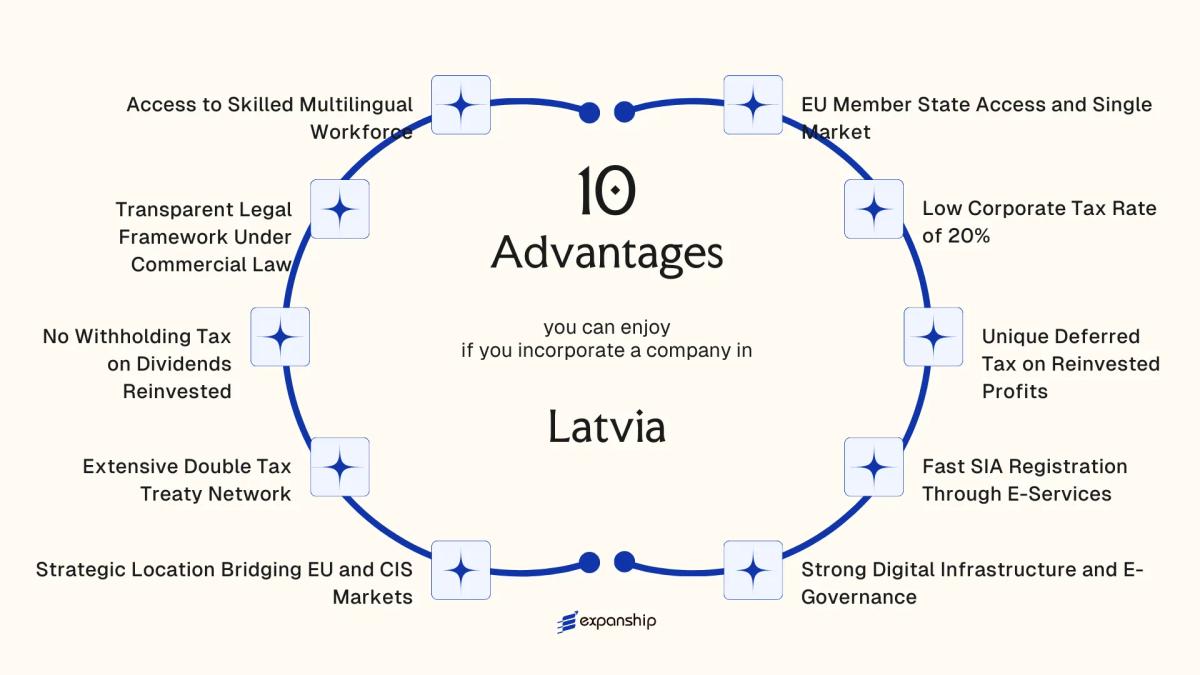
EU Member State Access and Single Market
Membership in the EU grants Latvia-incorporated companies direct access to the single market, one of the most significant structural advantages available to a foreign business owner operating through a European entity. This access is not incidental — it is treaty-backed and legally enforceable.
Passporting Rights and Cross-Border Operations
Under EU law, a Latvian-registered entity can provide services and establish branches across all 27 member states without requiring separate local incorporation in each country. For regulated sectors — financial services in particular — this passporting mechanism, governed by EU directives such as MiFID II and the CRD framework, means your firm can operate under a single authorization issued by Latvia's Financial and Capital Market Commission (FKTK).
Procurement, Movement of Goods, and Capital Flows
EU membership also grants your business access to public procurement across member states under the EU Public Procurement Directives. Free movement of capital means profits, dividends, and intercompany payments can flow across borders without the restrictions that apply to non-EU jurisdictions.
A Latvian entity gives you legally enforceable EU market access across 27 countries under a single corporate structure.
Low Corporate Tax Rate of 20%
Latvia applies a corporate income tax (CIT) rate of 20% on distributed profits. This rate sits below the EU average of roughly 21.3%, and the structural design of the system is where the Latvia 20% corporate tax rate advantages become most visible for foreign investors: tax is only triggered at the point of distribution, not at the point of earning.
Under the Corporate Income Tax Law adopted in 2018, undistributed profits face no annual CIT liability. Your firm pays tax when profits leave the company as dividends or deemed distributions. For a foreign-owned entity operating through a Latvian SIA (sabiedrība ar ierobežotu atbildību), this means retained earnings remain fully available for operational or capital use without immediate tax erosion.
The 20% rate applies to the gross dividend amount before tax deduction, which means the effective rate on net distributed profit is 20/80, equating to 25% on net profit. Foreign investors benefit from understanding this distinction before modelling returns.
The rate structure suits businesses that prioritise reinvestment, because:
- Profits retained in the company accumulate without triggering an annual CIT charge
- The timing of tax obligations is within the control of your business, not dictated by a fixed fiscal year assessment
- No minimum tax prepayments are required for standard operating entities

Company Incorporation in Latvia
Set up a Latvian SIA and access a competitive corporate tax structure under the 2018 Corporate Income Tax Law.
Unique Deferred Tax on Reinvested Profits
Latvia's deferred tax on reinvested profits is the structural foundation of its corporate tax model, introduced through amendments to the Corporate Income Tax Law that took effect on January 1, 2018. Under this framework, a company pays no corporate income tax on profits that remain within the business. Tax is triggered only at the point of profit distribution.
The practical effect is a form of tax deferral that operates automatically. Your business does not need to apply for an exemption or meet sector-specific criteria. As long as profits are retained and reinvested, the 20% tax obligation does not arise. This gives growing companies direct control over the timing of their tax liability.
| Parameter | Detail |
|---|---|
| Tax rate on distributed profits | 20% of gross distribution (equivalent to 20/80 of net profit) |
| Tax on retained/reinvested profits | None |
| Tax trigger event | Dividend distribution, deemed profit distribution, or non-business expenses |
| Governing legislation | Corporate Income Tax Law (amendments effective January 2018) |
| Filing and payment cycle | Monthly, due by the 20th of the following month |
For capital-intensive or growth-stage businesses, this model converts retained earnings into reinvestment capital without first being reduced by tax. A firm channeling profits into equipment, staffing, or market expansion retains the full profit amount to deploy. Compared to a conventional annual tax regime, where tax is paid on profit earned regardless of distribution, the cash flow advantage compounds materially over multiple operating years.
Fast SIA Registration Through E-Services
Latvia SIA registration e-services benefits are most visible in how quickly a foreign national can establish an operational legal entity without physical presence. The Lursoft e-registration portal, integrated with the Enterprise Register of the Republic of Latvia, allows the entire incorporation process to be completed online. For a foreign business owner, this eliminates the need to be present in-country, cutting both travel costs and setup time.
Registration through the Enterprise Register typically takes one to three business days when documentation is submitted electronically. Compare that to the weeks-long timelines common in several other EU member states, and the practical advantage becomes clear: your entity can begin contracting, opening bank accounts, and generating invoices far sooner.
The SIA structure requires a minimum share capital of EUR 2,800, which can be paid in installments under the Commercial Law. This staged payment option reduces the immediate capital burden on newly incorporated firms.
Keep the following in mind to make full use of this process:
- Authentication via eIDAS-compliant digital signature is required for non-residents
- The company's registered address in Latvia must be confirmed before submission
- Articles of association must comply with the Commercial Law of the Republic of Latvia
- Bank account opening timelines are separate from registration and may take longer
A SIA can be incorporated with a single shareholder and a single board member, both of whom can be the same foreign national resident outside Latvia.
Strong Digital Infrastructure and E-Governance
Latvia's digital infrastructure is one of the more concrete Latvia digital infrastructure business advantages available within the EU. The country consistently ranks among the top EU member states in the European Commission's Digital Economy and Society Index (DESI), driven by high-speed internet coverage, advanced public digital services, and a legally recognised electronic signature framework under the eIDAS Regulation.
Government Services Accessible Without Physical Presence
Your company's interaction with Latvian public institutions can be conducted almost entirely online. The latvija.lv unified state portal consolidates access to the State Revenue Service (VID), the Enterprise Register, and other regulatory bodies, meaning corporate filings, tax submissions, and official correspondence do not require physical presence in Riga.
For foreign directors and shareholders, this architecture removes a practical barrier that adds cost and delay in jurisdictions requiring notarised, in-person submissions. A registered entity can maintain full compliance from abroad, which is operationally significant when managing an international portfolio of companies.
Digitised Financial and Tax Administration
The VID's Electronic Declaration System (EDS) handles VAT registration, corporate tax filing, and payroll reporting through a single online interface. Filings submitted through EDS carry the same legal standing as paper submissions, backed by Latvia's Electronic Documents Law.
Data exchange between state institutions is handled through the X-Road secure data infrastructure, the same system used across Estonia's public sector. This inter-agency connectivity reduces the administrative burden on businesses, since government bodies retrieve data from each other rather than requiring your firm to submit duplicate documentation to multiple agencies.
Set Up Your Latvia Company With Full Compliance Support
Expanship helps you incorporate in Latvia and access its digital business environment, from registration to ongoing compliance, without the need for local presence.
Strategic Location Bridging EU and CIS Markets
Riga sits roughly equidistant between Western Europe and the former Soviet republics, placing your business within a geography that few EU member states can replicate. Latvia's strategic location bridging EU and CIS markets gives firms registered there a structural advantage when managing trade relationships across both blocs simultaneously.
- Latvia shares land borders with Estonia, Lithuania, Belarus, and Russia, and its ports, particularly the Port of Riga and the Port of Ventspils, handle significant cargo volumes moving between the EU single market and Eastern trade corridors.
- As a full EU member, any entity incorporated here operates under EU customs and trade rules, meaning goods exported westward face no internal tariffs and benefit from the EU's trade agreements with third countries.
- Historically strong commercial ties between Latvian firms and CIS-region counterparts have produced a business environment where Russian, Belarusian, and Ukrainian is commonly spoken alongside English and German, reducing friction in cross-border negotiations.
- The country's rail network connects directly to the broad-gauge lines used across the former Soviet rail system, which matters when your supply chain depends on land freight rather than air or sea.
- For firms serving both European and post-Soviet markets from a single registered entity, this geographic position reduces the need to maintain separate legal presences in multiple jurisdictions.
Extensive Double Tax Treaty Network
Latvia's double tax treaty network benefits foreign businesses by eliminating the risk of the same income being taxed twice across borders. As of 2024, Latvia has signed double taxation avoidance agreements with over 60 countries, covering major trading partners across the EU, Asia, and North America. Under each agreement, income categories such as dividends, royalties, interest, and capital gains are allocated taxing rights between the two contracting states.
For a foreign investor routing business through a Latvian entity, these treaties directly reduce withholding tax rates applied in the source country. Treaty-reduced rates on royalties, for example, can fall to 0-10% depending on the partner jurisdiction, compared to standard domestic rates that often exceed 15-20%. This reduction in cross-border tax friction is a structural cost advantage, not a discretionary benefit.
Treaty eligibility is generally conditional on the entity meeting the tax residency requirements under Latvian law and, where applicable, the treaty's Limitation on Benefits provisions.
A Latvian holding company receiving royalty income from a partner in a treaty country at a reduced withholding rate of 5% instead of a domestic rate of 20% retains an additional 15% of gross royalty income per payment cycle, which compounds significantly across multiple licensing arrangements.
No Withholding Tax on Dividends Reinvested
Latvia no withholding tax on dividends is not a concession — it is a structural feature of the corporate tax system under the Corporate Income Tax Law (Uzņēmumu ienākuma nodokļa likums), which came into force in January 2018. Distributed profits are taxed at 20% (applied as 20/80 on the net distribution), but profits retained within the business carry no tax obligation at all. For a foreign owner operating through a SIA (sabiedrība ar ierobežotu atbildību), this means the firm can accumulate and redeploy capital without triggering a tax event.
This structure directly benefits investors who prioritize growth over extraction. Reinvested earnings can fund operations, acquisitions, or working capital without the friction of a premature tax charge.
On cross-border distributions, Latvia imposes no withholding tax on dividends paid to EU/EEA parent companies, consistent with the EU Parent-Subsidiary Directive. Payments to non-EU shareholders may be subject to treaty rates, but many of Latvia's 60+ bilateral tax agreements reduce or eliminate withholding entirely.
Key implications for foreign-owned entities:
- Retained profits compound without annual tax drag
- Dividend tax exemption benefits apply within qualifying EU structures
- Treaty networks reduce exposure on outbound distributions to non-EU shareholders
The 0% withholding tax on reinvested profits applies only while earnings remain undistributed; once a dividend is declared, the 20/80 corporate tax rate applies at the entity level, not at the shareholder level.
Transparent Legal Framework Under Commercial Law
Latvia's commercial legal framework is codified primarily in the Commercial Law (Komerclikums), which has been in force since 2002 and governs the formation, operation, and dissolution of business entities. For a foreign investor, operating within a codified statutory framework means the rules are fixed, publicly accessible, and not subject to administrative discretion. Predictability of this kind directly reduces legal risk when structuring ownership, contracts, or exit arrangements.
The Enterprise Register (Uzņēmumu reģistrs) serves as the central authority for company registration and public disclosure. All filings, including articles of association, shareholder information, and annual accounts, are publicly accessible through the register. This transparency means counterparties and investors can conduct due diligence without relying on private data requests or third-party intermediaries.
Latvia's Commercial Law also sets clear statutory rules on shareholder rights, board responsibilities, and capital requirements for each entity type. A sabiedrība ar ierobežotu atbildību (SIA), for instance, operates under defined liability limitations backed by statute, not dependent on judicial interpretation case by case. Foreign owners can therefore structure their exposure with a degree of legal certainty that discretionary regulatory environments cannot offer.
As an EU member state, Latvia is subject to EU directives on corporate governance, anti-money laundering, and beneficial ownership disclosure. Compliance obligations under these directives are uniform across the bloc, which means:
- Beneficial ownership data is maintained in the Latvian Beneficial Owners Register
- Annual reporting obligations follow standardized EU accounting directives
- AML compliance aligns with the EU's AMLD framework rather than a bespoke local standard
This alignment reduces the legal translation burden for companies already operating in other EU jurisdictions.
Access to Skilled Multilingual Workforce
Latvia's multilingual skilled workforce advantages are rooted in the country's education system and its specific demographic composition. Approximately one-third of the population speaks Russian as a first language, and English proficiency rates rank consistently among the higher tiers in the EU according to the EF English Proficiency Index. For a foreign business operating across Eastern and Western European markets simultaneously, this combination reduces the cost and friction of hiring separate language specialists.
Latvian universities produce a steady supply of graduates in engineering, IT, finance, and law. The country's talent pool benefits businesses that require technical competence without the salary benchmarks typical of Western European capitals — compensation levels remain meaningfully lower than in Germany, the Netherlands, or Sweden while reflecting comparable educational standards.
Professionals in Latvia routinely communicate in three or more languages. This is not an incidental feature; it reflects decades of multilingual schooling under a national education framework that treats language instruction as a core curriculum requirement.
- Latvian, Russian, and English fluency in a single hire covers a communication range spanning the EU, Baltic states, and Russian-speaking CIS markets.
- The IT sector, in particular, has a well-established professional base, supported by programs at Riga Technical University and the University of Latvia.
- English-speaking workforce availability means foreign companies can operate management and client-facing functions without requiring translation infrastructure from day one.
For firms establishing a European subsidiary, this human capital depth means you can build a functional, cross-market team from a single hiring market.
Why Latvia Stands Out Among EU Business Destinations
Evaluated against the EU member states most likely to appear on the same shortlist, the comparison here focuses on Estonia, the Netherlands, and Ireland. These three jurisdictions target a similar profile of foreign investor: EU market access, holding or trading structures, and digital or service-based businesses. The contrast in tax mechanics and incorporation conditions is where meaningful differences emerge.
On the deferred tax model and the absence of withholding tax on reinvested dividends, the Latvian framework is structurally distinct from both Ireland and the Netherlands, which apply tax at the point of profit or distribution under standard corporate income tax rules. Estonia shares the deferred distribution tax model, making it the most direct structural comparator. Where Latvia holds a measurable position is in minimum capital requirements, treaty network breadth, and the combined cost of maintaining a registered entity year-on-year.
| Parameter | Latvia | Estonia | Netherlands | Ireland |
|---|---|---|---|---|
| Standard Corporate Tax Rate | 20% (on distribution) | 20% (on distribution) | 25.8% | 12.5% (trading income) |
| Tax on Retained/Reinvested Profits | None | None | Applied annually | Applied annually |
| Minimum Share Capital (Private Company) | EUR 1 (SIA) | EUR 2,500 (OÜ) | EUR 0.01 (BV) | EUR 1 (LTD) |
| Withholding Tax on Dividends to EU Parent | 0% | 0% | 0% (under EU PSD) | 0% (under EU PSD) |
| Double Tax Treaties | 62+ | 60+ | 100+ | 73+ |
| Company Registration Timeline | 1-3 days | 1 day online | 1-5 days | 5-10 days |
| EU VAT Registration Access | Yes | Yes | Yes | Yes |
Compliance Services for Companies in Latvia
Maintain your Latvian entity in good standing with ongoing support covering annual filings, accounting obligations, and regulatory reporting under Latvian Commercial Law.
Conclusion
Latvia's tax treatment of reinvested profits and its position within the EU single market form the structural foundation of what makes the benefits of incorporating in Latvia genuinely distinct for foreign investors. Under the Commercial Law and administered through the Enterprise Register, an SIA can be formed quickly by non-residents, with the 0% rate on retained earnings deferring the 20% corporate tax until distribution. That structural deferral is not a concession — it is the default regime.
Two features of the Latvian system carry particular weight. First, the deferred distribution tax directly rewards capital retention, which benefits early-stage and growth-oriented businesses where reinvestment is more practical than profit extraction. Second, EU membership grants your entity unrestricted access to the single market, meaning contracts, banking, and cross-border operations run under EU regulatory standards without the legal friction present in non-member jurisdictions.
Whether these advantages translate into a material benefit depends on your business model, ownership structure, and how you intend to use distributed profits. A holding entity with passive income has a different calculus than an operating firm with active EU trade relationships. The tax treaty network, the digital incorporation infrastructure, and the absence of withholding tax on qualifying dividend flows each carry different weight depending on your situation. Identifying which of these features aligns with your structure is the practical next step before formation proceeds.
Start Your Latvia Company Formation With Expanship
Engaging Expanship Latvia to handle your Latvia company formation with Expanship means the structural and fiscal advantages covered in this blog — the deferred corporate tax model, the SIA's single-shareholder eligibility, the absence of withholding tax on reinvested profits — are addressed within a defined compliance framework from the outset. Expanship manages the full registration cycle with the Latvish Enterprise Register, ensuring filings conform to the requirements of the Commercial Law and the Law on Enterprise Income Tax. Every engagement is structured around the specific obligations that apply to your entity type and ownership configuration.
Expanship's service scope across the incorporation and post-incorporation lifecycle includes:
- Preparation and notarization of constitutional documents, including the articles of association for SIA formation
- Registered address and resident agent provision in Riga, satisfying the Enterprise Register's local presence requirements
- Filing coordination with the Enterprise Register of Latvia and relevant state authorities
- Ongoing compliance management covering annual reporting, shareholder register maintenance, and UBO declarations under the Prevention of Money Laundering and Terrorism Financing Law
- Banking introduction assistance to support corporate account establishment with Latvian credit institutions
- Apostille and document legalization for cross-border corporate use
Reach the team through Expanship Latvia to discuss your incorporation requirements in detail.
Frequently Asked Questions (FAQ)
Under Latvia's Corporate Income Tax Law, companies do not pay corporate income tax on retained or reinvested profits. Tax at the standard 20% rate (applied to the gross-up of the distribution) is triggered only when profits are distributed as dividends or deemed distributions occur. This means a firm can accumulate and deploy earnings internally without an annual tax liability on those funds.
Dividends paid to a qualifying foreign parent company are generally exempt from withholding tax under Latvia's participation exemption rules, provided the recipient meets the conditions set out in the Corporate Income Tax Law. Where those conditions are not met, the applicable rate is governed by the relevant double tax treaty, of which Latvia maintains a network covering over 60 jurisdictions. The precise rate depends on the specific treaty in force with the recipient's country of residence.
Registration through the Latvian Enterprise Register (Uzņēmumu reģistrs) online system can be completed in one to three business days when all documents are in order and submitted electronically. The e-service portal accepts digitally signed founding documents, eliminating the need for in-person notarisation in most standard cases. Turnaround may extend if the Register raises queries or if additional documentation is requested.
Latvia can be suitable for holding structures primarily because of the absence of withholding tax on qualifying dividend distributions and the deferred taxation model under the Corporate Income Tax Law. However, direct comparison with other EU holding jurisdictions depends on factors such as the specific treaty network applicable to your investor chain, substance requirements, and the target markets involved. The answer is not categorical and requires analysis of your group's specific ownership and distribution flow.
Failure to submit annual accounts on time to the Latvian Enterprise Register can result in administrative penalties and, in persistent cases, compulsory liquidation proceedings initiated by the Register. The Commercial Law sets out obligations for timely financial reporting, and the Register actively monitors compliance. Directors bear personal responsibility for ensuring filings are made within the statutory deadlines.
Physical presence is not required if the incorporation process is completed remotely using qualified electronic signatures recognised under the eIDAS regulation and Latvia's national e-identity infrastructure. Non-resident founders who do not hold a qualifying electronic ID may need to arrange notarised and apostilled founding documents or appoint a representative with a power of attorney. The Latvian Enterprise Register accepts remote submissions provided authentication requirements are satisfied.
Legal Disclaimer
The information provided in this article is for general informational purposes only and does not constitute legal, tax, or professional advice. While we strive to ensure the accuracy and timeliness of the content, laws and regulations are subject to change, and the application of laws can vary widely based on specific facts and circumstances.
Readers should not act upon this information without seeking professional counsel tailored to their individual situation. Expanship and its authors disclaim any liability for actions taken or not taken based on the content of this article.
For specific advice regarding your business setup, compliance requirements, or any legal matters, please consult with qualified legal and tax professionals in the relevant jurisdiction.