
Key Takeaways
- Foreign investors incorporating in Lesotho under the Companies Act 2011 must navigate registration through the One Stop Business Facilitation Centre (OBFC), a process that remains slower and more bureaucratic in practice than its single-window mandate suggests.
- Lesotho's capital markets lack the depth and liquidity available in neighboring South Africa, limiting a locally incorporated company's ability to raise equity or access structured debt financing domestically.
- Because Lesotho's economy is heavily tied to South Africa through the Common Monetary Area and the Southern African Customs Union (SACU), businesses incorporated there absorb external economic shocks they have no direct mechanism to influence or hedge against.
- Intellectual property protections in Lesotho remain underdeveloped relative to the standards expected by technology firms or brand-intensive businesses, creating measurable enforcement risk for companies that depend on proprietary assets.
Lesotho operates under an evolving regulatory framework, with company formation governed primarily by the Companies Act 2011. The framework sits between the heavily codified systems of larger African economies and the lighter-touch regimes found in some offshore centers, placing it in a middle ground that carries its own set of structural constraints.
The disadvantages of incorporating in Lesotho span regulatory, financial, operational, and physical infrastructure categories. Not all of these will apply equally to every business — the Lesotho company formation drawbacks most relevant to a textile manufacturer differ considerably from those facing a financial services firm or a technology startup.
This article is most relevant to foreign investors and internationally oriented business owners considering entry into the Southern African market through a locally registered entity.
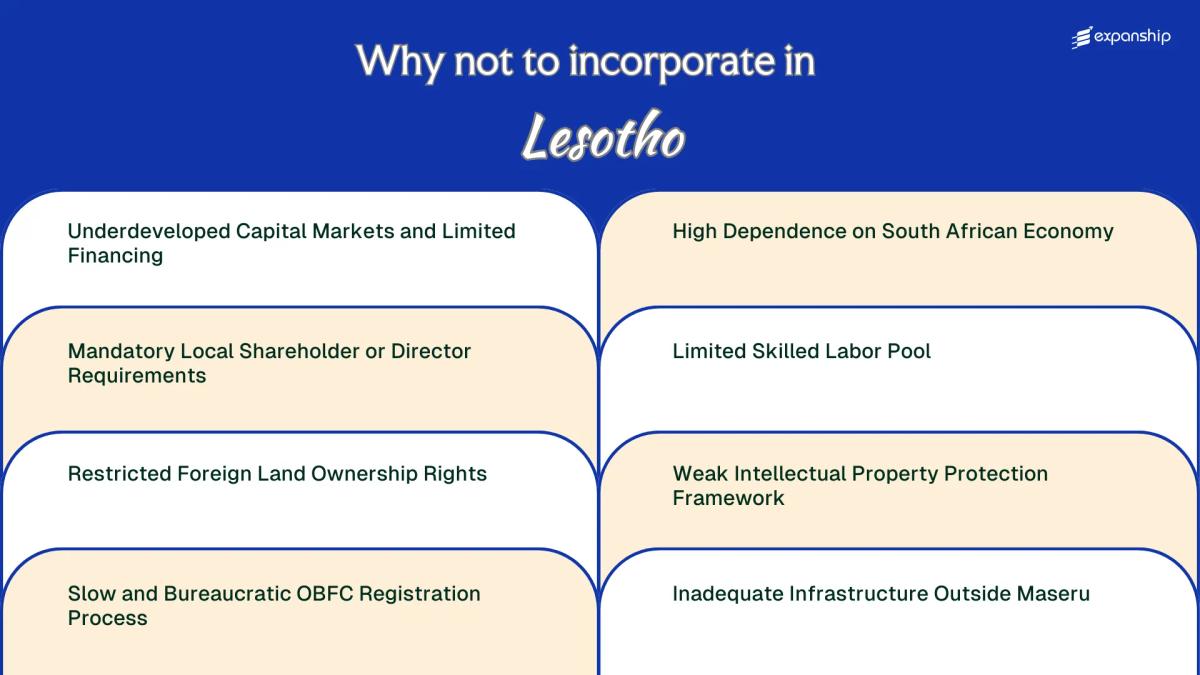
Underdeveloped Capital Markets and Limited Financing
Lesotho capital market limitations present a structural financing problem that most foreign investors underestimate before committing to incorporation.
No Functional Stock Exchange or Public Capital Market
The Maseru Securities Market, which operates under the Capital Markets Development Act, remains at an early stage with minimal listed instruments and thin trading volumes. For your business, this means equity financing through public markets is effectively unavailable, forcing reliance on private arrangements or foreign parent company funding.
Bank lending from institutions such as Lesotho Bank and Standard Lesotho Bank is available but constrained by high collateral requirements and interest rates that reflect the country's risk profile.
Structural Barriers to Debt and Development Finance
The Central Bank of Lesotho, the primary monetary authority, has limited tools to stimulate domestic credit expansion given the loti's peg to the South African rand. Accessing development finance through regional bodies is possible in principle, but the application process is lengthy and approval is not guaranteed for privately held foreign entities.
Your business may be unable to raise growth capital locally at any stage, making external funding dependency a permanent structural condition rather than a temporary constraint.
Mandatory Local Shareholder or Director Requirements
Lesotho local shareholder requirements restrictions are not codified as a blanket rule under the Companies Act 2011, but sector-specific licensing conditions and investment approval frameworks can impose local participation thresholds that reduce the equity stake a foreign investor retains.
Under the Lesotho National Development Corporation (LNDC) and relevant sectoral regulators, certain industries require a Basotho partner to hold a meaningful ownership share. This effectively forces foreign principals into joint-venture structures they may not have planned for, adding negotiation costs and diluting control.
Appointing a compliant local director to satisfy residency or nationality conditions creates its own friction:
- Finding a qualified local director with relevant industry experience is difficult given the shallow professional talent pool, raising the cost and risk of delegation.
- A mandatory local partner gains statutory rights under the Companies Act 2011, including access to financial records, which can expose proprietary business information.
- Profit-sharing obligations with a local shareholder reduce the return your firm can repatriate, affecting the investment's financial model.
- Disputes with a local co-director are resolved through Lesotho's domestic court system, which can be slow and unpredictable for foreign parties.
These conditions vary by sector, so the degree of restriction depends on the industry your business operates in.

Company Incorporation in Lesotho
Understand the ownership structures, local compliance requirements, and regulatory steps involved in forming a company in Lesotho.
Restricted Foreign Land Ownership Rights
Foreign land ownership restrictions in Lesotho represent one of the most structurally limiting factors for any foreign business seeking a physical footprint in the country. Under the Land Act 2010, land in Lesotho is vested in the Basotho Nation and administered by the King on its behalf. Foreign nationals and foreign-registered entities cannot hold freehold title to land under any circumstances.
What foreign businesses can obtain instead is a land lease, typically granted through the Land Administration Authority (LAA). These leases are time-limited, and their renewal is not guaranteed, which introduces long-term uncertainty into any capital investment tied to physical property.
| Restriction | Detail | Business Impact |
|---|---|---|
| Freehold ownership | Prohibited for foreign entities | No permanent property security |
| Lease term (commercial) | Generally up to 90 years | Cannot be collateralized as freehold asset |
| Lease renewal | Discretionary, not automatic | Long-term facility planning is unreliable |
| Land administration body | Land Administration Authority (LAA) | Single-point dependency for all lease approvals |
Leased land also carries constrained collateral value. Because you cannot hold freehold title, securing financing against property becomes significantly harder, compounding the difficulties already present in accessing local credit markets.
Industrial or manufacturing operations requiring large sites face compounded exposure. Site selection, lease negotiation, and approval through the LAA can extend project timelines considerably, with no statutory deadline binding the authority to conclude approvals within a fixed period.
Slow and Bureaucratic OBFC Registration Process
The OBFC registration process drawbacks in Lesotho are a consistent friction point for foreign businesses. The One Stop Business Facilitation Centre was designed to consolidate multiple registration steps, but in practice, processing timelines regularly extend beyond the officially stated targets, creating unpredictable delays that complicate pre-launch planning.
Manual document handling and inter-agency coordination gaps slow the process further. When submissions involve multiple ministries, each operating on its own schedule, your incorporation timeline becomes dependent on the slowest link in that chain.
System downtime and limited digital infrastructure mean that online submissions are not always a reliable alternative to in-person filing. Foreign applicants unfamiliar with local procedures face additional back-and-forth when documents are returned for correction without clear guidance.
- Registration requires physical presence or a local registered agent to submit documents at the OBFC office in Maseru
- Certificate issuance timelines are not guaranteed, and delays extend post-incorporation licensing steps
- Additional sectoral approvals from bodies outside the OBFC fall under separate timelines and are not consolidated
- Document rejection due to non-conforming formats restarts portions of the process without formal appeal timelines
Lesotho's OBFC was one of sub-Saharan Africa's early one-stop-shop experiments, yet the country still ranks below regional peers on business registration speed in World Bank assessments.
High Dependence on South African Economy
Lesotho's Lesotho South Africa economic dependence risks stem from a structural reality: the economy is deeply tied to South Africa through the Southern African Customs Union (SACU), which means external shocks originating in Pretoria or Johannesburg transmit directly into your operating environment here.
Structural Exposure Through SACU Revenue Dependency
SACU transfers account for a substantial share of government revenue in Lesotho, historically ranging between 40% and 60% of total fiscal receipts. When South Africa's customs pool contracts due to weaker trade volumes or policy shifts, Lesotho's government budget tightens, which can delay public procurement payments and reduce infrastructure spending that your business depends on.
The loti is pegged at parity to the South African rand under the Common Monetary Area agreement. Any depreciation in the rand therefore passes through directly into local inflation and input costs, without your firm having any currency buffer.
Operational Risks for Foreign Entities
Beyond macroeconomic exposure, the SACU dependence drawbacks for Lesotho-based businesses extend to supply chain vulnerability, since most manufactured inputs, consumer goods, and capital equipment enter through South African ports and road corridors. A disruption at that border — whether regulatory, logistical, or political — can halt operations with no viable alternative sourcing route.
This concentration of risk is rarely offset by domestic alternatives given Lesotho's limited internal market of approximately 2.2 million people.
Addressing South Africa Dependency Risks Before You Incorporate in Lesotho
Our corporate services team can assess how your specific business model is exposed to Lesotho's structural economic dependencies and help you structure your entity accordingly.
Limited Skilled Labor Pool
Lesotho skilled labor shortage problems directly affect hiring timelines, payroll costs, and operational capacity for foreign-owned entities. The country's tertiary enrollment rates remain low, and emigration of qualified professionals to South Africa compounds the domestic supply gap.
- Your business will face acute shortages in technical, managerial, and financial roles because the domestic labor market is heavily skewed toward semi-skilled textile and garment sector workers.
- Recruiting qualified professionals often requires sourcing from abroad, which triggers work permit obligations under the Labour Code Order No. 24 of 1992 and adds cost and administrative delay.
- Dependence on expatriate staff inflates your wage bill, since foreign hires typically command compensation packages above local market rates to offset relocation.
- High emigration of educated Basotho nationals to South Africa continuously shrinks the available talent pool, making retention a structural challenge rather than an isolated hiring event.
- Talent pool restrictions in Lesotho incorporation planning are compounded by limited specialist training institutions, leaving skills gaps that cannot be resolved through local recruitment alone.
Weak Intellectual Property Protection Framework
Weak intellectual property protection in Lesotho presents a tangible risk for any foreign business that relies on proprietary technology, branding, or creative assets. The country acceded to the African Regional Intellectual Property Organization (ARIPO) through the Harare Protocol, which provides a regional registration pathway, but registration alone does not guarantee enforcement.
Local IP enforcement capacity is limited. The courts handling IP disputes lack specialized IP benches, and the general judiciary processes cases slowly, meaning infringement can persist for years before resolution.
For technology firms or brand-dependent businesses, this gap between registered rights and enforceable rights is operationally significant. A competitor using your trademark or copying proprietary software faces low deterrent risk in practice.
- Domestic IP legislation has not kept pace with digital and software-based IP categories
- Customs enforcement mechanisms for counterfeit goods remain underdeveloped
- Civil remedies for infringement are available in principle but difficult to execute
A foreign software firm registering its IP through ARIPO could face months of infringement before obtaining a court injunction locally, with legal costs potentially exceeding the commercial value of the dispute in a market of Lesotho's size.
Inadequate Infrastructure Outside Maseru
Infrastructure limitations outside Maseru, Lesotho create direct operational costs for any business that cannot confine its activities to the capital. Road quality deteriorates significantly in highland and rural districts, making supply chain reliability a persistent problem rather than an occasional one.
Electricity access outside urban centers is inconsistent. The Lesotho Electricity Company (LEC) operates distribution networks that are largely concentrated in Maseru and nearby lowland towns, leaving many outlying areas dependent on unreliable grid connections or off-grid alternatives that add capital expenditure to setup costs.
Water and telecommunications infrastructure follow a similar pattern. Connectivity gaps in rural districts mean that businesses operating in sectors such as agribusiness, textiles manufacturing, or logistics face functional constraints that require independent infrastructure investment just to meet basic operational standards.
- Road infrastructure in highland areas is frequently impassable during seasonal rains, disrupting goods movement.
- Broadband penetration outside Maseru remains limited, restricting access to digital financial services and remote operations.
- Backup power solutions are a practical necessity in most non-urban locations, not a contingency measure.
If your business model depends on facilities, suppliers, or staff located outside Maseru, assume you will bear the cost of supplementary infrastructure independently, as no regulatory framework currently obligates the LEC or other utilities to guarantee service levels in underserved districts.
Overcoming Lesotho's Incorporation Challenges
Overcoming Lesotho's incorporation challenges requires a structured approach that addresses legal, operational, and financial constraints before committing to a full market entry.
- Confirm whether your business activity qualifies under the Lesotho Investment Policy or requires sector-specific approval from the Lesotho Revenue Authority prior to registration.
- Structure equity to meet any applicable local participation requirements under the Companies Act 2011 before filing with the OBFC.
- Secure financing arrangements through LNDC-linked channels or cross-border facilities, given the absence of developed domestic capital markets.
- Register intellectual property rights through ARIPO membership channels, as domestic IP enforcement mechanisms remain limited.
- Locate operational infrastructure within Maseru to avoid service and logistics gaps that affect businesses outside the capital.
- Establish supply chain and contingency arrangements that account for economic dependency on South African trade routes and border access.
Mitigating risks of incorporating in Lesotho does not eliminate the structural constraints embedded in its regulatory environment. The Companies Act 2011 and the OBFC's administrative framework govern the baseline compliance requirements that all registered entities must satisfy.
Lesotho's Business Viability at a Glance
| Pros | Cons |
|---|---|
| SACU membership provides preferential access to South African and regional markets without additional trade barriers. | The economy's heavy dependence on South Africa exposes registered businesses to external monetary and trade shocks outside local control. |
| AGOA eligibility supports export-oriented manufacturing, particularly in the garments sector. | Capital markets remain underdeveloped, and local debt financing options for foreign-owned entities are limited. |
| The OBFC serves as a single-window registration point intended to reduce procedural steps. | Registration through the OBFC in practice involves delays and inconsistent processing times. |
| Corporate tax incentives are available for qualifying entities in designated sectors. | Foreign nationals cannot own land, which restricts collateral options and long-term operational planning. |
| A relatively straightforward legal framework derived from Roman-Dutch and English common law. | Intellectual property protections exist in statute but lack consistent enforcement mechanisms. |
Any thorough Lesotho business viability risks assessment will surface a pattern of structural constraints that make this a selective rather than universal incorporation destination. The disadvantages covered in this blog are not minor administrative friction; several reflect policy positions and economic conditions that directly affect operational capacity. That said, for businesses with a specific regional trade rationale or sector alignment, the jurisdiction offers a defined, if narrow, value proposition grounded in treaty access and incentive frameworks.
Corporate Compliance Services in Lesotho
Maintain your company's good standing in Lesotho with ongoing compliance support, including annual returns, regulatory filings, and statutory record-keeping under the Companies Act 2011.
Conclusion
The Lesotho company incorporation drawbacks summary is straightforward: this is a market with genuine structural constraints that affect day-to-day operations and long-term planning. Capital access remains limited outside the formal banking sector, the labor pool for technical and specialized roles is thin, and the economy's exposure to South African monetary and trade conditions reduces your firm's insulation from external shocks. Setting up a business here requires a clear-eyed assessment of those conditions. Firms that proceed with accurate information about the local regulatory environment are better positioned to structure their entity accordingly.
Expanship's Lesotho Expansion Support
Incorporating in Lesotho brings specific administrative and compliance obligations that can be difficult to manage remotely. From satisfying OBFC registration requirements to meeting local director rules and navigating land ownership restrictions, the operational demands fall disproportionately on foreign investors unfamiliar with how the country's regulatory environment functions in practice. Expanship's Lesotho business expansion support services are structured around reducing that burden, not replacing your decision-making.
Our team works across the full incorporation and post-registration cycle. Services include:
- Preparing and submitting company registration documents to the OBFC on your behalf.
- Providing a registered office address and acting as your local registered agent.
- Handling government filings and liaising directly with Lesotho's regulatory authorities.
- Managing ongoing compliance obligations after your company is active.
- Introducing your business to local banking institutions to support account opening.
- Registering your entity for tax purposes and coordinating with local revenue authorities.
Reach out to Expanship Lesotho to discuss your specific requirements.
Frequently Asked Questions (FAQ)
Yes, all land in Lesotho is vested in the Basotho Nation under the Land Act 2010, which means foreign-owned companies cannot hold freehold title. Your business can only access land through leasehold arrangements, typically administered through the Land Administration Authority, and the terms of those leases can create long-term uncertainty for capital-intensive operations.
Lesotho's IP enforcement infrastructure is limited, and the capacity of local courts to handle complex trademark or patent disputes is not comparable to regional peers such as South Africa or Mauritius. If your business model depends on proprietary technology, brand exclusivity, or licensed content, contractual protections carry more practical weight than statutory ones in this jurisdiction.
The One Stop Business Facilitation Centre handles company registration, and while official fees are relatively modest, the process is frequently extended by document verification backlogs and inter-agency coordination gaps. Foreign applicants often face additional scrutiny, particularly around beneficial ownership declarations, which can add weeks to a timeline that officially should be completed far faster.
Lesotho's labor market is constrained by a relatively small population of approximately two million and significant emigration of skilled workers to South Africa. Sectors requiring technical, legal, or financial expertise face acute shortages, and firms in those industries typically must either import expatriate talent, which triggers work permit obligations under the Labour Code Order 1992, or invest heavily in internal training.
Under the Companies Act 2011, failure to maintain the required director appointments can result in the company being flagged as non-compliant by the Registrar of Companies, potentially leading to administrative penalties or striking off. Restoring a deregistered company requires a formal application and payment of outstanding fees, and the process is not always straightforward when the original filing records are incomplete.
A locally incorporated subsidiary with Basotho shareholders can hold a land lease, but the Land Act 2010 does not grant freehold rights to any private entity regardless of ownership structure. Using a nominee or proxy arrangement to circumvent the spirit of land regulations carries legal risk and would not confer secure tenure, making it an unreliable solution for businesses that require permanent commercial premises.
Lesotho has no functioning domestic stock exchange, and the banking sector is dominated by a small number of South African-affiliated institutions with conservative lending criteria. Foreign-owned entities without established local credit history or tangible asset collateral will find debt financing difficult to secure, and there is no local venture capital or private equity ecosystem to supplement traditional lending.
Legal Disclaimer
The information provided in this article is for general informational purposes only and does not constitute legal, tax, or professional advice. While we strive to ensure the accuracy and timeliness of the content, laws and regulations are subject to change, and the application of laws can vary widely based on specific facts and circumstances.
Readers should not act upon this information without seeking professional counsel tailored to their individual situation. Expanship and its authors disclaim any liability for actions taken or not taken based on the content of this article.
For specific advice regarding your business setup, compliance requirements, or any legal matters, please consult with qualified legal and tax professionals in the relevant jurisdiction.