
Key Takeaways
- Businesses incorporated under Lesotho's Companies Act 2011 gain immediate access to SACU's duty-free trade zone spanning five southern African markets, without requiring secondary approvals after registration.
- Manufacturing entities operating in Lesotho can reduce their effective tax burden below the standard 25% corporate rate through sector-specific incentives and exemptions designed to attract export-oriented production.
- Eligibility for AGOA preferences gives Lesotho-registered companies a direct preferential pathway into the U.S. market, a trade advantage that few regional jurisdictions can offer in combination with SACU membership.
- Lesotho's double taxation agreement network reduces the cross-border tax friction that would otherwise apply to profits repatriated or transacted between Lesotho entities and trading partners in treaty countries.
Lesotho is an independent landlocked kingdom entirely surrounded by South Africa, governed under a constitutional monarchy and recognized as a sovereign state within the Southern African Development Community (SADC). Company registration falls under the authority of the Registrar of Companies, operating within the One Stop Business Facilitation Centre (OBFC), which administers the incorporation process under the Companies Act 2011. Foreign businesses most commonly establish a private company limited by shares when setting up operations in the country.
From a tax posture, the jurisdiction operates a standard territorial system with a moderate corporate rate and a growing network of double taxation agreements. Foreign ownership is generally permitted across most sectors, with the government maintaining an openly stated policy of encouraging foreign direct investment as a mechanism for economic development.
This article examines the concrete advantages that make Lesotho company formation a considered choice for businesses targeting regional and international markets, covering everything from trade access and tax treatment to the legal structure that governs your entity once incorporated.
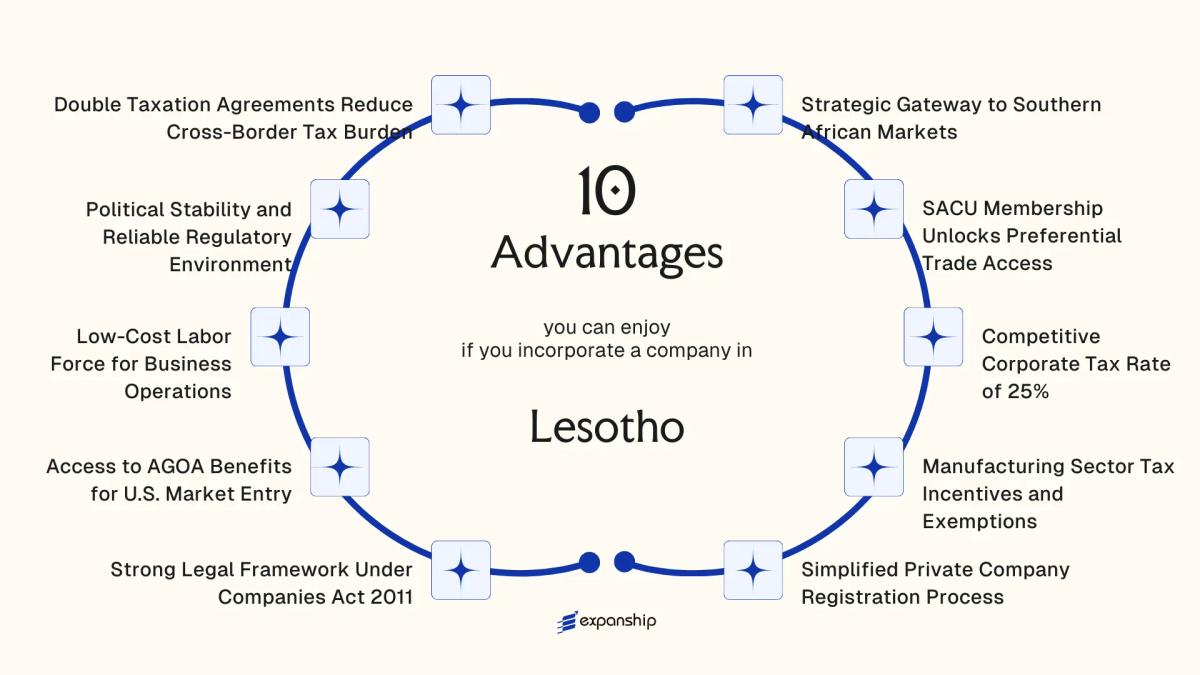
Strategic Gateway to Southern African Markets
Landlocked entirely within South Africa, Lesotho occupies one of the most geographically distinctive positions on the continent. This physical relationship with Africa's largest economy by GDP creates a market access dynamic that few other jurisdictions can replicate.
Direct Connectivity to the South African Economy
Your business registered in Maseru sits within a two-hour drive of Bloemfontein and within reach of Durban's port infrastructure, giving physical supply chains a practical anchor point. South Africa represents a consumer market of over 60 million people, and proximity alone reduces inland freight costs that would otherwise apply to firms based further north.
A Platform for Broader Regional Reach
Lesotho's gateway to Southern African markets extends beyond its immediate neighbor. Through its participation in the Southern African Development Community (SADC), firms incorporated here operate within a regional economic framework covering 16 member states and a combined population exceeding 380 million. Cross-border commercial activity within SADC benefits from trade facilitation protocols that reduce administrative barriers at member-state borders.
A company incorporated in Lesotho can serve both the South African domestic market and broader SADC trade corridors from a single registered entity.
SACU Membership Unlocks Preferential Trade Access
Lesotho's membership in the Southern African Customs Union (SACU) removes tariff barriers that would otherwise increase the cost of doing business across the region. As a SACU member alongside South Africa, Botswana, Namibia, and Eswatini, companies incorporated here can move goods across member state borders without paying intra-union customs duties. For a business exporting manufactured goods or sourcing inputs from South Africa, that tariff-free movement directly reduces operating costs.
SACU also applies a common external tariff to imports from non-member countries, meaning your firm benefits from a unified customs framework rather than navigating five separate tariff schedules. The revenue-sharing arrangement within SACU provides Lesotho with a stable fiscal base, which in turn supports the regulatory and infrastructure environment that businesses depend on.
The practical advantages of Lesotho SACU membership trade benefits for foreign-owned entities include:
- Duty-free access to South Africa, the continent's most industrialized economy, without requiring individual trade agreements
- No customs declarations or tariff payments on intra-SACU goods movement, reducing administrative overhead
- A shared trade policy that gives your business predictable rules when exporting within the customs union
- Access to SACU's combined market of over 60 million consumers under a single regulatory framework
Eligibility for these benefits applies to entities legally incorporated and operating within the territory, not to offshore holding structures that lack a genuine commercial presence.

Company Incorporation in Lesotho
Establish a legally compliant entity in Lesotho and access SACU trade benefits, regional market reach, and a straightforward registration process.
Competitive Corporate Tax Rate of 25%
Lesotho's corporate tax rate sits at 25% for resident companies, a fixed rate applied to taxable income under the Income Tax Act 1993. For foreign investors structuring operations through a locally incorporated entity, this rate determines the baseline tax cost before any sector-specific concessions apply.
At 25%, the rate is materially lower than the statutory corporate tax rates applied in several larger African economies. South Africa's standard rate, for instance, stands at 27%. For a foreign-owned company booking profits through a Lesotho-registered entity, the difference compounds meaningfully at higher income levels.
| Parameter | Detail |
|---|---|
| Standard corporate tax rate | 25% |
| Governing legislation | Income Tax Act 1993 |
| Tax residency basis | Incorporation or place of effective management |
| Withholding tax on dividends | 25% (subject to treaty relief) |
| Tax administration body | Lesotho Revenue Authority (LRA) |
The Lesotho Revenue Authority administers corporate tax filings, and resident companies are taxed on worldwide income. Non-resident companies are taxed only on income sourced within the country's borders, which gives foreign firms operating regionally through a branch structure a defined and limited exposure.
The 25% rate applies before any manufacturing or export incentives reduce the effective liability further. For a business establishing operations primarily to serve regional markets, the statutory rate already positions the corporate structure at a lower cost point than many neighboring jurisdictions offer by default.
Manufacturing Sector Tax Incentives and Exemptions
Lesotho manufacturing tax incentives for investors center on a reduced corporate tax rate of 10% for manufacturing entities, compared to the standard 25% rate that applies to most other sectors. This halved rate directly reduces your annual tax liability, improving margins on production operations registered in the country.
Under the Income Tax Act 1993, the Lesotho Revenue Authority administers this preferential rate for qualifying manufacturers. Eligibility generally requires that the business is engaged in an approved manufacturing activity within Lesotho's borders, not merely in trading or distribution.
Certain capital expenditures related to industrial infrastructure may also attract accelerated depreciation allowances, reducing taxable income in the early years of operation when capital outlay is highest.
- Confirm your business activity qualifies as manufacturing under the Income Tax Act 1993
- Register with the Lesotho Revenue Authority before claiming reduced rates
- Retain documentation of qualifying capital expenditure for depreciation claims
- The 10% rate applies to manufacturing income specifically; non-manufacturing revenue streams within the same entity are taxed at standard rates
A foreign firm operating in textiles, garments, food processing, or light manufacturing can structure operations to ensure the preferential rate applies to the core production income, while keeping service-side revenues separately accounted for.
Lesotho's manufacturing tax rate of 10% is one of the lowest sector-specific rates in the Southern African Customs Union, applying even to foreign-owned entities with no requirement for local ownership thresholds.
Simplified Private Company Registration Process
Registering a private company in Lesotho involves fewer procedural layers than many comparable African jurisdictions. One of the measurable Lesotho private company registration advantages is the single-window entry point provided by the One Stop Business Facilitation Centre (OBFC), which consolidates functions that would otherwise require separate engagements with multiple government agencies.
Single-Window Registration Through OBFC
The OBFC brings together the Registrar of Companies, the Lesotho Revenue Authority, and relevant licensing bodies under one administrative roof. For a foreign business owner, this structure eliminates the need to coordinate across separate departments with different timelines, documentation standards, and fee structures. Private companies under the Companies Act 2011 can be registered without a local director requirement, which further reduces the logistical burden on foreign incorporators.
Minimum Capital and Documentation Requirements
No statutory minimum share capital is prescribed for private companies, meaning your firm can be registered without committing a defined capital threshold upfront. This is a structural feature that gives founders flexibility in how they capitalize the entity relative to actual operational needs. The documentation required typically covers standard incorporation instruments, including a memorandum and articles of association, without extensive notarization requirements that tend to slow down formation timelines in neighboring jurisdictions.
Plan Your Entry Into Lesotho With Confidence
Connect with Expanship to understand the full scope of registration requirements, OBFC procedures, and compliance obligations for your private company in Lesotho.
Strong Legal Framework Under Companies Act 2011
The Companies Act 2011 replaced Lesotho's earlier corporate legislation and introduced a modernized framework that aligns more closely with contemporary international standards. For foreign investors, the practical value of this lies in predictability: the statute sets out clearly defined rights for shareholders, directors, and creditors, reducing the legal ambiguity that can complicate cross-border structures.
- Shareholder protections under the Act include defined rights to information, the ability to call extraordinary meetings, and remedies for oppressive conduct by majority shareholders. These provisions give minority investors a formal legal recourse, which is a meaningful assurance when entering a joint venture or co-investment structure.
- Director duties are codified, including obligations of care, skill, and disclosure of conflicts of interest. Defined duties reduce governance disputes and give foreign parent companies a clearer basis for holding local directors accountable.
- The Act permits a single-member private company, meaning your business can operate as a wholly owned subsidiary without a mandatory local co-shareholder. This preserves full ownership control for foreign principals.
- Financial reporting and audit requirements are structured according to company size and type under the Act. Tiered obligations mean smaller entities are not subject to the same compliance burden as large public companies, keeping operational costs proportionate.
Access to AGOA Benefits for U.S. Market Entry
Lesotho AGOA benefits for US market access give incorporated companies the ability to export qualifying goods to the United States duty-free and quota-free under the African Growth and Opportunity Act. For a manufacturer or exporter, this eliminates tariff costs that would otherwise apply to products entering one of the world's largest consumer markets.
Eligible product categories under AGOA include apparel, textiles, and a range of agricultural and industrial goods. The apparel provision is particularly significant: under the third-country fabric rule, your company can source fabric from outside sub-Saharan Africa and still qualify for duty-free treatment, a flexibility that most preferential trade arrangements do not extend to beneficiary countries.
AGOA eligibility is not automatic. The U.S. government reviews beneficiary status annually, and your business must ensure that goods meet the rules-of-origin requirements set out in the Act. An entity incorporated in the country and producing goods locally is positioned to satisfy these criteria directly.
A garment manufacturer exporting $500,000 worth of apparel to the U.S. at an average MFN tariff rate of 12% would face $60,000 in annual duties without AGOA. Under the Act, that cost drops to zero, directly improving unit margins on every shipment.
Low-Cost Labor Force for Business Operations
Lesotho low-cost labor advantages for businesses are directly tied to wage structures that remain competitive relative to other Southern African manufacturing hubs. The national minimum wage, set by the Ministry of Labour and Employment through periodic wage orders, applies across sectors including textiles, garments, and construction. For labor-intensive operations, the gap between local wage floors and those in comparable regional economies translates directly into lower per-unit production costs.
The garment and textile sector illustrates this clearly. Factories operating under the Lesotho National Development Corporation (LNDC) export processing framework employ large workforces at wage rates that allow competitive pricing in export markets, particularly for U.S.-bound apparel under AGOA-linked production arrangements.
Beyond wages, the labor pool carries practical manufacturing skills developed through decades of export-oriented factory work. Your business can draw on a workforce with existing familiarity with industrial production standards, reducing initial training overhead.
- The Labour Code Order 1992 governs employment contracts, working hours, and termination rights.
- Wage orders are sector-specific, so applicable minimum rates depend on your industry classification.
- Formal employment disputes are handled through the Directorate of Dispute Prevention and Resolution (DDPR).
Minimum wage rates in Lesotho are revised periodically, and sector-specific rates differ, so verify the current applicable wage order for your intended industry before modeling labor cost projections.
Political Stability and Reliable Regulatory Environment
Lesotho political stability benefits for investors are grounded in structural factors rather than general sentiment. The country operates as a constitutional monarchy, and its governance framework has maintained continuity through a functioning parliamentary system, which reduces the risk of abrupt policy reversals that can disrupt foreign business operations.
Constitutional Governance as a Business Foundation
The legal order rests on the Constitution of Lesotho 1993, which enshrines property rights and judicial independence. For a foreign business owner, this matters because asset protection and contract enforceability depend directly on whether courts can operate without political interference. An independent judiciary gives your firm a reliable mechanism for resolving commercial disputes.
Regulatory Oversight With Defined Authority
The Lesotho Revenue Authority (LRA) administers tax compliance, while the Registrar of Companies under the Ministry of Trade and Industry oversees corporate registration and ongoing compliance obligations. Having defined statutory bodies with clear mandates means your business interacts with known, accountable institutions rather than opaque bureaucratic processes.
Alignment With Regional Regulatory Standards
Membership in the Southern African Development Community (SADC) has required the country to align several regulatory standards with regional frameworks. This alignment reduces the compliance gap for firms already operating elsewhere in the region, since reporting expectations and business conduct rules follow recognizable regional norms.
- Property rights are constitutionally protected under the 1993 Constitution
- The LRA operates under statutory authority, reducing discretionary enforcement
- SADC membership supports regulatory consistency across the region
- Commercial disputes can be brought before an independent court system
Double Taxation Agreements Reduce Cross-Border Tax Burden
Lesotho double taxation agreement benefits are limited in number but targeted in scope. The country has concluded a tax treaty with South Africa, its most significant trading and investment partner. Under this agreement, withholding tax rates on dividends, interest, and royalties paid between the two countries are reduced below domestic statutory levels, which directly lowers the tax cost of repatriating income across the border.
For a foreign-owned company operating in Lesotho and distributing profits to a South African parent or partner, the treaty eliminates the risk of the same income being taxed in full by both jurisdictions. Without this protection, cross-border payments could be subject to withholding tax domestically and then again as ordinary income in the recipient's home country.
Beyond South Africa, the country's membership in regional frameworks creates a degree of informal tax coordination with neighboring states, though formal treaty coverage remains narrower than in larger African economies. This means businesses with complex multi-jurisdictional structures should map their specific flows against existing treaty provisions before relying on relief.
Key practical advantages the South Africa DTA provides include:
- Reduced withholding rates on dividends paid to qualifying South African resident shareholders
- Relief from double taxation on interest payments flowing between connected entities in both countries
- A framework for resolving disputes over tax residency and income allocation through competent authority procedures
- Protection against discriminatory taxation for businesses operating across the shared border
The Income Tax Act of 1993 governs the domestic tax treatment that treaty provisions sit alongside, and the Lesotho Revenue Authority administers treaty claims and residency determinations.
Why Lesotho Stands Out Against Regional Competitors
Businesses evaluating Southern African incorporation options typically weigh Lesotho against South Africa, Mauritius, and Botswana. Each targets a different investor profile, but the comparison reveals a consistent pattern: Lesotho's advantages are most pronounced for manufacturing-oriented foreign businesses that require physical market access to SACU, AGOA eligibility, and a cost-efficient operating base. Mauritius competes primarily as an offshore financial and holding structure jurisdiction, while South Africa offers market size but carries a significantly higher regulatory and cost burden. Botswana appeals to regional headquarters users but lacks the textile and manufacturing incentive framework that underpins much of Lesotho's foreign direct investment profile.
What the table below illustrates is not simply a rate comparison, but a structural point: your business can access the same SACU duty-free zone and AGOA benefits through Lesotho that a South African entity would access, at a lower corporate tax rate, with a lower-cost labor base, and with manufacturing tax incentives that South Africa does not offer in equivalent form to export-oriented foreign firms operating in designated sectors.
| Parameter | Lesotho | South Africa | Mauritius | Botswana |
|---|---|---|---|---|
| Standard Corporate Tax Rate | 25% | 27% | 15% | 22% |
| Manufacturing Tax Rate | 10% (qualifying entities) | 27% (no sector carve-out) | Standard rate applies | Standard rate applies |
| SACU Membership | Yes | Yes | No | Yes |
| AGOA Eligibility | Yes | Yes | Yes | Yes |
| Companies Act Governing Law | Companies Act 2011 | Companies Act 71 of 2008 | Companies Act 2001 | Companies Act (Cap. 42:01) |
| Minimum Paid-Up Capital (Private Company) | None (general principle) | None | None | None |
| Labor Cost Profile | Low | High | Moderate | Moderate |
| Double Taxation Agreements | Active network | Extensive network | Extensive network | Active network |
Compliance Services for Companies in Lesotho
Maintain your Lesotho company's good standing with ongoing statutory filings, annual returns, and regulatory compliance managed through Expanship.
Conclusion
Lesotho presents a coherent case for incorporation when the full picture is considered together. The combination of SACU membership providing duty-free access across five southern African markets, preferential entry to the U.S. market under AGOA, and manufacturing tax incentives that reduce the effective rate below the standard 25% corporate tax creates a layered commercial advantage that is difficult to replicate through a single registration elsewhere in the region.
These benefits are most material for businesses operating in export-oriented sectors, particularly apparel, light manufacturing, and goods destined for U.S. or South African buyers. A holding entity or trading company incorporated under the Companies Act 2011 and registered with the Registrar of Companies gains access to these frameworks from the point of incorporation, not after a secondary approval process.
The structure that suits your business will depend on factors specific to your industry, target markets, and operational footprint. Companies with a manufacturing focus will extract more value from the available exemptions than those in services. The regulatory and trade architecture already exists; the question is whether your business model aligns with it. Engaging qualified local counsel alongside a formation specialist ensures that compliance obligations under the Companies Act and the Lesotho Revenue Authority are met from the outset, and that available incentives are formally accessed rather than assumed.
Start Your Lesotho Company Formation With Expanship Today
Lesotho company formation with Expanship covers the complete incorporation cycle, from preparing and legalizing constitutional documents to filing with the Registrar of Companies under the Companies Act 2011. The blog above has outlined the structural, fiscal, and trade advantages that make this jurisdiction worth considering for foreign investors. Expanship translates those advantages into an actionable formation process, handling every formal interaction with the Registrar on your behalf.
Engaging Expanship for your business setup means a defined scope of services delivered without gaps in compliance:
- Preparation and notarization of incorporation documents, including the Memorandum and Articles of Association
- Registered office and resident agent provision to satisfy local presence requirements
- Filing and liaison with the Registrar of Companies in Maseru
- Post-incorporation compliance management, covering annual returns and statutory record-keeping
- Tax registration support with the Lesotho Revenue Authority
- Banking introduction assistance to facilitate opening a local corporate account
Each of these services addresses a specific obligation that a foreign-owned entity faces under Lesotho's regulatory framework, rather than a generic checklist applied across jurisdictions.
Expanship Lesotho is available to discuss your incorporation requirements in detail.
Frequently Asked Questions (FAQ)
The standard corporate income tax rate is 25% for resident companies. Manufacturing entities may qualify for a reduced rate of 10% under incentives administered through the Lesotho Revenue Authority, provided they meet qualifying criteria related to the nature and scale of their production activities. These rates are set under the Income Tax Act and apply to taxable income derived within the country.
AGOA eligibility covers a defined list of products under U.S. trade legislation, and Lesotho's beneficiary status means qualifying goods — particularly apparel and textiles — can enter the U.S. market duty-free. Eligibility is product-specific and subject to rules of origin requirements, so not every category of goods automatically qualifies. The U.S. Trade Representative periodically reviews beneficiary country status, which introduces a degree of policy-dependent variability.
Registration timelines through the Registrar of Companies vary based on document completeness and current processing volumes, but the process is generally designed to be concluded within a few business days for straightforward applications. The Companies Act 2011 sets out the required documentation, including the memorandum of incorporation, details of directors, and registered office address. Delays typically arise from incomplete submissions rather than statutory waiting periods.
Lesotho has entered into double taxation agreements with a number of countries, including South Africa and the United Kingdom, to reduce or eliminate double taxation on cross-border income. These treaties allocate taxing rights between contracting states and typically cover income categories such as dividends, interest, royalties, and business profits. The specific withholding tax rates and exemptions applicable under each treaty differ, so the relevant agreement should be consulted for precise terms.
The Companies Act 2011 requires that a private company maintain a registered office within Lesotho, but it does not mandate that all directors be resident nationals. However, at least one director must meet the fit and proper criteria prescribed under the Act, and the company must appoint a secretary who is accessible within the jurisdiction for compliance purposes. Non-resident directors are permissible, provided statutory filing and reporting obligations are maintained through a locally accessible representative.
As a SACU member, a company operating from Lesotho benefits from the common external tariff applied uniformly across Botswana, Eswatini, Namibia, and South Africa, meaning goods can move within the customs union without additional import duties. The common tariff schedule and trade policy are collectively administered by SACU member states, so individual member countries do not independently set external tariff rates. This arrangement effectively gives a Lesotho-registered business tariff-free access to the broader SACU market without separate bilateral negotiations.
Legal Disclaimer
The information provided in this article is for general informational purposes only and does not constitute legal, tax, or professional advice. While we strive to ensure the accuracy and timeliness of the content, laws and regulations are subject to change, and the application of laws can vary widely based on specific facts and circumstances.
Readers should not act upon this information without seeking professional counsel tailored to their individual situation. Expanship and its authors disclaim any liability for actions taken or not taken based on the content of this article.
For specific advice regarding your business setup, compliance requirements, or any legal matters, please consult with qualified legal and tax professionals in the relevant jurisdiction.