
Key Takeaways
- Liberia's Associations Law framework, administered by the Liberia Business Registry, imposes a mandatory registered agent requirement that adds an ongoing operational cost and compliance dependency for all foreign-incorporated entities.
- Foreign investors relying on treaty-based withholding tax relief will find Liberia's limited double taxation treaty network materially restricts cross-border tax planning options compared to more connected jurisdictions.
- Weak domestic legal enforcement mechanisms mean that contractual disputes and creditor protections carry meaningful execution risk for companies with operational assets or counterparties inside the country.
- Persistent governance deficiencies and elevated corruption perceptions create reputational exposure for foreign shareholders, particularly those subject to beneficial ownership disclosure requirements in their home jurisdictions.
Liberia operates under an evolving regulatory framework, shaped in part by the Associations Law and overseen by bodies including the Liberia Business Registry. The disadvantages of incorporating in Liberia span legal, financial, infrastructural, and reputational categories, each examined separately in this article.
Not every drawback applies equally to all entities. A non-resident holding company faces a different risk profile than an operational firm with local staff and physical assets.
This article is most relevant to foreign investors and internationally mobile business owners considering Liberia as a base for trade, investment holding, or regional operations. The drawbacks of Liberia company formation depend heavily on your structure, sector, and whether you intend to operate domestically or use the entity for cross-border purposes.
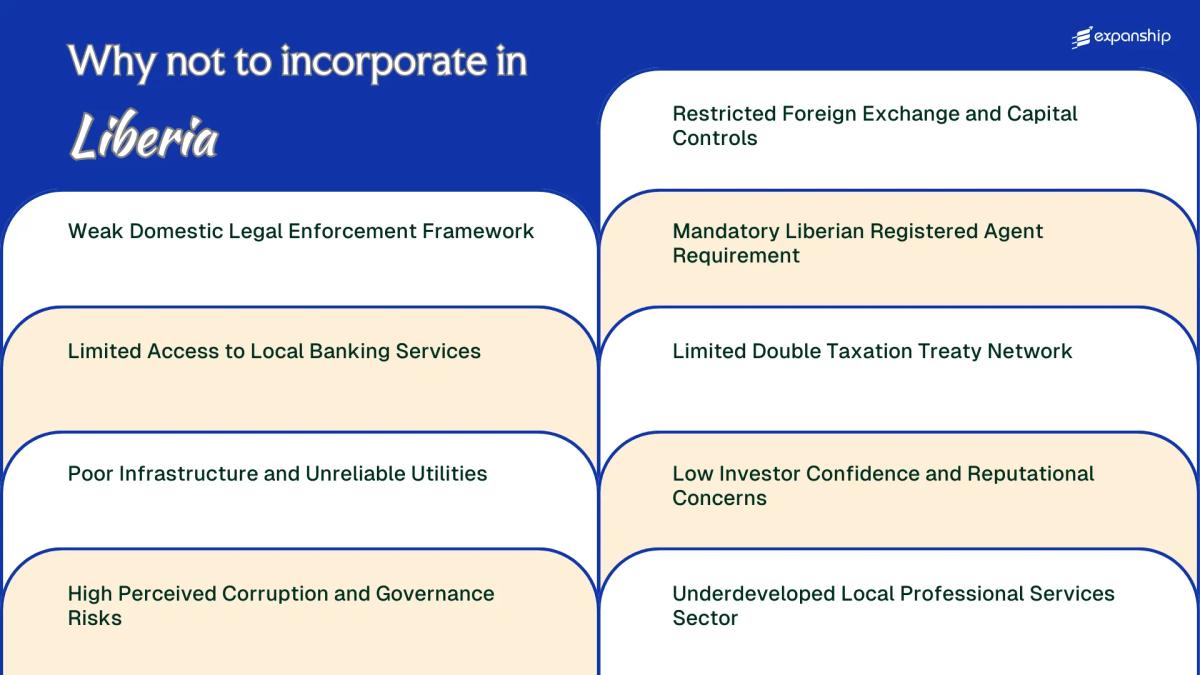
Weak Domestic Legal Enforcement Framework
Liberia legal enforcement risks for businesses are considerable, particularly for foreign firms that have no fallback on familiar legal systems. The domestic framework for resolving commercial disputes is structurally underprepared for the demands of international business.
Judicial Capacity and Contract Enforcement
The Commercial Court of Liberia, established to handle business disputes, operates with limited judicial resources and significant case backlogs. For your business, this means a breach of contract may take years to adjudicate, leaving you exposed to financial loss without timely legal remedy.
Enforcement of foreign arbitral awards is also inconsistent. Liberia's adherence to the New York Convention on the Recognition and Enforcement of Foreign Arbitral Awards is not reliably implemented at the domestic level, which weakens the practical value of arbitration clauses in commercial contracts.
Legislative Gaps and Regulatory Uncertainty
The Business Corporation Act governs company operations, but secondary regulations and implementing rules are often absent or irregularly applied. This creates unpredictability for foreign entities that rely on statutory clarity to structure transactions and manage liability exposure.
Contract enforcement through Liberian courts can take years, and without consistent arbitration enforcement, foreign business owners have limited practical recourse when commercial disputes arise.
Limited Access to Local Banking Services
Banking access challenges for Liberia companies are pronounced, and they begin before operations even start. The Central Bank of Liberia (CBL) oversees a financial sector that remains thin by regional standards, with only a small number of licensed commercial banks operating in-country.
Foreign-incorporated entities or businesses with non-resident ownership structures frequently encounter heightened due diligence requirements. Correspondent banking relationships between Liberian banks and major international institutions have been strained by anti-money laundering concerns, which directly restricts your ability to receive or send cross-border payments efficiently.
Opening a corporate bank account presents its own friction:
- You may be required to present in person, creating travel costs and delays for non-resident directors
- International wire transfers can face rejection or extended holds due to your bank's limited correspondent network
- Account opening timelines can extend weeks beyond comparable jurisdictions, stalling business activity
- Minimum deposit and balance requirements vary by institution, with limited competitive pressure to reduce them
Dual-currency circulation of US dollars and Liberian dollars adds further operational complexity. Your firm may hold accounts in both currencies yet still face restrictions on large USD outflows.

Company Incorporation in Liberia
Understand the full scope of requirements before registering a business entity in Liberia.
Poor Infrastructure and Unreliable Utilities
Liberia infrastructure problems for businesses are not incidental — they are systemic. The national grid, managed by the Liberia Electricity Corporation (LEC), covers a fraction of the country's territory, with consistent supply largely confined to parts of Monrovia. Outside the capital, grid access drops sharply, and even within Monrovia, outages are frequent and prolonged.
Your operational costs increase substantially as a result. Businesses that require continuous power must invest in private diesel generators, fuel storage, and maintenance contracts — expenses that are entirely absent in more developed markets.
| Infrastructure Gap | Practical Burden on Business | Estimated Impact |
|---|---|---|
| Unreliable grid power (LEC coverage) | Mandatory private generator procurement | High capital outlay plus ongoing fuel costs |
| Poor road network outside Monrovia | Elevated logistics and transport costs | Delays and damaged goods in supply chains |
| Limited fixed-line internet penetration | Dependence on costly mobile data for operations | Reduced bandwidth, higher per-unit data cost |
| Inadequate water and sanitation infrastructure | Self-provisioning required for manufacturing or hospitality | Added facility investment before operations begin |
Connectivity compounds the problem. Fixed broadband infrastructure remains underdeveloped, and firms relying on stable internet for finance, communications, or data-heavy operations face consistent bottlenecks.
Physical logistics present a separate constraint. Road conditions outside Monrovia degrade significantly, and this directly raises distribution costs for any firm sourcing or selling beyond the capital.
High Perceived Corruption and Governance Risks
Corruption risks incorporating in Liberia are consistently flagged by international monitors. The country has ranked poorly on Transparency International's Corruption Perceptions Index for years, reflecting systemic issues across public procurement, licensing, and regulatory approvals that directly affect foreign entities seeking to establish operations.
The General Business Law of Liberia and sector-specific licensing regimes require multiple government touchpoints. Each interaction with a ministry or agency creates exposure to informal payment demands, particularly during business registration, permit issuance, and regulatory renewals.
Governance oversight remains fragmented. The Liberia Anti-Corruption Commission (LACC) holds a statutory mandate to investigate and prosecute corruption, but enforcement against officials involved in commercial transactions has been inconsistent, leaving foreign firms with limited institutional recourse.
For your business, this translates into unpredictable costs and timelines. A registration process that should take weeks may stall without explanation, and the LACC's formal reporting mechanisms offer little guarantee of resolution.
- The LACC has jurisdiction over corruption complaints but does not guarantee commercial remedies for affected foreign firms.
- Multiple ministry approvals are required for licensed business activities, each creating a separate compliance exposure point.
- No formal ombudsman exists specifically for foreign investor grievances during registration.
- Bribery of public officials violates the Penal Law of Liberia, meaning participation also exposes your firm to criminal liability.
Liberia's anti-corruption legislation technically applies to foreign nationals operating within its jurisdiction, meaning a foreign director who pays a facilitation fee during registration can face prosecution under Liberian penal law.
Restricted Foreign Exchange and Capital Controls
Liberia foreign exchange restrictions businesses stem from a monetary environment where the U.S. dollar circulates alongside the Liberian dollar, yet formal regulatory oversight of cross-border capital flows remains inconsistent.
Structural Restrictions on Currency Movement
The Central Bank of Liberia (CBL) holds authority over foreign exchange regulation under the Central Bank of Liberia Act, but enforcement of outbound capital controls is applied unevenly across sectors. For a foreign-owned entity, this unpredictability makes it difficult to plan dividend repatriation or inter-company transfers with any reliable timeline.
Liberia imposes no formally codified capital controls of the kind found in exchange-control regimes such as Nigeria's, yet the absence of a clear statutory framework creates its own friction. Your firm may face informal restrictions or banking-level refusals when attempting large-value foreign currency transfers.
Practical Consequences for Foreign-Incorporated Entities
Liberia currency repatriation problems often materialize at the correspondent banking stage, where local banks have limited international clearing relationships. This means that even a legally compliant transfer can stall for weeks due to inadequate correspondent bank infrastructure rather than any explicit legal prohibition.
The forex limitations for incorporated companies compound when combined with thin liquidity in the local foreign exchange market, which can result in unfavorable conversion rates on Liberian dollar-denominated revenues.
Addressing Foreign Exchange and Capital Flow Challenges in Liberia
Understand the practical constraints on currency repatriation and foreign exchange management before incorporating in Liberia.
Mandatory Liberian Registered Agent Requirement
Every foreign-owned entity incorporated under the Liberia Business Corporation Act must appoint a licensed resident agent physically based in the country. The Liberia registered agent requirement drawbacks extend beyond a formality, creating ongoing financial and operational dependencies that persist for the entire life of the company.
- You must retain a licensed local agent continuously, meaning any lapse in that appointment triggers a compliance violation under the Business Corporation Act and can result in the entity losing its good standing.
- Resident agent fees are an unavoidable recurring cost that foreign shareholders cannot eliminate by restructuring ownership or relocating management offshore.
- Your agent serves as the official point of contact for regulatory correspondence, which means critical legal notices may be delayed or mishandled if the agent's service quality is inconsistent.
- Replacing a non-performing agent requires formal filings with the Liberian authorities, creating administrative friction that adds time and cost to what is otherwise a routine business adjustment.
Limited Double Taxation Treaty Network
Liberia's double taxation treaty limitations are among the most commercially significant obstacles for foreign businesses operating through a Liberian entity. The country has concluded very few formal DTAs, leaving cross-border income flows largely unprotected by bilateral tax relief mechanisms.
Without treaty coverage, dividends, royalties, and interest payments made from a Liberian entity to foreign shareholders are subject to withholding tax under domestic rates, with no treaty-based reduction available. Your foreign parent company or investors cannot claim the reduced rates that DTAs typically provide, meaning the same income can face taxation in two jurisdictions without offset.
The lack of DTAs Liberia maintains with major economies compounds this for businesses with multinational structures. Countries such as Germany, the Netherlands, or Singapore, which maintain extensive treaty networks of their own, offer no reciprocal protection to Liberian-sourced income.
- Royalty repatriation to a non-treaty country faces full domestic withholding
- Dividend distributions to foreign shareholders have no treaty-rate ceiling
- Interest payments abroad carry unreduced withholding exposure
A foreign-owned Liberian holding company distributing $200,000 in dividends to a parent in a non-treaty jurisdiction could face withholding tax on the full amount under domestic rates, with no foreign tax credit mechanism available in Liberia to offset the parent company's home-country tax liability, resulting in effective double taxation on the same profit.
Low Investor Confidence and Reputational Concerns
Liberia investor confidence concerns are not abstract. Foreign institutional investors and multinational counterparties routinely apply additional scrutiny to entities incorporated here, partly due to the country's historical instability and its persistent presence on international watchlists related to governance and financial transparency.
The Financial Action Task Force (FATF) and affiliated bodies have flagged West African jurisdictions for deficiencies in anti-money laundering and counter-terrorism financing frameworks. A company registered under the Business Corporation Act of Liberia may face elevated compliance burdens when opening correspondent banking relationships or onboarding institutional clients outside the region.
Reputational drawbacks incorporating in Liberia can affect your entity at a structural level. Partners, lenders, or investors in regulated markets such as the EU or UK may require additional due diligence documentation before engaging with your firm, which adds cost and delays that do not arise with companies formed in better-regarded jurisdictions.
Low investor trust in Liberia company formation also affects capital-raising. Private equity and venture capital funds with institutional limited partners often have internal policies restricting investment in entities domiciled in jurisdictions carrying high reputational risk scores.
Even if your business operations are fully compliant, the reputational risk tied to the jurisdiction of incorporation can independently disqualify your entity from certain banking relationships, investment rounds, or regulated market access without any wrongdoing on your part.
Underdeveloped Local Professional Services Sector
The underdeveloped professional services sector in Liberia creates a concrete operational gap for foreign businesses that require qualified local support. Chartered accountants, corporate attorneys, and compliance specialists are in short supply relative to international demand.
Liberia's legal profession is governed by the Liberia National Bar Association, but the number of practitioners with demonstrable experience in cross-border corporate structuring, transfer pricing, or international tax remains limited. This forces many foreign firms to source expertise externally, adding cost and coordination delays.
Accounting standards adoption has been inconsistent across local firms, meaning financial reporting prepared domestically may not meet the expectations of foreign auditors or institutional investors. Your due diligence processes become more expensive when local outputs require reworking.
- Local firms often lack capacity to handle multinational compliance calendars
- Specialized services such as trademark registration support or IP structuring are difficult to source in-country
Overcoming These Incorporation Challenges
Overcoming Liberia incorporation challenges requires structural preparation rather than reactive adjustments once problems emerge. The disadvantages covered in this blog are systemic, and addressing them begins before the entity is formally registered.
- Appoint a qualified Liberian registered agent listed with the Liberia Business Registry to satisfy the mandatory local representative requirement under the Associations Law of Liberia.
- Open correspondent banking relationships through internationally affiliated institutions before incorporation to reduce exposure to local banking access limitations.
- Conduct foreign exchange planning in advance, accounting for the Central Bank of Liberia's capital controls when structuring cross-border fund flows.
- Adopt a clear governance and record-keeping framework aligned with the Business Corporation Act to reduce vulnerability to enforcement gaps in the domestic legal system.
- Source international professional services for audit, legal, and compliance functions given the underdeveloped local professional services sector.
These steps address structural exposure points within Liberia's regulatory and institutional environment. They do not eliminate the underlying risks, which remain tied to governance conditions outside any single company's control.
Liberia's Overall Business Viability
Liberia's incorporation framework carries well-documented disadvantages, and the Liberia business viability risks and limitations covered across this blog reflect structural challenges that pre-date recent reform efforts. That said, the jurisdiction retains a functioning legal framework under the Business Corporation Act, an established offshore registry history, and a recognized flag-state reputation in maritime commerce.
| Pro | Con |
|---|---|
| Long-standing offshore registry with international recognition | Domestic legal enforcement is inconsistent and slow |
| No corporate income tax on foreign-sourced income for non-resident entities | Local banking access is severely limited for foreign-owned companies |
| Low annual maintenance costs relative to comparable offshore jurisdictions | Corruption and governance risks elevate compliance exposure |
| Registered agent requirement is straightforward to fulfill through licensed providers | No substantial double taxation treaty network to reduce withholding obligations |
| Established use case in maritime and holding structures | Foreign exchange restrictions complicate cross-border capital movement |
The jurisdiction suits a narrow profile of foreign businesses, particularly those using Liberian entities for holding, shipping, or asset-registration purposes with no intention of operating domestically. For firms requiring banking relationships, enforcement of contracts, or active local operations, the structural gaps documented in this blog present genuine operational constraints.
Compliance Services for Companies in Liberia
Stay current with Liberia's annual filing requirements, registered agent obligations, and corporate maintenance rules under the Business Corporation Act.
Conclusion
The cons of Liberia company registration are real and documented. Enforcement gaps within the domestic legal system, restricted access to correspondent banking, and the country's limited tax treaty network represent the most structurally significant obstacles for foreign-owned entities. Structural challenges around infrastructure and professional services capacity add further operational friction. Incorporating here carries a set of constraints that require deliberate planning rather than assumptions drawn from more established offshore jurisdictions. Specialist guidance from parties with direct experience in Liberian corporate formation and ongoing compliance remains the most practical way to manage these exposures.
Expanship's Liberia Incorporation Support
Incorporating in Liberia brings specific obligations that require local knowledge to handle correctly — from appointing a qualified registered agent under the Liberia Business Registry's requirements to managing the country's limited treaty network and constrained banking environment. Expanship's Liberia incorporation support is structured around reducing the operational burden these conditions place on foreign businesses, particularly during registration and early compliance phases.
Our service scope covers the practical steps from formation through to ongoing maintenance.
- We prepare and file all company registration documents with the Liberia Business Registry on your behalf.
- A qualified registered agent and a compliant registered office address in Liberia are provided as part of our service.
- We handle government filings and liaise directly with relevant regulatory authorities throughout the process.
- Post-incorporation compliance obligations are tracked and managed so your entity stays in good standing.
- Banking introduction assistance is available to support your account opening process.
- Tax registration and coordination with local authorities is handled as part of our onboarding support.
Reach out through Expanship Liberia to discuss your incorporation requirements.
Frequently Asked Questions (FAQ)
Yes, all entities incorporated under the Liberian Business Corporation Act must maintain a registered agent physically located in Liberia, regardless of whether the company conducts any domestic operations. This applies to non-resident international business corporations as well as domestically operating firms. Failing to maintain a compliant registered agent can result in loss of good standing and complications with annual filings submitted to the Liberian Business Registry.
Liberia has an exceptionally thin treaty network, with very few comprehensive double taxation agreements in force compared to jurisdictions like Mauritius or Cyprus, which each maintain 40-plus treaties. This means withholding taxes on dividends, royalties, and interest paid from treaty-partner countries will generally apply at domestic statutory rates rather than reduced treaty rates. For businesses routing international income through a Liberian entity, this gap directly increases the effective tax cost of cross-border transactions.
Non-compliance with foreign exchange reporting obligations monitored by the Central Bank of Liberia can result in administrative penalties and restrictions on future currency transactions. The CBL has the authority to suspend or revoke authorization for foreign exchange dealings, which can effectively freeze a company's ability to repatriate profits or settle cross-border invoices. Given that capital controls already limit flexibility, adding a compliance breach compounds the operational disruption considerably.
The banking access problem in Liberia is more acute than in most comparable West African jurisdictions because the domestic banking sector remains undercapitalized and heavily concentrated among a small number of commercial banks. While countries like Ghana and Senegal have seen broader financial sector development, Liberia's post-conflict recovery has left its banking infrastructure thin, with many international correspondent banks maintaining reduced relationships with Liberian institutions due to de-risking pressures. A non-resident company incorporated in Liberia will often need to open its primary operating account in a third-country jurisdiction.
Relying solely on locally based professionals for complex compliance work carries real risk in Liberia, where the pool of internationally trained accountants, corporate lawyers, and compliance specialists remains limited. The Liberian Institute of Certified Public Accountants has a relatively small active membership, and firms with experience in cross-border regulatory matters are concentrated in Monrovia with inconsistent capacity outside the capital. Most foreign-owned entities engaging in anything beyond basic annual filings will need to supplement local support with internationally based service providers.
Unreliable electricity supply and inconsistent internet connectivity in Liberia can disrupt access to government portals and delay document submission to the Liberian Business Registry and other regulatory bodies. While the registry has moved toward online processing for some filings, power outages and bandwidth limitations mean that time-sensitive submissions carry a higher failure risk than in jurisdictions with stable utilities. For a non-resident company managing filings remotely, these infrastructure gaps increase the likelihood of missed deadlines even when the intent to comply exists.
Low investor confidence materially limits a Liberian entity's ability to attract institutional financing or use its corporate structure as collateral. International lenders and private equity investors often apply higher risk premiums to Liberian-incorporated vehicles due to governance concerns and the perception of weak contract enforcement through the court system. This means that even a financially sound business using a Liberian structure may face narrower financing options and higher borrowing costs than an equivalent entity incorporated in a more creditworthy jurisdiction.
Legal Disclaimer
The information provided in this article is for general informational purposes only and does not constitute legal, tax, or professional advice. While we strive to ensure the accuracy and timeliness of the content, laws and regulations are subject to change, and the application of laws can vary widely based on specific facts and circumstances.
Readers should not act upon this information without seeking professional counsel tailored to their individual situation. Expanship and its authors disclaim any liability for actions taken or not taken based on the content of this article.
For specific advice regarding your business setup, compliance requirements, or any legal matters, please consult with qualified legal and tax professionals in the relevant jurisdiction.