

Key Takeaways
- Foreign-sourced income is excluded from Liberian corporate taxation under the country's territorial tax system, meaning profits generated outside Liberia's borders carry no local corporate tax liability.
- The Business Corporation Act of Liberia does not require public disclosure of beneficial ownership at the registry level, giving shareholders and directors a meaningful degree of structural privacy not available in more transparent jurisdictions.
- Companies registered through the Liberian Business Registry as Non-Resident Domestic Corporations can be owned entirely by foreign nationals without statutory restriction, removing a barrier that exists in many competing offshore frameworks.
- Businesses in the maritime sector gain a compounded structural advantage by pairing corporate registration with access to the Liberian International Ship and Corporate Registry, one of the largest ship registries in the world.
Liberia is an independent republic on the west coast of Africa, governed under a civil law framework that has been substantially shaped by American legal traditions. Company registration is administered by the Liberian Business Registry, which operates under the Ministry of Commerce and Industry. Foreign businesses incorporating here most commonly use the Non-Resident Domestic Corporation as their legal vehicle of choice.
The country operates a territorial tax system, meaning income generated outside its borders is generally not subject to local corporate taxation. Foreign ownership faces no statutory restrictions, and the government has maintained a consistently open posture toward foreign direct investment across most sectors.
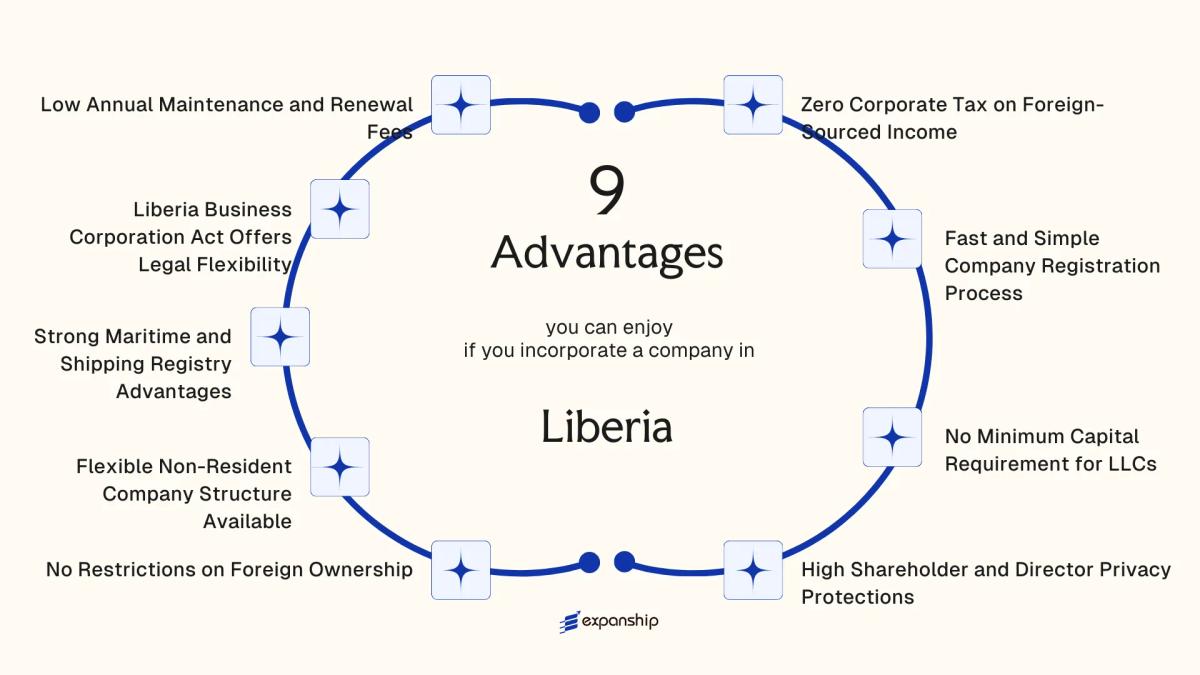
This article examines the key advantages your business gains when registering a corporate entity under Liberian law — including structural, fiscal, and administrative factors that make it a considered choice among the benefits of incorporating in Liberia for international operators.
Zero Corporate Tax on Foreign-Sourced Income
Under Liberia's territorial tax system, income generated outside the country is not subject to domestic corporate tax. For a holding company or international trading entity, this creates a direct cost advantage that compounds over time.
How the Exemption Is Structured
The Revenue Code of Liberia draws a clear line between domestic-source income and foreign-source income. Only income with a Liberian source is brought within the charge to tax, meaning your offshore revenues remain untouched by the local tax authority, the Liberia Revenue Authority.
What This Means in Practice
A business incorporated locally but operating internationally keeps its foreign profits whole, without any obligation to repatriate or report those earnings for Liberian tax purposes. This structural separation is particularly relevant for international consultancies, investment holding structures, and trading firms whose clients and contracts are entirely outside the country.
The exemption applies as a baseline rule under the Revenue Code, but you should confirm that specific income streams qualify as foreign-sourced before structuring around this benefit.
Foreign-sourced profits flow back to your company without a Liberian corporate tax deduction at the entity level.
Fast and Simple Company Registration Process
Incorporating a company through Liberia's registration system is notably faster than in many comparable offshore jurisdictions. The process is administered through the Liberia Business Registry, which processes non-resident domestic corporation filings without requiring physical presence. Your business can be legally constituted without an in-country representative attending in person, which removes a practical barrier that exists in several civil law jurisdictions.
The documentation threshold is low by design. Under the Liberia Business Corporation Act, formation requires only basic constitutional documents — articles of incorporation and basic director or agent information. This matters because it reduces the preparation time between a decision to incorporate and actual legal existence.
Several features of the registration process work in your favour:
- No requirement to file detailed shareholder information in a public registry, reducing document preparation time
- Registered agent appointment can be handled remotely, allowing foreign owners to proceed without establishing local presence first
- No pre-approval or licensing requirement for standard non-resident business activities, which removes waiting periods common in other jurisdictions
Expedited company formation in Liberia can typically be completed within a matter of days rather than weeks. For foreign business owners managing time-sensitive structuring needs, this timeline shortens operational delays between entity formation and the commencement of business activities.

Company Incorporation in Liberia
Register your Liberia non-resident company through the Liberia Business Registry with full remote support from Expanship.
No Minimum Capital Requirement for LLCs
There is no statutory minimum capital requirement for a Liberia LLC no minimum capital requirement rule under the Liberia Business Corporation Act (LBCA). Your business can be incorporated with a single share or a nominal capital amount, without any obligation to deposit funds into a local bank account before or after registration.
| Capital Feature | Applicable Rule |
|---|---|
| Minimum paid-up capital | None required |
| Minimum authorized capital | No statutory floor |
| Capital deposit requirement | Not applicable |
| Share structure flexibility | Single class or multiple classes permitted |
| Governing legislation | Liberia Business Corporation Act |
This flexibility has a direct consequence for how you allocate working capital. Funds that would otherwise be locked into a statutory capital account remain available for operational use from day one. For early-stage ventures or holding structures where the underlying assets are held elsewhere, this eliminates a common administrative bottleneck found in many civil law jurisdictions that impose paid-in capital thresholds before an entity achieves legal standing.
The LBCA also allows authorized capital to be denominated in any currency, which supports firms that operate across multiple currency environments. Adjusting your capital structure after incorporation does not require court approval, only a shareholder resolution. This means your entity's capitalization can scale with actual business needs rather than regulatory minimums set at the point of formation.
High Shareholder and Director Privacy Protections
Liberia shareholder privacy protections are codified under the Business Corporation Act administered by the Liberia Business Registry (LBR). Non-resident entities incorporated as foreign corporations are not required to disclose shareholder identities in public filings. Beneficial ownership data does not form part of the public record at the LBR.
Directors also benefit from this framework. The registry does not mandate public disclosure of director details for non-resident companies, which means your firm's management structure remains outside publicly searchable records.
This separation between registration requirements and public disclosure carries a direct operational benefit. Competitors, counterparties, and third parties cannot identify ownership or control structures simply by searching the corporate registry.
Keep the following in mind:
- Privacy protections apply primarily to non-resident foreign corporations, not all entity types
- Registered agent details are required and do appear in official records
- Compliance with Liberia's anti-money laundering obligations may require disclosure to regulatory authorities, even if not to the public
- Shareholder registers are maintained privately, not filed publicly
- International information exchange agreements may affect confidentiality in specific circumstances
Although Liberia is widely associated with its maritime registry, its corporate privacy framework predates many modern offshore jurisdictions, having been structured for international business use since the 1970s.
No Restrictions on Foreign Ownership
Liberia imposes no statutory restrictions on foreign nationals owning 100 percent of a locally incorporated business entity. Under the Business Corporation Act (BCA) and the applicable LLC framework, non-residents may hold the entirety of shares or membership interests without requiring a local co-owner, nominee shareholder, or government approval tied to nationality. This is the structural foundation of the Liberia no foreign ownership restrictions principle, and it has direct consequences for how you structure control and decision-making.
Full Ownership Means Undiluted Control
Retaining 100 percent ownership is not merely a formality. It means that profit distribution, strategic direction, and asset control remain entirely with you as the foreign investor, without obligations to a mandatory local partner who would otherwise hold legal rights over the firm's operations.
Certain sectors regulated by Liberian law, such as broadcasting or specific natural resource concessions, may carry separate licensing conditions. Outside those regulated industries, the general rule of unrestricted foreign ownership applies broadly across commercial, trading, and holding structures.
Ownership Structure Determines Operational Flexibility
Because there is no minimum local ownership threshold, you can register a single-shareholder entity without adjusting the ownership architecture to satisfy a host-country requirement. This eliminates a category of compliance cost that exists in jurisdictions where foreign equity is capped, such as several West African states that impose 40 to 51 percent local ownership floors in specified sectors.
The Liberia foreign investor ownership benefits here are structural rather than discretionary, grounded in statute rather than ministerial policy.
Claim Full Ownership of Your Liberia Company
Speak with our corporate specialists about structuring a 100% foreign-owned entity in Liberia and understanding which ownership frameworks apply to your industry.
Flexible Non-Resident Company Structure Available
Liberia non-resident company structure advantages draw particular interest from international founders because the Business Corporation Act of 1976 explicitly permits non-resident domestic corporations — entities incorporated under Liberian law that conduct all operations outside the country. This legal designation is built into the statute, not granted through discretionary approval, which gives your business a defined and predictable legal standing from the outset.
- A non-resident domestic corporation is not required to maintain a physical office, staff, or operations within Liberia. For founders operating across multiple markets, this removes a common structural constraint.
- The non-resident classification is formally recognised under the Business Corporation Act, meaning the entity type carries statutory legitimacy rather than relying on administrative tolerance.
- Your company can be managed entirely from abroad. Directors and shareholders may reside in any country, and board meetings are not required to take place on Liberian soil.
- This structure suits holding companies, international trading firms, and asset-holding entities that need a legally incorporated vehicle without a fixed operational base.
- Appointment of a registered agent within Liberia is required by law to maintain the entity in good standing. This agent serves as the formal point of contact with local authorities, satisfying the jurisdictional nexus requirement without obligating you to establish a physical presence.
Strong Maritime and Shipping Registry Advantages
Liberia maritime registry advantages extend well beyond flag convenience. The Liberia International Ship and Corporate Registry (LISCR) operates as the official flagging and corporate registry authority under Liberian law, administering one of the two largest ship registries by gross tonnage in the world. For shipping companies, this scale translates into established port reception globally and a recognized compliance framework under international maritime conventions.
Vessels registered under the Liberian flag are subject to LISCR's oversight, which maintains alignment with International Maritime Organization (IMO) standards. Your firm benefits from a registry that major charterers and port state control authorities recognize, reducing friction in commercial operations.
LISCR also functions as the corporate registry for offshore entities, meaning a Liberian holding company and its registered vessels can be administered through a single institutional framework. This structural overlap reduces administrative duplication for businesses that combine vessel ownership with corporate holding functions.
- Ship registration is available to non-citizen owners, with no nationality requirement for vessel ownership.
- The registry supports tankers, bulk carriers, container ships, and specialized vessels.
A vessel owner operating a 50,000 DWT bulk carrier under Liberian flag registration can access over 170 ports across major trading routes without flag-related operational restrictions, given LISCR's Paris and Tokyo MOU white-list standing.
Liberia Business Corporation Act Offers Legal Flexibility
The Liberia Business Corporation Act (BCA), enacted in 1976 and modeled in part on the Delaware General Corporation Law, gives companies a degree of structural freedom that many civil law jurisdictions simply do not permit. That legislative foundation is the core reason the BCA's legal flexibility is a genuine operational advantage.
Articles of Incorporation Can Be Tailored Broadly
Under the BCA, the articles of incorporation can authorize multiple classes of shares with differing voting rights, dividend preferences, and liquidation priorities. This means your corporate structure can be configured to match the actual ownership and governance arrangement your business requires, rather than defaulting to a one-size statutory model.
Director and Shareholder Meeting Rules Are Permissive
The BCA permits board meetings and shareholder votes to be conducted entirely outside Liberia, including by written consent without a formal meeting. For international holding companies or investment vehicles managed across multiple time zones, this eliminates significant administrative friction.
Broad Indemnification Provisions
The BCA allows companies to indemnify directors and officers to the fullest extent the law permits, which can be defined expansively in the corporate bylaws. This gives investors meaningful flexibility in structuring liability protections for management.
The BCA's flexibility applies to non-resident domestic corporations; entities conducting active business within Liberia are subject to separate statutory requirements.
Low Annual Maintenance and Renewal Fees
One of the more quantifiable aspects of the Liberia low annual maintenance fees advantage is how little it costs to keep a registered entity in good standing from year to year. Annual government fees for a non-resident domestic corporation or LLC remain among the lower tiers found in established offshore centers, which directly reduces the fixed overhead your business carries regardless of activity level.
Under the Liberia Business Corporation Act and the related regulations administered through the Liberian Registered Agents Association, annual renewal obligations are processed through a licensed registered agent rather than a government ministry. This arrangement consolidates your compliance costs into a single annual payment covering both the state fee and the agent's maintenance service. For holding companies, dormant entities, or special-purpose vehicles that generate no local revenue, this structure keeps the cost of continued existence predictable and contained.
The practical implication is straightforward: a firm incorporated here does not face escalating government charges tied to authorized capital thresholds or paid-up capital adjustments, as is common in higher-cost jurisdictions. Renewal fees remain flat rather than variable.
Conditions that apply to this benefit include:
- The entity must remain in good standing, meaning all prior annual fees must be current
- A licensed registered agent must be maintained at all times to process renewals on your behalf
- Failure to renew on time can result in the entity falling out of good standing, which triggers reinstatement procedures and associated costs
Why Liberia Stands Out Among Offshore Jurisdictions
Compared to other offshore jurisdictions targeting international holding structures and shipping-linked businesses, the field narrows quickly. The three jurisdictions most relevant to a reader evaluating Liberia are Panama, the Marshall Islands, and Seychelles. All four serve non-resident entities, exempt foreign-sourced income from local tax, and compete for similar incorporation mandates. The comparison below focuses on parameters where Liberia holds a neutral or favourable position relative to these peers.
What the table surfaces is less about any single figure and more about structural positioning. Liberia's advantages over other offshore jurisdictions become clearer when you account for the combination of its established corporate statute, the Business Corporation Act, its dual function as both a corporate and maritime registry, and its comparatively contained annual maintenance costs. For a business that values statutory depth alongside operational efficiency, that combination is less common among competing offshore options than the headline tax rates alone suggest.
| Parameter | Liberia | Panama | Marshall Islands | Seychelles |
|---|---|---|---|---|
| Corporate Tax on Foreign Income | 0% | 0% | 0% | 0% |
| Governing Corporate Statute | Business Corporation Act | Law 32 of 1927 | Business Corporations Act | Companies Act 1972 (amended) |
| Public Disclosure of Directors | Not required | Not required | Not required | Not required |
| Public Disclosure of Shareholders | Not required | Not required | Not required | Not required |
| Maritime Registry Integration | Yes (LISCR) | Yes | Yes (MIRAB) | Limited |
| Minimum Share Capital (Non-Resident Entity) | None | None | None | None |
| Annual Government Renewal Fees | Low | Moderate | Low to moderate | Low |
| Foreign Ownership Restrictions | None | None | None | None |
Compliance Services for Liberia Companies
Stay current with Liberia's annual renewal obligations, registered agent requirements, and reporting standards under the Business Corporation Act.
Conclusion
Liberia's offshore framework rests on a small number of structural features that carry real weight for foreign business owners. The exemption of foreign-sourced income from corporate tax, grounded in the country's territorial tax principle, means that profits generated outside the country are not subject to local taxation. Combined with the privacy protections built into the Business Corporation Act of Liberia, which does not mandate public disclosure of beneficial ownership at the registry level, the jurisdiction removes two of the most common friction points for internationally operating entities.
The benefits of incorporating in Liberia are most apparent when the specific nature of the business aligns with what the framework actually provides. A non-resident company generating income abroad, or a shipping-related business making use of the Liberian International Ship and Corporate Registry, stands to benefit more directly than a firm with substantial in-country operations. The annual maintenance structure is also low relative to comparable offshore jurisdictions, which keeps ongoing costs predictable over time.
The case for this jurisdiction is, at its core, a case for structural efficiency: a straightforward registration process, a tax regime that does not burden foreign earnings, and a legal framework that has remained stable and commercially oriented for decades. Whether a given business structure fits within that framework depends on the nature of operations, the applicable residency requirements, and the intended use of the entity. For those whose structure does align, the next step is determining how to proceed correctly under the applicable provisions of Liberian corporate law.
Start Your Liberia Company with Expanship Today
Expanship assists foreign business owners in forming and maintaining companies registered under the Business Corporation Act (BCA) of Liberia, administered through the Liberia Business Registry. From entity selection to post-incorporation filings, the firm handles each stage of the process while ensuring your entity stays compliant with annual reporting and registered agent requirements. The benefits covered throughout this blog — territorial tax treatment, privacy protections, foreign ownership rights, and low maintenance costs — are the foundation on which Expanship structures its formation and compliance support.
Working with Expanship Liberia covers each operational requirement your entity will face after incorporation:
- Preparation and legalization of incorporation documents under the BCA
- Appointment and maintenance of a statutory registered agent and registered office in Monrovia
- Filing liaison with the Liberia Business Registry on your behalf
- Post-incorporation compliance management, including annual report submissions
- Government fee tracking and renewal scheduling
- Banking introduction assistance to support account opening for your entity
To discuss your incorporation requirements directly, contact Expanship Liberia.
Frequently Asked Questions (FAQ)
Foreign-sourced income is not subject to Liberian corporate income tax for entities that qualify under the territorial tax principle. A company incorporated in Liberia that conducts all business activities and derives all revenue outside the country's borders is not assessed domestic corporate tax on those earnings. The key condition is that no taxable activity occurs within Liberian territory.
The Business Corporation Act provides a high degree of structural flexibility, including provisions for bearer-friendly arrangements, customizable director and shareholder configurations, and limited disclosure obligations. Unlike some civil law jurisdictions, Liberia's framework is modeled on U.S. corporate law principles, which makes it familiar to common law practitioners. This legal heritage tends to reduce drafting complexity for international transactions.
Physical presence is not required at any stage of the incorporation process. The entire procedure can be completed remotely through an authorized registered agent operating within the jurisdiction. All filings are handled on your behalf without requiring in-person attendance before any Liberian regulatory authority.
Failure to pay annual renewal fees can result in the company falling into bad standing, which may ultimately lead to administrative dissolution or removal from the registry. Reinstatement is generally possible but may involve penalty fees and the filing of outstanding obligations. Maintaining timely renewal payments is necessary to preserve the entity's legal standing and ability to conduct business internationally.
Yes, the Liberian International Ship and Corporate Registry (LISCR) administers both the maritime registry and corporate registry functions, operating under a mandate from the Government of Liberia. The dual function means that companies with shipping or vessel-ownership purposes benefit from integrated registration services under a single administrative body. LISCR maintains offices internationally, which facilitates access for foreign operators without requiring engagement with Monrovia-based authorities directly.
There is no statutory minimum share capital requirement for limited liability structures incorporated under Liberian law. Founders may set a nominal capital amount at the time of formation without regulatory restriction on the lower bound. This contrasts with jurisdictions that mandate a paid-up capital threshold before a certificate of incorporation is issued.
Legal Disclaimer
The information provided in this article is for general informational purposes only and does not constitute legal, tax, or professional advice. While we strive to ensure the accuracy and timeliness of the content, laws and regulations are subject to change, and the application of laws can vary widely based on specific facts and circumstances.
Readers should not act upon this information without seeking professional counsel tailored to their individual situation. Expanship and its authors disclaim any liability for actions taken or not taken based on the content of this article.
For specific advice regarding your business setup, compliance requirements, or any legal matters, please consult with qualified legal and tax professionals in the relevant jurisdiction.