

Key Takeaways
- Foreign investors must satisfy director residency conditions and maintain a physical registered office address in South Tarawa as statutory prerequisites for legal recognition under the Companies Ordinance (Cap. 160).
- Beneficial ownership disclosure is a regulatory obligation that requires entities incorporated in Kiribati to identify and report the individuals who ultimately own or control the company.
- All applicants are required to submit KYC documentation meeting the standards set by the Companies Registry under the Ministry of Finance and Economic Development before a registration application can be processed.
- Compliance with the share capital and governance structure requirements established under Kiribati's corporate legislative framework must be demonstrated at the point of incorporation, not retrospectively.
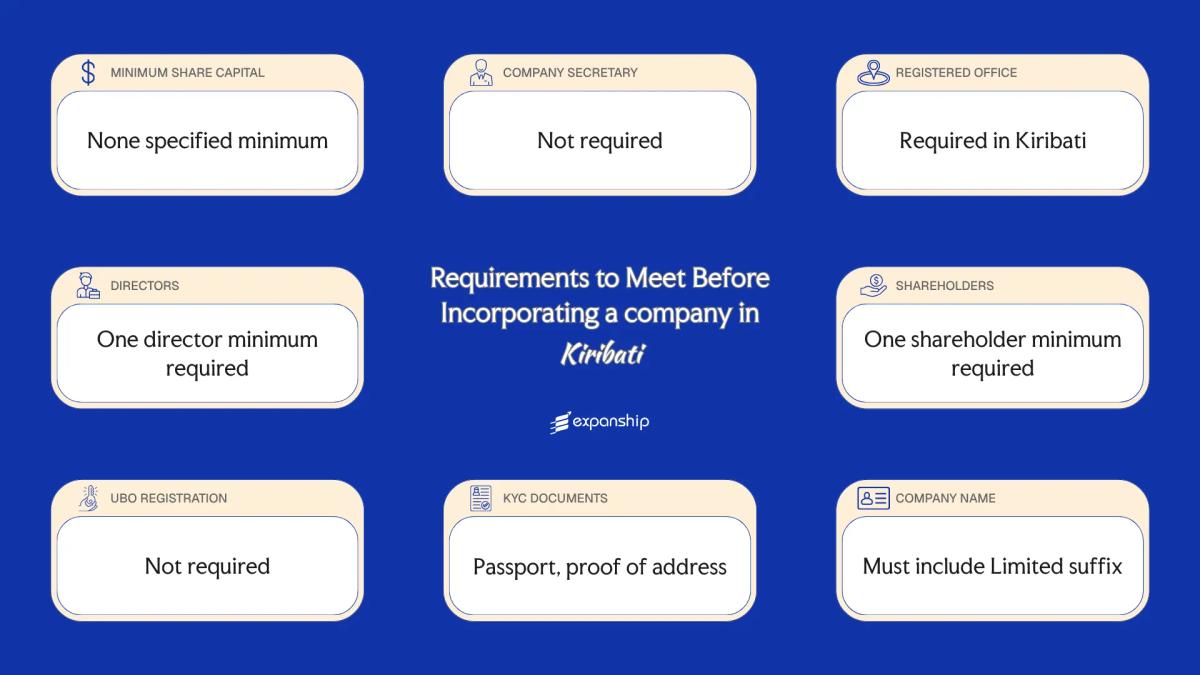
Company incorporation in Kiribati is governed by the Companies Ordinance (Cap. 160), administered through the Companies Registry under the Ministry of Finance and Economic Development. Meeting the incorporation requirements in Kiribati is a prerequisite for any entity seeking legal standing to operate within the jurisdiction.
This article covers the statutory and administrative requirements that apply across the formation process, from governance structure to documentation standards.
Failure to satisfy these conditions results in rejection of the registration application or, where an entity is already operating, potential legal liability and inability to conduct business lawfully. Specific requirements may also differ based on the type of entity being formed, the industry sector, and whether the applicant is a foreign or domestic investor.
The Companies Ordinance provides the primary legislative reference for Kiribati company registration requirements. Foreign investors, offshore entrepreneurs, and business owners considering setting up a company in Kiribati will find this article most applicable to their circumstances.
Minimum Share Capital Requirements in Kiribati

Kiribati minimum share capital requirements are governed under the Companies Act 1986, with oversight exercised by the Registrar of Companies under the Ministry of Commerce, Industry and Cooperatives. No statutory minimum authorized or paid-up capital is prescribed for private companies incorporating under this framework.
Shares in Kiribati companies are issued on a par value basis, meaning each share carries a nominal value that must be stated in the company's constitution or memorandum of association. Capital deposit verification is not handled through a designated bank escrow process at incorporation; the Registrar reviews the constitutional documents rather than requiring proof of funds.
| Parameter | Detail |
|---|---|
| Minimum Authorized Share Capital | No statutory requirement |
| Maximum Authorized Share Capital | No statutory requirement |
| Minimum Paid-Up Capital | No statutory requirement |
| Paid-Up Requirement at Incorporation | No statutory requirement |
| Accepted Currency | Australian Dollar (AUD), the official currency of Kiribati |
| Accepted Forms of Contribution | Cash and non-cash contributions permissible under the Companies Act 1986 |
| Timeframe to Deposit Capital | No statutory deadline prescribed |
Even with no minimum capital threshold, your company's constitution must state a nominal par value for each share class. Omitting this detail can delay registration or result in a defective incorporation filing.
Company Secretary Requirements in Kiribati
Kiribati company secretary requirements follow the general framework established under the Companies Ordinance, which governs the administration of locally registered entities. Every company incorporated in the jurisdiction is required to appoint a secretary responsible for maintaining statutory records and ensuring ongoing compliance with corporate obligations.
The secretary acts as the primary liaison between the company and the Registrar of Companies. Company secretary obligations in Kiribati include maintaining the register of members, filing annual returns, and recording resolutions passed by directors or shareholders.
Qualification criteria for who may serve as company secretary:
- The secretary must be an individual, not a corporate entity, unless local rules expressly permit corporate secretaries.
- Residency in Kiribati is generally expected, reflecting the requirement for a locally accessible compliance officer.
- The appointee must have reached the age of majority under applicable law.
- A person who is bankrupt or disqualified from directorship is ineligible to serve.
- No formal licensing body currently regulates the secretarial profession specifically within this jurisdiction.

Incorporate a Company in Kiribati
Set up your business entity in Kiribati with guidance on statutory requirements, document preparation, and Registrar filings.
Registered Office Requirements in Kiribati
Kiribati registered office requirements mandate that every incorporated company maintain a physical address within the country's territory, as established under the Companies Act 2015, with this address serving as the official point of contact for statutory correspondence and regulatory notices from the Registrar of Companies.
- A physical street address is required; a P.O. Box alone does not satisfy the registered office obligation.
- The address must be located within Kiribati; overseas addresses are not accepted.
- Virtual offices are generally not recognised as compliant registered office addresses under the Companies Act 2015.
- The registered office address is recorded on the public company register and is accessible to third parties.
- A formal notification must be filed with the Registrar of Companies when the registered office address changes.
- Supporting documentation such as a lease agreement or proof of premises occupation is generally required to establish address validity.
- Failure to maintain a compliant registered address can result in the Registrar taking administrative action against the company, including potential deregistration.
Director Requirements in Kiribati

Upon appointment, directors of a Kiribati-registered company assume statutory duties under the Companies Act 2015, including obligations to act in good faith, avoid conflicts of interest, and exercise reasonable care in managing the entity's affairs. Personal liability can attach where a director authorises unlawful distributions or trades while the company is insolvent.
| Parameter | Detail |
|---|---|
| Minimum Number of Directors | One director is required. |
| Maximum Number of Directors | No statutory maximum is prescribed. |
| Local/Resident Director Required | No local or resident director is required. |
| Nationality Restrictions | No nationality restrictions apply. |
| Minimum Age Requirement | Directors must be at least 18 years of age. |
| Corporate Directors Permitted | No statutory provision explicitly permits corporate directors under the Companies Act 2015. |
| Director Must Be a Shareholder | No, a director is not required to hold shares in the company. |
| Publicly Listed on Registry | Director information is recorded with the Registrar of Companies but public accessibility is subject to registry procedures. |
| Disqualification Conditions | A person who is bankrupt, of unsound mind, or disqualified by a court order is prohibited from serving as a director. |
A single individual can simultaneously hold the roles of sole director and sole shareholder in a Kiribati company, with no requirement for any additional officer or local presence.
Shareholder Requirements in Kiribati

Kiribati shareholder requirements permit a private company to be formed with a single shareholder, making sole shareholder structures valid under local company law. No statutory maximum applies to the number of shareholders a private entity may have, though public companies follow separate thresholds.
Nationality and Residency Restrictions
Foreign nationals may hold shares in a Kiribati-registered company without a mandatory local ownership requirement for most business structures. Certain sectors regulated under investment licensing may impose conditions on the proportion of foreign ownership permitted.
Corporate Shareholders
Corporate entities, including foreign-incorporated companies, are generally permitted to act as shareholders. Standard documentation confirming the corporate shareholder's legal existence and authority is typically required during incorporation.
Shareholder Liability
Shareholders in a limited liability company are liable only to the extent of their unpaid share capital contribution. Personal liability does not ordinarily extend beyond that amount unless a court pierces the corporate veil due to fraud or improper conduct.
Register of Shareholders
A register of shareholders must be maintained at the company's registered office. This register is not routinely available for public inspection, though regulatory authorities may access it upon lawful request, and any changes in ownership must be recorded promptly.
Guidance on Shareholder Structuring for Your Kiribati Company
Get tailored advice on meeting ownership and shareholder obligations when setting up a company in Kiribati.
UBO / Beneficial Ownership Disclosure Requirements in Kiribati
Kiribati beneficial ownership disclosure requirements are not established under a dedicated statutory UBO framework. The Companies Act (Cap 10) and associated regulations do not currently impose a formal beneficial ownership registration or disclosure obligation on incorporated entities.
KYC / Document Requirements in Kiribati

Kiribati KYC document requirements apply at the point of incorporation and are governed by the Financial Intelligence Unit under the Money Laundering and Proceeds of Crime Act 2002. All incorporating parties must submit identity and source of funds documentation before registration can proceed.
Individual / Personal Documents
- Certified copy of a valid government-issued passport or national identity card
- Proof of residential address dated within three months, such as a utility bill or bank statement
- Completed and signed due diligence declaration form as required by the registrar
- Recent passport-sized photograph may be required depending on the registered agent's internal compliance procedures
Corporate Documents
- Certificate of incorporation of the corporate shareholder or director entity
- Constitutional documents, including memorandum and articles of association
- Current register of directors and register of shareholders for the corporate entity
- Proof of the entity's registered office address
Source of Funds Documentation
- Recent bank statements covering a minimum of three months
- Audited financial accounts where the entity has been operating for more than one year
- A signed written declaration explaining the origin of capital if bank records are insufficient
Notarisation and Apostille Requirements
- Foreign-issued documents generally require notarisation by a qualified notary public
- Kiribati is not a party to the Hague Apostille Convention, so apostille is not applicable
- Certified English translations are required for any document not originally in English
Submission of uncertified or improperly translated foreign identity documents is the most frequent cause of incorporation delays.
Company Name Requirements in Kiribati
Kiribati company name requirements are assessed at the point of incorporation through a name availability check conducted with the registering authority. Names that are identical or deceptively similar to existing registered entities will be refused.
A legal suffix denoting limited liability is required, and the name must be submitted in English. No specific minimum or maximum character count is publicly codified, but names must be legible and unambiguous.
Certain words are restricted. Terms implying government affiliation, royal or sovereign connection, or regulated financial activity require prior approval or are prohibited outright.
Name reservation is generally available prior to formal incorporation. The reservation holds for a limited period, during which no other entity may register the same name.
Compliance Services for Companies in Kiribati
Maintain your company's good standing in Kiribati with ongoing compliance support, from annual filings to regulatory reporting.
Conclusion
Meeting the incorporation requirements in Kiribati involves engaging with a framework that spans company structure, documentation, and ongoing compliance under the Companies Act 2015. Residency conditions for directors and the registered office obligation to maintain a physical address in South Tarawa are among the more operationally significant requirements for foreign investors. Beneficial ownership disclosure adds a further layer of regulatory accountability. Once these requirements are understood, the practical work of structuring your entity, appointing local representatives, and preparing compliant documentation becomes the immediate focus.
Expanship's Corporate Services for Kiribati Expansion
Handling Kiribati corporate services requirements involves specific obligations around document authentication, registered office provision, and ongoing compliance under the Companies Ordinance. Expanship helps you manage the preparation and coordination work these obligations generate, reducing the administrative burden on your team without removing your responsibility to meet them.
Our services cover the full incorporation and maintenance cycle for businesses entering Kiribati:
- We prepare and lodge your company registration documents with the Registrar of Companies in South Tarawa.
- Our team provides registered agent and local office services to satisfy Kiribati's registered office requirements.
- We handle government filings and liaise with relevant regulatory authorities on your behalf.
- Post-incorporation obligations, including annual returns and compliance maintenance, are managed through our ongoing support.
- We provide introductions to banking institutions familiar with foreign-owned entities in Kiribati.
- Tax registration and coordination with local authorities is included as part of our setup process.
To discuss how we can support your entry into this jurisdiction, contact Expanship Kiribati.
Frequently Asked Questions (FAQ)
Foreign nationals can serve as directors of a Kiribati-registered company, and there is no statutory requirement for at least one director to be ordinarily resident in Kiribati. However, the company must maintain at least one director in total, and all director particulars must be filed with the Kiribati Registrar of Companies upon incorporation.
Foreign shareholders and directors are generally required to provide certified copies of a valid passport, proof of residential address such as a utility bill or bank statement dated within three months, and depending on the structure, a bank reference or professional reference letter. These documents support the due diligence obligations applied during company registration and must be certified by an appropriate authority such as a notary or solicitor.
Failure to maintain a registered office in Kiribati is a breach of the Companies Ordinance and can result in regulatory sanctions including fines and, in persistent cases, the company being struck off the register. The registered office must be a physical address in Kiribati capable of receiving official correspondence and statutory notices, and it cannot be a PO Box.
Kiribati has introduced beneficial ownership disclosure requirements aligned with its broader anti-money laundering framework, obliging companies to identify and record individuals who ultimately own or control 25% or more of the entity. These records are maintained as part of the company's statutory obligations, though public accessibility of the beneficial ownership register is limited compared to jurisdictions with fully open registers.
A corporate entity can fulfill the company secretary role in Kiribati, provided it meets the relevant eligibility criteria under the Companies Ordinance. If your business appoints a corporate secretary, that entity's registered details must still be filed with the Registrar, and the appointment does not remove the underlying compliance obligations associated with the role.
Certain words are restricted or prohibited in Kiribati company names, including terms that imply government affiliation, banking or financial services activity without the relevant licence, or that are deemed misleading to the public. Names must be approved by the Registrar of Companies, and a proposed name that is identical or deceptively similar to an existing registered entity will be rejected.
Legal Disclaimer
The information provided in this article is for general informational purposes only and does not constitute legal, tax, or professional advice. While we strive to ensure the accuracy and timeliness of the content, laws and regulations are subject to change, and the application of laws can vary widely based on specific facts and circumstances.
Readers should not act upon this information without seeking professional counsel tailored to their individual situation. Expanship and its authors disclaim any liability for actions taken or not taken based on the content of this article.
For specific advice regarding your business setup, compliance requirements, or any legal matters, please consult with qualified legal and tax professionals in the relevant jurisdiction.