

Key Takeaways
- Foreign investors incorporating in Kenya face a 30% corporate tax rate administered by the Kenya Revenue Authority, compounded by multiple overlapping tax obligations that increase the effective compliance burden beyond the headline rate.
- Company formation under the Companies Act 2015 involves structured registration procedures through the Business Registration Service that can introduce delays and administrative complexity for entities unfamiliar with Kenya's statutory requirements.
- Businesses operating in regulated sectors must navigate foreign ownership restrictions that limit or condition the extent to which non-Kenyan entities can hold equity, restricting structuring flexibility for international investors.
- Profit repatriation and currency controls add a layer of financial constraint for foreign-owned entities, meaning returns generated in Kenya may not be freely transferable without satisfying additional regulatory requirements.
Kenya operates under a structured and actively enforced regulatory environment, with company formation and ongoing compliance governed by the Companies Act 2015. The framework sits in a period of continuous reform, with regulatory bodies such as the Kenya Revenue Authority (KRA) and the Business Registration Service (BRS) issuing updated requirements on a recurring basis.
The disadvantages of incorporating in Kenya span across registration procedures, tax obligations, foreign ownership rules, and judicial processes. Not all of these will apply equally to every business — the specific drawbacks your firm encounters depend heavily on its industry, ownership structure, and intended activities within the jurisdiction.
This article is most relevant to foreign investors and internationally operating businesses considering direct incorporation or subsidiary formation in Kenya, particularly those unfamiliar with its statutory and regulatory requirements.
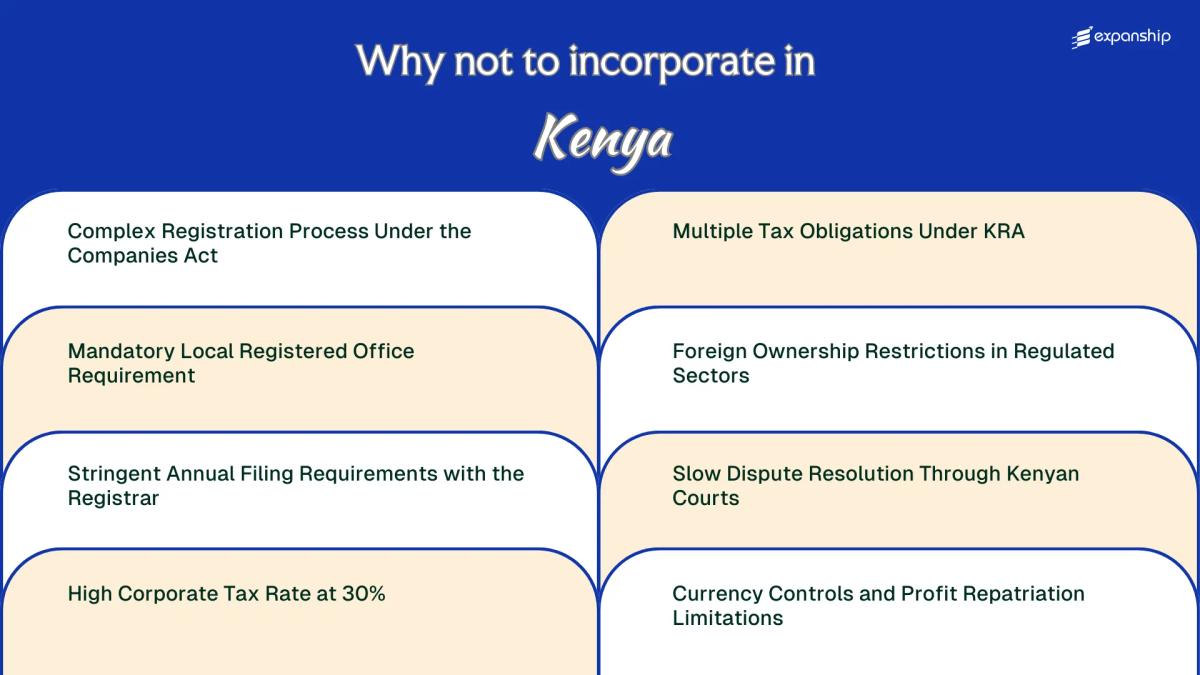
Complex Registration Process Under the Companies Act
Kenya Companies Act registration challenges begin well before your business is operational. The process involves multiple stages that can stall incorporation for weeks, particularly for foreign-owned entities unfamiliar with local procedural requirements.
System Delays Within the Business Registration Service
The Business Registration Service (BRS) administers company registration under the Companies Act 2015, but system outages and processing backlogs on the eCitizen portal regularly extend timelines beyond the stated targets. For a foreign director who has already committed to lease agreements or supplier contracts, these delays translate directly into missed commercial deadlines and mounting holding costs.
Name reservation must be completed before incorporation can proceed, adding a sequential step that compounds the total waiting period.
Document Authentication Requirements for Foreign Directors
Foreign directors must submit notarised and apostilled identity documents, a requirement that adds both time and cost before the registration process even begins. Obtaining apostilles from a home jurisdiction, then coordinating their acceptance through the BRS, can take several weeks depending on the applicant's country of origin.
Foreign directors should account for document authentication delays from their home jurisdiction, which can extend the total incorporation timeline well beyond Kenya's official processing estimates.
Mandatory Local Registered Office Requirement
Every company incorporated under the Companies Act 2015 must maintain a registered office address within Kenya. This address must be a physical location, not a P.O. box, and it serves as the official point of contact for correspondence from the Registrar of Companies and other government agencies.
For a foreign business owner without an existing physical presence, satisfying this requirement means engaging a local agent or renting commercial space before operations begin. That overhead cost arrives at the earliest, most uncertain stage of market entry.
The practical friction this creates includes:
- Paying recurring fees to a local registered agent whose services add no operational value to your business
- Risking service of legal or regulatory notices at an address you do not personally monitor
- Facing compliance failures if the registered address changes without timely notification to the Registrar
- Needing to source and verify a compliant physical address from abroad, with limited ability to assess its suitability
A company that fails to maintain a valid registered office can face penalties under the Companies Act 2015, compounding the administrative burden of what is already a mandatory baseline cost.

Company Incorporation in Kenya
Set up your company in Kenya with full registered office compliance handled from day one.
Stringent Annual Filing Requirements with the Registrar
The Kenya annual filing requirements burden falls on every incorporated company, regardless of size or activity level. Under the Companies Act, 2015, your business must file an annual return with the Registrar of Companies, and the deadline is fixed at 42 days after each anniversary of incorporation. Missing this window triggers penalties that accumulate daily.
| Filing Requirement | Governing Authority | Consequence of Non-Compliance |
|---|---|---|
| Annual Return | Registrar of Companies | Penalties plus potential striking off |
| Financial Statements | Registrar of Companies | Late filing fines; director liability |
| Company Secretary Appointment | Business Registration Service | Regulatory breach; company exposed to sanctions |
| Beneficial Ownership Register Update | Registrar of Companies | Criminal liability for officers |
Every private company must maintain a qualified company secretary, a Kenya company secretarial obligation that adds a recurring professional fee on top of state filing costs. Foreign-owned firms typically cannot self-administer this role, meaning an external appointment is unavoidable and non-negotiable.
The Registrar operates under the Business Registration Service, and its filing portal has historically experienced reliability issues, creating a practical risk that deadlines are missed even when a company acts in good time. Annual return filing problems in Kenya are therefore not always attributable to negligence.
Smaller foreign entities with minimal Kenyan operations still carry the full compliance load. There is no reduced filing regime for dormant or low-revenue companies outside specific exemptions granted under the Act.
High Corporate Tax Rate at 30%
The Kenya 30 percent corporate tax rate applies to resident companies on their taxable income under the Income Tax Act (Cap. 470). For foreign investors comparing entry points across East Africa, this rate sits noticeably above jurisdictions such as Mauritius, which levies a 15% corporate tax, making the high corporate tax burden Kenya companies carry a direct cost disadvantage from the first year of operation.
Under the Kenya Revenue Authority's framework, the 30% rate applies to the net taxable profit after allowable deductions. The base itself can be broader than expected because certain expenses face disallowance.
Your effective tax burden rarely equals exactly 30% downward. Thin capitalisation rules, transfer pricing adjustments, and disallowed deductions under KRA assessments frequently push the effective rate higher for foreign-owned entities.
Newly incorporated firms in Special Economic Zones or those qualifying under specific incentive schemes may access reduced rates, but these concessions carry eligibility conditions and approval processes that standard private companies do not automatically satisfy.
- Corporate tax is payable on net taxable profit at a flat 30% rate for resident companies
- Quarterly instalment tax payments are required under the Income Tax Act
- Transfer pricing documentation is mandatory for related-party transactions with foreign affiliates
- KRA can disallow deductions, raising the effective tax liability beyond the headline rate
- Tax returns must be filed within six months of the financial year-end
You can verify the current rate and filing obligations directly via the KRA portal.
Kenya's 30% corporate tax rate has remained unchanged since the early 1990s, making it one of the least-reformed headline rates among comparable emerging economies in Sub-Saharan Africa.
Multiple Tax Obligations Under KRA
Multiple tax obligations under the Kenya Revenue Authority add a distinct layer of administrative burden that compounds the cost of operating as a foreign entity in the country.
Scope of Concurrent Tax Obligations
Registered companies in Kenya must separately comply with corporation tax, Value Added Tax at the standard rate of 16%, Pay As You Earn for all employees, and withholding tax on qualifying payments such as dividends, royalties, and service fees paid to non-residents. Each obligation carries its own filing schedule, registration requirement, and penalty structure under the Tax Procedures Act, 2015, meaning your finance team must track multiple independent deadlines with the KRA simultaneously. A single missed filing can trigger automatic penalties and interest, which accumulate regardless of whether the underlying tax was actually owed.
Practical Cost for Foreign-Owned Entities
Non-resident companies face withholding tax rates on dividends and management fees that reduce after-tax returns on capital deployed in the country. Foreign firms without established local finance functions frequently require dedicated tax agents, since KRA's iTax platform, while digitised, demands familiarity with jurisdiction-specific filing formats that differ substantially from systems used in the EU or other African markets.
Managing Your Tax Compliance Burden in Kenya
If your business faces multiple concurrent tax obligations under the KRA, our Kenya-based corporate services team can help you structure compliant operations from registration through ongoing filings.
Foreign Ownership Restrictions in Regulated Sectors
Kenya foreign ownership restrictions in regulated sectors create binding caps on foreign shareholding that directly limit how much control your business can hold in certain industries.
- Under the Investment Promotion Act and sector-specific legislation, foreign investors are barred from holding majority stakes in industries such as broadcasting, where the Kenya Communications Act restricts foreign shareholding to 20%.
- The Mining Act requires that local communities and Kenyan nationals retain defined participation rights, reducing the operational and equity share available to foreign entities.
- Retail trade reserved for citizens under the Business Laws (Amendment) Act means foreign-owned firms cannot enter specific distribution and trading activities without a local partner.
- Aviation sector rules administered by the Kenya Civil Aviation Authority impose nationality requirements on operating licenses, forcing structural changes to your company's shareholding arrangement.
- These restrictions are enforced at the point of licensing, meaning a foreign-incorporated entity may complete full registration only to find its operating license refused on ownership grounds.
Slow Dispute Resolution Through Kenyan Courts
Slow dispute resolution in Kenya courts is a documented operational risk for foreign businesses. The Commercial and Tax Division of the High Court handles complex business disputes, but chronic case backlogs mean commercial litigation can stretch across several years before a final judgment is issued.
Contract enforcement is the measurable pressure point. According to the World Bank's Doing Business methodology, enforcing a contract in Kenya took an estimated 465 days on average, at a cost exceeding 47% of the claim's value.
That cost-to-claim ratio directly erodes the practical value of pursuing debt recovery or breach of contract claims, particularly for smaller cross-border transactions. Your firm may spend more litigating than the disputed amount warrants.
Arbitration under the Arbitration Act (Cap. 49) offers a private alternative, but it requires prior contractual agreement between parties. If your counterparty did not include an arbitration clause in the original contract, you default back to the court system.
A foreign supplier owed KES 4 million by a Kenyan distributor initiates a High Court claim. At a conservative litigation cost of 47% of claim value, the firm spends approximately KES 1.88 million in legal fees and court costs — before any judgment is enforced or appealed.
Currency Controls and Profit Repatriation Limitations
Kenya currency controls and profit repatriation limitations present a tangible operational friction for foreign investors, particularly those expecting to move capital freely after generating local profits. While Kenya does not impose a blanket ban on repatriating funds, the Central Bank of Kenya (CBK) oversees foreign exchange transactions under the Central Bank of Kenya Act and the Foreign Exchange (Forex) Regulations, and commercial banks are required to conduct due diligence on large or cross-border transfers.
In practice, your business must provide documentary evidence of the underlying transaction — such as audited accounts, tax clearance certificates from the Kenya Revenue Authority, and proof of regulatory compliance — before a transfer is processed. Assembling this documentation adds time and cost to what should be a straightforward treasury function.
Delays are not hypothetical. Banks frequently request additional verification, and transfers can be held pending review, disrupting cash flow planning for parent companies abroad.
Foreign exchange availability can also tighten during periods of currency pressure, as the Kenyan shilling has experienced volatility against major currencies. Your effective repatriated amount shrinks when conversion rates move against you during a processing delay.
Tax clearance from the Kenya Revenue Authority is a prerequisite for processing significant outbound remittances, meaning any outstanding KRA dispute or compliance gap can directly block your ability to repatriate profits regardless of their legitimate business origin.
Overcoming Incorporation Challenges in Kenya
Overcoming Kenya incorporation challenges requires structural preparation before the company is registered, not reactive adjustments after problems arise. The regulatory environment under the Companies Act 2015 and the Kenya Revenue Authority demands deliberate upfront planning.
- Pre-structure your entity type under the Companies Act 2015 to ensure the chosen vehicle aligns with the permitted foreign ownership thresholds in your target sector.
- Appoint a qualified local registered office address in Kenya before filing with the Business Registration Service.
- Establish a tax compliance calendar that accounts for corporation tax, VAT, PAYE, and withholding tax deadlines set by the Kenya Revenue Authority.
- Open a Kenya Shilling account with a local bank early to manage currency conversion requirements under Central Bank of Kenya guidelines.
- Engage with the Nairobi Centre for International Arbitration as an alternative to court-based dispute resolution from the outset.
Each of these steps addresses a discrete regulatory obligation rather than an isolated procedural preference. The Companies Act 2015 and KRA's iTax platform together form the core compliance framework within which your business must operate.
Kenya's Overall Business Appeal
Kenya presents a mixed picture for foreign investors. The Kenya business environment risks and appeal must be weighed against each other honestly: the country offers a sizable consumer market, a developed financial sector by regional standards, and an established legal framework under the Companies Act 2015. The disadvantages covered throughout this blog are real and affect day-to-day operations, but they do not uniformly disqualify the jurisdiction for foreign incorporation.
| Pros | Cons |
|---|---|
| Nairobi functions as a regional hub, providing access to East African markets and established banking infrastructure. | The corporate tax rate stands at 30%, one of the higher rates among comparable emerging market jurisdictions. |
| The Companies Act 2015 provides a recognised statutory framework for company formation and governance. | Registration under the Business Registration Service involves multiple procedural steps and can extend timelines. |
| Kenya's membership in the East African Community facilitates cross-border trade within the bloc. | The Kenya Revenue Authority imposes several overlapping tax obligations, including VAT, PAYE, and withholding tax. |
| A relatively active private sector and capital markets ecosystem supports business financing options. | Foreign ownership is restricted by statute in sectors such as land, media, and certain financial services. |
| English is an official language, reducing transaction and documentation friction for international businesses. | Dispute resolution through Kenyan courts is slow, with commercial cases often taking years to conclude. |
Compliance Services for Companies in Kenya
Stay aligned with Kenya Revenue Authority requirements, Companies Act obligations, and annual filing deadlines with structured compliance support.
Conclusion
The cons of Kenya company incorporation summary point to a jurisdiction with genuine commercial potential but structural friction that affects day-to-day operations. A 30% corporate tax rate applied under the Income Tax Act, compounded by multiple KRA-administered obligations, creates a layered fiscal burden that requires careful financial planning. Slow resolution through the Kenyan court system adds operational risk for businesses dependent on contract enforcement. Foreign ownership restrictions in regulated sectors further limit how certain entities can be structured. Professional guidance specific to the Kenyan regulatory environment reduces the likelihood of compliance failures after incorporation.
Expanship's Kenya Expansion Support
From Companies Act obligations and KRA multi-tax registrations to court-driven dispute timelines, the compliance burden of Kenya expansion support incorporation challenges is real and ongoing. Expanship works with your business to manage the operational weight of these requirements, from initial registration filings through post-incorporation obligations, without overstating what external support can change about the regulatory environment itself.
Our service scope covers the practical tasks that consume time and create risk when handled without local knowledge.
- We prepare and submit your company registration documents in accordance with the Companies Act and Business Registration Service requirements.
- A registered agent and physical office address in Kenya are provided to satisfy the local presence requirement.
- We liaise directly with government agencies and regulatory bodies on your firm's behalf.
- Ongoing compliance management covers annual returns, statutory filings, and Registrar deadlines.
- Banking introductions are coordinated to support your entity's account-opening process.
- Tax registration with KRA and liaison with relevant local authorities is handled as part of the setup process.
Reach out to Expanship Kenya to discuss your incorporation requirements directly.
Frequently Asked Questions (FAQ)
The restriction does not apply uniformly across all sectors. Certain industries, including land ownership, insurance, and some areas of broadcasting and finance, carry specific caps or licensing conditions that limit or complicate foreign shareholding. The Companies Act 2015 itself permits 100% foreign ownership for standard private limited companies, but sector-specific legislation can override that general position, so the practical constraint depends entirely on your industry.
Missing the annual return filing deadline exposes your company to financial penalties under the Companies Act 2015, and persistent non-compliance can result in the Registrar striking the entity off the register. Reinstatement after deregistration is a formal court-driven process that adds both cost and delay. The Kenya Revenue Authority may also treat filing gaps as grounds for closer scrutiny of the company's tax compliance record.
Profit repatriation is legally permitted but subject to withholding tax on dividends paid to non-residents, currently set at 15% under the Income Tax Act, though this rate may be reduced by an applicable double tax treaty. The Central Bank of Kenya oversees foreign exchange transactions, and large outward transfers require supporting documentation to satisfy anti-money laundering and capital flow reporting requirements. In practice, the administrative burden of documentation and bank processing times can slow repatriation significantly.
Yes, the process is more complicated for fully foreign-based directorates. The Companies Registry requires a local registered office address in Kenya, and while a nominee or agent can fulfill this, the directors must still provide certified identification documents and comply with KRA's PIN registration requirements. Remote incorporation is technically possible, but the verification, notarization, and submission steps add time and third-party cost compared to jurisdictions with fully digitized foreign-director onboarding.
The Tax Procedures Act 2015 sets out penalties for late filing, late payment, and under-declaration of tax, with interest on unpaid tax accruing at 1% per month on the outstanding balance. Penalties for failure to file returns can reach a fixed amount per return type or a percentage of tax due, depending on the specific obligation breached. Repeated non-compliance can trigger a KRA audit, and in serious cases, directors may face personal liability for unpaid corporate tax obligations.
High Court commercial cases in Kenya routinely take several years from filing to final judgment, even in the dedicated Commercial and Tax Division. Enforcement of judgments adds further delay, particularly where assets need to be traced or attached. International arbitration seated outside Kenya offers a faster and more predictable alternative for cross-border contracts, but domestic disputes involving local counterparties often have no practical route around the court system.
The requirement under the Companies Act 2015 is for a registered office address in Kenya where official correspondence and legal notices can be served, not necessarily a fully operational commercial premises. A registered agent's address satisfies the statutory requirement. That said, if your business activities trigger obligations under sector-specific licensing regimes, those regulators may separately require evidence of genuine physical presence, which goes beyond what the Companies Act alone mandates.
Legal Disclaimer
The information provided in this article is for general informational purposes only and does not constitute legal, tax, or professional advice. While we strive to ensure the accuracy and timeliness of the content, laws and regulations are subject to change, and the application of laws can vary widely based on specific facts and circumstances.
Readers should not act upon this information without seeking professional counsel tailored to their individual situation. Expanship and its authors disclaim any liability for actions taken or not taken based on the content of this article.
For specific advice regarding your business setup, compliance requirements, or any legal matters, please consult with qualified legal and tax professionals in the relevant jurisdiction.